
You’re sitting in your parents’ living room, or a tiny rented place in Dubai, Lagos, Manila, or Karachi. Your friends are posting white coat photos and hospital selfies from U.S. residencies. You have passed (or are about to pass) the USMLEs. ERAS season is here or coming.
But you’re stuck abroad.
Tourist visa was denied. B1/B2 is about to expire. You aged out of a dependent visa. Or you never had any U.S. visa in the first place. Every residency webinar seems to assume you can “come do some observerships” and “network in person.” You can’t.
Here’s the blunt truth: the system is not designed for you. But you are not dead in the water. There are things you can do right now that actually move the needle instead of doom-scrolling visa forums.
Let’s go step-by-step.
1. Get Clear on Your Actual Situation (Not the Drama Version)
You need a cold, clinical view of where you stand. Not the panicked WhatsApp version.
There are three main variables:
- Your exam status
- Your visa reality
- Your application timeline
| Scenario | Exams | Visa | Timeline Risk |
|---|---|---|---|
| A | Step 1 pass, Step 2 CK pending | No visa | High |
| B | Step 1 & 2 CK done, no USCE | No visa | High |
| C | Steps done, some USCE in past | No current visa | Medium |
| D | Steps + USCE + prior B1/B2 refused | No visa | Very High |
If you recognize yourself in B, C, or D, you’re the exact person I’m talking to.
Ask yourself, in writing (not just in your head):
- Do I have any prior U.S. entry history (tourist, dependent, student)?
- Have I ever had a visa refusal, and if yes, what was the reason?
- When is my target Match year? Next cycle? Two cycles from now?
- What’s already strong in my profile (scores, research, home country training)?
- What’s weak (USCE, recency, gaps, no U.S. connections)?
This is your starting map. Everything else will build on this.
2. Stop Wasting Energy on Fantasy Visa Paths
Let me be direct: you are not going to outsmart U.S. consular officers with some magical visa hack you saw in a Telegram group.
Here’s the basic reality of common visas for IMGs pre-residency:
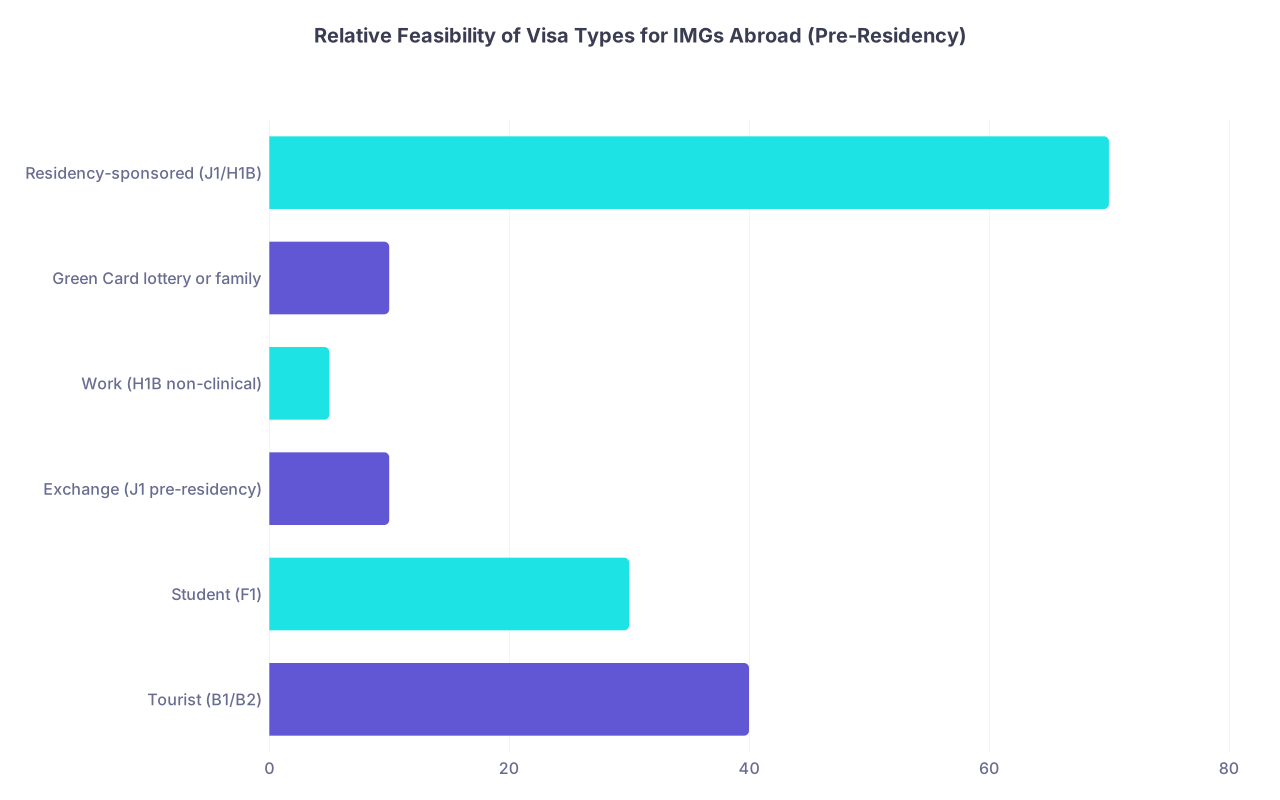
| Category | Value |
|---|---|
| Tourist (B1/B2) | 40 |
| Student (F1) | 30 |
| Exchange (J1 pre-residency) | 10 |
| Work (H1B non-clinical) | 5 |
| Green Card lottery or family | 10 |
| Residency-sponsored (J1/H1B) | 70 |
Interpretation:
- Tourist (B1/B2): Somewhat possible, but if you’ve already been refused or look like a clear immigrant risk, odds are bad.
- F1: Only realistic if you’re doing a real degree (MPH/MSc) at a recognized school and can show funding.
- J1 pre-residency (observership/short training): Rare and program-dependent; not a strategy you can count on.
- H1B non-clinical: Highly unlikely unless you have specialized skills beyond medicine (e.g., data science, coding, PhD-level research).
- Green card/family: Outside the scope of this article. If you have that path, good. Most do not.
- Residency-sponsored J1/H1B: This is the realistic visa path for most IMGs. Which means the primary mission is: get a residency offer first.
So your job right now is to stop burning hours in immigration rumor loops and refocus on the only thing that truly shifts your visa odds: becoming a resident they want badly enough to sponsor.
3. Build a Strong Application Completely From Abroad
You can’t get into the U.S. now. Fine. Then your strategy is: be so academically strong and so useful on paper that a program director is willing to take the “we’ll figure out the visa” burden.
Here’s what you can control from your bedroom abroad.
A. Maximize Exams and Timing
If you’re early in the process:
- Aim for Step 2 CK 245+ as an IMG if you can. Below 230 is survivable, but then everything else must be sharp.
- Take OET seriously. A weak OET or borderline communication impression can kill your chances quietly.
Do not rush into a bad ERAS cycle. If your Step 2 is pending and likely to be mediocre because you’re juggling a job and family drama, consider delaying your application one year to rewrite your own story.
B. Replace In-Person USCE With Serious Remote Value
You’re not getting into U.S. hospitals right now. You can still show U.S.-relevant activity.
Useful remote options (and how they actually matter):
Real research roles with ongoing output
- Target: U.S.-based researchers in your specialty of interest
- Minimum useful level: data extraction/chart review / clinical outcomes projects where you end up as co-author, not “volunteer” with no name on anything
- Where to look:
- Faculty emails from PubMed searches (yes, direct cold-emailing works when done well)
- LinkedIn and department websites for “research coordinator” or “remote research assistant”
- U.S.-based NGOs or global health groups doing outcomes work
Structured online shadowing/tele-observerships
Most are fluff. A few are actually credible. What you want:- Named U.S. physician supervising
- Clear, documented curriculum or case discussions
- Certificate + potential for a letter of recommendation (LOR)
Will a Zoom observership equal 3 months at a U.S. hospital? No. But it beats “no U.S. exposure whatsoever.”
Non-U.S. clinical work with U.S.-compatible documentation If you’re working in your home country:
- Keep detailed logs of procedures, responsibilities, call, and patient numbers
- Ask supervisors to write U.S.-style LORs (focused on competency domains, not generic “hard working and kind”)
- Frame rotations and responsibilities in ERAS language: inpatient, outpatient, continuity clinic, etc.
C. Letters of Recommendation: Your Substitute for In-Person Networking
You cannot shake hands in Pennsylvania. Fine. Your letters need to talk for you.
Aim for:
- 2–3 strong letters from physicians who know your actual work
- At least 1 from someone connected to U.S. medicine – this can be:
- A U.S.-trained doctor working abroad
- A researcher with U.S. collaborators
- Faculty with prior U.S. appointment or training
When you ask for a letter, explicitly say:
“I’m unable to get a visa right now, so my application will be heavily judged on what my supervisors can say. Could you include specific examples of my clinical reasoning, reliability, and communication skills?”
Specific examples > flowery adjectives.
4. Target the Right Programs as Someone Physically Abroad
Not all programs treat “never set foot in the U.S.” the same way. Some basically auto-filter you out. Some do not care.
Here’s how to play this strategically.
A. Identify Programs That Actually Sponsor and Actually Take IMGs
Do not guess. Look it up.
Use:
- FREIDA (filter for “Sponsorship of J1” and/or “H1B”)
- Program websites listing % IMGs, visa policies
- Recent match lists from your home country advising services or IMG groups (actual matched programs, not rumors)
| Signal | Good Sign | Bad Sign |
|---|---|---|
| Website IMG info | Explicit about visas | No mention at all |
| Current residents | Multiple IMGs | All U.S. grads |
| Visa type | J1/H1B both listed | “No visa sponsorship” |
| Response to emails | PD/PC replies | Auto or no reply |
If a program clearly states “We do not sponsor visas,” don’t waste an application. You’re not the exception.
B. Accept That Your Application List Must Be Heavy and Focused
From abroad, with no U.S. experience and limited visa options, you’re not “casting a wide net.” You’re carpet-bombing targeted programs.
In most cases:
- 120–150 programs in one core specialty is not crazy for your situation
- Add 20–40 in a backup specialty if and only if you have some credible tie to it
You’re buying lottery tickets, but you’re buying in the right zip codes.
C. How to Address the “Stuck Abroad” Issue in Your Application
Don’t make your visa situation the emotional center of your personal statement. But don’t pretend it does not exist either.
You can say, briefly:
“Due to current visa limitations, I have not been able to participate in in-person U.S. clinical experiences. I’ve focused instead on remote research with Dr X’s cardiology group at Y University, and continued hands-on clinical work in my home country’s busiest emergency department.”
This does two things:
- Acknowledges the elephant
- Immediately reframes you as productive, not helpless
Save the detailed visa story for interviews, if they ask.
5. Handle Time Zones and Virtual Interview Reality Like a Pro
Many IMGs abroad get interviews but blow the logistics. Do not be that person.
A. Make Your Environment Interview-Ready
You need:
- Stable internet (pay for backup data if you have to)
- A quiet room with a neutral background
- Decent lighting (lamp behind your screen, not behind you)
- Headphones with mic to avoid echo
Do a mock interview at the same time of day as your typical U.S. interview slot. If you’re in India, a 7–9 pm Eastern interview is 4–6 am for you. Try doing complex clinical reasoning at 4 am without practice and watch your brain collapse.
B. Time Zone Discipline
Create a U.S. Eastern Time master schedule for common interview windows and your local equivalent. Post it on your wall. Don’t trust your tired brain the night before.
Set:
- Two alarms for each interview time
- Calendar entries with both time zones
- A single “U.S. phone number” using a service like Google Voice or similar, if possible, that you can monitor from abroad
If they call you suddenly, you want a professional voicemail and not “The number you have dialed is not reachable.”
6. Parallel Track: Non-U.S. Routes That Keep You Competitive
If your chances to get into the U.S. in the next 1–2 cycles look poor, you should not be idle at home. Gaps poison applications. Active work (anywhere) keeps you alive as an applicant.
Reasonable parallel paths:
Residency or training in another country
- UK (PLAB/UKMLA), Canada (very tough), Germany, Ireland, Gulf countries
- Even if you end up not going to the U.S., you have a career.
- If you eventually match in the U.S., prior training often helps.
Strong clinical job in your home country
- Emergency, ICU, internal medicine, or primary care work with real responsibility
- You can later frame this as: “I have managed X patients per month, including Y number of acutely ill cases…”
Research-heavy path
- Long-term remote post with U.S. institution
- Aim for abstracts, posters, and ideally at least one full paper each year

| Step | Description |
|---|---|
| Step 1 | IMG stuck abroad |
| Step 2 | Finish Step 2 CK and OET |
| Step 3 | Remote research and online observership |
| Step 4 | Use existing USCE and letters |
| Step 5 | Apply broadly to IMG friendly programs |
| Step 6 | Consider non US training while building CV |
| Step 7 | Exams done? |
| Step 8 | USCE available? |
| Step 9 | Target Match year |
You’re not choosing between “U.S. or nothing.” You’re choosing between “only one risky path” and “multiple paths that keep you progressing.”
7. Visa Strategy: What You Actually Do (Not Just Worry About)
You are not an immigration lawyer. Don’t pretend to be one. But you should own the data-gathering and reality-check part.
Concrete steps:
Read the current official info:
- U.S. embassy / consulate site for your country
- ECFMG’s visa section for J-1
- NRMP and ERAS guidelines for non-U.S. applicants
Stop applying for random visas just to “try your luck” if:
- You already have one or more tourist visa refusals
- Your situation has not changed (income, status, major event)
Every refusal is a scar. Programs won’t see it directly, but consular officers will.
If you get an interview invite from a U.S. program that requires in-person interview, then consider a well-prepared B1/B2 attempt with:
- Official interview invitation letter
- Evidence of strong ties back home (job contract, property, family)
- Clear explanation that you will return after the interview
Will it always work? No. But this is one of the few rational times to try.
Consider a short consult with an actual immigration lawyer if:
- You have multiple denials
- You have any immigration violations or overstays
- You’re marrying a U.S. citizen or have potential family-based changes
Do not let random social media advice outrank a real lawyer’s 30-minute consult.
8. How to Stay Mentally Functional When You Feel Trapped
You’re not a robot. Being stuck abroad while others advance is brutal. It’s very easy to slide into paralysis or toxic comparison.
What actually helps:
- Fixed “U.S. path hours” each week (e.g., 10–15 hours on research, studying, or ERAS tasks)
- Fixed “local career hours” (your job or training)
- Scheduled off-time where you are not allowed to think about visas, scores, or programs
And one practical rule:
No checking Match forums or IMG panic groups after 9 pm. It wrecks your sleep, which wrecks your next day’s productivity.
You don’t need to be perfectly positive. You just need to be consistent.
9. Realistic Expectations: What’s Actually Possible
Let me set expectations straight, so you’re not building castles in the air.
From abroad, with:
- No U.S. visa
- No in-person USCE
- Average scores (say Step 2 CK 230–240)
You are not a strong candidate for ultra-competitive specialties or university programs that rarely take IMGs.
You are still a plausible candidate for:
- Community internal medicine programs with a history of IMGs
- Some family medicine programs
- Psychiatry at certain community sites
- Prelim internal medicine/surgery in rare cases, as a foot in the door
You will probably need:
- More than one application cycle, or
- A very well-built profile (high scores + research + strong letters) in a single cycle
People in your position do match. Not hundreds every year, but enough that it’s not a fantasy. The difference is that the ones who make it:
- Stop trying random visa stunts after a point
- Build concrete value from where they are
- Keep clinical or research work going every single year
- Apply aggressively to the right places, not just many places
FAQ (Exactly 5 Questions)
1. Should I delay my USMLEs until I get a visa or do observerships?
No. That’s backwards. Your exams are the foundation; visas and observerships are built on top of that. Take Step 2 CK when you can score competitively. If you postpone everything waiting for the “perfect” visa moment, you’ll age out of competitiveness. Prioritize a strong academic profile first.
2. Is it worth doing paid online observerships from abroad?
Some are garbage certificate mills; some are decent. It’s “worth it” only if:
- You get structured teaching with real cases,
- There’s a chance at a real letter of recommendation, and
- The supervising physician has a credible U.S. affiliation.
Don’t drain your savings for a generic “4-week online shadowing” that nobody respects.
3. How many research projects should I aim for if I’m stuck abroad?
Quality over quantity. Aim for 1–2 substantial projects per year that realistically lead to an abstract, poster, or paper with your name on it. Ten “in progress” projects with zero output look worse than two completed ones. Consistent productivity over time is what impresses program directors.
4. Will multiple tourist visa refusals ruin my residency chances?
Not directly. Programs don’t see your visa refusal history. But practically, multiple denials make it harder for you to attend in-person observerships or interviews and later to get J1/H1B stamped. That’s why you should avoid serial, poorly-prepared applications. If you already have several refusals, stop guessing and get real legal advice before trying again.
5. If I start residency or training in another country (like the UK), can I still later match into the U.S.?
Yes, it’s possible and people do it. Prior training often helps, especially if it’s in English-speaking, structured systems. But you’ll still need valid USMLE scores, visa sponsorship, and a solid story about why you’re transitioning. The upside: you won’t be sitting idle, and you’ll grow clinically—both of which make you more mature and attractive as a candidate later.
Key points, stripped down:
- Stop chasing visa magic. Your strongest move is to become the kind of applicant programs want badly enough to sponsor.
- From abroad, you win by stacking: strong Step 2 CK, continuous clinical or research work, targeted applications, and professional virtual interviewing.
- Build parallel tracks. U.S. residency is one path, not your only path. Keep your career moving somewhere while you fight for your spot.