
What do you do when your “internship” back home looks nothing like what US programs expect?
You’re filling out ERAS. It asks for “Internship,” “Clinical Experience,” “PGY-1 equivalent,” “Rotating Internship,” “Transitional year.” In your head:
“We did a year of internship, but it was all OB and surgery with 1 week of medicine. Does this even count?”
Or worse: “We graduate straight into residency. There is no separate internship in my country.”
You’re not crazy. The US system is weird compared to most of the world. And yes, if your home country internship / early training doesn’t match US expectations, it can hurt you—if you handle it badly.
Let me walk you through how to handle this, step by step, depending on your exact situation.
1. First, get brutally clear on what you actually did
Before you can explain anything to a US program director, you need to understand your own training in US terms.
Forget what your country calls it (internship, house job, preregistration year, foundation year, rotating internship, straight residency). Translate it into:
- Where were you in training (pre‑licensure vs licensed doctor)?
- What was your role (observer, supervised intern, independent junior doctor)?
- What were your responsibilities (admit, write notes, prescribe, “just write vitals”)?
- What specialties and for how long?
Do this on paper. Literally.
Write something like:
- Graduation date:
- First clinical year after graduation:
- Type: Rotating internship / house officer / first year of residency
- Rotations (with durations):
- Internal Medicine: 2 months
- General Surgery: 3 months
- OB/GYN: 2 months
- Pediatrics: 2 months
- Emergency: 1 month
- Others: …
- Who supervised you (consultants, registrars, residents)?
- What core tasks did you personally do (admissions, H&P, orders, discharges, call, nights)?
This becomes your translation dictionary for ERAS, your CV, and interviews.
If you think, “We did mostly nights covering 3 wards, and there was no formal education,” write that. It will matter when you choose how to present it.
2. How US programs think about “internship”
Here’s the part most IMGs miss: US programs don’t care what it’s called. They care what it is.
When they read “internship,” they’re roughly scanning for:
- Did this person have structured, supervised early clinical training after graduation?
- Did it include at least some internal medicine exposure for IM / FM programs, or surgical exposure for surgery?
- Was there evaluation, accountability, and progressive responsibility?
- Does it suggest they can function safely as a PGY‑1 in the US?
They are not expecting a perfect 1:1 match with a US transitional year.
The problem comes when:
- Your “internship” was super unbalanced (e.g., all OB, no medicine).
- Or your country goes straight to specialty training (e.g., immediately in anesthesia or radiology, zero broad-based rotations).
- Or your pre‑graduation clerkships look like internships, and your real post‑grad year is mostly non-clinical / service-heavy.
So your job is to:
- Be honest about what your year was.
- Bridge the gaps—through USCE, extra explanation, letters, and sometimes additional training.
3. Identify which of these four buckets you’re in
Most IMG situations fall into one of these buckets. Read carefully and figure out which is you.
| Type of Training Structure | How US Programs Often Perceive It |
|---|---|
| Classic rotating internship (4–12 weeks each IM, Surgery, Peds, OB) | Roughly comparable to US transitional year |
| Internship heavily skewed to one area (e.g., all Surgery/OB) | Partial coverage; medicine-heavy specialties see gaps |
| Direct entry into specialty (no broad-based internship) | Strong in that field, weak in general medicine foundations |
| No formal internship; straight to service/locum roles | Viewed as inconsistent; needs explanation and USCE |
Bucket 1: Classic rotating internship (you’re in better shape than you think)
Example: Many Middle East, South Asia, and some Latin American systems.
- 12 months after graduation
- 6–8 core rotations: medicine, surgery, peds, OB/GYN, ER, maybe psych/family
- Supervised by consultants and registrars
- Documented evaluations
If this is you, US programs mostly understand this model.
What to do:
On ERAS, list it as: “Rotating Internship – [Hospital Name]”
In the description, explicitly break down your rotations:
“Completed a 12‑month rotating internship with 2 months Internal Medicine, 3 months General Surgery, 2 months Pediatrics, 2 months OB/GYN, 1 month Emergency, 2 months electives.”Ask at least one strong letter from a medicine or core specialty consultant from this year, especially if you’re applying IM/FM.
Your main job here is clarity, not reinvention.
Bucket 2: Internship that doesn’t match what you want to apply for
Example: You’re applying to Internal Medicine, but your post‑grad year is:
- 4 months OB
- 4 months Surgery
- 3 months Emergency
- 1 month Orthopedics
…and maybe 2 weeks of medicine somewhere nobody documented.
US IM / FM programs will immediately think: “Where’s the medicine?”
You can’t pretend it’s something it isn’t. You can fix it going forward.
What to do, specifically:
Reframe, don’t rebrand.
On ERAS:- Name it honestly: “Rotating Internship – [Hospital]”
- Still list every rotation with durations. Don’t delete the OB and surgery time; that variety is actually a positive for many programs.
Fill the medical gap with USCE.
You need real internal medicine exposure in the US:- Aim for 2–3 US clinical electives, sub‑internships, or hands-on observerships in Internal Medicine or related (cards, pulm, hospitalist).
- If you graduated long ago and cannot do electives, get inpatient IM observerships where you can follow admissions, rounds, and discharges closely and get letters.
I’ve seen candidates with surgery-heavy internships match IM after 3 strong US IM rotations + good Step scores + clear explanation.
Get targeted letters.
Do not rely only on letters from OB or surgery if you’re applying IM. You want:- 2+ letters from Internal Medicine (ideally from US rotations)
- 1 additional letter can be from your home-country internship supervisor showing your work ethic and reliability, even if not IM.
Explain the mismatch in 2–3 sentences in your personal statement.
Something like:“My rotating internship was heavily weighted toward obstetrics and general surgery due to national training requirements. During that year, I found myself drawn to the longitudinal relationships and diagnostic complexity I experienced in my limited medicine exposure, which led me to pursue additional internal medicine experience in the US, including rotations at [X] and [Y].”
Short. Clear. No apology tour.
Bucket 3: Direct entry into specialty without broad internship
Example: Many European systems, some Asian countries.
You graduate → immediately enter specialty training: Anesthesiology, Radiology, Neurology, etc. No “general rotating internship” at all.
For US programs, the questions are:
- Can this person handle ward-based, general inpatient care as a PGY‑1?
- Or are they hyperfocused on one specialty with gaps in basic hospital medicine?
If you’re applying to the same field you trained in (e.g., radiology there, radiology here), this can be okay. If you’re applying to Internal Medicine, Family, or EM after doing early anesthesia or psych, you’ve got explaining and supplementing to do.
Your move:
Label your early training accurately.
- If it really was specialty training, call it “Postgraduate Training – [Specialty] Residency Year 1” or similar.
- In the description, spell out that your system does not use a separate rotating internship.
Bridge the general medicine deficit.
- You must show internal medicine exposure somewhere (either final-year clerkships or US electives).
- On ERAS, under “Medical School Experiences,” clearly highlight robust medicine rotations:
“12‑week Internal Medicine clerkship with inpatient and outpatient experience at [Hospital].”
Use your specialty training as a strength, not something to hide.
If you did anesthesia and now want IM, don’t pretend anesthesia didn’t happen. Frame it:
“My initial postgraduate training in Anesthesiology gave me significant experience in perioperative medicine and acute management. Over time I realized I was more fulfilled by longitudinal medical care and complex chronic disease management, which is why I’m now pursuing Internal Medicine.”
Prioritize US rotations in your target field.
Observerships and electives in your new specialty are non‑negotiable if you’re changing direction. At least 2:
- For IM: inpatient general medicine rotations
- For FM: broad outpatient + continuity clinic experience
- For EM: ED rotations with documented shifts and responsibilities
US programs want proof you know what the US version of that specialty actually looks like.
Bucket 4: No real structured internship / chaotic early experience
This is the hardest group. Not impossible—but you cannot be casual about it.
Typical profile:
- Country with loose or inconsistent post‑grad structure
- You graduate
- You work as a locum, junior doctor, or “medical officer” with minimal formal evaluation
- Rotations are ad hoc; you cover whatever service needs a warm body
US perception if you don’t manage this: “Unclear training,” “unstructured,” “risk.”
What to do if this is you:
Organize the chaos retroactively.
Sit down with your employment records and reconstruct:
- Exact dates and locations
- Wards / specialties you covered and for roughly how long
- Level of supervision (consultant available? senior residents? totally alone at night?)
On ERAS, split long, messy jobs into parts when possible:
Instead of:
“Medical Officer – [Hospital], 2019–2022, all services”Do:
- “Medical Officer – Internal Medicine & ER, [Hospital], Jan 2019–Dec 2020”
- “Medical Officer – Outpatient and Rural Clinics, [Hospital], Jan 2021–Dec 2022”
Then describe responsibilities clearly and honestly.
Use one supervisor letter to define what your role actually was.
Get at least one powerful letter from someone senior (consultant, medical superintendent) who can say:
- What you did
- How independently you worked
- How you handled acute care, ward work, night call
That letter often does more to “explain your internship” than anything you’ll write yourself.
Compensate with US structure.
If your home system is chaotic, your US CV must scream “structured.”
That means:
- Multiple US rotations with clear responsibilities
- Program directors who can vouch for your reliability and teachability
- No “floating around” gaps without explanation
Clarify situation in ERAS experiences, not in a long personal statement sob story.
Use the free-text description in the experience section to write 2–4 tight lines:
“Worked as a Medical Officer at a district hospital covering Internal Medicine and Emergency. This role functioned as the first post‑graduate year in our system, with direct consultant supervision available and responsibility for admissions, daily rounds, and overnight cross-cover.”
That’s enough. Program directors read fast. Do not bury them in your country’s health policy history.
4. Don’t let internship confusion mess up your ERAS and CV
US application systems force you to cram your reality into their boxes. People mess this up a lot.
Here’s how to avoid common errors.
How to list your internship / early training in ERAS
Use the Work/Experience section. Choose the type carefully:
- If it was structured and mandatory post‑grad training → “Internship” or “Postgraduate Training”
- If it was a job as a doctor without formal teaching → “Employment”
- If a mix, choose the one that best reflects how it would be seen in the US, then explain in the text.
Key points in the description:
- Duration and specialties
- Responsibilities in US language: admissions, H&P, progress notes, orders, consults, procedures, call
- Supervision level
Write it like this:
“Completed a 12‑month rotating internship at a 600‑bed tertiary hospital. Rotations: Internal Medicine (2 mo), General Surgery (3 mo), Pediatrics (2 mo), OB/GYN (2 mo), Emergency (1 mo), electives (2 mo). Responsibilities included initial assessment, daily rounds, writing notes and orders under consultant supervision, and 4–6 overnight calls per month.”
That’s the kind of language that reassures US readers.
5. When you should consider extra clinical time or even a US preliminary year
Sometimes, your home-country internship misalignment is so big that the smartest move is to add more structured training either at home or in the US.
Red flags where this might be needed:
- Zero or almost zero internal medicine exposure, but you want IM/FM/EM
- Internship more than 5–7 years ago and no substantial clinical work since
- Entire early training in a non-ACGME-style system with very little documented supervision
- Failed attempts to match already with feedback like “concerns about clinical preparedness”
Options:
Do extra structured training at home.
- Another year in a teaching hospital department (medicine/family) with evaluations and a clear role
- A formal “residency year 1” that has defined curriculum
Then get letters emphasizing structure and supervised progression.
Aim for a US preliminary / transitional year if you match something later.
More realistic for people targeting advanced specialties (Neuro, Anesthesia, Rad Onc, etc.). But some IMGs intentionally apply to prelim IM/Surgery first to build a US track record, then reapply categorical.
Risk: that’s an extra year of your life and a lot of money. But sometimes it’s the right reset.
Maximize USCE now if you’re too late for big structural changes.
If you’re close to application season, your main move is:
- 2–4 strong US rotations before ERAS submission
- Letters that directly address, “This applicant is ready for PGY‑1 level responsibilities in a US system”
6. How to talk about your internship in interviews without digging a hole
You will almost certainly be asked some version of:
“So tell me about your internship / early training back home. How does it work there?”
This is where many IMGs either:
- Oversell (“It’s basically the same as US residency”) → looks naive or dishonest
- Or undersell (“To be honest, it was chaotic and I didn’t learn anything”) → destroys confidence.
Here’s the middle lane.
Use a tight 3-part structure:
Describe the system clearly in 1–2 sentences.
“In [Country], after graduation we complete a 12‑month rotating internship in a teaching hospital before we can get full registration.”Summarize your actual experience, highlighting what’s relevant to the US.
“I rotated through Internal Medicine, Surgery, Pediatrics, OB/GYN, and Emergency. I admitted patients, wrote daily notes, presented on rounds, and took overnight call under consultant supervision.”Connect it to why you’re prepared for their PGY‑1.
“That year taught me how to manage ward patients, prioritize tasks on busy call nights, and communicate with multidisciplinary teams. My US rotations then helped me adapt those skills to the US system, documentation, and EMR.”
If your internship was unbalanced, you acknowledge it briefly and pivot:
“Our national structure emphasized surgical rotations, so my medicine exposure was limited. That’s why I made sure to do additional Internal Medicine rotations in the US at [Hospital A] and [Hospital B], where I focused on inpatient ward work and admissions.”
Short. Direct. No nervous rambling.
7. A few things that are flat-out bad ideas
Let me be blunt. I’ve seen these tank otherwise decent applications:
- Calling something an “internship” that is clearly just observership/volunteer time. Directors are not stupid.
- Trying to hide a non-traditional structure instead of explaining it. If they’re confused, you lose.
- Writing a full page in your personal statement about your country’s training bureaucracy. Nobody has time for that.
- Pretending your system is “basically the same as the US.” It’s not. And they know it.
- Not backing up weak home-country structure with strong, recent US clinical experience.
If you’re not sure whether something “counts as internship,” ask yourself:
“Could a reasonable US physician read this description and understand what I actually did day-to-day?”
If the answer is no, fix the description, not the history.
8. Put it all together: your practical checklist
Here’s how to start fixing this problem in a focused way.
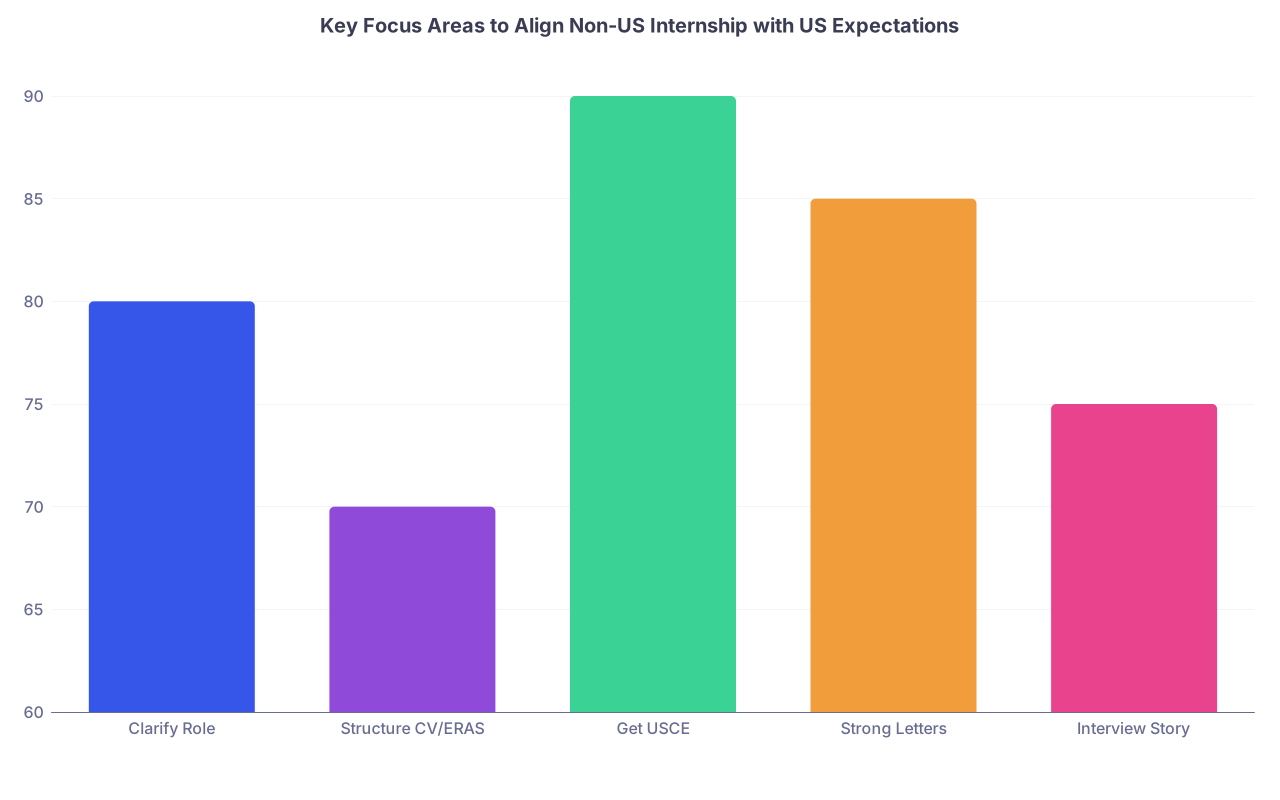
| Category | Value |
|---|---|
| Clarify Role | 80 |
| Structure CV/ERAS | 70 |
| Get USCE | 90 |
| Strong Letters | 85 |
| Interview Story | 75 |
Today or this week:
- Write out a one-page summary of your internship / early training: dates, rotations, responsibilities, supervision.
- Classify yourself into Bucket 1–4 from above.
- Identify your main gap for US expectations (e.g., very little IM, no documentation, chaotic structure).
Over the next 1–3 months:
- Schedule or secure US clinical experiences that directly patch that gap.
- Ask specific supervisors from internship/early training for letters that spell out your role and responsibilities.
- Rewrite your CV and ERAS experience descriptions using clear, US-style language about tasks and supervision.
Before ERAS submission / interview season:
- Craft a 2–3 sentence explanation of your country’s structure and your experience. Practice saying it out loud until it sounds natural, not defensive.
- Make sure your personal statement acknowledges any big mismatch only briefly, and shows what you did to address it.

| Step | Description |
|---|---|
| Step 1 | Map Your Internship |
| Step 2 | Identify Gaps vs US Expectations |
| Step 3 | Plan US Clinical Experiences |
| Step 4 | Update ERAS Descriptions |
| Step 5 | Secure Targeted Letters |
| Step 6 | Prepare Interview Explanation |

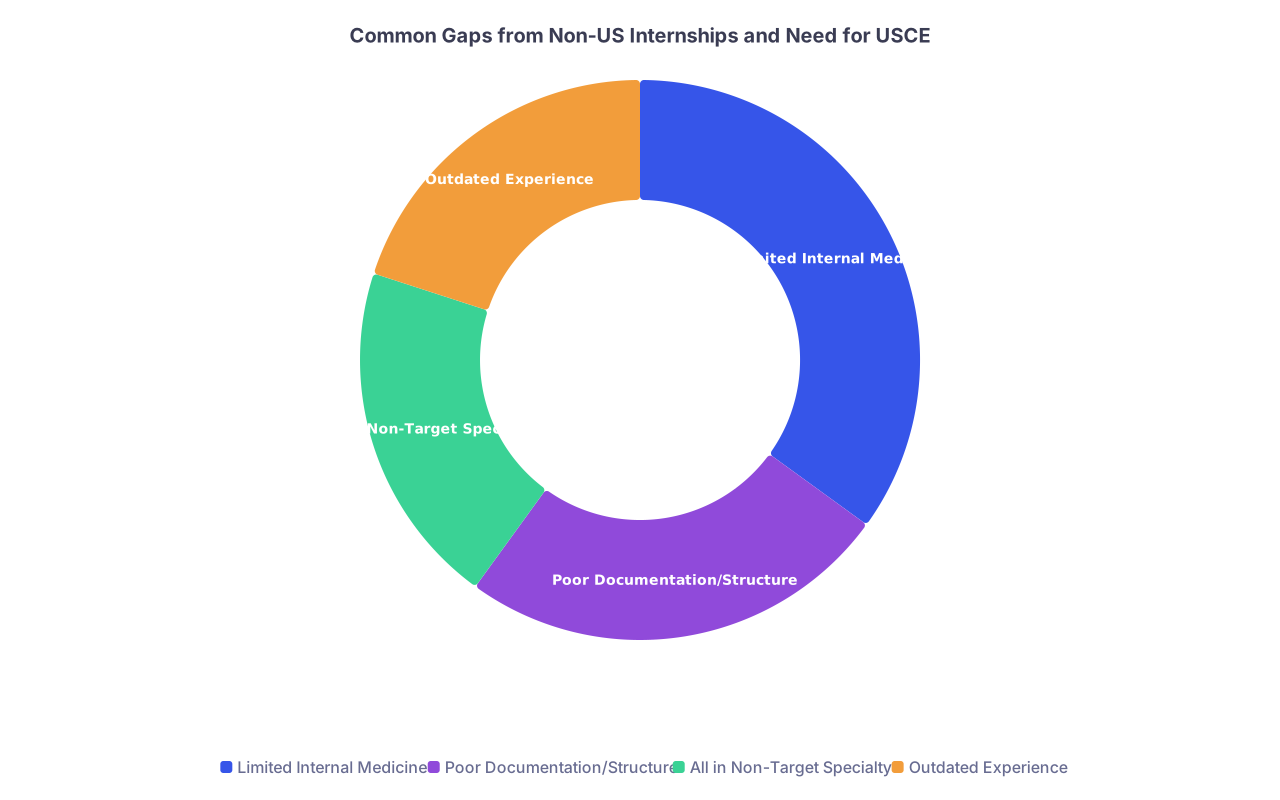
| Category | Value |
|---|---|
| Limited Internal Medicine | 35 |
| Poor Documentation/Structure | 25 |
| All in Non-Target Specialty | 20 |
| Outdated Experience | 20 |
Open a blank document right now and write a brutally honest, detailed description of your internship or first post‑grad year—rotations, tasks, supervision, and dates. That’s your raw material. Once you can see it clearly on the page, you can start reshaping it into something US programs will understand and respect.