
The biggest mistake IMGs make with observerships is assuming, “If I work hard and show up, they will write me a strong letter.” That is wrong. Strong letters do not happen by accident. They are engineered.
You are not just doing an observership. You are running a structured, four‑week campaign to earn one specific outcome: a detailed, enthusiastic, U.S. clinical LOR that actually moves your application.
Here is the scripted process that works.
The Goal: A Program‑Usable U.S. Letter, Not Just “He Was Here”
Before we talk scripts, you need a clear target. Most IMG letters are useless. They say things like:
“Dr. X observed in our clinic for four weeks. She is punctual, polite, and will make a good resident.”
Programs skim that and forget you 3 seconds later.
A strong LOR from an observership does three things:
Establishes credibility of the writer
- Academic title, role, years in practice
- Affiliated residency program or medical school
- Experience working with multiple residents and students
Communicates specific, observed behaviors
- Initiative, clinical reasoning, professionalism
- Concrete examples: cases, tasks, patient interactions
- Comparison: “among the top 10% of observers/trainees I have worked with”
States a clear, strong, specialty‑aligned endorsement
- “I give my strongest recommendation for internal medicine residency”
- Mentions suitability for U.S. residency, not just “future career”
Everything you do in the observership should be designed to give the attending material to write those three categories.
Overview: The 4‑Phase LOR‑Focused Observership Plan
Think of your observership as a project with four phases:

| Step | Description |
|---|---|
| Step 1 | Before Observership |
| Step 2 | Week 1 Positioning |
| Step 3 | Weeks 2-3 Proof |
| Step 4 | Week 4 Ask for LOR |
| Step 5 | Post Rotation Follow up |
We will walk through each phase with scripts.
Phase 1: Before You Start – Set Up The Win
If you show up on Day 1 with no prep, you have already weakened your letter.
Step 1: Choose the right observership when possible
Your priority is not just “get any U.S. experience.” It is “get the most letter‑friendly environment.”
Ideal features:
- Academic or teaching hospital
- Attending who regularly works with residents/students
- Specialty aligned with your planned Match (do not collect random letters)
- Minimum 4 weeks; 6‑8 weeks is even better for a main letter writer
If you have options, choose:
| Option | Priority |
|---|---|
| Academic IM department with residency | Highest |
| Community program with active residents | High |
| Private clinic, known to write letters | Medium |
| Pure shadowing with minimal interaction | Low |
| Remote/tele-observership only | Very Low |
Step 2: Pre‑email the attending (or coordinator) properly
You want to set expectations that you are serious and proactive, without sounding desperate for a letter.
Subject line idea:
- “Upcoming Observer – [Your Name], [Specialty], [Dates]”
Email script (1–2 weeks before start):
Dear Dr. [Last Name],
My name is [Full Name], an international medical graduate from [Country, Medical School, Grad Year]. I will be joining you as an observer from [start date] to [end date] in [clinic/hospital name].
I am pursuing residency in [Specialty, e.g., Internal Medicine] and am particularly interested in [specific aspect related to their work – e.g., complex inpatient medicine, outpatient chronic disease management, etc.].
During my observership, my goals are:
• To understand how you approach diagnosis and management in [setting]
• To observe how care is coordinated in a U.S. teaching environment
• To receive feedback on how I can improve my clinical reasoning and communication for U.S. residencyIf there are any expectations you have for observership participants or any reading you recommend before I start, I would be grateful to know.
Thank you for the opportunity to learn from you.
Sincerely,
[Full Name], MD
[Country]
[Preferred email] | [Phone, if appropriate]
This does three things:
- Signals you are residency‑oriented
- Invites expectations (which gives you targets)
- Plants the idea that you care about growth and feedback
Phase 2: Week 1 – Position Yourself As “Letter‑Worthy”
Your first week is not about showing you know everything. It is about showing you are:
- Reliable
- Teachable
- Professional
- Safe around patients
Step 1: Nail the basics from Day 1
Non‑negotiables:
- Arrive 15–20 minutes early. Every day.
- Dress one step more formal than residents. Clean white coat.
- Have a small notebook. Take real notes. Not just scrolling on your phone.
- Learn the nurses’ names and be respectful. They talk. A lot.
These are boring details. Yet I have seen attendings kill a letter just because “he was frequently a bit late and on his phone.”
Step 2: Clarify your role early
On Day 1 or Day 2, ask directly and respectfully.
Script:
Dr. [Last Name],
I wanted to clarify how I can be most useful during this observership. I understand I cannot provide direct patient care or place orders, but are there specific tasks you have found helpful for observers?For example, would you like me to:
• Pre‑read charts before clinic
• Draft short case summaries in my notebook
• Look up guidelines between patients
• Prepare a short presentation on a topic you chooseI want to make sure I am contributing in the way you prefer.
This does two things:
- Shows respect for boundaries. Very important legally.
- Opens a door for you to do more than stand in a corner.
Step 3: Identify potential letter writers
You probably have exposure to more than one attending. Not all are equal for letters.
Look for:
- Those who speak up on rounds, teach, and ask you questions
- Those who comment on your progress
- Those who show interest in your background
By end of Week 1, you should have a primary target: the attending you will ask for your main letter.
Phase 3: Weeks 2–3 – Give Them Material For A Strong Letter
Here is the core reality: an attending can only write about what they see. If all they see is you standing at the back and nodding, the letter will be generic.
You must create safe, appropriate opportunities to show:
- Clinical thinking
- Work ethic
- Communication skills
- Professionalism under pressure
Step 1: Use a simple “case summary” structure
When asked about a patient, do not ramble. Use a 3‑part structure:
One‑line ID statement
- “This is a 65‑year‑old man with a history of diabetes and hypertension admitted with shortness of breath.”
Key data, then assessment
- Symptoms, vital signs, most relevant labs/imaging
- Your leading diagnosis or differential (even if you are not sure)
Question + reasoning
- “I am considering CHF exacerbation vs pneumonia. Based on the elevated BNP and bilateral crackles, I lean toward CHF, but the fever makes me wonder about infection. I would like to understand how you are weighing these possibilities.”
This tells the attending: you think systematically, you are not reckless, and you know your limits.
Step 2: Ask one or two high‑quality questions per day
Not constant questions. Thoughtful ones.
Examples:
- “I noticed you chose [medication A] instead of [medication B]. Is that primarily due to his kidney function or something else?”
- “For similar patients in my home country, we would often [X]. I see that here we do [Y]. Could you explain the reasoning behind that difference?”
- “If I am on wards as an intern here, what are the top 2–3 things you expect from me on a busy day?”
These conversations give the attending narrative content for your letter.
Step 3: Volunteer for the right “extra” work
Within whatever is allowed for an observer, you want to:
- Read charts before clinic and summarize key points
- Prepare 5–10 minute mini‑presentations (once a week is plenty)
- Offer to draft progress note “templates” in your notebook for educational purposes if they are open to it
Mini‑presentation script (Week 2):
Dr. [Last Name],
We have seen several patients with [e.g., decompensated cirrhosis] this week. Would it be helpful if I prepared a brief 5–7 minute summary on current guidelines for [specific aspect – e.g., ascites management] to present one morning this week?
This sets up something that can later show up as: “He independently prepared high‑yield presentations on topics relevant to our patient population.”
Step 4: Request mid‑rotation feedback (Week 2 or early Week 3)
You cannot fix what you do not know. And asking for feedback telegraphs maturity.
Script:
Dr. [Last Name],
We are about halfway through my observership, and I would really appreciate any feedback you have.Specifically:
• Are there things I should do differently to better prepare for U.S. residency?
• Are there areas where you have seen improvement, or where I should focus more during the rest of the rotation?I want to use the remaining time to improve as much as I can.
Three possible outcomes:
- They give constructive criticism. Good. Implement it fast and visibly.
- They say you are doing well, nothing major. Still good. Ask if there is any particular skill they think you can stretch on.
- They seem uninterested / vague. Likely not your best letter writer. Identify another.
Phase 4: Week 4 – How To Actually Ask For The LOR
Most IMGs mumble something like, “If you feel comfortable, maybe could you write a letter?” and then hope.
You are going to be respectful, direct, and make it easy for them.
Step 1: Ask in person first, then follow up by email
Aim for late Week 3 or early Week 4. Not the last 5 minutes of the last day.
Pick a quiet moment (after clinic, after rounds) and say:
In‑person script:
Dr. [Last Name],
I have really appreciated the opportunity to observe and learn from you this month. I am applying to [specialty] residency in the upcoming Match, and your perspective would be extremely valuable.I wanted to ask if you would feel comfortable writing a strong letter of recommendation for my residency applications, based on what you have seen of my work and progress here.
Two important phrases:
- “Strong letter of recommendation” – this gives them an out if they cannot.
- “Based on what you have seen” – reminds them this is about observed behavior.
If they hesitate or say something like, “I can write a letter stating that you observed here,” that is code for “weak letter.” You should not use that as a main letter.
If they say yes:
Thank you very much. I truly appreciate it. I will send you an email with my CV, personal statement draft, and any details you prefer for the letter.
Step 2: The follow‑up LOR email
Send this within 24 hours.
Dear Dr. [Last Name],
Thank you again for agreeing to write a strong letter of recommendation for my residency applications. I am very grateful for your support.
As we discussed, I will be applying to [Specialty] residency in the [ERAS cycle year] Match.
I have attached:
• My current CV
• A draft of my personal statement
• A brief summary of my activities during the observership, including specific patients and tasks we worked on togetherIf it is helpful, I have also included a few points you observed that might be worth mentioning, though of course you should feel free to include whatever you think is most accurate:
• My punctuality and reliability – I was present each day from [time] and stayed until [time]
• My case summaries and differential diagnoses on patients with [examples]
• The mini‑presentation I gave on [topic] on [approximate date]
• My interactions with patients, especially [brief reference to a specific memorable patient, without identifiers]ERAS will send you a secure link to upload the letter once I list you as a recommender. If you prefer, I can also provide a deadline that aligns with my application submission in [month].
Please let me know if you would like any additional information or if you prefer the letter to be addressed to a particular program or “Dear Program Director.”
Thank you again for your mentorship and support.
Sincerely,
[Full Name], MD
[Country]
[ERAS AAMC ID, once you have it]
You are not writing the letter for them. You are jogging their memory and giving them specifics, which most attendings appreciate.
Handling Common Complications
Real life is messy. Let us deal with the usual problems.
Problem 1: Short observership (1–2 weeks)
A 1–2 week observership by itself rarely justifies a powerful letter. If it is all you have, you must maximize intensity.
Actions:
- Ask for expectations on Day 1
- Push for at least one mini‑presentation in Week 1
- Ask for feedback by Day 4–5
- When requesting the letter, explicitly acknowledge the short duration and frame it around what they did observe
Ask script (short rotation):
Dr. [Last Name],
I know my time here has been brief, but I have learned a great deal from watching how you manage [X]. I am applying to [specialty] this year and I wanted to ask if, based on what you have seen, you would feel comfortable writing a strong, albeit brief, letter of recommendation focusing on my professionalism, clinical interest, and potential for growth.
If they hesitate, accept that and move on.
Problem 2: Attending says “I do not really know you well enough”
Do not argue. Use it as feedback.
Response:
I understand, and thank you for your honesty. I appreciate the chance to learn from you regardless. If there are specific things you would recommend I focus on in future rotations to be a stronger candidate for U.S. residency, I would be very grateful for your advice.
Then target another attending who has seen more of your work.
Problem 3: They agree verbally but the letter is late or missing
This happens often. It is usually disorganization, not malice.
Your follow‑up structure:
Initial reminder (2–3 weeks before your planned ERAS submission):
Dear Dr. [Last Name],
I hope you are well. This is a gentle reminder regarding the letter of recommendation for my [Specialty] residency application that you kindly agreed to write.ERAS has sent you an email with a secure link. My goal is to submit my application by [date], so if it is possible to upload the letter by then, I would greatly appreciate it.
Please let me know if you need any additional information from me.
Thank you again for your support.
Sincerely,
[Name]Second reminder (7–10 days before submission deadline):
Short, respectful.
Dear Dr. [Last Name],
I wanted to follow up briefly regarding my residency LOR, as my ERAS submission date of [date] is approaching. I remain very grateful for your willingness to support my application.Please let me know if completing the letter by [date] is still feasible.
Thank you again,
[Name]
If no response at all, you must have backup letters planned. You never rely on a single promised LOR.
How Many Observership LORs Do You Actually Need?
For most IMGs applying in a single specialty:
- Total ERAS letters used: 3–4
- Ideal composition:
- 2–3 U.S. specialty‑specific clinical letters (inpatient/outpatient mix is fine)
- 1 additional letter (could be research, home country but in same specialty, or a U.S. letter from a related field)
You do not need a letter from every single observership. You need 3–4 excellent ones. Better to have:
- 2 very strong U.S. IM letters + 1 solid research/home‑country IM letter
than:
- 6 generic “he observed here and was nice” letters.
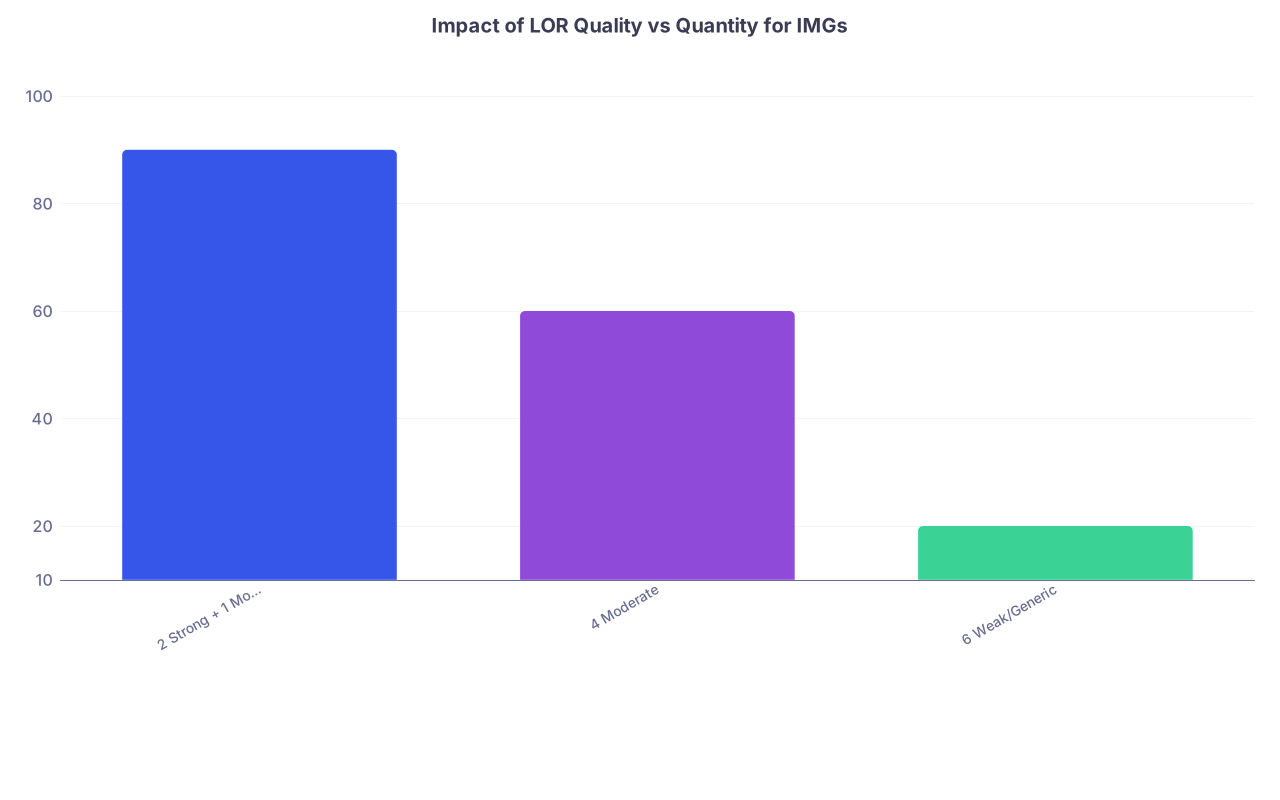
| Category | Value |
|---|---|
| 2 Strong + 1 Moderate | 90 |
| 4 Moderate | 60 |
| 6 Weak/Generic | 20 |
(Think of these numbers as “usefulness scores,” not percentages. Programs care about quality.)
Writing‑Style Signals You Want In The Final LOR
You cannot control every line of the letter. But you can influence what the attending has to work with.
Strong letters often contain phrases like:
- “I worked with Dr. [Name] for [duration] in my role as [Title] at [Institution].”
- “Compared with other international graduates and U.S. students I have worked with, [he/she] ranks in the top [10–20]% in [work ethic/knowledge/professionalism].”
- “She consistently arrived early, came prepared having reviewed charts, and took initiative in summarizing patients and reading relevant guidelines.”
- “He gave a focused, high‑quality presentation on [topic], which demonstrated a solid understanding of current evidence.”
- “I would be pleased to have [Name] as an intern in our program and give my strongest recommendation for [Specialty] residency in the United States.”
How do you get that kind of language? By giving them the stories and behaviors that justify it during the rotation and in your follow‑up summary.
Post‑Observership: Staying On Their Radar (Without Being Annoying)
Once the observership is over, your relationship with the attending should not die.
Reason: Programs sometimes contact letter writers. You want your attending to remember you clearly.
Reason two: You may need an updated letter next cycle if you do not Match.
Minimal, professional maintenance
Thank‑you email within 48 hours of finishing:
Dear Dr. [Last Name],
Thank you again for the opportunity to observe in your practice this past month. I learned a great deal from how you manage [X] and how you communicate with patients and the team.I especially appreciated [1–2 specific things].
I will keep you updated on my residency application progress. Thank you again for your mentorship and for supporting my application with your letter.
Sincerely,
[Name]Update emails:
- When you submit ERAS
- When you receive interviews (particularly if any are in the same specialty/region)
- When you Match (or when you plan to reapply)
These can be 3–6 lines. Do not overdo it.
A Sample Timeline: 4‑Week Observership to LOR
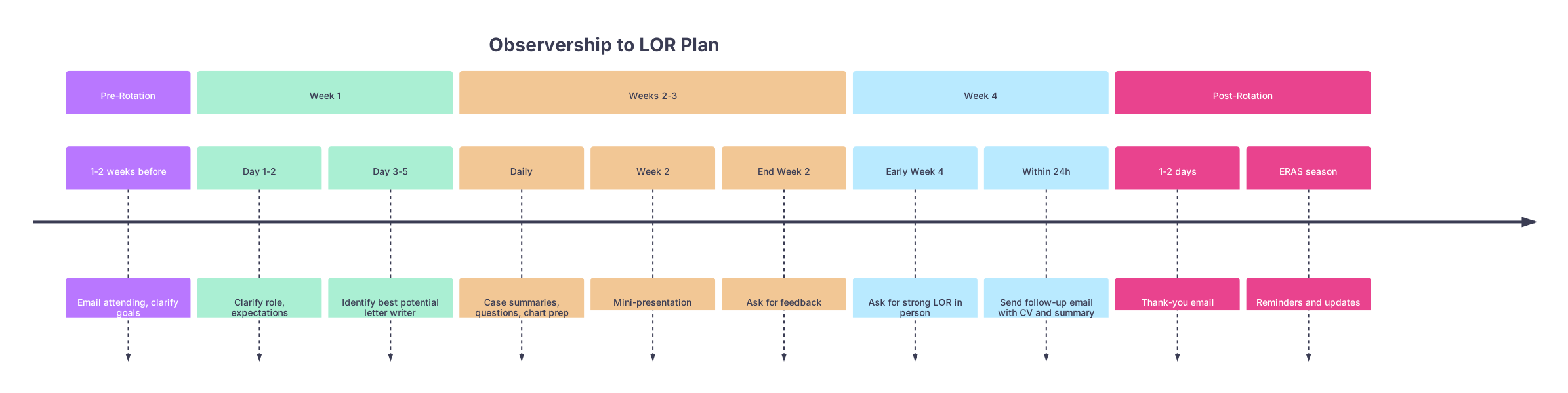
| Period | Event |
|---|---|
| Pre-Rotation - 1-2 weeks before | Email attending, clarify goals |
| Week 1 - Day 1-2 | Clarify role, expectations |
| Week 1 - Day 3-5 | Identify best potential letter writer |
| Weeks 2-3 - Daily | Case summaries, questions, chart prep |
| Weeks 2-3 - Week 2 | Mini-presentation |
| Weeks 2-3 - End Week 2 | Ask for feedback |
| Week 4 - Early Week 4 | Ask for strong LOR in person |
| Week 4 - Within 24h | Send follow-up email with CV and summary |
| Post-Rotation - 1-2 days | Thank-you email |
| Post-Rotation - ERAS season | Reminders and updates |
This is what a deliberate, LOR‑focused approach looks like. Not random hope.
Quick Reality Checks For IMGs
A few blunt truths I have seen over and over:
- A U.S. clinical LOR based purely on shadowing with no interaction is rarely strong. You must create intellectual and interpersonal contact.
- A letter from a junior faculty who knows you well can be more powerful than a one‑line endorsement from a famous chair who barely remembers you.
- Too many IMGs wait until the last day to mention letters. That is a rookie error. Set up the LOR ask no later than early Week 4.
- Do not script your attending’s letter or send them a full draft. Programs and PDs smell that from a mile away. Offer bullet points, not ghostwriting.

If You Are Reapplying: Reusing and Updating Observership LORs
Many IMGs need more than one cycle. That is reality, not failure.
If you already have a solid letter from an observership:
- You can absolutely reuse it for another cycle, especially if it was recent (within 1–2 years).
- If you are in touch with the writer, consider asking for an updated version mentioning what you have done since (research, new observerships, Step 3, etc.).
Update request script:
Dear Dr. [Last Name],
I hope you are well. I am writing to share an update and a request.
I applied to [Specialty] residency in the recent Match and will be reapplying this coming cycle. Since working with you, I have [brief list: completed Step 3, done additional observerships, engaged in research, etc.].
Your previous letter was very meaningful to me. If you feel comfortable, I would be grateful if you could either allow me to reuse your prior letter or provide a brief updated version noting my recent progress.
I would be happy to send a short summary of my new experiences.
Thank you again for your continued support.
Sincerely,
[Name]
Reasonable. Professional. Clear.
Final Tight Summary
You convert observerships into strong LORs by design, not by luck. The core moves:
- Engineer the environment. Choose letter‑friendly sites, pre‑email your goals, clarify your role, and identify the right attending early.
- Give them real material. Show up like a professional, think out loud in structured ways, ask smart questions, volunteer for small presentations, and request mid‑rotation feedback.
- Ask correctly and follow through. Ask in person for a strong letter, send a sharp follow‑up email with your CV and specific rotation highlights, and maintain light contact through the application cycle.
Do this, and your observership stops being a checkbox. It becomes a weapon in your Match strategy.