
Should I Disclose Non‑Clinical Gaps Openly as an IMG? What to Include
What happens when a program director sees a full year of “nothing” on your CV… and you never mention it anywhere?
They assume the worst. Every time.
Let’s deal with this head‑on.
You’re an IMG. You’ve got gaps that aren’t easily packaged as “research year” or “master’s degree.” Maybe you:
- Took a year to care for a sick parent
- Worked in retail or IT to pay off debt
- Had visa or licensing delays
- Failed a step and stepped away to regroup
- Got married, moved countries, and lost a year in the chaos
The real question isn’t “Is this bad?”
The real question is: Do I disclose it openly, and if yes, how much detail do I give?
Here’s the answer you actually need.
1. The Core Rule: Unexplained Gaps Are Worse Than Almost Any Reason
Program directors hate two things: surprises and mysteries.
A 4–12 month unexplained gap on an IMG application is a bright red siren. Most PDs I’ve talked to will say something like:
“If they don’t explain it, I assume it’s something I don’t want to discover later.”
So the baseline rule:
- If it’s 3 months or less: Often safe to leave alone unless it coincides with a bad test attempt or red flag.
- If it’s more than 3 months and clearly visible on a timeline: You should address it somewhere.
- If it’s 6–12 months or more: You absolutely need to address it, cleanly and confidently.
And yes, this includes non‑clinical gaps. Employment outside medicine. Moving countries. Family responsibilities. Personal issues.
You don’t need to give your life story. But you do need to show three things:
- You were doing something purposeful or necessary
- You came out of it stable and professional
- You’re fully committed to medicine now
If you hit those three, you’re fine.
2. What Counts as a “Non‑Clinical Gap” That Needs Explaining?
Let’s be very specific, because people get confused here.
Gaps that usually need explanation (as an IMG)
- 6+ months with no listed activity between graduation and current date
- 6+ months after a failed exam attempt
- “Dead” years between attempts to match
- Long visa / relocation periods where nothing is written down
- Extended caregiving or family responsibilities that pulled you out of the workforce
- Periods where you worked full‑time outside healthcare (e.g., software developer, Uber driver, retail, business)
Gaps that usually don’t need big explanation
- 1–3 month short gaps between rotations or contracts
- A short break for exam prep clearly connected to a later passing score
- Military service or mandatory national service (as long as listed clearly by dates)
- Master’s or degree programs (they’re self‑explanatory; you may just mention briefly in your PS)
- Documented research positions, even if not directly clinical
General rule: If a PD can look at your CV and say, “Okay, I see what they were doing then,” you’re fine.
If they say, “What on earth were they doing for that whole time?” — you need to explain.
3. Where To Disclose: PS, CV, ERAS Experiences, or Interview?
You’ve got several places you can address non‑clinical gaps. Use them strategically.
Personal Statement (PS)
Use this if:
- The gap is long (1+ year)
- It meaningfully shaped your motivation, maturity, or priorities
- You want to show growth, resilience, or a narrative arc
How to do it right:
- Acknowledge the gap in 1–3 sentences, max
- Name what you did (in broad terms)
- Briefly state what you gained that helps you as a future resident
- Move on to your strengths and current readiness
Example:
“After graduating in 2020, I spent one year working in retail while supporting my family during the pandemic. During that time, I continued preparing for USMLE Step 2 and volunteering at a local clinic when restrictions allowed. This period taught me discipline, financial responsibility, and how to communicate with people in stressful situations—skills I now bring into clinical care.”
That’s enough. You don’t need to confess your soul.
ERAS/Resume “Experiences” Section
Use this when:
- What you did is an actual job, role, or consistent responsibility
- It lasted ≥3 months
- You can describe it in a professional way
Label it clearly. For example:
- “Customer Service Associate – Retail”
- “IT Support Technician – Full Time”
- “Full‑Time Caregiver – Immediate Family Member”
- “Relocation and Exam Preparation – USMLE Step 2 CK”
Then in the description:
- Keep it short, concrete, and transferable
- One line on what you did
- One line on what you learned that’s relevant to residency
Interview
Sometimes you keep the written version minimal and save details for when they ask.
If you have a sensitive gap (mental health, burnout, family crisis), you can:
- Acknowledge it briefly in writing (“family responsibilities,” “health reasons”)
- Give more detail and reassurance verbally if they directly ask
You are allowed to draw a boundary. For example:
“I had a significant family situation that required my full attention for several months. It’s now fully resolved and I’m in a stable position with strong support, which is why I’m fully committed to pursuing residency without interruption.”
That’s enough for most PDs.
4. What To Include When Explaining Non‑Clinical Gaps (And What To Leave Out)
Here’s the structure I recommend. Think of it like a mini‑formula.
A. Time frame
Be clear on “when” and roughly “how long.”
Bad: “I had some time off after graduation.”
Better: “From June 2020 to March 2021, I…”
You can round months if needed. Nobody needs exact dates.
B. Simple, neutral label for what you did
Avoid drama and avoid being too vague.
Some good neutral phrases:
- “Worked outside healthcare to support my family”
- “Addressed a personal health issue that is now fully resolved”
- “Served as full‑time caregiver for an immediate family member”
- “Relocated and focused on immigration and licensing steps”
- “Prepared for and retook USMLE Step 1 after an initial failure”
Don’t lie. Ever. But you don’t have to expose every detail.
C. Evidence you stayed connected or came back stronger
This part matters. Programs want to see that you’re not drifting.
Include things like:
- Continued exam preparation or eventually passed exams
- Volunteer work (even if minimal)
- Online CME courses, observerships, clinical reading
- Language courses to improve English
- Any step you took that points back to medicine
D. What you gained that’s relevant to residency
If you skip this, you’re leaving value on the table.
Tie the gap experience to residency‑relevant traits:
- Reliability and time management (from working full‑time)
- Communication with stressed/angry people (retail, call centers)
- Problem‑solving under pressure (IT, business)
- Empathy and patience (caregiving)
- Adaptability and resilience (moving countries, visa chaos)
Example:
“While caring for my father after his stroke, I coordinated multiple appointments, medications, and home therapy. This experience changed how I see families navigating the healthcare system and deepened my commitment to clear communication and patient education.”
That’s exactly what PDs want: proof you didn’t just disappear; you grew.
5. How Honest Is “Too Honest”?
You don’t need to put your psychiatric chart in ERAS.
Here’s the line:
- Be truthful about the nature of the gap
- Be selective about vulnerable details
- Be reassuring about your current stability and readiness
Stuff you typically should not include in detail:
- Specific psychiatric diagnoses (unless you’re very comfortable and it directly shaped your career; even then, be careful)
- Details of family conflict, divorce, abuse, legal fights
- Overly emotional language (“I was completely lost and depressed…”)
- Anything that makes you sound currently unstable or unreliable
You can absolutely say:
“I had a personal health issue that required treatment and recovery, which is now fully resolved. During this time, I continued studying for Step 2 and am now medically cleared with strong support systems in place.”
That’s honest, respectful of your privacy, and program‑friendly.
6. Example Phrasing by Scenario
Let’s run through a few common IMG situations.
Scenario 1: Worked in non‑medical job for 1–2 years
PS or ERAS description:
“From 2019 to 2021, I worked full‑time as a retail associate to support my family financially while preparing for the USMLE exams. In this role, I learned to communicate clearly with people from diverse backgrounds, manage high‑stress situations, and maintain professionalism in difficult interactions—skills that have translated directly into my clinical work.”
Scenario 2: Caregiving for sick parent
“After graduation, I spent 10 months as the primary caregiver for my mother during her cancer treatment. While this limited my ability to engage in full‑time clinical work, I remained connected to medicine through independent study and preparation for Step 2 CK, which I later passed. This experience gave me a deeper understanding of patient and family perspectives and reinforced my interest in internal medicine.”
Scenario 3: Mental health break after exam failure
“Following an unsuccessful attempt at USMLE Step 1 in early 2020, I took several months to address my mental health and restructure my approach to studying. With professional support and a more sustainable study plan, I retook the exam in 2021 and passed. This period taught me how to recognize burnout, seek help appropriately, and develop resilience—skills that I believe will help me handle the demands of residency.”
Scenario 4: Visa / immigration / relocation delays
“Between arriving in the United States in late 2021 and starting observerships in mid‑2022, my primary focus was completing immigration, licensing, and documentation requirements. During this time, I prepared for Step 2 CK, which I passed, and completed online CME courses in internal medicine to stay current with guidelines.”
All of these are clean, honest, and professional.
7. What Program Directors Actually Want to See
Strip away the noise. PDs reading IMG applications with gaps are asking three questions:
Are you hiding something dangerous?
Your job: Make sure the answer feels like “No.”Are you actually committed to medicine, or is this a backup plan?
Your job: Show consistent steps that point back to medicine.Will you show up, do the work, and finish residency?
Your job: Show stability now, not perfection in the past.
You don’t need a flawless past. You need a believable, responsible present.
| Situation Length | Where to Address | Level of Detail |
|---|---|---|
| < 3 months | Usually nowhere | None or 1 short line if asked |
| 3–6 months | ERAS experiences or brief PS line | Basic label + 1 benefit |
| 6–12 months | PS + ERAS entry | Clear label + connection to medicine + growth |
| > 12 months | PS + ERAS + ready interview explanation | Same as above, with strong reassurance |

| Step | Description |
|---|---|
| Step 1 | Identify Gap |
| Step 2 | Usually no disclosure |
| Step 3 | Address in ERAS and maybe PS |
| Step 4 | Address in ERAS, PS and interview plan |
| Step 5 | Explain briefly and show growth |
| Step 6 | Longer than 3 months |
| Step 7 | More than 12 months |
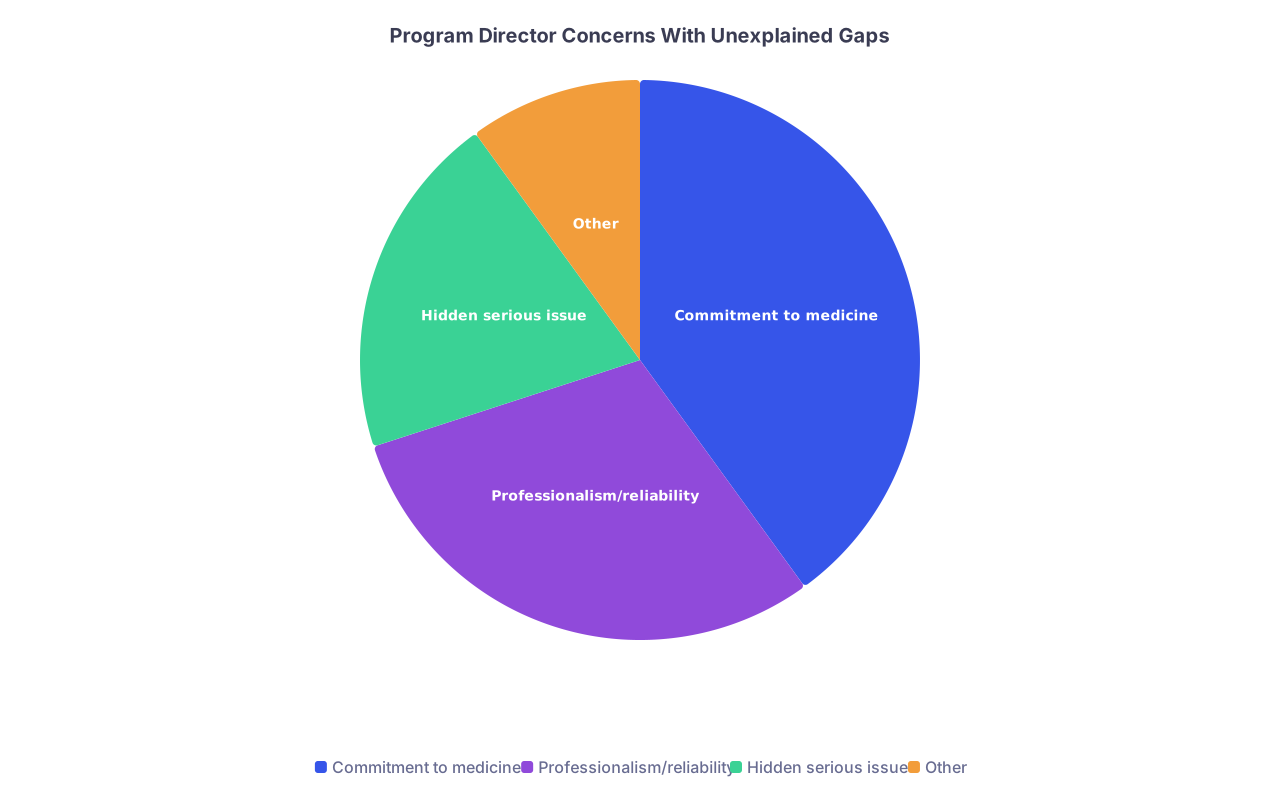
| Category | Value |
|---|---|
| Commitment to medicine | 40 |
| Professionalism/reliability | 30 |
| Hidden serious issue | 20 |
| Other | 10 |

FAQ: Non‑Clinical Gaps for IMG Applicants
1. Will disclosing a non‑clinical gap automatically hurt my chances?
No, not automatically. An unexplained gap is usually worse than a well‑explained one. What hurts you is:
- Long gaps with no clear activities
- Gaps directly tied to repeated failures with no evidence of improvement
- Gaps that sound like you’re still unstable or undecided
A clear, honest, concise explanation can neutralize most concern.
2. Should I list non‑medical jobs on my ERAS application?
If they were significant (≥3 months, substantial hours), yes. List them professionally in the Experiences section. Programs would rather see that you worked and took responsibility than see an empty year. Just keep descriptions short and tie 1–2 skills to residency (communication, teamwork, reliability).
3. How do I handle multiple small gaps over several years?
If each gap is <3 months and they’re naturally between rotations, exams, or jobs, you probably don’t need to explain every one. But if they add up to long unexplained periods, cover them with broad labels like “USMLE preparation,” “Relocation,” or “Family responsibilities” and show that during each period you were still moving toward residency in some way.
4. What if my gap was due to depression, anxiety, or burnout?
You don’t have to name the diagnosis. You can say “personal health issues” or “a health situation that required treatment.” The key points:
- You recognized the issue and addressed it
- It’s now stable/treated/resolved
- You’re functioning well enough to handle residency (supported by recent work, observerships, or clinical activity)
If asked directly in an interview, you can share a bit more—but you’re still allowed to keep details private.
5. Should I write a separate “gap explanation” letter or addendum?
Usually no. US residency culture isn’t big on separate addendum letters the way some other systems are. Use:
- ERAS Experiences entries
- A short paragraph in your PS (if needed)
- Clear, practiced answers for interviews
That’s more than enough. Extra letters often come across as defensive or overexplaining.
6. What if my entire post‑graduation period is non‑clinical so far?
Then you must do two things:
- Show that your non‑clinical period had structure (work, responsibilities, exam prep, courses).
- Prove that you’re now actively re‑entering medicine: observerships, hands‑on experiences where possible, recent exams, strong letters.
You can absolutely match from a non‑clinical background, but only if your recent 12–18 months look like someone aggressively moving back toward clinical work.
Key points to walk away with:
- Long non‑clinical gaps aren’t fatal—but unexplained ones usually are.
- Be brief, honest, and purposeful: time frame, simple label, connection to medicine, and what you gained.
- Your goal isn’t to look perfect. It’s to look stable, committed, and ready for residency now.