
The worst thing an unmatched IMG can do is “take a year off and see what happens.” You are not taking a year off. You are entering a 12‑month recovery sprint.
I am going to walk you through that year, step by step, in order. At each point you will know exactly what you should be doing and what you should stop doing. No wishful thinking. No magical “networking” that is just sending cold emails into the void.
You will treat this like a structured rehab after a serious injury: targeted, time‑bound, and brutally honest about what went wrong.
Step 0: Week 0–2 After Unmatch – Stop the Bleeding
At this point you should diagnose why you did not match before you do anything else. Do not sign up for random observerships or new exams blindly.
Your first 2 weeks’ tasks:
Collect your data
- ERAS application PDF (save it now; ERAS resets).
- Rank order list.
- List of interviews received (if any) and outcomes.
- USMLE scores and number of attempts.
- YOG (year of graduation) and current clinical activity.
Do a triage analysis Open your ERAS and ask, bluntly:
- Scores
- Any fail or multiple attempts?
- Are you below typical IMG cutoffs (e.g., Step 2 CK < 230 for competitive IM programs)?
- YOG / Gap
- More than 3–5 years out of medical school with minimal current clinical activity?
- US experience
- Less than 2–3 months of recent, credible US clinical experience (USCE)?
- Specialty choice
- Applied mainly to ultra‑competitive specialties (Derm, Ortho, Plastics, Rad Onc, ENT) without elite credentials?
- Application strategy
- Applied to fewer than ~80–120 programs in IM/FM/Peds or fewer than ~30–40 in categorical surgery?
- Did not apply broadly (many programs in only one or two states)?
- Red flags
- Failures, major gaps, professionalism issues, visa complications.
- Scores
Get two external opinions At this point you should show your materials to:
- One US physician who knows residency (ideally faculty or PD/APD).
- One experienced advisor who regularly works with IMGs.
Ask them specific questions:
- “Looking at my profile, would you have interviewed me at your program? If not, why?”
- “If I change only one thing in the next 12 months, what must it be?”
Define your main deficit category
Almost every unmatched IMG falls mainly into one of these buckets:
| Category | Primary Problem |
|---|---|
| Scores | Low / failed exams |
| Recency | Old graduate / gaps |
| USCE | Weak or no US experience |
| Strategy | Too few / wrong programs |
| Specialty choice | Overly competitive field |
Your entire year will revolve around fixing the top 1–2 of these. Not all five.
Month 1–2: Post‑Match to Late Spring – Rebuild the Foundation
At this point you should lock in your next cycle strategy and start executing, not dreaming.
Week 3–4: Decide Your Specialty And Visa Reality
You cannot afford indecision.
If you applied to a highly competitive specialty and have no interviews:
- At this point you should strongly consider switching to IM, FM, Peds, Psych, or Path.
- Exception: truly exceptional profile (research fellowships, 260+ scores, strong US academic mentors). Be honest.
Visa status:
- If you need a visa, you must:
- Create a list of programs in your specialty that actually sponsor your visa type (J‑1 vs H‑1B).
- Accept that this will shrink your pool and that other aspects must be stronger.
- If you need a visa, you must:
Week 4–8: Concrete Plan By Deficit Type
From now through late spring, your weekly schedule must line up with your main weaknesses.
I will lay it out by deficit; you will map yours.
1. If your scores are weak or you have a fail
At this point you should:
- Register for Step 3 (if eligible) with a test date no later than August.
- Study 2–3 hours per weekday, more on weekends.
- Use:
- A full QBank (UWorld or AMBOSS).
- At least 2 practice assessments (NBME/UWSA equivalent).
Goal: show an upward trend and have a pass on file before interview season. For some programs, Step 3 makes or breaks H‑1B and older‑grad candidates.
2. If you are an older graduate or have gaps
You must fix recency. On paper and in reality.
At this point you should:
- Secure continuous clinical activity:
- USCE if possible (observerships, hands‑on externships, sub‑internships).
- If not possible, structured non‑US work (hospitalist role, primary care, inpatient work).
- Aim for no empty months from now until the next ERAS submission.
Even unpaid clinical volunteering in a US hospital is better than a blank year. Program directors are suspicious of inactivity.
3. If your USCE is weak
Priority for the next 4–6 months: be in a US clinical environment where attendings can write strong letters.
- Target:
- 3+ months of USCE in your intended specialty.
- At least 2 rotations that finish by July–August so letters are ready for ERAS.
Apply aggressively to:
- University‑affiliated observership and externship programs.
- Community hospitals that accept IMGs (search by program websites and alumni contacts).
- Rotations connected to residency programs that routinely take IMGs.
Month 3–4: Early Summer – Lock in Experiences and Start Quiet Preparation
By now, you should have your 12‑month map, not just vague plans. This is where structure matters.
At this point (early summer), your calendar should look like:
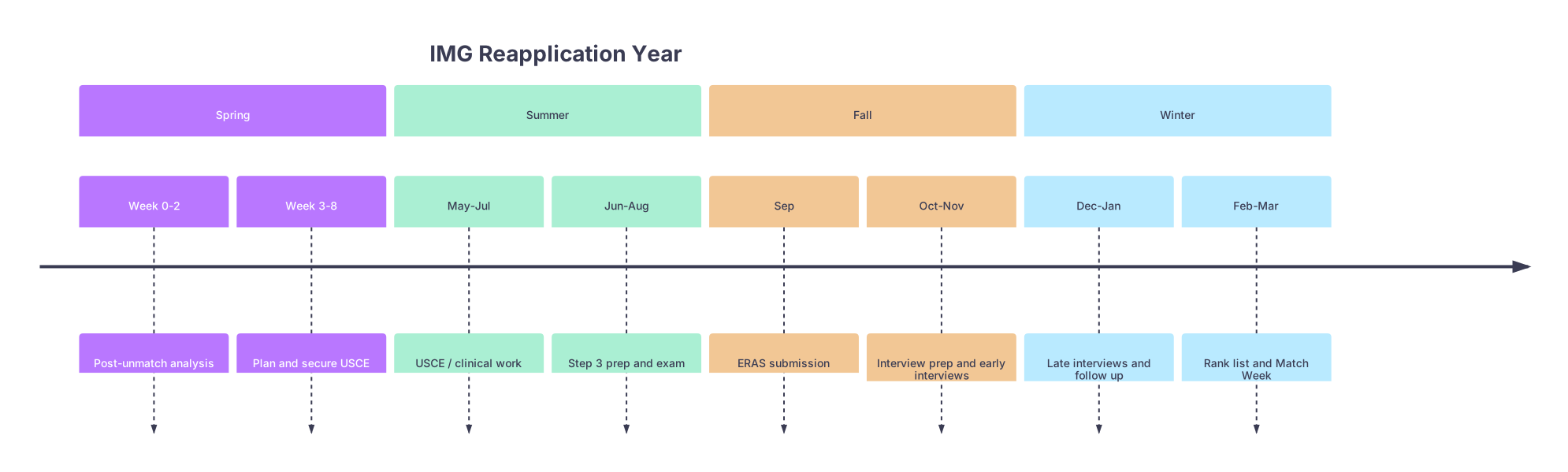
| Period | Event |
|---|---|
| Spring - Week 0-2 | Post-unmatch analysis |
| Spring - Week 3-8 | Plan and secure USCE |
| Summer - May-Jul | USCE / clinical work |
| Summer - Jun-Aug | Step 3 prep and exam |
| Fall - Sep | ERAS submission |
| Fall - Oct-Nov | Interview prep and early interviews |
| Winter - Dec-Jan | Late interviews and follow up |
| Winter - Feb-Mar | Rank list and Match Week |
Now, the week‑by‑week moves.
Week‑by‑Week: Months 3–4
Week 9–12
At this point you should:
Finalize all USCE slots through at least November:
- Prioritize July–October in programs that take IMGs.
Confirm:
- Start/end dates.
- Whether they provide formal letters of recommendation (LORs).
- Whether you can work closely with attending physicians, not just shadow residents.
If doing Step 3:
- Increase QBank volume.
- Take and review a practice assessment.
- Adjust test date if you are scoring too low.
Week 13–16
At this point you should start quiet ERAS prep while your clinical and exam work continues:
- Update CV with:
- Clear description of each role and month/year timelines.
- Draft:
- New personal statement outline based on your actual story this year, not recycled text from last cycle.
- Make a list of:
- 3–5 potential letter writers (US attendings, research mentors, program leaders).
- Dates when you will ask for letters (typically near the end of each rotation).
Month 5–6: Late Summer – Application Build Phase
This is where IMGs usually underestimate the work. They focus only on Step 3 or only on rotations. Your application materials must be rebuilt in parallel.
Weekly Structure (Months 5–6)
You should be thinking in weekly blocks now. A typical week might look like:
| Day | Morning | Afternoon | Evening |
|---|---|---|---|
| Mon–Fri | USCE / clinical work | USCE / clinical work | Step 3 / ERAS prep |
| Saturday | Step 3 / QBank | ERAS drafting | Rest or light review |
| Sunday | ERAS fine‑tuning | Email follow‑ups / planning | Off |
At this point (late summer), you should be doing:
Final Step 3 push (if needed)
- Test ideally between late July and late August.
- Do not delay into October; late scores help almost no one.
Letters of recommendation
- At the end of each rotation, ask in person:
- “Doctor, I am reapplying to internal medicine this year. Would you be comfortable writing a strong letter of recommendation for me?”
- Give them:
- Your updated CV.
- Draft personal statement.
- List of your clinical contributions and cases.
- Target:
- 3–4 strong letters, at least 2 from US attendings in your chosen specialty.
- At the end of each rotation, ask in person:
Rewriting your personal statement
Stop recycling. Program directors recognize generic IMGs phrases by line 3.
At this point you should:
- Write a draft that:
- Explains your unmatched cycle briefly and maturely, or does not mention it at all if it adds nothing.
- Emphasizes:
- Growth this year.
- Specific US clinical experiences.
- Clear, realistic career goals.
One short paragraph, maximum, to address being unmatched if you choose:
- Own it: “I applied last cycle with limited US clinical experience and an application that did not reflect my current abilities. Over the past year, I have…”
- Then move on to what you did, not what happened.
- Program list construction
This is where many IMGs destroy their chances with fantasy lists.
At this point you should:
- Build a program spreadsheet with:
- Region.
- Whether they take IMGs regularly.
- Visa policy.
- Minimum USMLE requirements.
- Past interview / match track record for IMGs.
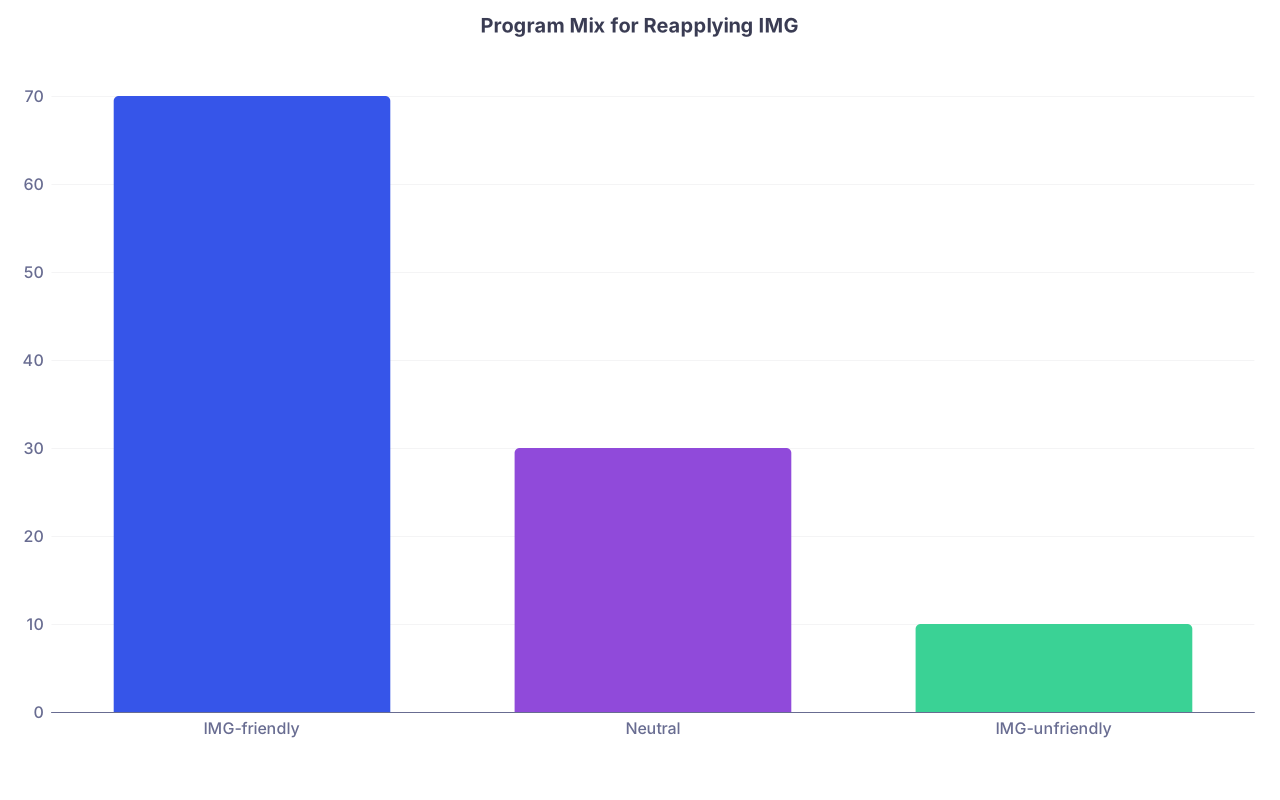
| Category | Value |
|---|---|
| IMG-friendly | 70 |
| Neutral | 30 |
| IMG-unfriendly | 10 |
For most IMGs reapplying in IM/FM:
- Aim for:
- 80–120 programs if visa‑requiring or lower scores.
- Heavier emphasis on community and IMG‑friendly programs.
- Limit:
- “Dream” academic programs to 10–15% of your list unless your profile is outstanding.
Month 7: September – Application Launch
This month is non‑negotiable. By now, you should be ready to submit ERAS early in the opening window.
Week 1 of September: Final Assembly
At this point you should:
Have:
- All exam scores in (including Step 3 if taken).
- At least 3 letters uploaded (a 4th can arrive later).
- Personal statement polished, not perfect.
- CV and experiences updated, with no gaps.
Double‑check:
- Dates are accurate.
- Employment and clinical experiences are continuous.
- No unexplained multi‑month gaps in the last 1–2 years.
ERAS Submission Week
Your tasks:
- Submit early – do not wait weeks “to perfect things.”
- Apply to your full list within the first few days, not in small batches stretched over weeks.
- Customize where it matters:
- Use slightly different personal statements for different specialties or for primary vs backup specialty.
- Mention specific connections only if they are real (USCE there, mentor linked, geographic family ties).
From this point forward, you are in signal‑sending mode.
Month 8–9: October–November – Interview Season Tactics
At this point you should transition from application building to interview hunting and prep.
Week‑by‑Week Priorities
Weekly (ongoing from October onward):
- Check email and ERAS daily – no missed invites.
- Respond to invitations within hours, not days.
- Keep a flexible schedule to accept interview dates.
If you have few or no invites by late October
This is the reality check.
At this point you should:
Have your mentors intervene
- Ask attendings or research mentors who know you well:
- “Are there any programs you would feel comfortable emailing on my behalf?”
- A direct email from a US faculty to a PD can convert into an interview far better than your own cold email.
- Ask attendings or research mentors who know you well:
Send targeted, not spammy, emails
- Focus on programs where:
- You did USCE.
- Your mentor has a real connection.
- You have strong geographic or family ties.
- Focus on programs where:
Keep your clinical work going
- Do not disappear into a test prep cave.
- Programs like to see that you remained active in clinical environments through fall and winter.
Interview Preparation (once invites start)
At this point you should allocate specific evenings each week for:
Practicing:
- Tell me about yourself.
- Why this specialty?
- Why this program / this region?
- Explain gaps / failures / reapplication year calmly and briefly.
Simulating:
- 2–3 mock interviews with:
- US mentors.
- Senior residents.
- Peers who matched previously.
- 2–3 mock interviews with:
Your answers must show:
- Insight about the previous unmatched cycle.
- Concrete growth:
- “Since last cycle, I have completed X months of USCE, passed Step 3, and worked closely with Y attending where I led…”
Month 10–11: December–January – Close the Loop
Interviews may still be coming, especially for community and IMG‑heavy programs. At this point your job is to finish strong, not coast.
Ongoing in December–January
You should:
- Continue any ongoing USCE or clinical job.
- Keep your email responses prompt.
- After each interview:
- Send a brief, specific thank‑you email to interviewers.
- Take notes immediately after:
- Program culture.
- Geography.
- Call schedule.
- IMG support.
These notes will matter when you rank programs.
Month 12: February–Match Week – Ranking And Contingency Planning
By now, your main work is done. But this last stage can still be mishandled.
Early–Mid February: Rank Order List Construction
At this point you should:
- Rank every program where you would be willing to train.
- Do not leave a program off the list because you “did not feel a connection” if you would still attend.
- Use your notes:
- Pathology of cases, teaching structure, resident happiness, visa reliability, IMG track record.
Do not:
- Try to game the algorithm by ranking “strategically”.
- The NRMP algorithm is applicant‑favorable. Rank in your true order of preference.
Quiet Contingency Planning (In Parallel)
You cannot control Match Week. You can control what happens if it goes badly.
At this point you should sketch:
- If I do not match:
- Will I:
- Stay in the US for research or more USCE?
- Return to home country for clinical practice and reapply?
- Consider another specialty next year?
- Will I:
This is not pessimism. It is professional planning.
Match Week: Emotional Control And Micro‑Decisions
Whether you match or not, those few days are emotionally brutal.
If you match – the year worked. You pivot to onboarding.
If you do not match again:
- Do not S.O.A.P. blindly into fields you would hate long term just “to get anything.”
- Evaluate quickly:
- Is there a SOAP option that is remotely aligned with your skills and goals?
- Would another reapplication cycle, with further strengthening, put you in a far better position?
I have seen IMGs SOAP into a poor‑fit preliminary year and then get stuck or burn out. Think hard before accepting a seat that derails your entire career trajectory.
The Year in One Glance
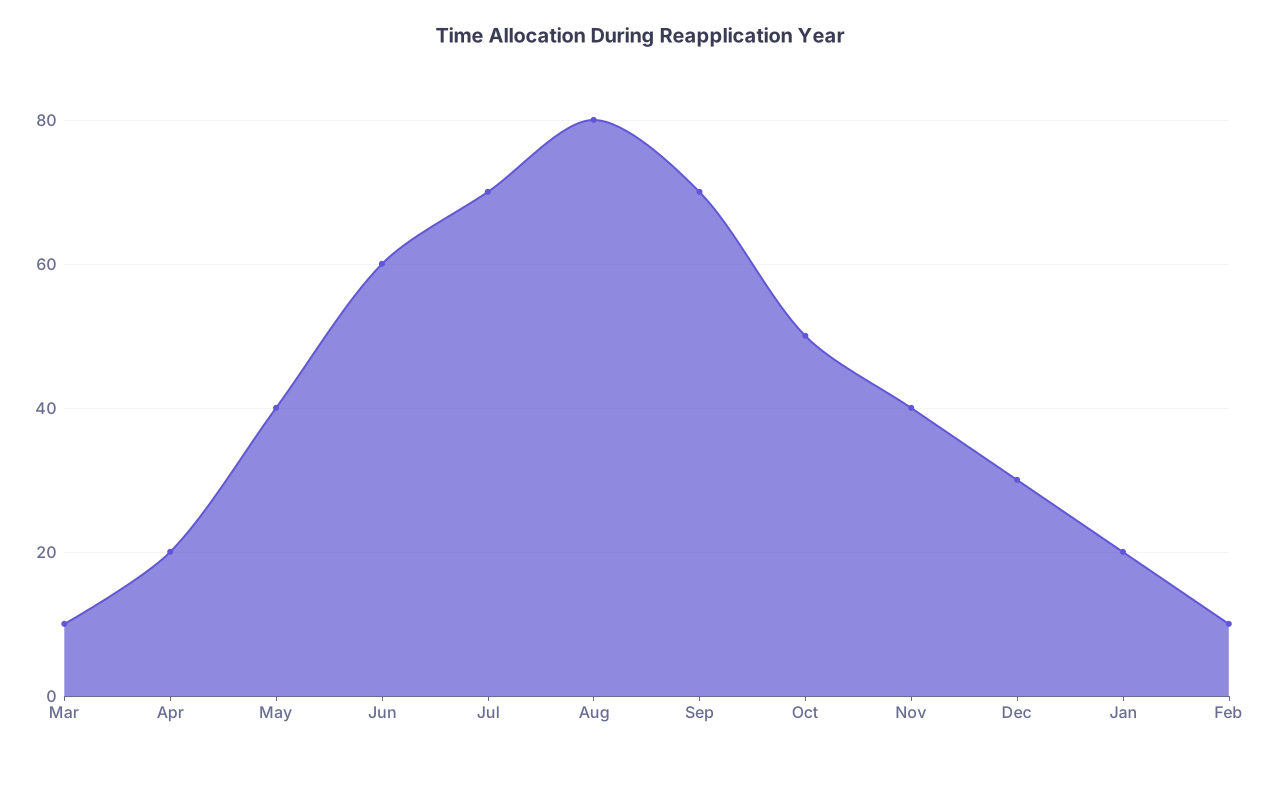
| Category | Value |
|---|---|
| Mar | 10 |
| Apr | 20 |
| May | 40 |
| Jun | 60 |
| Jul | 70 |
| Aug | 80 |
| Sep | 70 |
| Oct | 50 |
| Nov | 40 |
| Dec | 30 |
| Jan | 20 |
| Feb | 10 |


Final Checklist: Where You Should Be At Each Major Point
To make this concrete, here is your compressed, time‑anchored checklist.
| Time Point | You Should Have… |
|---|---|
| Week 0–2 post-match | Clear diagnosis of why you failed |
| End of Month 2 | Specialty decision, USCE slots in motion |
| End of Month 4 | Active USCE/clinical role, ERAS draft |
| End of Month 6 | 2–3 US letters lined up, Step 3 date |
| Early September | ERAS submitted, full program list |
| End of November | Interviews attended or targeted outreach |
| February | Thoughtful rank list, contingency plan |
You recover from an unmatched cycle by doing three things well:
- Identify and fix your top one or two real deficits, not everything at once.
- Stay continuously clinically active so your story is about growth, not waiting.
- Use the calendar ruthlessly – by each month, you either hit the milestone or you adjust hard, not drift.
Follow the calendar. Do the unglamorous work every week. That is how IMGs actually turn an unmatched year into a match letter.