
Most IMG letter requests fail before you ever open your mouth—because your “packet” is vague, lazy, or nonexistent.
Let me be blunt: strong letters of recommendation do not appear by magic. Especially not for IMGs. They are built. Brick by brick. And the bricks are in your request packet.
If you are an IMG trying to match, your LOR packet is not optional. It is your only defense against generic, useless letters like:
“I had the pleasure of working with Dr. X during their time in our department. They were punctual, hardworking, and will make a fine resident.”
That kind of letter might as well say: “I do not know this person.” And programs can smell that from across ERAS.
We are going to build a packet that makes it easy—almost unavoidable—for an attending to write a detailed, US-style, program-relevant, IMG-rescuing letter.
1. The Real Problem: Why IMGs Get Weak Letters
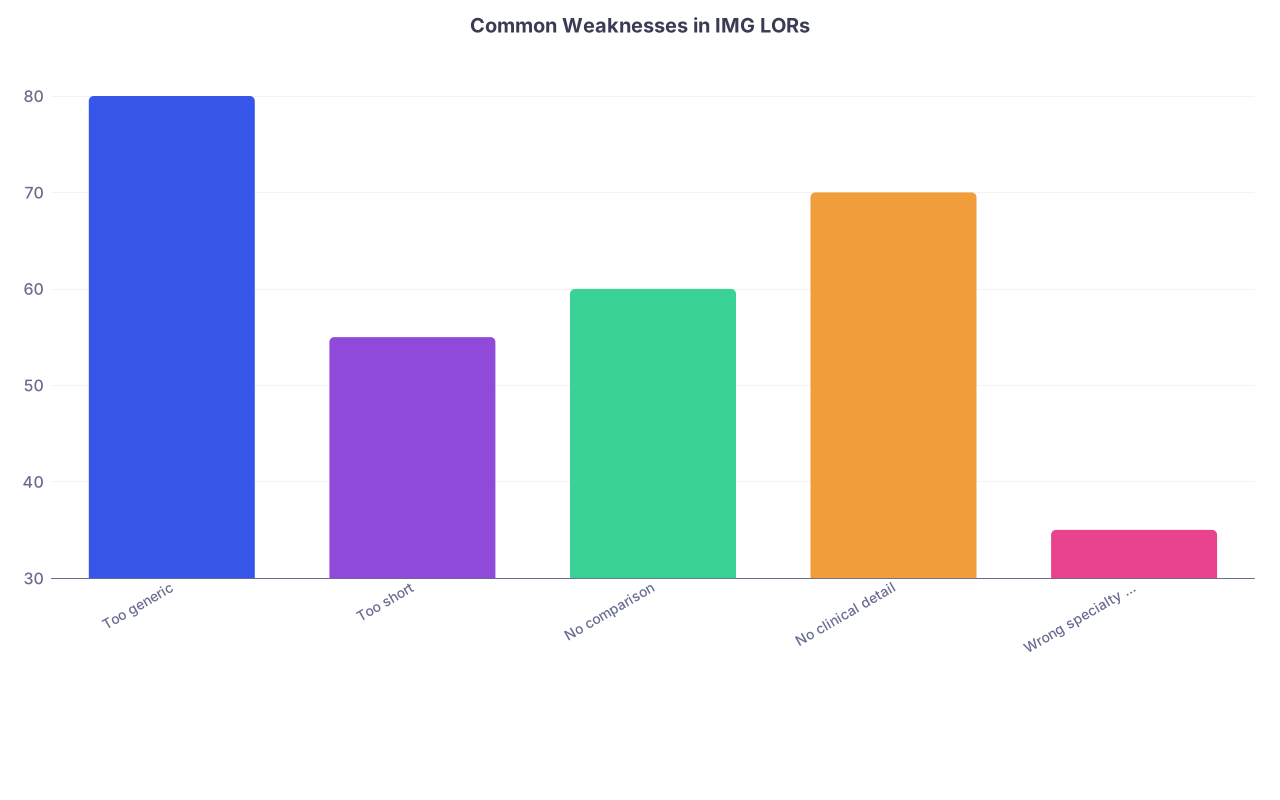
| Category | Value |
|---|---|
| Too generic | 80 |
| Too short | 55 |
| No comparison | 60 |
| No clinical detail | 70 |
| Wrong specialty focus | 35 |
The core problem is not that attendings hate writing for IMGs. Many will go out of their way for you—if you give them something solid to work with.
What usually happens instead:
- You finish an observership or elective.
- You send a two-line email: “Dear Dr. Smith, could you please write me a strong letter of recommendation for residency?”
- You attach… nothing. Or just your CV.
- They are busy, open ERAS the night before the deadline, and dash off a template-style letter they use for everyone.
You end up with:
- Generic adjectives (hardworking, pleasant, punctual).
- No specific cases, no numbers, no real comparison to peers.
- No mention of US residency expectations, ACGME competencies, or actual resident-level skills.
- Often, no clear specialty alignment.
For IMGs, this is fatal. You already fight:
- Visa questions.
- “Are your clinical skills current?”
- “Can you function in the US system?”
- “Will you struggle with communication, EMR, or cultural norms?”
A good letter answers those directly. A bad one ignores them.
Your request packet exists for one reason: to make it so easy for the writer to address these issues that they almost copy-paste your own talking points into the letter—but in their voice and with their credibility.
2. The Anatomy of an IMG LOR Request Packet
Think of the packet as a mini-dossier. Not bloated. Targeted.
At minimum, your packet should contain:
- Cover page / summary sheet (one page)
- Tailored CV (2–3 pages)
- Personal statement (or focused paragraph) for the target specialty
- ERAS details + logistics sheet
- Talking points document (this is where most IMGs fail or skip)
- Optional: Brief “case highlights” appendix (1 page) if the writer saw you in real clinical action
Let me break these down.
2.1 Cover Page / Summary Sheet
This is the “at-a-glance” page your writer actually reads.
Include:
- Your full name as used in ERAS
- Medical school, year of graduation, degree
- Current status (e.g., “Completed MBBS in 2021, now doing US clinical rotations”)
- Target specialty (and whether this letter is specialty-specific or general)
- Your 3–5 key strengths as you want them emphasized
- 2–3 sentences reminding them when and how you worked together
Example structure:
- Name: Ahmed Hassan, MBBS
- Medical School: Aga Khan University, Class of 2022
- Target Specialty: Internal Medicine (categorical)
- How we worked together: “I worked with you on the inpatient medicine service at University Hospital from May 1–31, 2025, as an acting intern. I took primary responsibility for 6–8 patients daily, pre-rounded independently, and presented on rounds.”
Then:
Strengths to emphasize (in your own words, brief):
- Able to function at intern level in US inpatient setting
- Strong clinical reasoning and differential diagnosis, especially in complex multi-comorbidity cases
- Excellent communication with nurses and patients; took lead on family discussions under supervision
- Reliable, organized, and adapted quickly to EMR and local workflows
You are not putting words in their mouth. You are giving them accurate reminders and directions.
2.2 Tailored CV
Your CV should not be a chaotic 8-page academic CV from your home country with every workshop since high school.
Cut ruthlessly:
- Clinical experiences (especially US) first
- Research, publications, QI projects relevant to the specialty
- Leadership/teaching experiences that signal maturity and team functioning
- Leave in only awards and activities that would matter to a PD looking at an IMG

You are not trying to impress your writer with volume. You are giving them hooks.
They might write:
“On reviewing Dr. Hassan’s CV, I was struck by his sustained engagement in internal medicine research, including a retrospective study on heart failure readmissions, which aligns with his clinical strengths that I observed.”
They cannot do that if your CV reads like a random dump.
2.3 Personal Statement or Specialty Paragraph
If you already have your personal statement, include it. If it is a mess, at least include a one-paragraph “Why this specialty and where you see yourself” that is coherent.
This helps your writer frame you:
- As a future academic vs. community physician
- Primary care vs. subspecialty-leaning
- Long-term commitment to US practice vs. uncertain
They might echo:
“Dr. X has a clear, thoughtful commitment to primary care for underserved populations, which was evident in…”
That kind of alignment matters.
2.4 ERAS + Logistics Sheet
Do not make them guess where and when to upload.
This sheet should include:
- ERAS AAMC ID
- Application season (e.g., 2026–2027 cycle)
- Type of letter: specialty-specific (IM) vs “for all specialties”
- Whether the letter should be:
- On letterhead
- Dated within current season
- Addressed “To the Program Director” (standard)
- Deadline you are aiming for (with buffer)
Also indicate:
- Whether you waive your right to see the letter (you should; non-waived letters are a red flag)
- If they can use the letter for multiple cycles if you do not match (some will agree, some will not)
2.5 Talking Points Document (The Core Weapon)
This is where you give them the raw material.
Length: 1–2 pages max. Bullet format is fine. But make it sharp.
Sections you should include:
How we worked together
- Dates of rotation
- Setting (inpatient, outpatient, ICU, ED, subspecialty clinic)
- Level of responsibility (observer vs sub-I vs extern; be honest)
Specific clinical examples
2–4 short bullets describing concrete moments that illustrate your strengths.For example:
- “During our inpatient service, I admitted a 68-year-old male with decompensated CHF and possible pneumonia. I independently organized the H&P, created an initial differential including PE, ACS, and COPD exacerbation, and presented a structured plan on rounds, which we then refined together.”
- “I took initiative to coordinate family meetings for two complex patients with multiple admissions. I prepared a clear summary of the situation, explained it to families in accessible language, and then reviewed my approach with you for feedback.”
Attributes to highlight (mapped to ACGME competencies)
This is how you subtly remind them what residency programs care about:- Patient care: “Comfortable managing 6–8 patients, tracking labs, following up on consults, adjusting plans daily”
- Medical knowledge: “Prepared evidence-based plans, familiar with US guidelines”
- Interpersonal & communication skills: “Worked closely with nurses, gave clear sign-out”
- Professionalism: “No lateness, stayed late for sick patients, took feedback well”
- Systems-based practice: “Learned to navigate EMR, discharge planning, social work, insurance barriers”
- Practice-based learning: “Actively sought feedback, read on cases, presented mini-teachings”
Comparison to peers
This helps them comfortably write the classic comparison line.You can suggest wording like:
- “If appropriate, you may comment on how my performance compared with US medical students or residents at my level.”
Remind them: PDs love phrases like “among the top 10% of students I have worked with in the last 5 years.”
- “If appropriate, you may comment on how my performance compared with US medical students or residents at my level.”
Special situations (if relevant)
- If you had a gap and are now back in clinical form
- If you switched specialties and want them to endorse the switch
- If you had language/cultural adaptation initially but then improved significantly
2.6 Optional: Case Highlights Appendix
One page. 1–3 short case vignettes of patients you managed with them. Very focused:
- Patient type
- Your role
- Key decisions, communication, or follow-up you handled
- What you learned
Many attendings will literally lift pieces of this and convert them into narrative.
3. Templates You Can Actually Use (And Modify)
Let me give you concrete templates, not vague suggestions.
3.1 Email Template – Initial LOR Request
Subject lines that work:
- “Letter of recommendation request – [Your Name], [Rotation/Date]”
- “LOR request for Internal Medicine residency – [Your Name]”
Sample email:
Dear Dr. Smith,
I hope you are well. I am writing to ask whether you would feel comfortable writing a strong letter of recommendation in support of my application to Internal Medicine residency in the 2026 ERAS cycle.
I had the privilege of working with you on the inpatient medicine service at University Hospital from May 1–31, 2025, as an acting intern. During that month, I cared for 6–8 patients daily, presented on rounds, and received valuable feedback from you on my clinical reasoning and communication.
I am very committed to Internal Medicine and plan to pursue a career in academic general medicine with a focus on underserved populations.
If you are able to support me with a strong letter, I have prepared a brief LOR packet to make this as easy as possible, including my CV, personal statement, and a one-page summary of our work together and suggested talking points. I will, of course, waive my right to view the letter in ERAS.
My ERAS AAMC ID is XXXXXXXX, and I am aiming to have all letters uploaded by August 15 to ensure timely submission.
Thank you very much for considering this request, and for the teaching and support you have already given me.
Sincerely,
Ahmed Hassan, MBBS
Email: …
Phone: …
Key points:
- You explicitly ask for a “strong” letter. This gives them an out if they cannot.
- You remind them who you are and what you did, concretely.
- You mention the packet but do not dump attachments on a cold contact. If this is someone you know well, you can attach directly.
3.2 Short Follow-up Email (If They Agree Verbally)
If they say “Sure, happy to write” in person:
Dear Dr. Smith,
Thank you again for agreeing to write a strong letter of recommendation for my Internal Medicine residency applications. I really appreciate your support.
As discussed, I am attaching my LOR packet, which includes:
– A one-page summary of our work together and suggested points you may wish to address
– My CV
– My Internal Medicine personal statement
– A brief logistics sheet with my ERAS AAMC ID and target upload datePlease let me know if any additional information would be helpful.
With gratitude,
Ahmed
You are not begging. You are acting like a professional colleague coordinating something important.
4. Timing: When and How to Ask Without Annoying People
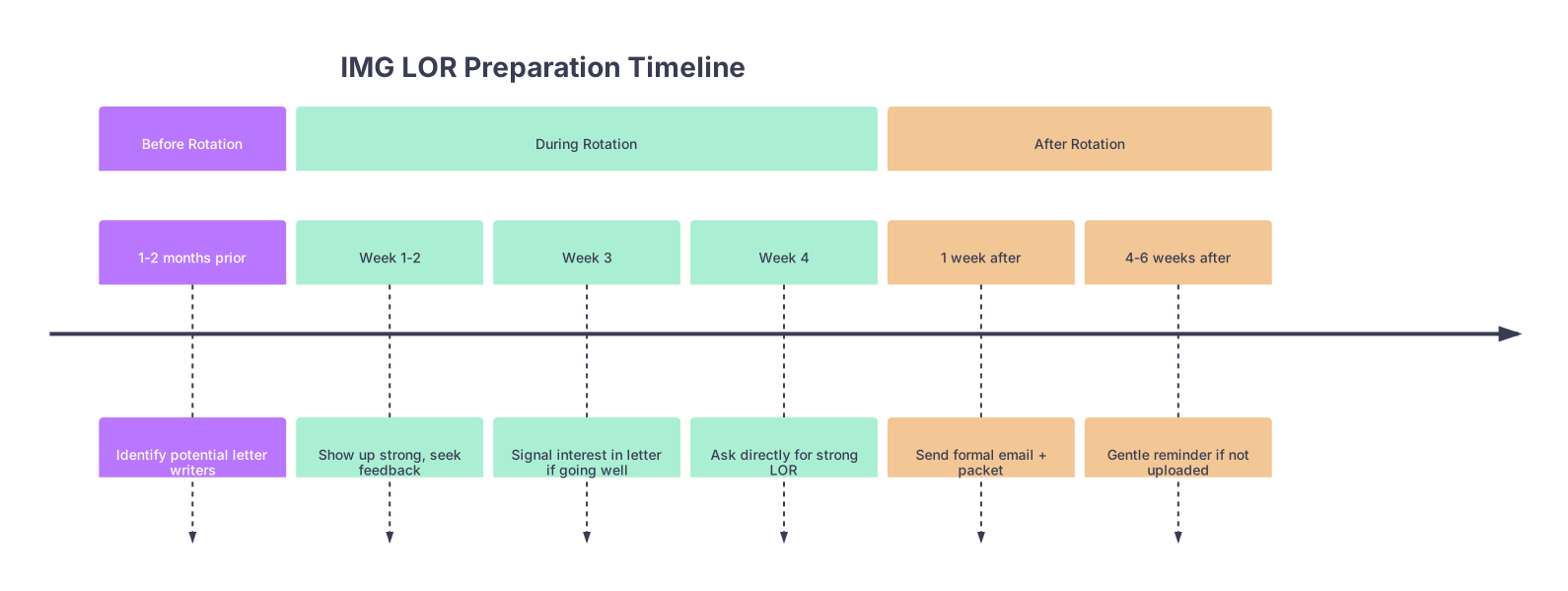
| Period | Event |
|---|---|
| Before Rotation - 1-2 months prior | Identify potential letter writers |
| During Rotation - Week 1-2 | Show up strong, seek feedback |
| During Rotation - Week 3 | Signal interest in letter if going well |
| During Rotation - Week 4 | Ask directly for strong LOR |
| After Rotation - 1 week after | Send formal email + packet |
| After Rotation - 4-6 weeks after | Gentle reminder if not uploaded |
4.1 Asking During the Rotation
Ideal approach:
Week 2 or 3: ask for performance feedback:
“Dr. Smith, I am aiming for Internal Medicine. Could you give me feedback on how I am doing compared to other students at my level?”If feedback is positive, near the end of the rotation:
“Given your feedback and my interest in IM, would you feel comfortable writing a strong letter of recommendation for my residency applications?”
If they hesitate or look uncomfortable, back off. A lukewarm letter is worse than no letter.
4.2 Asking After the Rotation
Maximum delay: 2–3 months, unless you stayed in close contact.
Past 6–12 months, details blur. They can still write, but your packet becomes even more important because their memory is fading.
For IMGs, your US clinical rotations may be limited and spaced out. Do not wait until ERAS opens to start this process.
4.3 Deadlines and Reminders
Most attendings are not malicious. They are just drowning.
You handle this by:
- Setting your personal “soft deadline” 2–3 weeks before you truly need it
- Sending one reminder 2 weeks before, then another 1 week before if still not done
- Reminders are short, respectful, and guilt-free
Example reminder:
Dear Dr. Smith,
I hope your week is going well. I wanted to gently follow up regarding the letter of recommendation for my Internal Medicine residency application.
My goal is to have all letters uploaded by August 15, which is about 10 days away. Please let me know if I can provide any additional information or if this timeline is difficult.
Thank you again for your support.
Best regards,
Ahmed
If they miss the deadline repeatedly, you quietly shift your expectations and strengthen other letters.
5. Tailoring for IMGs: What Your Packet Must Solve
Your packet must work harder than a US grad’s. It has to answer unspoken doubts.

5.1 Addressing “Recency” of Clinical Skills
If you graduated 3–5 years ago, PDs worry your skills are rusty.
Your talking points should deliberately highlight:
- How recently you worked in hands-on clinical settings
- That you handled real patient loads, not just shadowing
- That your attending supervised you on US-style notes, orders (if allowed), and team interaction
Encourage your writer (indirectly) to mention phrases like:
- “Dr. X functioned at the level of a US graduating medical student / intern.”
- “Their clinical skills are current and well adapted to the US healthcare system.”
5.2 Communication and Cultural Adaptation
IMG letters that ignore communication are a missed opportunity.
You can prompt this with bullets like:
- “Worked closely with nursing staff, took nursing pages, and responded promptly and respectfully.”
- “Demonstrated clear, understandable communication with patients and families; no significant language barriers.”
- “Adapted quickly to local expectations around documentation, sign-out, and interprofessional collaboration.”
Those are not minor points. For IMGs, they are central.
5.3 Visa and Commitment to US Training
Never ask your writer to discuss visa issues directly. But they can comment on your reliability and long-term commitment.
You might include:
- “I plan to pursue a long-term career in the US in academic internal medicine.”
- “I have already relocated to the US and am fully committed to complete residency and fellowship here.”
If they echo that, it reassures programs you are not applying “just to see what happens.”
6. Specialty-Specific Nuances in Your Packet
Not all letters are created equal across specialties.
| Specialty | Critical Emphasis |
|---|---|
| Internal Medicine | Clinical reasoning, follow-through |
| Family Medicine | Communication, continuity, empathy |
| Psychiatry | Communication, insight, boundaries |
| Surgery | Work ethic, technical potential |
| Pediatrics | Family communication, patience |
6.1 Internal Medicine (most common IMG target)
Emphasize:
- Differential diagnosis
- Management of multimorbidity
- Organization and follow-through
- Response to feedback, self-directed learning
6.2 Family Medicine
Emphasize:
- Longitudinal thinking
- Preventive care
- Community/underserved interests
- Patient education, motivational interviewing (if you actually did it)
6.3 Psychiatry
Emphasize:
- Communication clarity and empathy
- Comfort with challenging patient behaviors
- Boundaries and professionalism
- Interest in talk therapy / psychopharm balance, if relevant
6.4 Surgery
Now the bar changes.
- Grit. Reliability at 4:30 a.m.
- Ability to take and implement blunt feedback
- Early signs of technical skills (if truly there)
- Stamina and teamwork in the OR and wards
Do not fabricate. If your clinical exposure was outpatient dermatology, do not ask them to write a “strong surgery letter” because you decided last minute to pivot.
7. Common IMG Mistakes And How To Fix Them
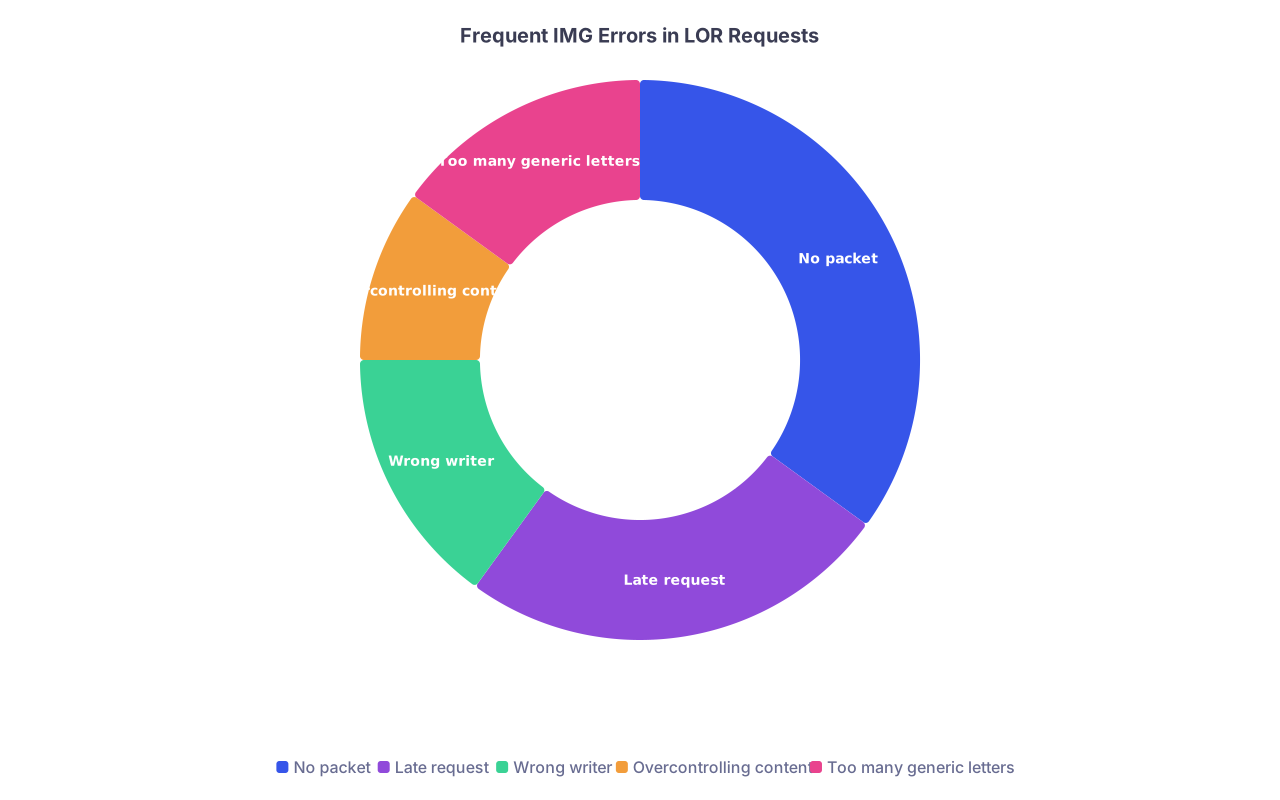
| Category | Value |
|---|---|
| No packet | 35 |
| Late request | 25 |
| Wrong writer | 15 |
| Overcontrolling content | 10 |
| Too many generic letters | 15 |
Let me be clear about what I see repeatedly.
Mistake 1: No Packet At All
You “do not want to impose” so you send just a CV. This is how you get a 3-line letter.
Fix: Always send at least: summary sheet + CV + talking points.
Mistake 2: Asking the Wrong Person
You chase big titles (department chairs) who barely know you, instead of the associate program director who rounded with you daily.
A detailed letter from an attending who truly saw your work beats a vague letter from a famous name. Every time.
Mistake 3: Overcontrolling the Letter
Bad move: writing a full draft of your own letter and asking them to “sign off.”
Most faculty hate this. It feels dishonest, and the tone is obvious.
Your role is to provide raw material and direction, not ghostwrite. Talking points, not a final product.
Mistake 4: Waiting Until ERAS Opens
You email in September when everyone is already slammed.
Fix: As soon as you finish a strong rotation—even if it is months before the next cycle—ask for the letter. ERAS has re-use options. At worst, they write it and you hold it.
Mistake 5: Too Many Generic Letters
Four letters that all say “hardworking and pleasant” are useless.
Aim for 2–3 truly strong US-based, specialty-aligned letters rather than 5–6 “meh” ones from your home country plus random observerships.
8. Example: What a Good IMG-Focused Letter Actually Looks Like
You will never see your waivered letters. But you should know what you are aiming for.
Patterns in excellent IMG letters that I have seen for matched applicants:
- Specific rotation timeframe and setting
- Statement of writer’s role and experience (e.g., “APD in XYZ program for 10 years”)
- Clear statement of support: “I recommend without reservation” or “I give my strongest recommendation”
- Concrete anecdotes: “I recall a patient…”
- Explicit comparison: “Top 5–10% of students I have worked with in the last X years”
- Address IMG-specific concerns: adaptability, US system, communication, recency
Your packet heavily nudges them to hit these notes.

9. Practical Workflow: How To Systematize This As An IMG
If you are rotating across multiple hospitals and attendings, you need a system, not chaos.
- Create a “LOR” folder with subfolders for each potential writer.
- For each, prepare:
- Customized summary sheet
- Tailored talking points that reflect what you actually did with them
- Keep a simple tracking sheet (Excel or Google Sheets):
| Writer | Specialty | Rotation Dates | Asked On | Confirmed | Uploaded |
|---|---|---|---|---|---|
| Dr. Smith | IM | May 1–31, 2025 | Jun 5 | Yes | Pending |
| Dr. Garcia | FM | Jul 1–28, 2025 | Jul 25 | Yes | Uploaded |
| Dr. Nguyen | Psych | Aug 1–30, 2025 | Aug 30 | No | N/A |
- Log who actually saw you in action vs those who mostly saw you as an observer. Prioritize the former.
- Update deadlines and reminders on your calendar, not in your head.
Treat this like part of your clinical work. Because for IMGs, it absolutely is.
FAQ (Exactly 5 Questions)
1. How many letters of recommendation should an IMG ideally have for residency applications?
For most specialties, 3–4 total letters is appropriate. You should aim for at least 2 strong US clinical letters in your target specialty (e.g., Internal Medicine) if possible. One additional letter can come from another US rotation, research mentor, or a strong home-country clinician who supervised you extensively. Quality beats quantity; three detailed, credible letters will help you more than five generic ones.
2. Is it acceptable for an IMG to use letters from home-country rotations if they lack enough US letters?
Yes, but those letters are typically secondary in impact. If you must use home-country letters, choose writers who can comment on your long-term clinical development, reliability, and academic engagement, not superficial observers. In your packet, provide them with context about US expectations so they can address your adaptability, independence, and readiness for high-responsibility environments. Still, prioritize securing at least 1–2 US-based letters wherever possible.
3. Should I ask attendings to mention my exam scores, gaps, or failures in the letter?
No. Your scores and transcript speak for themselves. Asking them to justify a failure or discuss score context usually backfires and draws more attention to weaknesses. Instead, your packet can emphasize how you have improved, matured, or performed strongly in recent clinical work. If a writer volunteers to comment positively on evident growth or resilience, that can help—but you do not script it directly.
4. Can I reuse the same letter for multiple specialties as an IMG (for example, IM and FM)?
You can, but it is suboptimal. A letter that clearly advocates for you as an Internal Medicine resident will not sound fully aligned if used for Family Medicine or Psychiatry. If you genuinely apply to multiple specialties, you ideally want at least one letter tailored to each. Your packet should specify for the writer whether the letter is “Internal Medicine–specific” or “general medicine” so they can phrase their support accordingly.
5. What if an attending agrees to write a letter but I suspect it will be lukewarm?
If they seemed hesitant when you asked, or their feedback during the rotation was mixed, you should not rely on that letter as one of your core three. You can still accept it and keep it in your ERAS pool, but prioritize stronger letters for specialties where you are most serious. Your best move is prevention: ask for performance feedback before asking for a “strong” letter. If the feedback is anything less than solidly positive, thank them for the feedback and do not escalate to a letter request.
Key points, so you do not forget:
- Strong IMG letters are engineered, not gifted. Your packet is the blueprint.
- Provide concrete talking points, clinical examples, and clear logistics; stop sending vague “please write me a letter” emails.
- Ask early, ask the right people, and make it easy for them to say yes to writing the kind of letter that actually moves a PD’s needle.