
What if this is already “one try too many”… and you just don’t know it yet?
That’s the thought that sits in the back of your mind, isn’t it? Not “how do I improve?” but “am I delusional for trying again at all?” Especially after you’ve already gone unmatched once as an IMG.
Let me say the scary part out loud so we can actually deal with it: yes, there is a point where more applications stop making sense. And no, it’s not the same number for everyone.
Let’s walk through this like two people who are a little bit freaked out and very tired of vague advice.
The harsh landscape: what you’re actually up against
You already know IMGs have a harder road, but it helps (and hurts) to see it clearly.
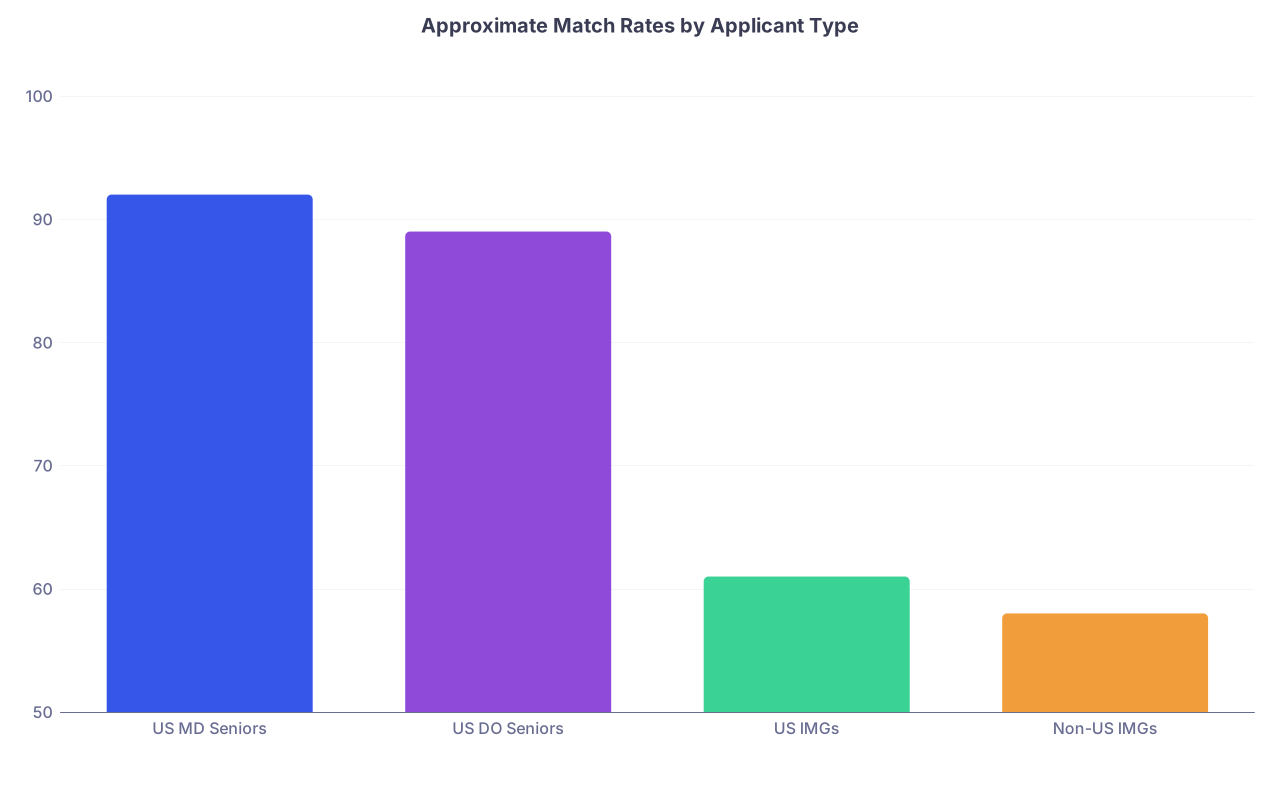
| Category | Value |
|---|---|
| US MD Seniors | 92 |
| US DO Seniors | 89 |
| US IMGs | 61 |
| Non-US IMGs | 58 |
For non‑US IMGs, overall match rates usually hover around the 55–60% range. That’s with everyone mixed in: fresh grads, people with big research, people backed by home-country programs, etc.
You already went through one cycle and didn’t match. So your brain goes:
- “If 60% match, am I already in the ‘unmatchable’ 40%?”
- “Does one failed cycle destroy my odds permanently?”
- “Am I wasting years I’ll regret later?”
You’re not crazy for thinking that. Programs really do care about:
- How many years since graduation
- Number of attempts at Steps
- Gaps with no clear clinical or academic activity
- Multiple previous unsuccessful match attempts
The problem is nobody tells you clearly: “After X tries, don’t bother.” Because they can’t. It depends way more on trajectory than on the raw number of tries.
Still, I’ll give you actual numbers and cutoffs. Not the generic “keep trying, anything is possible” stuff.
How many tries is “too many” for an IMG?
Let me be blunt: for most non‑US IMGs, 3 full, serious attempts is usually the upper limit before you should seriously reassess and maybe pivot hard.
Not 3 half‑hearted, disorganized attempts.
I mean 3 cycles where you:
- Applied smart (right specialties, right programs, right volume)
- Were realistically competitive for something (at least on paper)
- Improved your application between tries
If you’ve done that 3 times and nothing changed—no more interviews, no stronger interest from any program—that’s not “just more bad luck.” That’s a pattern.
Here’s how I’d roughly break it down:
| Attempt # | If You Don't Match… | Realistic Outlook |
|---|---|---|
| 1st | Not the end of the world | Very reasonable to try again, but with changes |
| 2nd | Red flag starts forming | Try again only if there was *real* improvement |
| 3rd | Programs notice this | Fourth try is only reasonable in very specific situations |
| 4th+ | Major concern | Usually better to pivot unless something huge changes |
Is a 4th or 5th attempt impossible? No. I’ve seen a few people match after 4 tries.
But let me be honest: those cases almost always had at least one of these:
- They switched to a less competitive specialty
- They completed a US-based research year with strong letters
- They got a US MPH/PhD and integrated themselves into a department
- They had strong personal advocacy from a program director
- Their previous attempts were weak or misdirected (e.g., initially applied only to super competitive specialties or too few programs)
If your profile has stayed basically the same for multiple cycles, and you’re just hitting “resubmit” on ERAS with a slightly tweaked personal statement—then yes, there really is a point where more tries become throwing time and money into a fire.
The stuff that quietly kills your chances (and how many cycles you can “afford”)
1. Years since graduation
This one is brutal and real. Programs love “fresh grads.” For many IMGs:
- 0–3 years since graduation: usually okay
- 4–5 years: starting to get questioned
5–7 years: many programs auto‑screen you out
10 years: very few programs will touch your app unless there’s something very special
If you’re already, say, 6 years out from graduation and unmatched after cycle 1, can you try again? Yes.
But do you have unlimited cycles? Absolutely not.
Every extra year widens the gap between “trained recently” and “rusty knowledge.” Programs worry about that. They’ll absolutely prefer a fresh 2024 grad IMG over a 2016 grad with roughly similar stats.
So you don’t just have a “number of tries” limit. You also have a time limit.
2. Step exams and attempts
Multiple attempts, especially on Step 2 or CK, hurt. Not necessarily fatal, but they make repeated attempts harder to justify.
Here’s a rough truth:
| Situation | 2nd Serious Try | 3rd Serious Try | 4th+ Tries |
|---|---|---|---|
| Strong scores, no failures | Reasonable | Maybe | Rarely |
| One Step failure, then pass | Cautious yes | Borderline | Usually no |
| Multiple Step failures | Very tough | Often no | Almost never |
If you’ve failed Step 1 or Step 2 more than once, each extra unmatched cycle weighs more heavily. Programs see:
- Time since graduation
- Multiple attempts
- Multiple match failures
That becomes a huge wall to climb. Does one unmatched cycle kill you? Not by itself. But with exams issues, the “how many tries” limit gets lower.
3. Specialty choice
Here’s where people quietly sink themselves: applying to specialties that don’t forgive multiple attempts or gaps.
Think:
- Dermatology
- Plastic surgery
- Ortho
- Rad onc
- Neurosurgery
For an IMG who’s already unmatched once, continuing to chase these without an insanely strong CV is… I’ll be honest… fantasy.
More realistic fields for multiple attempts (if done strategically):
- Internal Medicine
- Family Medicine
- Psychiatry
- Pediatrics
- Pathology (in some settings)
- Neurology (for some programs)
If you went unmatched once applying to something like anesthesia or EM or radiology as an IMG, and you’re thinking of just “trying again and hoping” in the same specialty—don’t. That’s where 3+ tries becomes too many very quickly.
Switching to a less competitive specialty can extend how many attempts make sense. Staying in an already-competitive one reduces your “try count” drastically.
4. What you actually did between cycles
This is the part almost everyone glosses over.
If your “improvement” between cycles was:
- Rewriting your personal statement
- Changing your photo
- Maybe one extra observership
…that’s not really an improvement. That’s just rearranging things on a losing application.
The only way multiple tries are justified is if each time, your application is objectively stronger in a meaningful way:
- Full-time US clinical experience (hands-on if possible)
- A full US-based research year with posters, abstracts, or at least actual work with attendings
- New, very strong US letters from people who know you well
- A real, genuine change in specialty to something more realistic
- Major gaps explained by something real (illness, family crisis, war, etc.) and covered by new activity
Otherwise you’re just re‑submitting the same “no” three times and calling it hope.
The honest self‑check: should you try again?
Let’s be brutally practical. Use this as a mental checklist.
You probably should try again if:
This was your first match attempt, and you:
- Got at least a few interviews
- Were reasonably close (e.g., waitlisted, good feedback)
- Applied late or sloppily and know exactly what to fix
Or this was your second attempt, and:
- You saw real improvement (more interviews, better programs)
- You can realistically strengthen your CV again this year
- You’re willing to change specialty if needed
In these scenarios, a 2nd or even 3rd try can make sense.
You need to seriously reconsider if:
- You’re 5–7+ years out of med school
- You’ve had 2+ serious attempts, applied broadly, and:
- Got zero or 1 interview each time
- Or interviews only at very weak or unstable programs
- Your profile has not significantly improved between tries
- You have multiple Step failures and no major offsetting strengths
In that situation, I wouldn’t tell a friend “just keep going, you’ll get it eventually.” I’d say: “You might get lucky one day, but you’re gambling your 30s/40s on very long odds.”
When a 4th attempt might be worth it
Very narrow cases. Like:
- You initially applied to super competitive fields, then pivoted to IM/FM/psych for real
- You just finished a legit US research fellowship with strong backing from a PD who’s actually picking up the phone for you
- You were under-applied before (like 20 programs) and now can finally afford a true broad application (100+ appropriate programs)
- You had a major personal life disruption that ruined a prior season, and now you can clearly explain it and show stability
If none of that sounds like you, a 4th attempt is probably more self‑punishment than strategy.
Alternatives that aren’t “giving up” (even though it feels like it)
This is where the throat‑tightening fear kicks in: “If I stop trying for residency, I’ve wasted my entire medical degree.”
I hate how true that feels. But it’s not actually that simple.
Some realistic pivots IMGs actually take:
- Research career: Long-term research assistant or coordinator → PhD → academic track. You still work in medicine. Not clinical, but not nothing.
- Public health / MPH: Policy, epidemiology, NGOs, global health roles, pharma.
- Industry / pharma: Medical affairs, clinical trials, pharmacovigilance roles.
- Non-US residency: Canada (tough, but possible for some), UK, Germany, Gulf countries, home country systems with possible later transitions.
- Non-physician clinical roles: PA/NP in some countries (though this can sting for MDs), or other allied health pathways.
Are these as emotionally satisfying as the residency you pictured in your head? Usually not. At least not at the beginning.
But I’ve watched people who were shattered after a 3rd unmatched cycle build genuinely decent careers doing those things. While others stayed locked in endless match attempts, getting older and more bitter.
There isn’t moral superiority in “never giving up” if what you’re doing is banging your head against a wall that isn’t moving.
A simple reality filter you can use right now
Here’s a harsh but useful thought experiment:
If you knew, with 100% certainty, that you’d need 3 more cycles to match—so 3 more years of stress, applications, money, limbo—but you would definitely match in the 4th year… would you do it?
Most people say yes.
Now flip it: if there was only a 10–15% chance of eventually matching, and you might go 3–5 more years with no guarantee—would you still do it?
That’s closer to what many multi‑cycle IMGs are actually facing. No one says it out loud, but it’s the truth.
So the real questions become:
- Are your odds actually improving each cycle?
- Or are you just repeating the same year of your life with more anxiety?
If nothing in your application trajectory is changing, more tries very quickly becomes “too many.”
FAQ – The questions that haunt you at 2 a.m.
1. Does going unmatched once permanently label me as “damaged goods”?
Not automatically. One unmatched cycle is common, even for IMGs who later match. Programs don’t love it, but it’s not a scarlet letter if:
- Your application improves clearly
- You’re not too far from graduation
- Your exam history is clean(ish)
Multiple unsuccessful cycles, with no upward trend, start to look like a red flag. One cycle alone doesn’t doom you.
2. I’m a 2017 grad and just went unmatched again. Is it already over?
Not guaranteed, but your window is shrinking fast. At 7–8+ years out, many programs auto-screen you. If you:
- Don’t have sustained recent US clinical or research work
- Haven’t significantly improved your profile
- Are considering a 3rd or 4th similar attempt
Then yes, I’d say you’re approaching the point where more tries are unlikely to change much. You’d need a major strategic change (research year with strong PD support, specialty switch, or another country’s system) to justify continuing.
3. Should I apply fewer times but “stronger,” or just keep applying every year?
If your “stronger” doesn’t include real new content (research, clinical work, letters, exam improvement), then spacing out cycles doesn’t help. It just makes you older and further from graduation.
Most people should:
- Take at least 1 focused “rebuild” year after going unmatched once
- Then do 1–2 more serious cycles with an actually different, stronger application
Endless yearly applications with no strategic change are a waste.
4. If I switch to a less competitive specialty, do my previous unmatched attempts still hurt?
Yes—but less. Programs will still see your prior attempts, but if you:
- Switch from something like neuro / anesthesia / EM → IM/FM/psych
- Can explain the decision with a real story, not “I just want to match anywhere”
- Show your recent experience aligns with the new field
…then you can partially “reset” how they see you. They may view prior attempts as mis-targeting more than evidence you’re a bad candidate.
5. Can doing an MPH or research year really change things after I’ve already gone unmatched?
Sometimes. Not by magic, though. An MPH where you just attend classes and never touch a hospital or lab doesn’t impress anyone.
Helpful if:
- It’s US-based
- You’re embedded in a department (IM, psych, etc.)
- You actually get US letters and maybe some research output
- You use that time to get known by specific faculty
That kind of year can reasonably justify another match attempt. But don’t expect a degree alone to erase multiple failed cycles.
6. How do I know I’m not just in denial?
Ask yourself:
- Did I get more interviews this year than last?
- Did my new experiences actually change my CV, or just pad it?
- Would an honest PD, looking at my file, see an upward trend—or just age and repetition?
- If someone I cared about had exactly my profile, what would I advise them?
If your answers lean toward “nothing meaningful changed” and “I’d tell them to strongly consider moving on,” that’s your answer too, even if it hurts.
Key points, without sugarcoating:
- For most IMGs, 2–3 real, improved attempts is the upper limit before you should seriously consider other paths.
- The number of tries matters less than your trajectory—if things aren’t improving, more cycles won’t magically fix it.
- Choosing to pivot isn’t proof you “failed.” It’s proof you stopped pretending the odds were better than they really were.