
It’s 2:13 a.m. Your phone screen is too bright because you’ve opened your score report for the 40th time today. That single word is burned into your brain: Fail. You keep zooming in on the number like somehow it’ll change by 0.1 point if you stare long enough.
You’re an IMG. You already feel like you’re walking into the US residency game with a target on your back. And now this: a failed Step/USMLE attempt, or maybe an OET/IELTS hiccup, or even a specialty board prep gone wrong. Your brain is spiraling:
- “No decent program will touch me now.”
- “I’ve completely destroyed my future over one exam day.”
- “I should have never tried this. I’m not cut out for the US system.”
I’m going to be blunt: a failed attempt hurts. It does close some doors. But it’s not an automatic career death sentence, especially for an IMG who plays the long game strategically.
Let’s talk about what actually happens now. Not the nightmare version in your head. The real version.
First: How Bad Is a Failed Exam Attempt, Really?
It’s bad. Let’s not sugarcoat it. Programs do care about failures. They’re obsessed with “signal” and “risk,” and a fail is a red flag they can see in five seconds on your ERAS.
But here’s the part your 3 a.m. brain keeps ignoring: it’s a red flag, not a blacklisted stamp.
A few realities:
- Some programs automatically filter out any exam failures. They will not see your application. You won’t even get to plead your case.
- Some programs are more flexible, especially in:
- Internal Medicine (community-based programs especially)
- Pediatrics
- Psychiatry
- Family Medicine
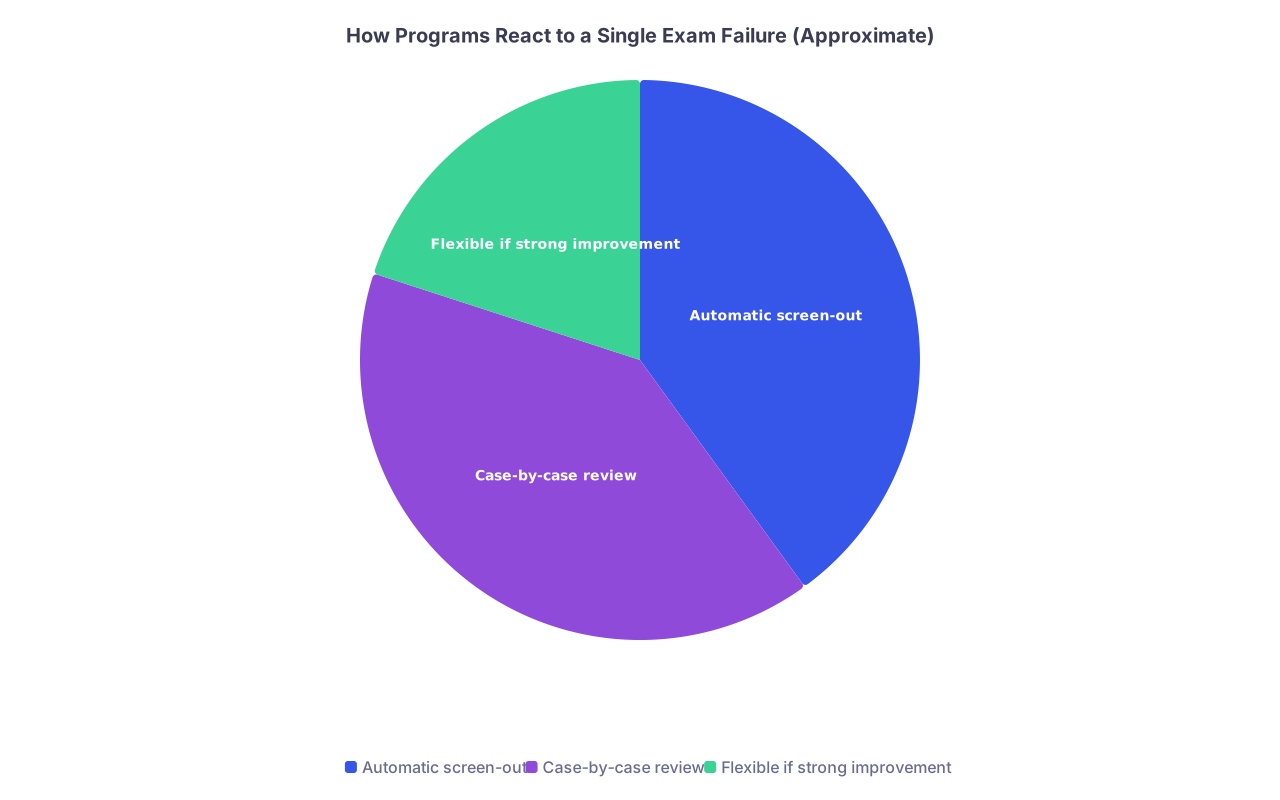
- A smaller number of programs will look directly at your trajectory instead of just the failure: did you improve, did you pass later on a strong attempt, did you keep moving?
| Category | Value |
|---|---|
| Automatic screen-out | 40 |
| Case-by-case review | 40 |
| Flexible if strong improvement | 20 |
These percentages aren’t official, but they match what I’ve seen from applicants and program feedback: a large chunk of programs will auto-screen you, a large chunk will at least glance at context, and a minority actively look for comeback stories.
So yes, your pool shrinks. But “smaller pool” is not “no pool.”
The real question is: what you do next. That’s where some people quietly recover and some people sink themselves.
What Kind of Exam Failure Are We Talking About?
Not all failures are equal in the eyes of programs. Annoying but true.
| Exam / Attempt Type | Typical Impact on Residency Chances |
|---|---|
| Step 1 fail, then pass | Moderate–High impact, but recoverable |
| Step 2 CK fail, then pass | Very high impact, harder to offset |
| OET/IELTS fail, then pass | Mild–moderate impact if explained |
| Multiple USMLE fails | Severe impact, very limited options |
| In-training exam fail | Usually minor if later improvement |
Step 2 CK failure is usually worse than Step 1 failure now that Step 1 is pass/fail. Step 2 CK is seen as your clinical readiness exam. But again, I’ve seen IMGs with a Step 2 CK failure match — usually with:
- Strong improvement on retake
- Applied mainly to community IM/FM programs
- Solid US clinical experience
- Late graduation? Often, yes. Not ideal, but it happens.
So, does it ruin everything? Not by itself. It just stacks the odds against you, and now you need to stack something else on your side.
What Programs Actually Think When They See a Failure
Let me translate what’s happening in a PD’s head when your application pops up:
They’re not just thinking: “This person is dumb.”
They’re thinking:
- “Is this applicant a risk for failing boards in residency?”
- “Was this a one-time mess, or a pattern?”
- “Do they show recovery and growth?”
- “Is there anything else that makes me say: I’ll take a chance?”
They’re terrified of residents failing Step 3 or board exams. Because that hits their accreditation, their statistics, and their stress levels.
So you have to answer those unspoken questions in your application:
- You failed once. Fine. But did you:
- Crush the retake?
- Show consistent performance after that?
- Take ownership and explain without sounding like you’re making excuses?
If they see: Failure → stronger second attempt → upward trajectory → serious effort to grow?
You shift from “just another risky IMG with a fail” to “someone who hit a wall and climbed over it.” There’s a difference.
Will This Follow Me Forever?
This is the nightmare thought, right? “Every PD, every job, every fellowship will always see this F in my file and judge me.”
So, reality:
- For residency: yes, the failure is right there on your USMLE transcript. They will see it.
- For fellowship: they may glance at it, but by then:
- Your residency performance
- In-service exam scores
- Letters of recommendation matter much more.
- For jobs after training: most employers honestly don’t care about that one exam fail the way you think. They care that:
- You’re board-certified
- You finished residency without drama
- You’re not a nightmare to work with
No one at a hospital ten years later is going to be like, “We almost hired Dr. X, but I discovered they failed Step 1 in 2023. Denied.” That’s your catastrophizing talking.
Will it show up in credentialing paperwork sometimes? Yes. Will anyone care as much as you care right now? No.
What Actually Improves Your Chances After a Failed Attempt
You can’t erase the failure. You can only build enough counterweight that programs feel safer ranking you.
Here’s where I’ve seen IMGs claw their way back:
Destroy the retake.
Not “barely pass.” Aim to make the second attempt boringly solid. That means:- UWorld thoroughly done
- NBME practice tests with scores above passing margin repeatedly
- No ego on content gaps — you plug all the embarrassing holes
Get real US clinical experience.
Not five random observerships you bought off some sketchy website. Real:- Hands-on externships (if you can find them)
- Long-term observership in one place where people actually know you
- Strong letters that talk about your reliability, work ethic, and growth
Pick specialties and programs that actually take IMGs with red flags.
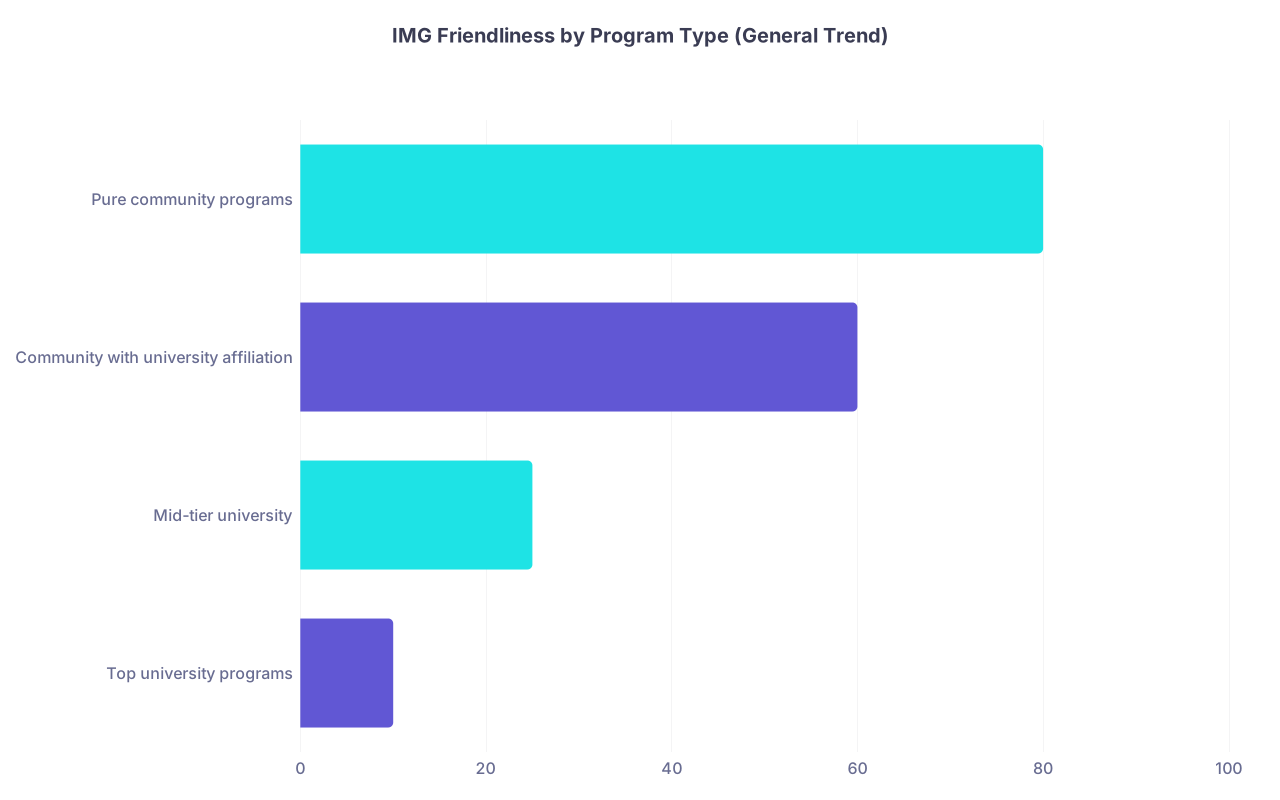
Yes, this is harsh. But applying to all the big-name university IM programs with an exam failure is usually a donation, not a strategy.
| Category | Value |
|---|---|
| Top university programs | 10 |
| Mid-tier university | 25 |
| Community with university affiliation | 60 |
| Pure community programs | 80 |
That last category — pure community programs — is usually where IMGs with a failure still have a realistic shot, especially in IM/FM/Psych.
Explain, but don’t whine.
In your personal statement or an additional info section:- Briefly state what happened (illness, poor prep strategy, personal crisis, misjudged timing — whatever is true)
- Focus more on: what changed, how you adjusted, what you did differently
- Don’t sound bitter, don’t blame the exam, don’t sound like a victim of the system
Show proof of consistency after the failure.
- Good Step 3 (if taken at the right time)
- Strong performance on home country exams
- Any pattern of improvement over time
Worst-Case Scenarios You’re Afraid Of (And What Actually Happens)
Let’s hit the thoughts that are probably bouncing around in your head:
“What if I never match now?”
That is a risk. I’m not going to pretend every IMG with a failed attempt will magically match.
Who’s at highest risk of never matching:
- Multiple USMLE failures
- Older year of graduation (+7–10 years out)
- Weak English communication
- No meaningful USCE
- Unrealistic application strategy (applying to 30 reach programs, nothing else)
But even some people in that group do eventually match by:
- Changing specialty targets (e.g., going from Neuro to FM)
- Doing research years in the US
- Strengthening language + communication skills
- Applying more broadly and more strategically over multiple cycles
You’re allowed to decide how many cycles you’re willing to do before you pivot your life. That’s a personal decision. But one failed attempt by itself does not equal “never matching is guaranteed.”
“What if programs think I’m stupid?”
Some will. Some won’t.
A failure doesn’t only signal “low intelligence.” It could signal:
- Bad test strategy
- Unrealistic timing with life stress
- Not understanding the US exam format the first time
- Panic/anxiety issues
If your later performance shows that your brain works just fine — PDs can put it in context. Not all, but some.
Also: you’re an IMG. You finished med school. In another language, another system, often with fewer resources. You’re not stupid. You might be underprepared. Or anxious. Or unlucky. Those are different things.
“What if this ruins fellowship chances later?”
Fellowship is already hard as an IMG, especially competitive ones like Cards, GI, Heme/Onc.
But by the time you apply for fellowship:
- PDs will care much more about:
- Program director letter
- Your performance as a resident
- Your research in that field
- Your reputation on the wards
A single failed attempt 7–10 years in the past is background noise if the rest of your record is strong.
I’ve seen people with a Step 1 failure end up in Cards fellowships. It wasn’t common. But it happened. Their residency record was stellar.
When Is It Time to Pivot Away from US Residency?
This is the question no one wants to say out loud, but it’s in your mind: At what point do I stop?
Some moments when I’d seriously reconsider:
- Multiple exam failures with no upward trend
- Several unsuccessful match cycles despite:
- Broad, realistic applying
- Decent scores on later attempts
- Solid USCE and letters
- Extreme financial or emotional burnout where continuing would wreck your life
Pivot options I’ve seen people take:
- Training in another country with more flexible rules (UK, some EU countries, Gulf states, home country)
- Non-clinical roles: medical education, pharma, clinical research, public health
- Later on, sometimes back-dooring into the US system after training abroad
Does that feel like “giving up” when you’re deep in the US residency dream? Yes. But it can also be choosing a life that’s not defined by one exam in one system.
What You Should Do in the Next 3–6 Months
Concrete. Not vague motivational quotes.
If you just failed:
- Give yourself 48–72 hours to be miserable. Cry. Sleep. Rage. Whatever.
- Then:
- Schedule your retake date strategically, not reactively.
- Diagnose why you failed:
- Content gaps?
- Time management?
- Anxiety/freeze?
- Underestimating question style?
- Change your plan in a real way:
- New QBank strategy
- Different study schedule
- Support for anxiety if needed (therapy, meds, coaching)
- If you’re near application season:
- Be realistic about whether to apply this year or delay a cycle to fix your profile properly.
If you failed an attempt and already applied this cycle:
- You can’t undo it. So:
- Be honest if asked in interviews.
- Focus on showing maturity, insight, and growth.
- Start planning how to strengthen your file if you don’t match.
FAQ (Exactly 5 Questions)
1. I’m an IMG with one USMLE failure and average scores afterward. Do I still have a real chance to match?
Yes, you still have a real chance, especially in more IMG-friendly fields like Internal Medicine, Family Medicine, and Psychiatry, mainly at community programs. Your odds are worse than an IMG with clean passes and high scores, but you’re not out. The key is: smart program list, strong USCE and letters, a clear upward trend, and a non-delusional application strategy. It’s not guaranteed, but it’s not hopeless.
2. Should I postpone my next attempt because I’m terrified of failing again?
Postpone only if your practice scores are clearly below passing and you can actually use the extra time productively. Don’t postpone just because you’re scared. A second failure is way more damaging than a delay, though, so if your NBMEs are still under the passing bar, waiting and fixing your prep is the better evil. Fear alone is not a reason; poor readiness is.
3. Do I need to explain my failure in my personal statement?
If it’s a USMLE failure, yes, I’d address it briefly. One short paragraph max. State what happened without melodrama, own your role in it, and spend most of the space on what changed and what your later performance shows. Don’t write a full sob story. PDs are busy and allergic to excuses. They want responsibility + improvement.
4. Is Step 3 a good idea to “fix” a previous failure?
Step 3 can help if:
- You have enough time to genuinely prepare
- Your prior attempts are now solid passes
- You can realistically score well above passing
A strong Step 3 won’t erase your failure, but it reassures PDs about board passage risk. But if you rush it and do mediocre or fail again? That makes everything worse. So use Step 3 strategically, not as a panic move.
5. How many application cycles should I try before giving up on US residency?
There’s no magic number, but I’d say: if you’ve applied 2–3 cycles with a realistic strategy, to the right specialties, with improved scores and strong USCE, and you’re still getting nothing — then it’s time to seriously rethink. At that point, you’re not a failure as a person; you’re just hitting the hard limits of a brutal system. Pivoting to another path (another country, another role in medicine) is not “ruining your career.” It’s choosing not to let a single exam system own your entire life.
If you remember nothing else, remember this:
- A failed attempt makes things harder, not impossible.
- Your trajectory after the failure matters more than the failure itself.
- You’re allowed to fight for this, and you’re also allowed to walk away later without that meaning your life is over.