
It’s 7:12 a.m. on a Tuesday in October. A program director has coffee in one hand, ERAS open on the other monitor, and 750 applications in the queue.
She clicks “Next Application.”
You pop up. IMG. Within 10 seconds—before she’s even scrolled—she’s already mentally decided “probable interview,” “maybe if we’re desperate,” or “no chance.”
You think they’re carefully reading your personal statement and letters. They’re not. Not at first. The first pass is pattern recognition. Snap judgments. Years of experience distilled into a 10-second sniff test for red flags—especially for IMGs.
Let me walk you through what they really see. And what silently kills IMG applications before they’re even read.
The 10-Second Scan: What PDs Actually Look At First
Before we get into specific red flags, understand the sequence. I’ve watched PDs, APDs, chief residents do this live in committee rooms. The cursor moves in almost the same pattern every time.
First with IMGs, here’s the unspoken order of triage:
- Medical school name and country
- Graduation year
- USMLE (or OET/PLAB equivalents where relevant) – especially Step 2 CK
- Gaps in training or unexplained timeline issues
- US clinical experience (USCE) vs “observerships” vs nothing
- Visa status
- Anything that looks “off” in professionalism or communication
Only if you survive that initial 10-second sweep does your personal statement, letters, and experiences even start to matter.
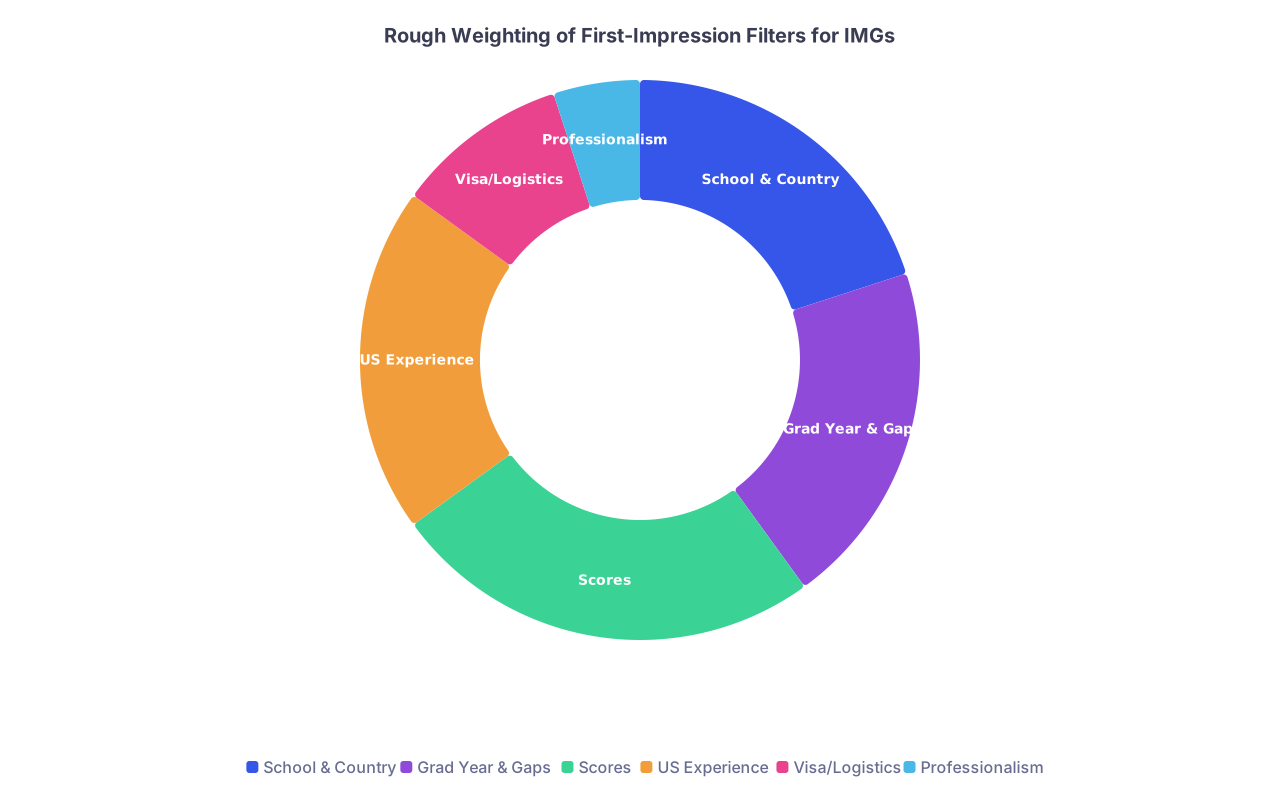
| Category | Value |
|---|---|
| School & Country | 20 |
| Grad Year & Gaps | 20 |
| Scores | 25 |
| US Experience | 20 |
| Visa/Logistics | 10 |
| Professionalism | 5 |
Now, let’s get specific about the red flags they see instantly.
Red Flag #1: The “Old Grad” Without a Story
Here’s the harsh truth: the second they see “Year of Graduation: 2017” and it’s now 2025, a little alarm goes off.
Not automatically fatal. But it’s a big, bright yellow flashing light.
The real red flag is not being an older graduate per se. It’s being an older graduate with:
- No clear, structured clinical trajectory
- Big empty spaces on the timeline
- Vague or obviously fake-sounding “research” or “observerships” filling the gaps
Program directors are asking themselves one thing instantly:
“Why has this person not matched already—and why did nobody else take them?”
They’ve all seen the same pattern: candidate who’s been applying 3–4 cycles, each year stacking on another “research assistant” line, still no match. Those portfolios tend to carry risk—burnout, learned helplessness, difficulty adapting back to clinical pace.
If you’re 5+ years out from graduation and your ERAS looks like:
2017 – Graduated
2018–2019 – Family issues (brief)
2019–2021 – Gap or vague “preparation”
2021–2024 – Research, observerships, tutoring
You look like someone drifting, not someone moving with purpose.
You need a story. A coherent one. Continuous, clinical, and plausible.
I’ve watched PDs skim the education and experiences section and say out loud:
“This is a permanent applicant. Pass.”
If you’re an older grad, your application must scream:
“I have stayed clinically active, relevant, and supervised. And here’s exactly how.”
Red Flag #2: “Observership-Dump” Instead of Real USCE
Let me be blunt: programs know exactly what a 2-week observer spot at some random outpatient clinic means. Someone with a business model. Not rigorous teaching.
When they see:
- Ten observerships, each 2–4 weeks
- Mostly in private offices with generic names like “Internal Medicine Clinic – Dr. X”
- No sub-internships, no hands-on inpatient time, no EMR notes, no order entry, no responsibility
Their interpretation is:
“You’ve watched a lot. You haven’t really done anything in a US healthcare system.”
What they want to see, especially for IMGs:
- 1–2 strong, longer USCE experiences (4–12 weeks)
- In actual hospitals, preferably teaching hospitals
- Clear responsibilities: pre-rounding, writing notes, presenting, developing plans
- At least one letter from someone who’s seen you work day in, day out on real patients

What PDs mutter when they see a list of ten 2-week observerships?
“Tourist.”
“CV stuffing.”
“Somebody sold them these.”
You think volume impresses. It doesn’t. Depth does. Continuity does. Strong letters from meaningful experiences do.
If you’re stuck with mostly observerships, you must:
- Highlight any real case presentation, note-writing, or research stemming from them
- Have letters that sound like the writer actually supervised you, not just saw you in the hallway
- Avoid obviously transactional-looking experiences at “IMG coaching clinics”
Red Flag #3: The “Bad Fit” Program List That Outs You Instantly
PDs can see your applicant type by the pattern of programs you apply to. Yes, they talk. Especially in smaller regions.
They know when someone with:
- Minimal USCE
- Lower Step 2 CK (or borderline passes)
- Needing a visa
- Older grad year
…is mass applying to all the hyper-competitive academic places that historically barely take IMGs.
The red flag is: lack of insight and unrealistic expectations.
I’ve sat in discussions where someone pulled up an applicant and another PD in the same city said, “Yeah, they applied to us too. Completely wrong profile for our program.”
Now, they won’t reject you just for aiming high. But if your application screams “I don’t understand my competitiveness,” it bleeds into how they perceive your judgment.
That’s the unspoken part: they are evaluating not just your scores, but your self-awareness.
Strong IMGs know where they fit. They stack their lists strategically. A few reaches. Many realistic targets. Some safeties. And their ERAS reflects that grounding.
Red Flag #4: Step Performance That Raises Questions, Not Just Numbers
Let me be clear: failure does not automatically end your chances. I’ve seen IMGs with a Step 1 fail and a strong Step 2 CK match internal medicine and even some prelim surgery roles. But you know what kills them?
Patterns.
Program directors look at your score section and think in seconds:
- Any failures?
- Any big jumps or drops?
- Any clear “barely passed” trend?
- Timing of exams vs graduation year (delayed attempts = suspicion of struggle)
Here’s what quietly bothers them:
- Massive gap between Step 1 (strong) and Step 2 CK (weak) → “Did they check out? Burnout?”
- Delay of several years post-graduation before taking Step 1 or Step 2 → “Rusty clinically?”
- Just-barely-passed scores stacked with long gaps → “Will this person survive our boards pass requirements?”
Where you can salvage this as an IMG is not by pretending it doesn’t matter. It matters. Instead:
- You offset weaker scores with strong, recent clinical performance
- Concrete letters stating: “This candidate demonstrates knowledge and clinical reasoning well above what their board scores might suggest”
- Clear, upward trajectory—recent exam or meaningful certification that shows your brain still works at speed
But understand: in those 10 seconds, they are not doing this level of nuance. They’re sorting: “Scores make us nervous” vs “Scores are fine.”
You don’t need perfect. You need “not scary.”
Red Flag #5: Unexplained Gaps and Vague Excuses
Every PD I know has this reflex: they scroll through your timeline like they’re looking at an EKG. They’re scanning for flat-lines.
1-year gap.
2-year “preparation for exams.”
“Personal reasons.”
“Family issues.”
Once? Maybe okay. Twice? Now you look unreliable.
Here’s the ugly truth: they imagine worst-case scenarios. Health crises you’re not mentioning. Legal problems. Motivation problems. Poor resilience.
The red flag is not the gap itself. It’s the vagueness and lack of structured activity during that gap.
A 1-year gap that looks like:
- “Prepared for USMLE Step 2 CK”
- No concurrent work, volunteer, or research
- Nothing else documented
Looks bad.
The better version:
- “Prepared for Step 2 CK while working as [position]”
- Documented consistent role: teaching assistant, telemedicine in your home country, research coordinator, even non-clinical but responsible roles
- An explicit short explanation in the personal statement if the gap was for illness, family, or relocation
PDs are surprisingly understanding when they sense maturity and honesty. They’re quick to blacklist you when they smell avoidance or half-truths.
Red Flag #6: The “Weird” Letter of Recommendation
IMG letters can be brutal. And half the time, the applicant doesn’t even realize.
Here’s what raises eyebrows instantly when they glance at your LoRs:
- Letters from people with completely unknown credentials or institutions
- Letters with vague, formulaic praise: “hard-working, punctual, professional” and nothing else
- Letters from your home country that read like they were written by your uncle
- Letters that do not mention specific clinical scenarios or skills at all
The biggest unspoken red flag: a USCE letter where the writer clearly barely knows you.
PDs are reading between the lines. They’ve all seen the “template letters” clinics hand out to every IMG who pays for an observership. The ones that say, “I had the pleasure of working with Dr. X, who is a very good doctor,” and literally nothing meaningful.
I’ve heard PDs say:
“This is a purchased letter.”
Or, “Another letter from [infamous IMG mill clinic], trash it.”
You want your letters to:
- Come from someone who actually supervised your work
- Contain a few specific, memorable examples of your behavior or clinical reasoning
- Avoid obviously canned phrases repeated across multiple letters
If three letters all say the exact same “hard-working, eager to learn, good communication skills” with zero examples, that’s a silent red flag. It says: nobody actually knows you well enough to describe you.
Red Flag #7: The “Bad English = Bad Communication” Assumption
No one will say this out loud in public forums, but I’ve heard it dozens of times in committee rooms:
“If the personal statement reads like this, how will they present on rounds or write notes?”
Your ERAS has a smell-test for English and communication:
- Personal statement with clunky phrasing, obvious translation tools, or bizarre metaphors
- Activities with poor grammar and inconsistent tense
- Email communication that reads unprofessional or overly casual
IMGs get judged harder on this than AMGs. That’s reality.
Programs are terrified of communication issues. Misunderstandings with patients. Documentation problems. Team friction. A personal statement with obvious language issues becomes a proxy for future headaches.

You cannot afford sloppy language. Have a native-level speaker ruthlessly review:
- Personal statement
- CV experiences
- Any free-text fields
Not just for grammar. For tone. For clarity. For sounding like someone who can pick up the phone and call a consultant without confusion.
Red Flag #8: The “Everything and Nothing” Experience Section
A lot of IMG applications feel the same when you’ve read 500:
- Dozens of small activities
- Nothing with depth
- Lots of “volunteering” that sounds like padding
- Research with vague titles and no clear role
PDs can tell when you’ve thrown every single thing you’ve done since high school onto ERAS. They see desperation.
The unspoken red flag: your experiences show no clear professional identity.
You want to be a future internist, but your ERAS is 70% non-clinical volunteering, random general research, and one tiny internal medicine observership. That mismatch is a problem.
They look for:
- Longitudinal commitment: things you did for 6–12 months, not 6–12 days
- Clear roles and responsibilities, not just “participated in rounds”
- Any evidence you’ve functioned as part of a healthcare team recently
If your experience section looks like a shopping list of short, weak entries, they assume your commitment and follow-through match that.
Better to have fewer, stronger, better-written entries than to flood ERAS with filler.
Red Flag #9: Visa Status + High-Risk Profile
You knew this was coming.
Programs absolutely factor in visa needs. Not just whether you need one, but in combination with everything else:
- Older grad + Visa + Weak USCE + Marginal scores = Hard pass
- Recent grad + Visa + Strong USCE + Excellent scores = Much more acceptable
Visa by itself is not a red flag. Visa-plus-risk is.
They’re asking:
“If I go to bat for this person with GME and they struggle or fail Step 3, will this blow back on me?”
Some PDs hate dealing with visa bureaucracy. Others are fine with it—for the right candidate. But nobody is taking a borderline application and signing up for extra administrative work if they don’t have to.
That’s why as a visa-needing IMG, you can’t just be “ok.” You must be clearly worth it.
Red Flag #10: The Subtle Signs You Don’t Get the System
This one is less concrete, but every PD I know talks about it.
You look like you don’t understand how American residency actually works when:
- Your personal statement is a generic “I want to help people, I love medicine” with zero US system nuance
- You mention “residency” in a way that sounds like you think it’s an extension of school, not a job with real responsibility
- You over-emphasize prestige, name-dropping big-name hospitals or professors that have zero relevance
- You apply to wildly mismatched specialties without a coherent narrative (applying to neurology, surgery, and family medicine all in the same cycle with no explanation)

| Step | Description |
|---|---|
| Step 1 | Open IMG Application |
| Step 2 | Reject |
| Step 3 | Questionable Pile |
| Step 4 | Consider for Interview |
| Step 5 | School and Grad Year OK |
| Step 6 | Scores Acceptable |
| Step 7 | USCE and Letters Strong |
| Step 8 | Visa and Gaps Reasonable |
PDs are looking for subtle evidence that you actually understand what an intern’s life looks like in the US:
- Realistic reflection on workload, system challenges, communication, EMR
- Concrete examples from US experiences
- Not romanticizing medicine in a way that sounds pre-med-ish
If you sound naive, you look like a risk.
How You Counter These Red Flags as an IMG
You can’t change your med school. You can’t un-age your grad year. But you have more control than you think over how your risk profile looks in that 10-second window.
Think like a PD.
They want three things from an IMG before they even care who you are as a person:
- Low likelihood of academic failure
- Low likelihood of professionalism or communication disasters
- Evidence you’ll actually show up, work hard, and finish the program
Everything we’ve talked about—gaps, letters, language, weird USCE—feeds those fears.
So you fight back by:
- Making your timeline airtight and coherent
- Securing at least one or two real USCE experiences with supervisors who can write about you in detail
- Having your written materials polished to native-level clarity
- Owning your setbacks (scores, gaps) with structure, not hiding them
- Showing depth over breadth in experiences
You can’t remove every red flag. But you can stop them from piling up on top of each other. One concern they might work with. Four concerns? You never leave the rejection pile.
Years from now, you won’t remember every line you typed into ERAS. But you’ll remember whether you built an application that told a coherent, credible story—or one that looked like a desperate collection of patches.
| Red Flag Snapshot (10 sec view) | What PDs Secretly Think |
|---|---|
| 6+ years since graduation, vague gaps | Drift, risk of rust, “permanent applicant” |
| Many short observerships, no real USCE | Purchased experiences, no real responsibility |
| Weak or canned letters from USCE | Clinic mill, nobody knows you well |
| Poorly written personal statement | Possible communication liability |
| Visa + older grad + marginal scores | Too much risk for the extra work |
FAQ (Exactly 5 Questions)
1. I’m a 7-year-old grad with some gaps. Am I automatically out?
No, but you’re starting the race behind. You need a crystal-clear timeline, ongoing clinical involvement (even if abroad), and very strong, recent USCE with detailed letters. If your ERAS shows consistent, supervised clinical work and not just “preparation for exams,” you can still be taken seriously. Without that, most PDs will quietly move on.
2. Are observerships completely useless for IMGs?
Not useless, but dramatically overvalued by applicants. Observerships help with exposure and sometimes letters, but PDs know they’re low-responsibility. One or two observerships tied to a meaningful letter is fine. Ten short observerships at random clinics looks like CV stuffing and raises suspicion.
3. Should I explain my exam failure or gap in my personal statement?
If it’s significant (Step failure, multi-year gap), yes—but briefly and with structure. One short, honest paragraph: what happened, what you learned, and how your subsequent performance proves it’s no longer an issue. Do not write a trauma memoir. PDs want reassurance and maturity, not a defense argument.
4. How many US letters of recommendation should an IMG have?
Ideally at least 2 strong US letters, 3 is better if you can get quality, not quantity. One home-country letter from someone who truly supervised your work can be valuable, especially if you’ve been clinically active there. But three weak US letters from people who barely know you are worse than two strong ones and one solid home letter.
5. My English isn’t perfect. Will that alone kill my chances?
Imperfect? No. Disorganized, unclear, or obviously translated? That can. Programs are less concerned about your accent and more concerned about whether you can chart safely, call consults, and communicate acute information clearly. Get your written materials edited by a native-level speaker. If your ERAS reads clean and your interviews go fine, slight language imperfections won’t sink you.