
The worst thing you can do with a graduation gap is try to hide it. Program directors do not hate gaps. They hate fog, evasiveness, and contradictions.
You are an IMG with one of the biggest red flags in the file: non‑clinical years after graduation. Let me walk you through exactly how to document, explain, and defend that gap so it does not sink your application.
1. Understand How Programs Actually View Graduation Gaps
Before you write a single line in ERAS, you need to understand the reality on the other side of the screen.
What “graduation gap” really means in residency language
When a program director sees “Year of graduation: 2017” and “Current application: 2026 entry,” their brain auto‑fills a few questions:
- How many years out of medical school?
- How many of those years were non‑clinical?
- Has this person’s knowledge decayed?
- Is there some professionalism, visa, or behavior issue buried in that gap?
- Is this an applicant who will struggle to adapt on day one?
They are not philosophically opposed to older graduates. They are practically wary of risk. Risk of incompetence on day one. Risk of onboarding someone who still thinks like a final‑year student from 8 years ago.
What actually raises red flags
There are three things that reliably cause trouble:
Unexplained time.
A 2‑year hole with “personal reasons” and nothing else? Immediate suspicion.Vague, overpolished language.
“Pursued personal growth and self‑reflection while contemplating career trajectory.” Translation in PD’s head: unemployed, unclear, not committed.Stories that do not match the paperwork.
ERAS says “full‑time research,” but your letter writer barely remembers you. Or you say you worked 40 hours a week at a US clinic but you never logged procedures, no letter, no certificate. That disconnect is poison.
By contrast, what calms PDs down is simple:
– Clear, chronological activity list
– Concrete responsibilities (even if non‑clinical)
– Honest but controlled explanation of setbacks
– Evidence you are clinically “current enough” to be trainable
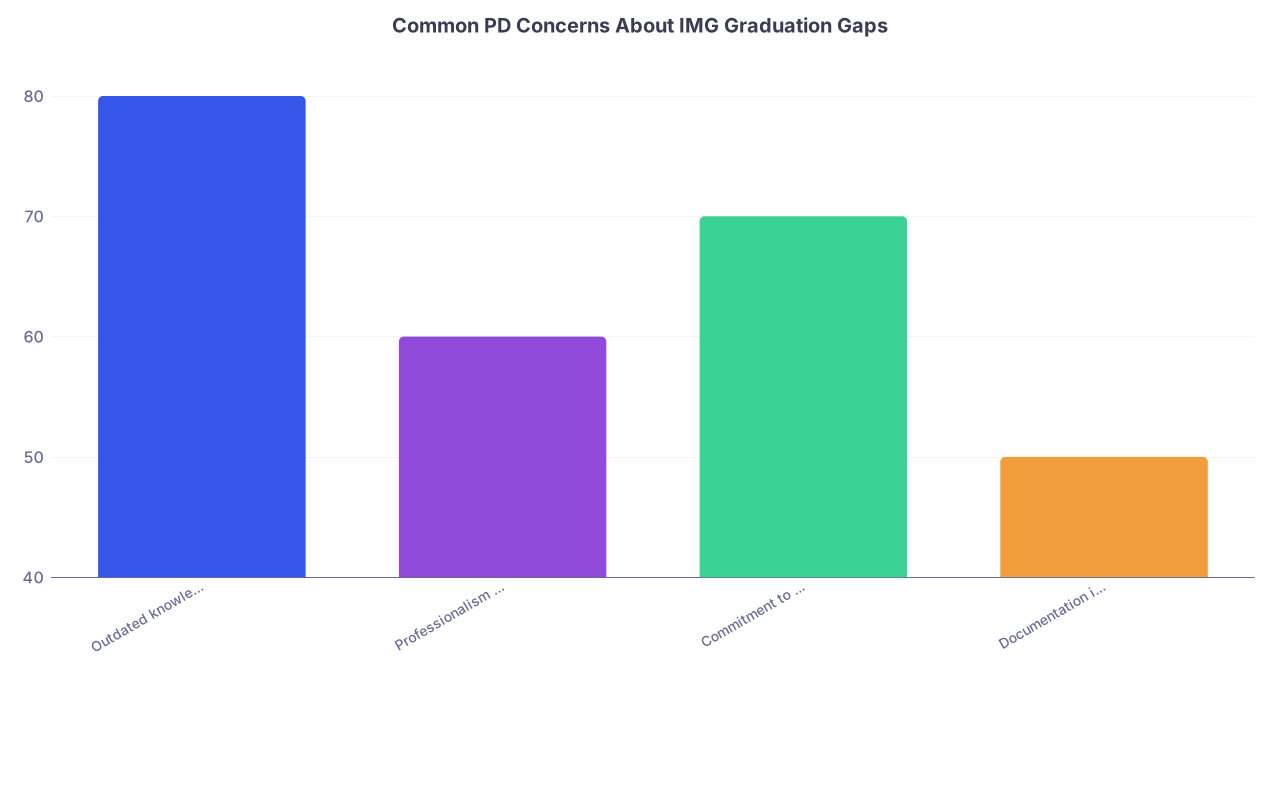
| Category | Value |
|---|---|
| Outdated knowledge | 80 |
| Professionalism risk | 60 |
| Commitment to medicine | 70 |
| Documentation inconsistency | 50 |
2. Map Your Timeline: The Non‑Negotiable First Step
If you cannot explain your own last 5–10 years clearly on a sheet of paper, you are not ready to touch ERAS.
Take a blank page and write:
- Month/Year of graduation
- Every block of time of 3 months or more since graduation
- What you were doing, where, and roughly how many hours/week
Be brutally literal. No euphemisms yet. Something like:
- 07/2017 – 03/2018: Studied for USMLE Step 1 full time
- 04/2018 – 10/2018: Family responsibilities (father’s stroke; primary caregiver)
- 11/2018 – 08/2019: General practice clinic, Lahore, Pakistan, ~30 hrs/week
- 09/2019 – 06/2020: USMLE Step 2 CK prep + part‑time clinic (Lahore)
- 07/2020 – 12/2020: Research assistant, cardiology, ABC University, Remote
- 01/2021 – 09/2021: Economic gap; local tutoring + Step 3 prep
- 10/2021 – 03/2022: US clinical observerships (3 sites)
- 04/2022 – 06/2024: Full‑time clinical practice, internal medicine, Karachi
Now, highlight the periods that are:
- Non‑clinical but medicine‑related (research, teaching, exam prep)
- Non‑clinical and non‑medical (family, finance, immigration, other work)
- Unemployed / unclear
That highlighted map is what you must convert into a narrative that is honest and defensible.
3. The Four Major Types of Graduation Gaps—and How To Frame Them
Not all non‑clinical years are equal. Programs react very differently depending on the why and the what you did with them.
I will break this down by category and give you phrasing you can actually use.
A. Exam preparation years
This is the classic IMG situation: “I spent 1–2 years preparing for USMLE / PLAB / local licensing.”
On its own, 12–18 months of exam prep is not a problem. The problem is when:
- It extends to 3–5 years with no exams taken
- There are multiple failed attempts and no clear turning point
- You try to disguise it as something else
How to present exam preparation:
Be concrete about the goal and outcome.
“Prepared for USMLE Step 1 and Step 2 CK; achieved Step 2 CK 244” is much stronger than “Prepared for USMLE exams.”Anchor the time with structure.
Mention structured courses, fixed schedules, study groups, dedicated hours.
Sample ERAS description (Experience entry):
Title: Full‑time USMLE Examination Preparation
Organization: Self‑directed, structured study
Dates: 07/2018 – 12/2019
Average hours/week: 40
Description:
Engaged in full‑time preparation for USMLE Step 1 and Step 2 CK. Followed a structured schedule including UWorld question banks, NBME self‑assessments, and standardized review texts. Completed all major question banks twice and improved practice scores from low 200s to mid‑240s. Sat for Step 1 in 06/2019 and Step 2 CK in 11/2019.
In an interview, you tighten it further:
“After graduation I focused full time on USMLE preparation for about 18 months. I treated it like a full‑time job—40–50 hours a week—and improved my performance from low 200s on practice tests to mid‑240s on the actual exams.”
Notice what I am not doing: I am not apologizing for “only studying.” I am treating it as intensive professional preparation.
B. Family or personal health responsibilities
This is where many IMGs either overshare or hide everything. Both are bad.
You do not need to tell a stranger your relative’s full medical history. You do need to clearly indicate that:
- There was a specific, time‑limited responsibility
- You were the primary or major caregiver / support
- The situation has now stabilized or resolved sufficiently
Sample ERAS description:
Title: Primary caregiver – family medical emergency
Organization: Family responsibility
Dates: 03/2019 – 11/2019
Average hours/week: 30–40
Description:
Served as primary caregiver for an immediate family member with acute neurologic illness requiring prolonged hospitalization, rehabilitation, and outpatient care. Coordinated medical appointments, medications, and daily care. During this period I was unable to maintain clinical employment but remained engaged in self‑study of internal medicine topics. Once the family member’s condition stabilized, I resumed formal clinical work.
Interview‑level explanation:
“In 2019, my father had a severe stroke. I was the primary family member available to manage his care for about eight months. That meant I stepped away from formal clinical work. Once his condition stabilized and additional support was in place, I returned to practice and exam preparation. The situation is now stable and would not interfere with residency.”
You do not oversell it. You do not dramatize. You show that it was real, significant, and now under control.
C. Immigration / visa / relocation delays
For many IMGs, 1–3 years evaporate because of:
- Licensing bureaucracy
- Visa issues
- Repeating exams in a new jurisdiction
- Language requirements
Programs see this all the time. What they want to know is:
- Were you passive or active?
- Did you maintain any connection to medicine?
- Does this predict ongoing visa headaches for them?
Sample description:
Title: Licensing and immigration process – Canada to USA
Organization: Self‑managed process
Dates: 01/2020 – 09/2021
Average hours/week: 20–30
Description:
Completed credential verification, licensing exams, and immigration steps required to transition from Canadian practice to US residency eligibility. Activities included ECFMG certification, USMLE Step 3, English proficiency testing, and immigration documentation. During this time I maintained part‑time volunteer teaching of medical students in clinical skills workshops.
Note the key elements: specific tasks, some ongoing medical engagement, and the sense of forward motion.
D. Non‑medical work or “off‑track” years
This is the one applicants fear most. They left medicine. Worked in IT, business, retail, translation, whatever. Then they came back.
Let me be blunt: trying to pretend this did not happen is far worse than explaining it maturely.
You are defending two issues here:
- Commitment to medicine.
- Transferable skills and current readiness.
The formula that works:
- One honest sentence about why you stepped away.
- One or two sentences describing what you did (factually).
- A clear turning point and what drew you back.
- Evidence that you did the work to become clinically current again.
Sample ERAS entry for non‑medical work:
Title: Data analyst – health insurance claims
Organization: XYZ Analytics Ltd
Dates: 02/2018 – 05/2020
Average hours/week: 40
Description:
Worked as a data analyst in a health insurance analytics firm processing large datasets of inpatient and outpatient claims. Developed skills in SQL, Excel, and basic statistical analysis. Collaborated with clinical teams to identify patterns in readmissions and medication adherence. During this period I explored career options outside direct clinical care but ultimately decided to return to hands‑on medicine and prepared for USMLE and observerships.
Then you must show a re‑entry period with clinical or exam activity immediately following:
Title: Clinical reintegration – internal medicine observerships
Organization: ABC Internal Medicine Clinic; DEF Community Hospital
Dates: 06/2020 – 03/2021
Average hours/week: 30–40
Description:
Completed sequential internal medicine observerships in outpatient and inpatient settings, focusing on US clinical communication, documentation, and current guidelines. Observed and participated in discussions of over 400 patient encounters. Reviewed contemporary guidelines in hypertension, diabetes, and heart failure management. Obtained letters of recommendation commenting on current clinical knowledge and work ethic.
The message: “Yes, I stepped away. No, I am not stale. I did the work to come back.”
4. How To Document Gaps Correctly in ERAS (Without Shooting Yourself in the Foot)
This is where I see IMGs sabotage themselves constantly: the ERAS Activity section.
Principle #1: Do not leave chronological gaps longer than 3 months
If there are 6–12 months with literally nothing, you need an entry that states what was happening—even if that was “family responsibilities + self‑study” or “economic hardship + exam preparation.”
PDs are not offended by “unemployment” if there is a coherent reason and clear end. They are offended by hiding it.
Principle #2: Choose the correct ERAS activity type
For non‑clinical years you will commonly use:
- Education / Training
- Work
- Volunteer
- Other
For exam prep or caregiving, “Other” is usually cleaner. For non‑medical employment, use “Work” and do not pretend it was clinical.
Principle #3: Use honest but controlled language
Avoid:
- “Burnout,” “depression,” “lost interest in medicine,” “confused about my future.”
You can hint at struggle without handing them a red flag labeled “future problem.”
Better:
- “Reassessed long‑term career goals.”
- “Faced personal and financial constraints, which I have now resolved.”
- “Needed to support my family financially; after achieving stability, I returned to clinical work.”
Principle #4: Be consistent across everything
Your:
- ERAS Activities
- Personal Statement
- MSPE / Dean’s letter
- Letters of recommendation
- Interview answers
Must all tell the same basic story, with the same dates and transitions.
If your CV says you were doing full‑time research in 2021, but your letter writer describes working with you only in late 2022, PDs notice.
| Scenario | Bad Documentation | Good Documentation |
|---|---|---|
| 1‑year exam prep | Leaves gap blank | Activity titled 'Full‑time USMLE Preparation' with dates and structure |
| Family illness | 'Personal reasons' only | 'Primary caregiver – family medical emergency' with resolved status |
| Non‑medical job | Labeled as 'clinical research' | Correctly labeled as 'Data analyst – health insurance claims' |
| Immigration delay | Not mentioned | 'Licensing and immigration process' with some part‑time medical engagement |
5. Writing About the Gap in Your Personal Statement: One Paragraph, Not Your Life Story
Your personal statement is not your therapy session. It is not a confessional. Its job is to answer one disguised question:
“Why should we invest 3 years of training resources in you, now?”
If you have a notable graduation gap (more than 3–4 years, or any period clearly off‑track), you address it. Briefly. Then move on.
The 4‑sentence template that works
You can adapt this structure:
Context sentence.
“After graduating in 2016, my path to residency was not immediate.”Simple explanation.
“I spent two years focused on USMLE preparation while working part‑time in a general practice clinic, followed by a year addressing a family medical crisis that required my full attention.”Turning point + resolution.
“Once my family member’s condition stabilized, I committed fully to pursuing internal medicine in the United States, completed my exams, and sought out US clinical experiences to update my skills.”Current readiness.
“These years matured me, strengthened my resilience, and confirmed that direct patient care is the work in which I am most effective and fulfilled.”
That is it. No dramatic backstory. No five‑paragraph saga about suffering. One clear paragraph that frames your gap as part of a larger arc toward readiness.
6. How To Defend Your Non‑Clinical Years in Interviews—Question by Question
Let me give you actual Q&A patterns. Because you will get these questions, especially in community and mid‑tier academic programs that actually read applications carefully.

| Step | Description |
|---|---|
| Step 1 | Graduated 2016 |
| Step 2 | Ask about activities since graduation |
| Step 3 | Move to next topic |
| Step 4 | Ask why stepped away |
| Step 5 | Ask about clinical experiences |
| Step 6 | Ask how stayed current |
| Step 7 | Assess readiness for residency |
| Step 8 | Gap > 3 years |
| Step 9 | Non clinical years? |
Q1: “I see you graduated in 2015. Can you walk me through what you have been doing since then?”
You must have a practiced, 60–90 second answer. Chronological, calm, no defensiveness.
Bad answer:
“Yeah, so after graduation there were many issues and some family problems and I was kind of confused, and then I started some research but it was not really going anywhere…”
Good answer (structured):
“Certainly. I graduated in 2015. From 2015 to mid‑2017, I worked in a busy internal medicine clinic in Mumbai while preparing for USMLE Step 1 and Step 2 CK. In late 2017, my mother developed advanced cancer, and I took about ten months away from formal work to coordinate her care. After her death, I reassessed my goals, completed my remaining exams by late 2019, and began focused US observerships in 2020 and 2021. Over the last two years, I have worked in a hospital‑based internal medicine role in India while continuing to pursue US residency.”
Short, factual, no emotional oversharing, but clearly human.
Q2: “Why did it take you several years to apply for residency?”
You are answering: “Are you indecisive? Is this a backup plan?”
Frame it around circumstances + growth + clarity.
“The delay was a combination of external constraints and my own need for clarity. Early on I was limited by family and financial responsibilities, so I worked locally and studied for licensing exams as I could. During that time I also explored non‑clinical roles, which made it clear that I am most engaged at the bedside, not behind a desk. Once I resolved those constraints, I moved in a straight line toward residency—completing exams, updating my clinical experience, and seeking strong letters.”
Q3: “How have you kept your clinical knowledge up to date during your non‑clinical years?”
This is crucial. You cannot just say “I read.” You need specifics.
Better answer:
“During the period when I was primarily working in data analysis, I maintained a structured plan. I completed all of UWorld for Step 2 CK and redid high‑yield internal medicine sections before my observerships. I regularly reviewed the latest ACC/AHA guidelines for hypertension and heart failure and followed NEJM and JAMA summaries. When I returned to hands‑on clinical environments, attendings commented that my guideline knowledge was current, even if my initial US documentation style needed adjustment.”
You are showing methods, sources, and real‑world validation.
Q4: “What makes you confident you can transition back to full‑time clinical training now?”
They are asking: “Are you going to fall apart in October of PGY‑1?”
Answer with:
- Recent sustained clinical work or observerships
- Concrete examples of performance
- Self‑awareness about stamina and adaptation
“Over the past 18 months I have been working full‑time in an internal medicine ward setting with 60–70 hour weeks, including night shifts. That experience reminded me of the physical and cognitive demands of training, and I have handled that workload well. Supervisors have trusted me with increasing responsibility, and I have no ongoing personal or family obligations that would limit my ability to give residency my full focus.”
7. Strengthening Your File Around the Gap: What You Must Add
You cannot change the past. You can change what surrounds it.
If you have significant non‑clinical years, you need compensating strengths that tell PDs, “Yes, there was a gap, but this person will perform.”
Here is where to focus:
A. Recent clinical experience, as close to application as possible
If your last hands‑on experience is 5 years old, that is a serious problem. You want:
- At least 3 months of recent (within 1–2 years) clinical exposure
- Preferably in the specialty you are applying to
- Ideally with direct patient interaction and EMR exposure
Observerships are fine if that is all you can get. Externships, even better. A solid home country hospital role with strong letters can also carry weight.
B. Letters that explicitly address your “currentness”
You want at least one letter that says, in plain language, something like:
“Although Dr. X graduated several years ago, their clinical knowledge and reasoning are up to date. They quickly adapted to our system, manage patients using current guidelines, and function at the level of a US graduating medical student or above.”
Do not be shy about asking your letter writer to comment directly on:
- Up‑to‑date knowledge
- Ability to learn new systems quickly
- Work ethic after returning from a non‑clinical period
C. Concrete academic signals
If your Step scores, OET/IELTS, or other exams are strong and recent, that helps.
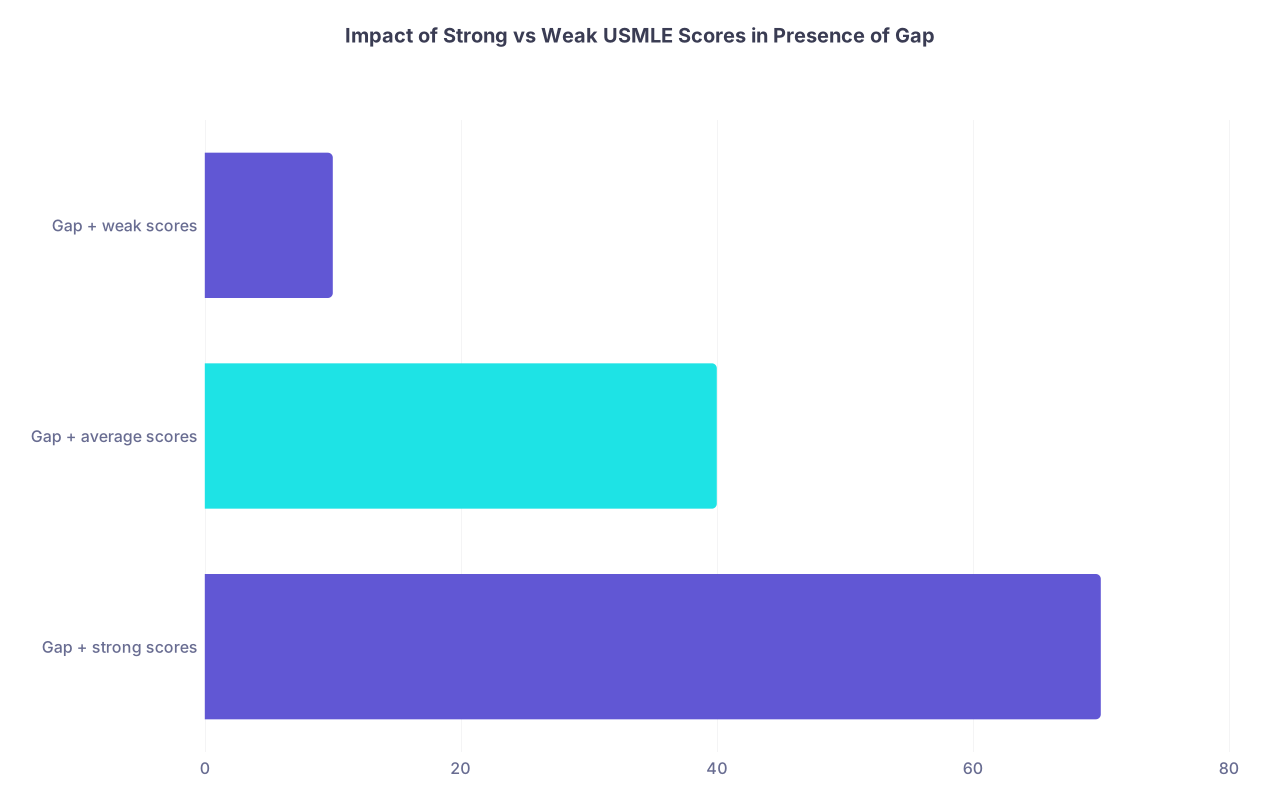
| Category | Value |
|---|---|
| Gap + strong scores | 70 |
| Gap + average scores | 40 |
| Gap + weak scores | 10 |
That is not real percentage data, but it reflects reality: a 4‑year gap with a 250+ and strong letters gets read. A 4‑year gap with 210 and vague letters often does not.
8. Common Mistakes IMGs Make With Gaps—and How To Avoid Them
Let me hit a few patterns I see every year.
Mistake 1: Over‑explaining tragedy
You do not need graphic details of a relative’s illness, your depression symptoms, or financial hardship. It makes PDs uncomfortable and raises concerns about your future resilience.
Solution: Name the category (family medical crisis, economic hardship, immigration process), state the time frame, and move on.
Mistake 2: Trying to spin obviously non‑clinical time as “research”
PDs know what proper research involvement looks like. They expect:
- Named supervisor
- Specific project
- Output (poster, paper, abstract)
- Timeline matching PubMed dates
If you cannot produce these, do not call it “research.” Call it what it was.
Mistake 3: Long, rambling personal statements centered on suffering
Programs are not looking for tragedy narratives. They are looking for reliable future coworkers. Your gap is a data point, not your brand.
Mistake 4: Inconsistency between applications
You tell one story on ERAS, another to one interviewer, a third in an email. This kills trust.
Write down your “official” short explanation and stick to it. Same dates, same sequence.
9. Putting It All Together: A Worked Example
Let me synthesize this with a realistic composite case.
- Graduated: 2014, India
- 2014–2016: General practice, part‑time, plus Step prep
- 2016–2018: Full‑time non‑medical work (IT support)
- 2018–2019: Family caregiving
- 2019–2021: USMLE exams + observerships
- 2021–2024: Hospitalist‑style work in home country
How do we frame this?
ERAS Activities (simplified):
- 07/2014 – 06/2016 – General practitioner, City Clinic (Work)
- 07/2016 – 12/2018 – IT support specialist, TechCo (Work)
- 01/2019 – 10/2019 – Primary caregiver – family medical emergency (Other)
- 11/2019 – 08/2021 – USMLE exam preparation and observerships (Education/Training + Other)
- 09/2021 – Present – Internal medicine physician, District Hospital (Work)
Personal Statement paragraph:
“My path from graduation in 2014 to this application has not been linear. Early on, I divided my time between general practice and IT work to support my family financially. In 2019, my father’s prolonged critical illness required me to step away from formal employment for much of the year as his primary caregiver. Once his condition stabilized, I committed fully to internal medicine, completed my USMLE exams, and undertook observerships in US hospitals to update my skills and understand the system. Over the past three years, I have worked as an internal medicine physician in a high‑volume district hospital, which has reaffirmed my motivation and prepared me for the demands of residency.”
Interview answer (summary version):
“There were three main phases to my gap. First, I balanced early clinical work with IT employment for financial reasons, which delayed my exams. Second, I stepped away from work for most of 2019 to care for my father during his critical illness. Third, once that resolved, I focused on exams, US clinical exposure, and then full‑time internal medicine practice. Those experiences clarified that my long‑term place is on the wards, and my recent years of continuous clinical work reflect that.”
That is how you own a messy history without being eaten by it.
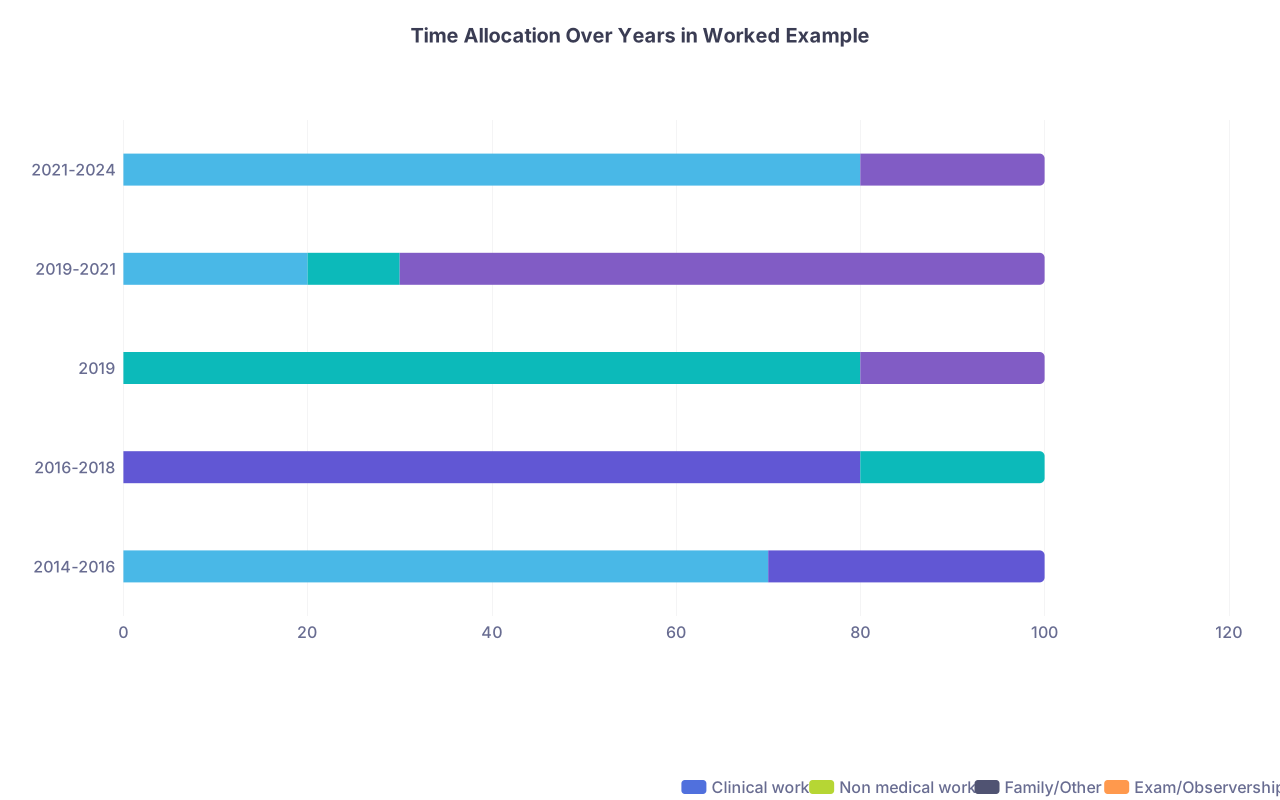
| Category | Clinical work | Non medical work | Family/Other | Exam/Observership |
|---|---|---|---|---|
| 2014-2016 | 70 | 30 | 0 | 0 |
| 2016-2018 | 0 | 80 | 20 | 0 |
| 2019 | 0 | 0 | 80 | 20 |
| 2019-2021 | 20 | 0 | 10 | 70 |
| 2021-2024 | 80 | 0 | 0 | 20 |


Key Takeaways
- Do not hide your graduation gap. Document every 3+ month block clearly in ERAS with honest, specific descriptions.
- Control the narrative: one concise paragraph in your personal statement and a rehearsed 60–90 second explanation for interviews that emphasizes resolution and current readiness.
- Surround the gap with evidence: recent clinical experience, strong letters explicitly addressing your up‑to‑date skills, and solid exam performance.