
Most IMGs do not have a weak profile. They have a scattered story.
That is what kills otherwise solid applications.
You are judged in the Match not by isolated documents, but by the portfolio those documents create together: CV, personal statement, letters of recommendation, ERAS entries, MSPE, even your photo. Programs subconsciously ask one question:
“Does this entire packet clearly describe one believable, trainable resident who fits what we need?”
If the answer is anything short of “yes, obviously,” you slide down the rank list. Or never get the interview.
Let me break this down specifically: your real task is portfolio design, not document writing. You are architecting one coherent narrative across all pieces. For IMGs, this is harder and more critical, because your path is non‑standard, often fragmented, and frequently misunderstood.
We are going to fix that.
1. The Core Problem: Fragmented vs Coherent IMG Narratives
Most IMG portfolios suffer from the same predictable fractures:
- CV looks like: “I did a bit of everything, everywhere.”
- Personal statement sounds like: “Medicine is my passion, since childhood, etc.”
- LORs: generic, vague, and not clearly connected to what you say about yourself.
- ERAS experiences: random bullet points, variable quality, repeated phrases.
Programs see this daily. You are not competing with “better” people only. You are competing with clearer stories.
What a coherent portfolio actually does
A strong portfolio for an IMG does three things relentlessly:
Defines a central identity
Example: “Clinically strong, dependable future internist with excellent communication skills and proven ability to adapt to US systems.”
Not glamorous. But very trainable.Aligns every document around 3–4 recurring themes
For instance:- Clinical maturity and reliability
- Adaptability and growth in US settings
- Teamwork and communication
- Curiosity / commitment to continued learning or QI
Anticipates and answers doubts about IMGs
The unspoken program questions:- Can this person function on Day 1 on the wards?
- Will they struggle with communication / EMR / US culture?
- Are their letters and experiences current enough and from credible US sources?
- If there are gaps / attempts / visa needs, can I explain them to my PD and CCC without embarrassment?
Your portfolio must systematically address these.
2. Step Zero: Pick Your “Resident Identity” Before You Write Anything
You do not start with your CV. You start with a one‑sentence professional identity.
Something like:
“I am an IMG with strong internal medicine foundation, 6+ months of recent US clinical experience, and a track record of calm, organized patient care in high‑volume settings.”
Or for psychiatry:
“IMG with a background in community mental health, strong longitudinal patient relationships, and demonstrated empathy and communication skills in diverse populations.”
You are not married to one sentence forever, but you need a working label. This drives what you emphasize in CV, PS, and LORs.
Then, choose 3–4 core themes you want to be visible in every document.
| Specialty | Core Themes to Emphasize |
|---|---|
| Internal Med | Reliability, clinical reasoning, teamwork |
| Family Med | Continuity, community engagement, versatility |
| Psychiatry | Empathy, communication, longitudinal care |
| Pediatrics | Family communication, patience, teaching |
| Neurology | Attention to detail, curiosity, persistence |
Once you pick your themes, they become your “portfolio spine.” Everything attaches to them.
3. Designing the CV as the Structural Backbone
The CV is not just a list of things you did. For IMGs, it is your timeline, translation guide, and credibility scaffold all at once.
A. Chronology: showing a clean, defendable timeline
Programs are obsessive about:
- Graduation year
- Gaps
- Attempts / retakes
- Recency of clinical experience
Your CV must make it easy to see:
- Graduation → what you did immediately after → how you ended up in US → what you are doing now.
If there is a one‑year “gap” where you studied for USMLE, fine. Say that, but structure it:
- “07/2020 – 06/2021 – Independent Study – Full‑time preparation for USMLE Steps with clinical observerships at [X] (2 months)”
Do not pretend the gap does not exist. That just makes programs suspicious.
B. Prioritization: what goes “above the fold”
On a PD’s 30‑second scan, they will look at:
- Medical school, year of graduation
- US clinical experience (type, location, dates)
- Exams (Step 1, Step 2 CK)
- Recent activities
So your CV (and ERAS entries) should front‑load:
- US clinical experience
Always higher than:- Research in your home country (unless you are applying to physician‑scientist pathways)
- Old experiences from >5–6 years ago
- Recent clinical work (even if in your home country)
- Meaningful, long‑term involvements rather than a list of one‑week observerships
C. Aligning CV content with your themes
Take one theme: Reliability under pressure.
How does that show up in the CV?
Not by writing “I am reliable.” By selecting experiences and structuring bullets to reflect it:
- “Primary physician providing overnight coverage for 20–30 inpatients in a district hospital with limited resources.”
- “Sole intern responsible for triaging emergency admissions during COVID surge, under direct supervision of attending.”
Notice what is happening: your CV is already doing some of the storytelling work. When your personal statement later mentions how you learned to handle high‑volume, uncertain environments, it feels grounded.
4. The Personal Statement: The Narrative Glue, Not a Standalone Essay
Most IMGs misuse the personal statement. They treat it as a standalone creative writing exercise, totally disconnected from LORs and CV.
Wrong approach.
The PS is the narrative glue that:
- Interprets your CV (“Here is how these scattered experiences form one trajectory.”)
- Prepares the reader for what your letters will say (“Here is who I am on the wards; you will see others confirm this.”)
- Normalizes and explains any potential red flags once (not three different explanations in three different places).
A. Structure that actually works for IMGs
Think in four parts:
Opening snapshot – concrete clinical moment that shows one of your core themes.
Not a birth story. Not “the day I knew I wanted medicine.”Example for IM / IMG:
“At 2 a.m. in a busy Bronx ward, the senior turned to me and said, ‘You run the next admission. I will watch only if you need me.’ As an international graduate only three weeks into my first US rotation, that statement was both terrifying and defining.”
Professional journey, not autobiography
Walk them through:- Training in home country
- Key clinical or service experiences
- Transition to US system and what you learned there
You highlight the same themes that your CV is already hinting at.
Clarify transitions / gaps / changes
Single clear paragraph:- Why you graduated in 2018 but are applying now
- Why you switched from surgery to internal medicine
- Why Step 1 took multiple attempts yet Step 2 improved
You own it. Briefly. Neutrally.
Forward‑facing conclusion
Not “I know I will be an excellent resident.”
Instead:- What kind of resident you aim to be
- What environments you thrive in
- The skills you bring now that are useful on Day 1
B. Explicit linkage to CV and LORs
Make your PS “set up” what letters will confirm.
If your strongest LOR is from a US IM rotation emphasizing your meticulous follow up and team communication, your PS should:
- Include one paragraph about that rotation.
- Describe a moment or pattern (“I routinely followed up on culture results, called families, and pre‑rounded before sign‑out”) that matches what the attending will mention.
You are not copying phrases, you are aligning themes and facts.
5. Letters of Recommendation: Targeted, Not Random
Letters are where many IMGs quietly lose ground. The usual pattern:
- Two or three generic letters from home country
- One short US letter from a brief observership
- Sometimes a research letter that barely discusses clinical ability
From a PD perspective, that tells them: “I have no idea how this person will function on an American ward.”
Your goal is different: build a deliberate LOR set that together answers:
“Can we trust this applicant as an intern?”
A. What an ideal IMG LOR set looks like
For a standard IM applicant, a competitive pattern might be:
- 2 strong US clinical letters in your specialty
- 1 US letter (research or another specialty) speaking to work ethic / reliability
- 1 home‑country letter if it adds unique value (leadership, long‑term mentorship)
If you only have 1 US clinical letter, then that single letter becomes crucial. You must design your portfolio so that PS and CV repeatedly point to that experience, and that the letter ideally addresses:
- Clinical reasoning
- Reliability
- Communication with patients and team
- Adaptation to US system (EMR, handoffs, multidisciplinary care)
B. Coordinating talking points with letter writers
You cannot script their letter. But you can guide focus.
When asking for the LOR, you send:
- Your CV
- Your personal statement draft
- A one‑page “Summary of my work with you” including:
- Dates and nature of your interaction
- 3–4 key themes you hope they might address (aligned with your portfolio themes)
For example:
“During my 4‑week inpatient IM rotation with you at Lincoln Medical Center, I worked as a sub‑intern with direct patient care responsibilities. If you feel it is appropriate, I would be grateful if you could comment on:
- My reliability with follow‑up tasks
- My communication with patients and nurses
- My ability to adapt to the US clinical workflow and EMR.”
You are not begging for flattery; you are orienting them to the dimensions that residency programs care about.
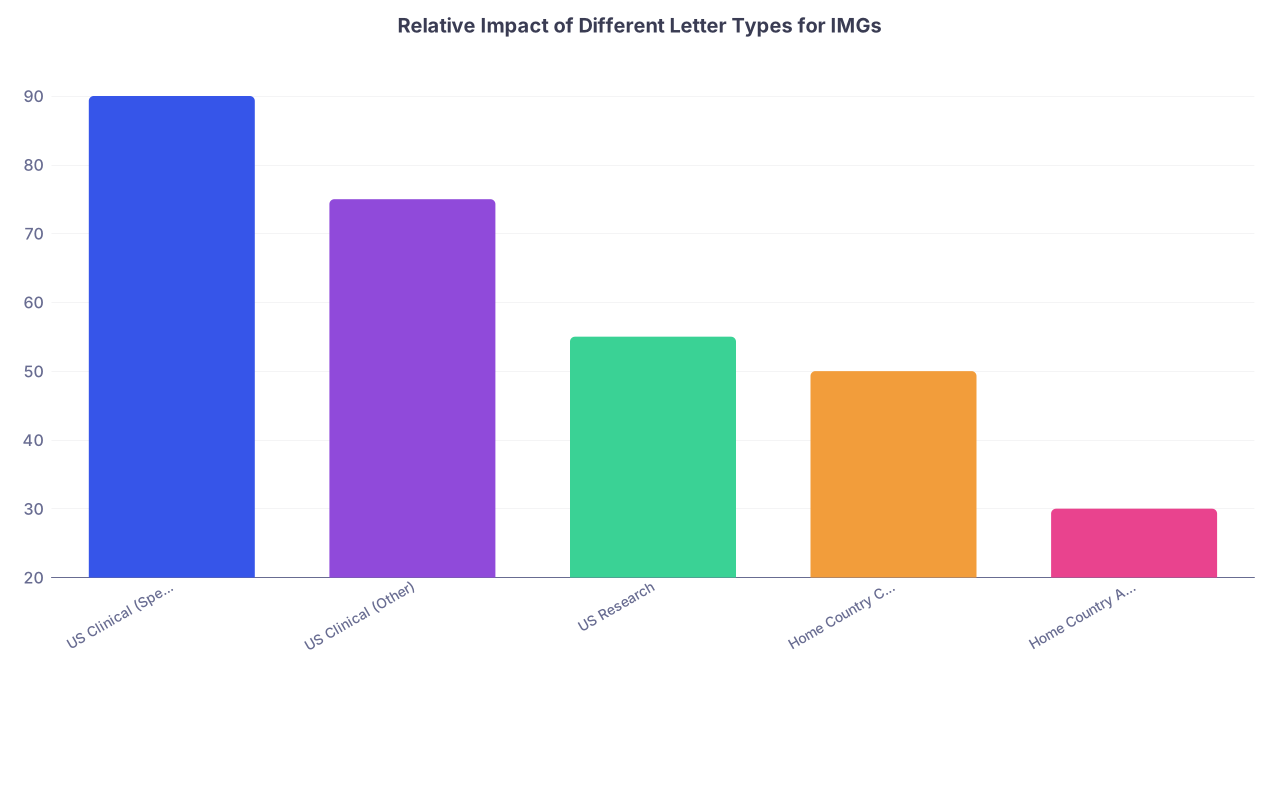
| Category | Value |
|---|---|
| US Clinical (Specialty) | 90 |
| US Clinical (Other) | 75 |
| US Research | 55 |
| Home Country Clinical | 50 |
| Home Country Academic | 30 |
Obviously the numbers are conceptual, but you get the hierarchy.
C. Avoiding destructive letters
I have seen more than one IMG destroyed by a “polite” but weak letter.
Red flags in letters:
- Excessive focus on how “nice” or “polite” you are, with no clinical substance
- Vague “hard working” with no specific example
- Overemphasis on “language barrier improvement” or “adapting from another system” in a way that sounds like you still struggle
If you suspect a potential writer is lukewarm, you simply do not ask them. Better 3 good letters than 4 with one undermining the story.
6. Making All Three Coherent: Concrete Alignment Map
Let us build a small example so you see real alignment.
Say you are an IMG applying to Internal Medicine, graduated 2019, with:
- 2 months US inpatient IM electives
- 1 month US outpatient IM
- 1 year general practice in your home country
- Step 1 pass, Step 2 CK 238
- One short gap for exam prep
You choose themes:
- Reliability and ownership of patient care
- Adaptability to new systems
- Communication with diverse patients and teams
Now you design:
CV / ERAS
- USCE entries:
- Bullets emphasize showing up early, following through, coordinating care.
- Mention working with interpreters, social workers, discharge planning.
- Home‑country practice:
- Bullets highlight independent management but always under “supervision of senior consultant” to reassure programs.
- Activities:
- Any teaching or QI that shows responsibility and initiative.
Personal Statement
- Opening: moment on US rotation where you were trusted with more responsibility because of reliability.
- Middle: contrast between home‑country practice and US rotations, what you learned about system‑based care and team communication.
- Gap explanation: one short paragraph about exam prep and deliberate plan for US transitions.
- Conclusion: who you are as a resident – the one who “will be early, prepared, and calm when the list is long and the night is busy.”
Letters
You aim for:
- US inpatient IM letter: emphasizes your follow‑through on tasks and ability to manage overnight admissions with supervision.
- US outpatient IM letter: emphasizes your rapport with patients and reliability in closing care loops (labs, follow‑up calls).
- Home‑country letter: long‑term relationship, highlighting consistent professionalism and growth.
Now add the missing layer: timing and process.
7. Process Flow: How to Actually Build This Portfolio
You cannot fix portfolio coherence by editing one document at a time in random order. You need a simple workflow.

| Step | Description |
|---|---|
| Step 1 | Define Resident Identity |
| Step 2 | Choose 3 to 4 Themes |
| Step 3 | Outline CV and ERAS Entries |
| Step 4 | Draft Personal Statement |
| Step 5 | Identify Ideal LOR Writers |
| Step 6 | Send CV and PS to Writers |
| Step 7 | Revise All Docs for Alignment |
| Step 8 | Final Consistency Check |
Follow this order:
- Identity + themes
- CV / ERAS structure and entries
- PS draft
- LOR strategy and requests
- Global revision, checking for repetition and contradiction
8. Common IMG Portfolio Mistakes (That Make PDs Nervous)
Let me be blunt about what I see repeatedly that hurts IMGs.
A. Inconsistent tone about same issue
Example:
- PS: “Although I needed two attempts for Step 2, it motivated me to improve my study strategies.”
- Dean’s letter / MSPE (or other document): “Student suffered from poor time management and professionalism issues.”
This mismatch is fatal. If you know you have a concerning narrative somewhere (e.g., MSPE language), your PS must acknowledge and reframe it without arguing.
B. “Everything I ever did” CV
You cram:
- High school volunteer work
- Irrelevant non‑medical projects from 10 years ago
- Every 3‑day observership as a separate “rotation”
Result: PDs feel you are padding. Instead, consolidate and curate. Depth beats breadth.
C. Letters that do not match your own claims
If your PS makes you sound like a world‑class clinical thinker, but your letters only say you are “very polite” and “enthusiastic,” there is a credibility gap. Better to understate in your PS and let letters pleasantly exceed expectations.
D. Copy‑paste repetition across documents
If your PS paragraphs look identical to ERAS experience descriptions, and then similar wording appears in LOR template letters, PDs smell canned or coached content. Use alignment of themes, not cloned sentences.
9. Advanced Layer: Tailoring for Different Program Types
Once your core portfolio is coherent, you can add subtle tailoring.
Different program “types” care about slightly different emphases:
| Program Type | What They Care About Most | What You Emphasize |
|---|---|---|
| Community IM | Work ethic, independence, reliability | USCE, call experience |
| University IM | Academics, research, teaching | Research, teaching roles |
| Safety‑net / County | Resilience, diverse patient care | Resource‑limited work |
| Small FM programs | Community orientation, continuity | Longitudinal experiences |
You do not rewrite your entire portfolio each time, but you may:
- Slightly adjust PS conclusion to connect to community / academic interests.
- Choose which experiences to emphasize in ERAS’s “most meaningful” entries.
- Highlight specific LORs differently in email communication when programs ask.
10. Visualizing Your Story: Simple Portfolio Map
Sometimes it helps to literally map themes vs documents.
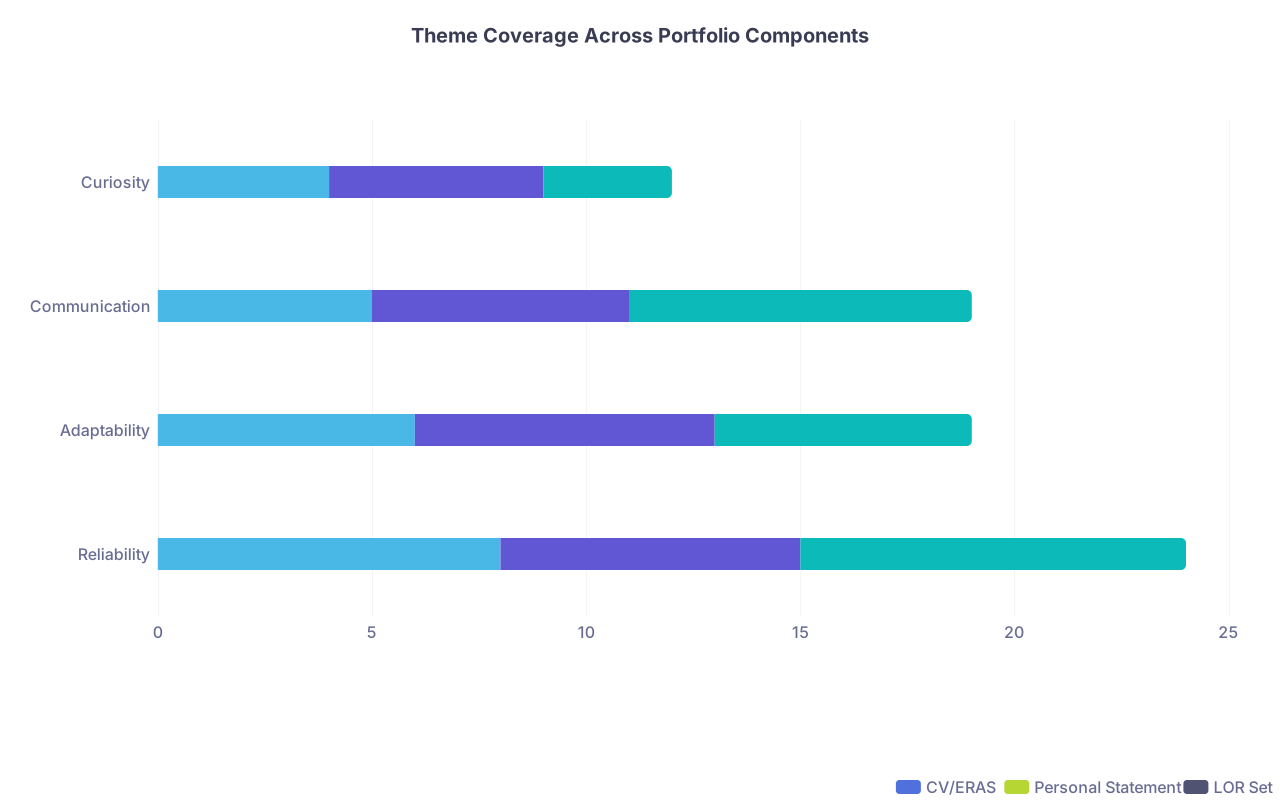
| Category | CV/ERAS | Personal Statement | LOR Set |
|---|---|---|---|
| Reliability | 8 | 7 | 9 |
| Adaptability | 6 | 7 | 6 |
| Communication | 5 | 6 | 8 |
| Curiosity | 4 | 5 | 3 |
You want:
- Each key theme present in at least 2–3 components.
- No theme carried only by one weak letter or one anecdote.
If “adaptability” appears only in one PS paragraph, and nowhere in LORs or CV, a PD will not anchor you as “adaptable.” They will remember whatever is repeated: reliable, kind, prepared, or nothing at all.
11. Special Situations for IMGs and How to Integrate Them
Let us hit a few common tough scenarios and how to design portfolio coherence around them.
A. Older graduate (5–10+ years since graduation)
Your story must answer: “Why now, and are they still clinically sharp?”
Portfolio strategy:
- CV: show continuous clinical involvement, not a 5‑year gap.
- PS: one clear, forward‑focused explanation of the delay and what reactivated your path.
- LORs: at least one very recent clinical letter (preferably US) confirming your current skill and adaptability.
- Strong emphasis on self‑directed learning and current guidelines.
B. Limited US clinical experience
Then your entire portfolio must squeeze maximum value out of what you have.
- PS: a strongly detailed section about that rotation—what you actually did, not just “observed.”
- CV: this US experience at the very top of clinical activities, well‑described.
- LOR from that US experience: must be detailed and specific.
- If possible, supplement with remote case discussions, telehealth experiences, or US‑based courses that show engagement with the system.
C. Prior non‑US training (e.g., completed residency abroad)
You cannot hide a previous residency. And you should not.
- CV: clearly list your previous residency with roles and responsibilities.
- PS: explain why you are re‑training in US. Not because you “want prestige,” but because you want to practice here long‑term, and you understand the need for US training.
- LORs: ideally one letter from that prior training emphasizing your maturity and skill, plus US letters proving you can adjust to a different system and hierarchy.
12. Final Consistency Check Before You Submit
Before you certify ERAS or send anything, sit down and ask:
- If a PD skimmed my CV, PS, and LORs in 5–7 minutes, what three adjectives would they reliably use to describe me?
- Can I summarize my story in one sentence that feels obviously supported by the documents?
- Are any themes or issues introduced in one place and ignored everywhere else?
- Does anything in one document subtly contradict another? Tone, dates, explanation?
You want your documents to feel like different camera angles of the same person, not entirely separate characters.
To make this more explicit, some applicants even create a simple grid on paper:
| Component | Reliability | Adaptability | Communication | Gap Explanation |
|---|---|---|---|---|
| CV / ERAS | Yes | Partial | Partial | Dates only |
| Personal Statement | Strong | Strong | Strong | Clear |
| LOR 1 (US IM) | Strong | Moderate | Strong | Not mentioned |
| LOR 2 (US Outpt) | Moderate | Moderate | Strong | Not mentioned |
If any crucial dimension (e.g., your biggest concern like a gap or exam attempt) appears only in your PS and nowhere else, think about whether that is enough. Sometimes you want a letter to discreetly mention improvement or resilience as well.

FAQ (Exactly 6 Questions)
1. Should my CV and ERAS application ever differ for strategy reasons?
No. Dates, titles, and core facts must match exactly. Strategic “differences” should only be about level of detail and ordering, not substance. ERAS is the official record; your PDF CV is usually a cleaner, more readable version, not a parallel universe.
2. Can I reuse the same personal statement for all programs and specialties?
For a single specialty, yes, you can usually use one well‑designed core PS, with minor edits if you are targeting very different program types (e.g., academic vs rural community). For different specialties, you must not use the same PS. Your identity, themes, and experiences emphasized need to shift meaningfully, or you will look unfocused.
3. How many letters of recommendation should IMGs actually submit?
For most specialties, 3–4 total letters are acceptable. I usually advise IMGs to aim for 3 strong letters rather than stretching to 4 with a weak one. If you have 3 strong US letters and 1 solid home‑country letter, that is fine; if your fourth is generic or very old, leave it out.
4. Is it a problem if my strongest letter is not from my chosen specialty?
Not fatal, but not ideal. If your strongest letter is from, say, a US cardiology elective, and you are applying to IM, that is actually fine—cardiology is still within IM. But if your strongest letter is from surgery and you are applying to psychiatry, you must compensate heavily through PS and other letters to show fit with psychiatry.
5. How do I handle a low Step score or multiple attempts within this “coherent story” framework?
Address it once in your PS, briefly and factually, linking it to demonstrated improvement (better Step 2 score, recent strong clinical evaluations, QI or academic work that required discipline). Do not write an emotional essay about failure. Then reinforce the “improvement” theme through a letter that mentions your current reliability and knowledge.
6. What if I already wrote everything and realize my documents are inconsistent?
You reverse‑engineer your themes. Read your existing PS and letters (if you have access), look at your CV, and ask: “What positive traits keep showing up?” Choose 3–4 of those that you can strengthen. Then revise your PS and ERAS entries to lean into these shared themes. You are not starting from zero; you are tightening the pattern.
You are not just an IMG “with a CV, a PS, and some letters.” You are a candidate presenting one integrated professional story to a very time‑pressured audience.
Once you learn to think like a portfolio designer, every future cycle—away rotations, fellowships, even job applications—becomes less mysterious. You are building a recognizable, trustworthy identity in documents. With that foundation in place, the next step is learning how to project the same coherent story in interviews and emails with programs. But that is a conversation for another day.