
Most IMG interview narratives fall apart at the exact moment training differences come up.
That is where programs decide: safe hire or risky unknown.
You are not losing interviews because of your accent, your passport, or your school name. You are losing them because you cannot translate your training and system into their mental model of a US intern. And you panic when they probe those gaps.
Let me break this down specifically.
1. What Programs Really Worry About When They See “IMG”
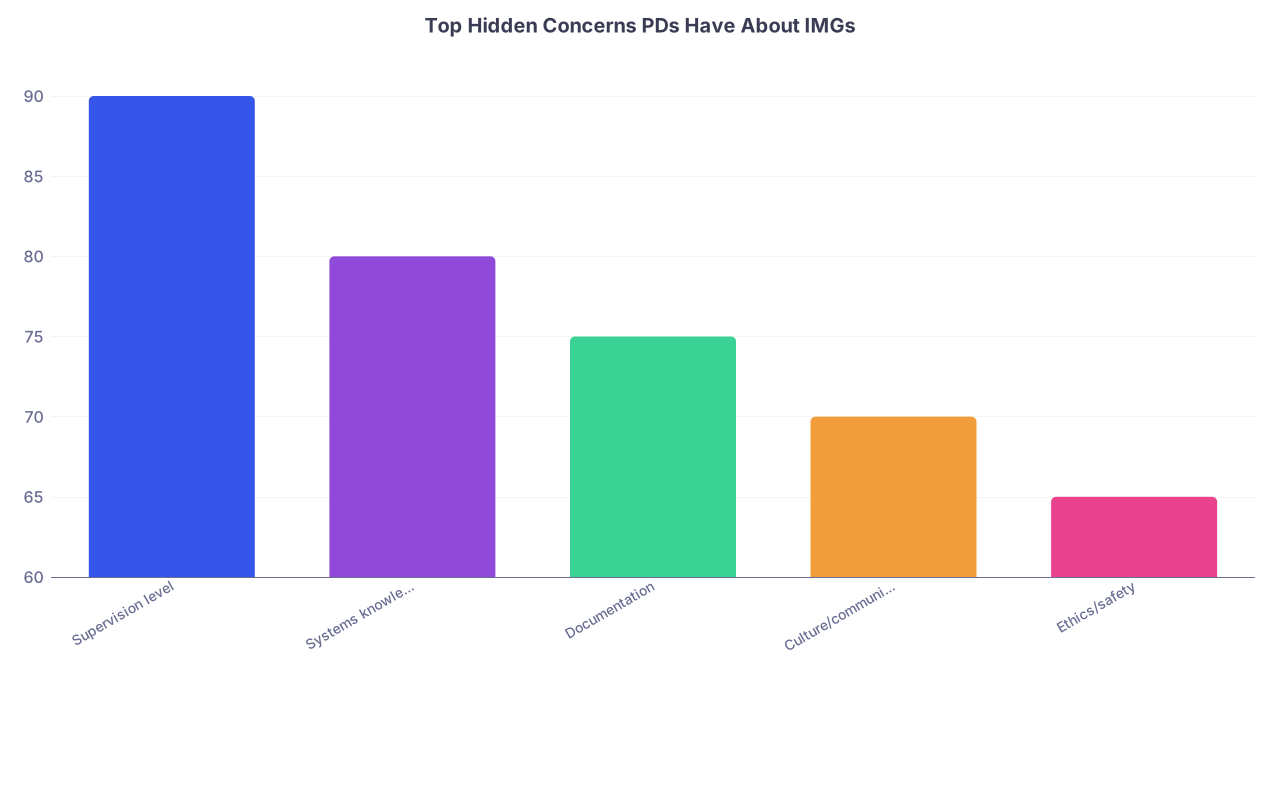
| Category | Value |
|---|---|
| Supervision level | 90 |
| Systems knowledge | 80 |
| Documentation | 75 |
| Culture/communication | 70 |
| Ethics/safety | 65 |
Programs are not sitting around plotting how to exclude IMGs. They simply cannot afford a resident who is unsafe, untrainable, or constantly out of sync with the system.
When they see “IMG”, especially from a non-US system, they quietly ask:
- Does this person understand graded responsibility, supervision, and escalation?
- Can they function inside US systems: EHR, billing, multidisciplinary teams, QI, safety culture?
- Are they going to “freelance medicine” based on how things were done at home?
- Will they adapt quickly enough that PGY-1 does not become a remediation project?
Every time they ask you about training differences, it is not curiosity. It is a stress test. They are probing for:
- Overconfidence (independent practice without oversight)
- Under-exposure (too much theory, not enough responsibility)
- Systems blindness (“we just wrote it in the chart and sent the patient home”)
- Rationalization of unsafe norms (“this is how we did it there”)
If you treat these as casual cultural questions, you will answer like a tourist. They want you to answer like someone who has done a safety and systems audit on your own career.
2. The Three Core “Training Difference” Narratives You Must Control

Think in three buckets. If you prepare controlled, honest, structured narratives in each, you stop fumbling.
2.1 Clinical Role and Supervision Narrative
You will be asked some version of:
- “Tell me about your responsibilities during internship.”
- “How independent were you in your home country?”
- “Describe your role on a typical ward day.”
The trap: IMGs either oversell (“I independently managed 30 patients and did all procedures”) or undersell (“We just followed orders and wrote notes”).
You want a calibrated, structured answer:
- Who was on your team
- What you actually did clinically
- How supervision and escalation worked
- How that compares to a US intern
Example, internal medicine, non-US internship:
“On our general medicine ward, our team was one consultant, one registrar, and two interns. As an intern, I was primary for 10–15 inpatients. I did daily rounds, wrote notes, placed initial orders on routine issues, and coordinated consults and discharge paperwork.
For new admissions or unstable patients, my role was first assessment and stabilisation: vitals, focused exam, initial labs, and starting basic interventions like fluids, oxygen, or common antibiotics based on our protocols. Any chest pain, hypotension, or altered mental status was immediately escalated to the registrar, who was usually in-house, and to the consultant by phone.
Compared to a US intern, I would say my day-to-day patient load was similar, my procedural exposure was moderate, but all major diagnostic and therapeutic decisions, especially around ICU transfer or high-risk medications, were consultant-led.”
Notice what that answer does:
- Names the team structure
- Uses actual numbers (10–15 patients)
- Describes the first steps you took
- States clearly how and when you escalated
- Benchmarks against US interns without pretending you know their system perfectly
If your training was more independent (e.g., you “ran the ward at night”), you cannot present that as a badge of honor. You must present it as: “Here is what I learned, and here is what I will not do in the US.”
For example:
“During night shifts, I was sometimes the only doctor physically present on the ward, with the registrar on call from home. That gave me strong triage skills and forced me to prioritise rapidly. However, I am very aware that US training has a much lower threshold for calling senior help, and I would absolutely follow your escalation protocols rather than trying to manage alone.”
You just turned a red flag into a maturity signal.
2.2 Systems and Workflow Narrative
US programs need to know if you can function in a system where:
- Every order is electronic
- Documentation is legal and billable
- Handoffs are structured
- Consultants, nurses, pharmacists, PT/OT all have strong voices
If you describe your prior system as “we wrote in a paper chart and called the consultant if needed,” you sound unprepared.
Instead, build a narrative with specific operational details:
- How were orders written and verified?
- How were labs/imaging requested and followed up?
- How did you hand off patients?
- Who else was in the care loop (nurses, pharmacists, etc.)?
Then you pivot to: “Here is what I already understand about US systems, and here is how I am bridging the gap.”
Example answer:
“Our hospital used a hybrid system. Progress notes and order sheets were paper-based, but labs and imaging were electronic and accessible through a basic portal. Medication orders were handwritten and verified by a ward nurse, with a pharmacist reviewing only high-risk medications.
Handoffs were usually verbal at the bedside plus a written list with key problems and pending results, but we did not have a formal protocol like I-PASS. That experience taught me to be very explicit about pending tests and contingency plans, because if I was not clear, things simply did not happen.
I know US hospitals rely heavily on fully integrated EHRs, structured order sets, and formal safety checklists. During my observership at [US Hospital], I made a point of shadowing interns while they placed orders and documented, and I have been practising I-PASS-style handoffs in my current clinical research job. I am comfortable that I can adapt quickly to your EHR and documentation expectations.”
You are doing two things:
- Demonstrating you are not naive about systems
- Showing you have already taken action to shorten the learning curve
2.3 Safety, Ethics, and “How We Did It There”
The landmine question: “Tell me about a time you saw something done in a way that might be different from the US, and how you handled it.”
They are testing:
- Will you justify unsafe or ethically questionable practices as “normal”?
- Can you separate resource constraints from standards of care?
- Do you have an internal safety compass?
Bad answer: “We often did not have imaging, so we just treated empirically and discharged.”
Better answer:
“In our setting, CT scans were limited and often unaffordable. For suspected appendicitis in a young, otherwise healthy patient with a classic history and exam, we would frequently proceed to surgery without imaging. That was standard practice given our constraints and actually aligned with older surgical guidelines.
However, for atypical presentations or older patients with comorbidities, the lack of accessible imaging definitely increased diagnostic uncertainty. In those cases, our consultants often kept patients for observation longer or used ultrasound when possible, but I was always aware that in a better-resourced system, we would have done more.
That experience pushed me to be very conscious of risk, to document my reasoning, and to discuss uncertainties with seniors instead of pretending we knew more than we did. In a US setting where imaging and labs are more available, I would absolutely use those tools more aggressively to reduce diagnostic risk.”
You acknowledge constraints but do not pretend they were ideal. You show ethical awareness.
3. Building “Gap-Aware” Stories: Where You Were Weak and What You Did About It

Programs are not looking for the IMG with no gaps. That person does not exist. They want the IMG who understands their own gaps better than anyone else in the room.
You need explicit, rehearsed narratives in these high-risk gap areas:
- ICU/vent management
- Advanced procedures
- Code leadership and ACLS/BLS familiarity
- Multidisciplinary team work
- QI, safety culture, and incident reporting
- Outpatient continuity (for primary care-focused fields)
3.1 How to Structure a Gap Narrative
Use this simple 4-part skeleton; it works repeatedly:
- Baseline: “During my training, my exposure to X was limited because…”
- Consequence: “I realised this left me less confident in…”
- Action: “So I deliberately did A, B, C to address this.”
- Future: “Coming in as a PGY-1, here is how I would safely handle X while still learning.”
Example for ventilators:
“During my internship, ventilator management was almost entirely consultant and senior registrar-driven. I intubated only under supervision and followed ventilator plans rather than adjusting settings myself.
I realised that for US internal medicine or anesthesia training, interns are expected to at least understand basic vent modes, alarm troubleshooting, and when to escalate.
To address this, I completed an online mechanical ventilation course from [reputable platform], reviewed the ARDSNet protocols, and spent two weeks during my observership in the US following the ICU team specifically focusing on vent management. I also worked through common scenarios with a critical care fellow, like worsening hypoxia or high plateau pressures, to develop an escalation and troubleshooting mental model.
As a new resident here, I would not make independent ventilator adjustments initially, but I would be able to recognise concerning patterns, communicate clearly with the ICU team, and I am confident I would pick up hands-on management quickly within your structured teaching.”
That is how you turn a weakness into a reason to trust you.
3.2 Do Not Hide the Gaps That Everyone Knows Exist
There are predictable differences in many non-US systems:
- Less structured QI/safety infrastructure
- Variable documentation standards
- Less formal feedback culture
- Different hierarchy around nurses and allied health
- Resource constraints that change thresholds for tests and interventions
If you pretend these differences do not exist, you sound either naive or dishonest. Example for QI:
“We did not have a formal morbidity and mortality conference or QI curriculum in my home program. Adverse outcomes were usually discussed informally between seniors, and as interns we were rarely invited into those conversations. That meant I had fewer structured opportunities to reflect on system-level changes.
I found that frustrating, so I started keeping a personal log of near misses and adverse events I was involved in and tried to categorise them by system issue, communication breakdown, or knowledge gap. That habit is something I would bring into residency here, along with a lot of enthusiasm for formal M&M and QI projects, because I have seen firsthand how lack of structure can hide important lessons.”
You just took an institutional weakness and turned it into your personal driver.
4. Scripted Answers to The Questions That Trip IMGs
| Question Type | Strategic Angle |
|---|---|
| “Tell me about your internship responsibilities.” | Team structure + patient load + supervision + comparison to US intern |
| “How is care delivered differently in your country?” | Acknowledge 2–3 concrete differences + emphasise safety mindset |
| “Have you ever practised independently?” | Clarify scope + stress escalation + show respect for US supervision norms |
| “How comfortable are you with US systems/EHR?” | Admit learning curve + show exposure + highlight adaptability |
| “What gaps do you see in your training?” | Name 1–2 real gaps + show targeted remediation + safe future behaviour |
Let me give you tightened, high-yield responses you can adapt.
4.1 “How is your training system different from the US system?”
Avoid rambling about national health policy. They care about how you functioned.
“Three main differences:
- Resource availability – Many advanced imaging tests and some medications were limited by cost or supply, so our thresholds for ordering tests were higher, and we relied more on clinical assessment.
- Documentation – Our notes and discharge summaries were shorter and less formal, and there was less emphasis on medicolegal language and billing documentation.
- Hierarchy – Consultants made almost all major decisions, and interns were less involved in multidisciplinary rounds compared to what I have seen in the US.
The upside was that my physical exam and clinical reasoning were challenged daily. The downside was less exposure to structured EHR workflows and multidisciplinary collaboration. That is exactly why I pursued hands-on experience in a US setting before applying, to start bridging that systems gap.”
You pick three, tie them to your personal development, and stop.
4.2 “Have you ever practised independently without supervision?”
This is one of the most dangerous questions for IMGs who have worked as GPs, medical officers, or in remote areas.
You must:
- Define the context
- Respect US standards
- Emphasise safety and escalation
Bad: “Yes, I ran a clinic alone seeing 40 patients a day and managing everything.”
Better:
“After internship, I worked as a medical officer in a rural clinic. I was the only physician physically present, but I had access to senior consultants at the referral hospital by phone. For routine primary care, I managed patients independently within well-established guidelines. For unstable patients, unclear diagnoses, or anything beyond our capacity, my threshold for transferring or seeking senior input was extremely low.
That role taught me to recognise my limits quickly and to use protocols and consultation rather than improvisation. In the US, I see myself firmly as a supervised trainee, and I would follow your escalation pathways rather than attempting independent practice.”
You are not bragging. You are signaling judgment.
4.3 “What challenges do you anticipate transitioning into US residency?”
If you say “none, I will adapt,” you are done.
Pick 2–3 real challenges that are skills, not identity.
Example:
“I expect three main challenges.
First, EHR navigation and documentation. I have used basic electronic lab systems but not a fully integrated EHR with order sets and billing requirements. I learn software quickly, but I know there will be a steep learning curve initially.
Second, the pace and volume of multidisciplinary communication. In my previous hospital, most decisions were between doctors and nurses, with fewer allied health professionals involved day-to-day. I actually welcome having more voices at the table, but I will need to get used to that flow.
Third, getting comfortable with the specific guidelines and pathways used here, for example, sepsis bundles or chest pain pathways. I have started reviewing ACC/AHA and Surviving Sepsis guidelines and I would want to shadow closely in my first weeks to align with how your program implements them.
The good part is that I have already gone through one cultural and systems transition before, moving from [country/region A] to [B/US rotation], so I know I can adapt quickly when I am intentional about it.”
This projects realism plus a plan.
5. Converting “Systems Gaps” into a Competitive Advantage
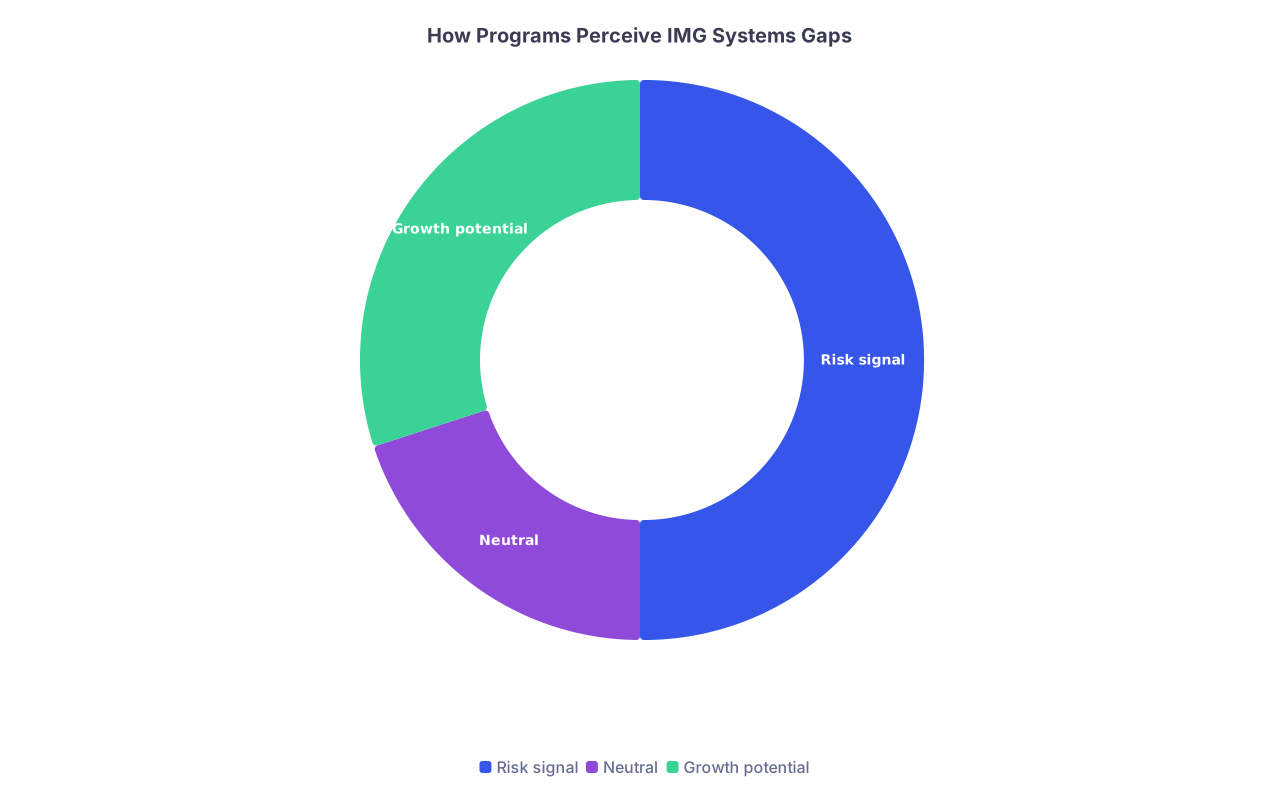
| Category | Value |
|---|---|
| Risk signal | 50 |
| Neutral | 20 |
| Growth potential | 30 |
Half the time, systems differences hurt you because you treat them as shameful or deny them. The trick is to reposition them as training data.
5.1 Resource Constraints → Diagnostic Discipline
You saw diseases late. You sometimes operated without ideal imaging. Use that.
Example phrasing:
“Working in a resource-limited environment forced me to rely on a very disciplined approach to symptoms, signs, and basic tests. I developed a strong habit of building and prioritising differential diagnoses before looking for confirmatory tests. In a US setting with more diagnostic tools available, I see that as complementary: use the same disciplined reasoning, then apply tests more liberally to reduce uncertainty and risk.”
You are not saying “we were better without CT.” You are saying “I learned to think before I click.”
5.2 Less Formal Safety Culture → Personal Vigilance
If your hospital had weak incident reporting and QI, you can frame the discomfort you felt.
“We did not have a structured culture around near-miss reporting, and I often felt that system issues repeated themselves without being addressed. That made me personally more alert to patterns of failure, like recurrent delays in lab reporting or communication gaps at transfer.
One of the reasons I am drawn to US training is the emphasis on safety systems and QI. I come with a lot of motivation to participate in those efforts because I have seen what happens when they are absent.”
That is a powerful narrative: you are not complacent.
5.3 Hierarchy Differences → Respectful Assertiveness
In many systems, questioning a senior is… not encouraged. If you learned to speak up anyway, that is gold.
“Our hierarchy was quite rigid, and juniors were not routinely invited to challenge decisions. Early on, I missed an opportunity to question an antibiotic choice that later turned out to be suboptimal. That bothered me, and over time I learned to prepare my questions with data and to ask them respectfully but clearly.
In a US team-based environment, I think that will help me contribute meaningfully while still respecting the experience of my seniors.”
You are showing that you already started rewiring yourself.
6. Practicing Delivery: The Part IMGs Underestimate

You can have flawless content and still lose the room if your delivery sends the wrong signals.
6.1 Tone: Confident, Not Defensive
Watch for these red flags in your own language:
- “But in my country we had to…” (defensive, comparative)
- “Actually, we also…” (arguing about equivalence)
- “It was not our fault because…” (blame-shifting)
Replace them:
- “That experience taught me…”
- “The main limitation of that system was…”
- “Here is how I would adjust in the US context…”
You are not auditioning as Ambassador of Your Health System. You are auditioning as a future resident in their system.
6.2 Length: 60–90 Seconds, Max
Most IMG answers about systems differences are too long. You overload details that do not affect patient care.
As you practice, time yourself:
- Basic direct question: 45–60 seconds
- Complex “tell me about a time” story: 60–90 seconds
If you are going beyond that, you are dumping. Tighten to:
- Context in 1–2 sentences
- What you did, saw, or learned in 2–4 sentences
- How you will apply it in US training in 1–2 sentences
6.3 Mock Interviews with Brutal Feedback
You need at least two rounds of practice where someone is allowed to say:
- “That answer makes you sound unsafe.”
- “I do not understand what you actually did day-to-day.”
- “You are defending a bad system instead of showing you learned from it.”
If you do not have a mentor:
- Record yourself answering 10 core questions about training and systems
- Watch with the specific lens: Does this make me sound:
- Safe?
- Honest?
- Reflective?
- Adaptable?
Be ruthless. Programs will be.
7. Visual Map: Turning Differences into US-Ready Narratives

| Step | Description |
|---|---|
| Step 1 | Identify Training Difference |
| Step 2 | Describe Honestly with Context |
| Step 3 | Keep Brief |
| Step 4 | State Specific Weakness or Limit |
| Step 5 | Show Concrete Remediation |
| Step 6 | Explain How You Will Act in US System |
| Step 7 | Concise Interview Narrative |
| Step 8 | Affects Safety or Systems? |
This is the cycle you need to internalise. Every time you think “we did it differently,” run it through:
- What exactly was different?
- Did it affect safety, systems, or your role?
- What did that leave you missing or stronger in?
- What have you done since?
- How will you behave on July 1 as an intern?
If you can do that, you are not just “an IMG.” You are a candidate who has done more meta-training on themselves than most US grads.
FAQ (Exactly 6 Questions)
1. Should I ever say “my training was equivalent to US residency”?
No. That line almost always backfires. You do not know their exact expectations, and it sounds arrogant or uninformed. Instead, frame it as: “There is overlap in clinical exposure, but the systems and structures are different. Here is where I am strong, and here is where I am actively catching up.”
2. How do I handle it if my home institution had objectively poor standards in some areas?
You acknowledge the problem without trashing anyone personally. “Our monitoring of outpatient follow-up was weak, and patients were sometimes lost to follow-up. That concerned me and made me very conscious of closing loops on results and appointments. I am looking forward to working in a system with more robust follow-up mechanisms.” You are allowed to be honest about system-level flaws.
3. Is it a mistake to talk about doing procedures independently as an intern or medical officer?
It is not a mistake if you frame it safely. Always pair independence with supervision structure and escalation: “I performed X under Y type of supervision, and for any complication or uncertainty I immediately involved a senior.” Do not glorify unsupervised high-risk procedures. Programs care more about your judgment than your procedural ego.
4. How much detail should I give about my country’s health financing, insurance, or public/private mix?
Very little. Unless you are directly asked about policy, stay close to what affects your daily practice: access to tests, medications, follow-up. A one-sentence mention of insurance or government funding is enough context; beyond that you are wasting interview time on things that do not help them judge your readiness as an intern.
5. What if my only exposure to US systems is observerships or research, not hands-on clinical work?
That is fine, as long as you do not oversell it. Say exactly what you did and did not do: “I did not place orders or write notes in the EHR, but I sat with residents while they did and asked them to walk me through their thought process and workflow.” Programs care more about your insight and humility than your ability to click buttons on Epic on day one.
6. I feel my English and accent make it hard to explain complex systems differences. How do I manage that?
Script and rehearse your key narratives word-for-word until they are smooth and automatic. Keep sentences shorter. Use concrete nouns and verbs, avoid long, abstract explanations. If you slow down slightly and pause between points, you will sound clearer and more confident. The content and structure of your answer matter more than sounding like a native speaker.
Key Takeaways:
- Training differences and systems gaps are not your downfall unless you deny, defend, or vaguely mumble through them.
- Programs want IMGs who can precisely describe their role, honestly name their gaps, and show concrete steps they have taken to adapt to US systems.
- If you can turn each “this is how we did it there” into a clear, safety-focused, future-oriented narrative, you move from risky unknown to deliberate, high-yield hire.