
How PDs Really Interpret Foreign Medical School Names and Rankings
It’s late November. You’re refreshing your email between patients on an observership, wondering why your application with 250+ on Step 2, multiple publications, and strong US letters has fewer interviews than your classmates from “better-known” schools.
You keep circling back to the same thought:
“My school is top 3 in my country. Why are programs not seeing that?”
Let me tell you what actually happens on the other side of ERAS when a program director sees your school name. Because it is not what your dean, your local advisor, or your classmates think is happening.
Most PDs in the US do not know your school.
They do not know your country’s ranking system.
They are not secretly consulting some global list of medical schools.
They are doing something much simpler. And much harsher.
Let’s walk through it.
The First Harsh Truth: Your School Name Is Usually Just “Noise”
I’ve sat in rooms where PDs scroll through applications at ridiculous speed. We’re talking 10–15 seconds per file on the first pass.
Here’s roughly what happens when a foreign medical school appears on that screen:
- PD glances at your name, visa status, YOG (year of graduation).
- Eyes flick down to USMLE scores and attempt history.
- Quick look at experiences and whether you have US clinical or not.
- Maybe, maybe a brief glance at medical school name.
That’s the order. Notice where your school lands: near the bottom.
Unless you’re from a tiny subset of “high-signal” schools, your medical school name isn’t really being “interpreted.” It’s being categorized.
In PDs’ heads, foreign medical schools roughly sort into a few mental buckets. They don’t say this out loud at institutional meetings, but they absolutely say it in their offices, in hallways, and on Zoom calls.
| Bucket | What PDs Actually Think |
|---|---|
| Known Elite | Probably solid training, good English, accustomed to US-style exams |
| Known Workhorse | Decent, lots of alumni in US, we know what we’re getting |
| Unknown but Legit | No idea, let scores and US experience speak |
| Problem Reputation | Risky, need stronger scores and proof |
| Diploma Mill / Offshore | Only if we are desperate, and only with stellar metrics |
Most IMGs are in that third category: Unknown but Legit. Which means your “top 3 in the country” label lives only in your head and on your school’s website. To them, it’s just: unknown.
The Few Schools PDs Actually Recognize
There’s a very short list of foreign schools that consistently ring a bell for US PDs. Not all PDs, but enough that you can feel it in committee meetings.
Think of places like:
- Karachi’s Aga Khan University
- AIIMS Delhi
- Certain well-established Caribbean schools (SGU, AUC, Ross)
- Some Irish, UK, and Australian schools with long histories sending grads to the US
- A handful of other institutions whose alumni are already attendings or chiefs in US programs
When those names appear, the PD doesn’t go to Google. They go to memory.
“I had a great resident from there.”
“Those grads always have strong basic science.”
“We’ve matched two people from there and they were rock solid.”
That’s the real currency: prior experience with alumni, not abstract ranking.
You know what almost never happens?
No one is pulling up “Top Medical Schools in Country X” ranked by some local newspaper. PDs do not care who is number one or number three in your country’s internal prestige system. They do not understand it, and they do not have time to learn it.
They look for their own versions of “rankings”:
- Have we taken people from this school before?
- Did those residents pass boards, cause no major drama, and do decent work?
- Do we see this school name in a lot of ERAS applications every year?
That last one matters more than anyone admits. A school that sends 80 applications a cycle to US programs will be more “known” than a tiny but elite European institution that sends 2.
How PDs Actually Judge an Unknown Foreign School
When the PD has never heard of your school, they do not open a new tab and research it. They do something far more crude but very predictable.
They use proxies.
Proxy 1: Your USMLE Scores and Attempts
This is the first translation filter for an unknown school.
A PD literally said this in a meeting once:
“If I don’t know the school, I let the Step score tell me whether their exam system is serious.”
Is that fair? Not really. But it’s fast. And speed dominates in a pile of 3,000+ applications.
Strong Step 2 score from an unknown school = “Probably fine, maybe even strong.”
Low or barely passing scores from unknown school = “I’m not taking that risk when I have 300 other apps.”
For foreign schools, the bar is just higher. A 230 from a US MD might slide into the “maybe” pile. The same 230 from a totally unknown school often falls into “only if we’re short on candidates.”
Proxy 2: US Clinical Experience and Letters
If they do not recognize your institution, they look for names they do recognize: US attendings.
A foreign school with extensive, supervised US clinical experience and strong letters from US physicians often overrides the “unknown” problem. A PD might not know your dean, but they might recognize the letter writer from Cleveland Clinic, Mayo, or a well-regarded community hospital.
What they’re thinking:
- “If Dr. X at [US hospital] says this person is strong, I trust that more than their school’s marketing page.”
- “They’ve functioned in our system already. They won’t be completely lost on day one.”
No US clinical, unknown school, average scores? You’re invisible at many programs. And no, that’s not because they hate your country. It’s because they have no reasons to invest limited interview spots in an unknown quantity when they have hundreds of seemingly lower-risk options.
The Dirty Secret: Some Country Labels Help, Some Hurt
Now let’s talk about a piece that almost nobody will say out loud in public forums: regional bias exists. Heavily.
PDs build stories in their heads based on countries and regions, not just specific schools.
In private conversations, I’ve heard versions of:
- “Graduates from X region tend to struggle with communication and documentation.”
- “We’ve had great success with applicants from Y country; let’s keep reviewing them aggressively.”
- “I’m cautious about schools from Z area; we’ve had remediation issues.”
This is old data. Anecdotal. Biased. But it drives real decisions.
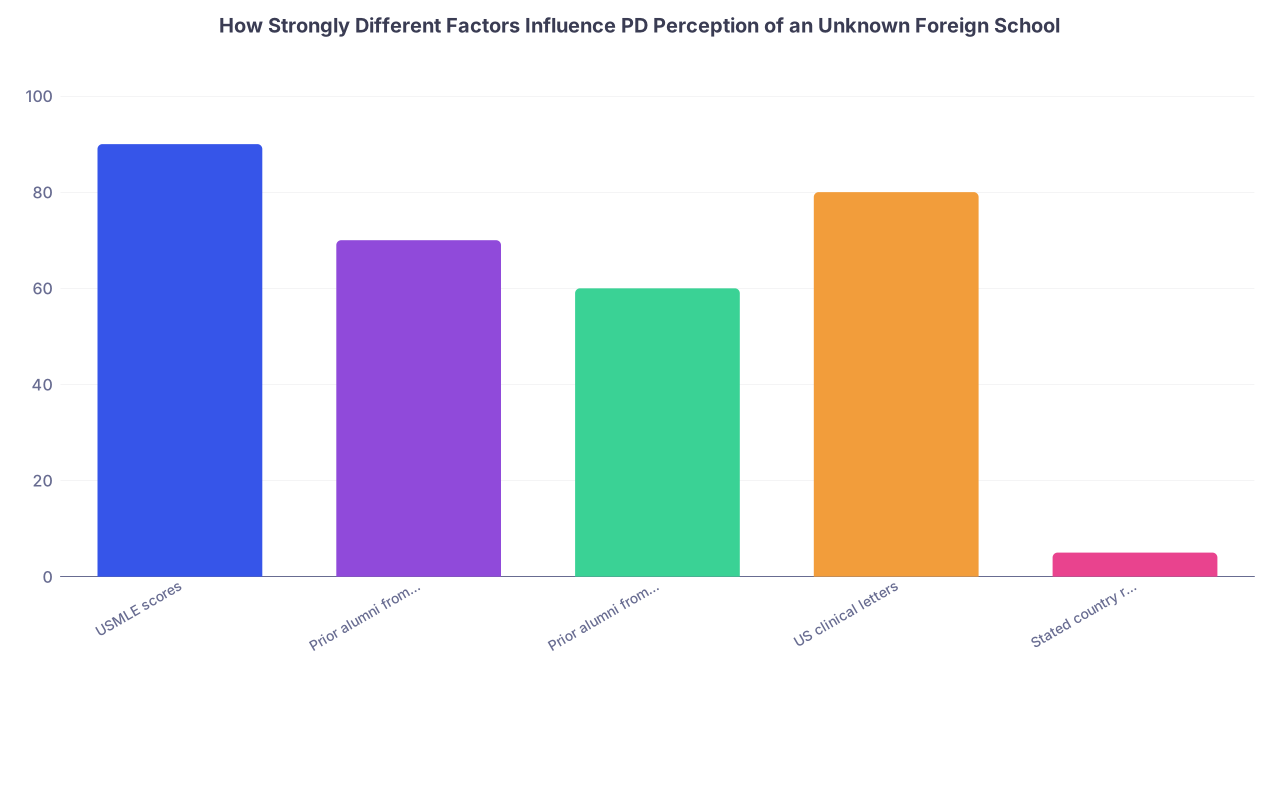
| Category | Value |
|---|---|
| USMLE scores | 90 |
| Prior alumni from same country | 70 |
| Prior alumni from same school | 60 |
| US clinical letters | 80 |
| Stated country ranking | 5 |
The “top 5 in the country” note in your personal statement? Maybe a 5 out of 100 in actual influence.
The fact that your school has sent 8 solid residents from your country to US programs over the last decade? That’s a 60–70.
And if your country has a reputation (fairly or unfairly) for strong English, good exam prep, and disciplined training, you benefit from that halo whether or not your individual school is actually elite.
On the flip side, if your region is known for:
- Grade inflation
- Weak clinical exposure
- Questionable offshore operations
Then your school starts from a deficit, and you are forced to compensate with USMLE scores and US-based performance.
What PDs Actually Do When They’re Unsure About a School
Sometimes a PD truly doesn’t know what to do with your school. They haven’t seen it before, the name doesn’t signal anything obvious, and your metrics are borderline.
Here’s what happens behind the scenes.
1. They Ask a Trusted IMG Faculty or Resident
This is the most “insider” move, and you won’t see it documented anywhere.
A PD will walk down the hall or send a quick message:
“You’re from India, right? Ever heard of [School X]?”
“You know much about [Latin American university name]?”
If that faculty or senior resident says:
- “Yeah, that’s a good government school, solid students” — you just got an invisible boost.
- “Honestly, that’s more like a private-pay school; not that strong” — your application quietly drops a tier.
Sometimes they’ll ask: “Would you take someone from there?” That answer matters far more than your country’s internal ranking.
2. They Look at Prior Match Lists and Alumni Networks
Human nature: PDs like patterns.
If they discover:
“We took a resident from that school 5 years ago; she was outstanding.”
Result: Your chances just improved.“We’ve had three residents from that school, two failed boards, one was put on remediation.”
Result: You are now paying for problems you didn’t create.
This is why alumni pipelines matter more than theoretical prestige. A mid-tier public university in your country with a strong history of sending disciplined graduates to US residencies will beat a hyper-elite, research-focused local school that never sends anyone abroad.
The Illusion of International Rankings
You know those QS, Times Higher Education, or obscure “Top Medical Schools in [Country]” pages? PDs rarely look at them. When they do, it’s mostly out of curiosity, not decision-making.
There are several reasons:
- Those rankings often measure research output, not clinical training quality.
- Many PDs barely trust US News rankings for US schools, let alone foreign ones.
- They’re not paid to study global medical education systems; they’re paid to fill service lines with residents who can function safely.
I’ve literally watched a PD google a school once. They opened the site, saw glossy promotional photos, a proud “Top 5 in [Country]!” banner, and then said:
“Yeah, this doesn’t tell me anything.”
They closed it and went back to the ERAS tab.
Then they looked back at the only things they truly trust: your scores, your letters, your experience.
Your school’s self-reported prestige doesn’t move them. They’ll believe your competency when they see it quantified or described by someone they know.
Caribbean and Offshore Schools: A Special Category
Let’s talk frankly about Caribbean and other offshore English-language schools, because PDs group them separately.
Inside PD minds, Caribbean/offshore schools are their own universe, mostly divorced from country-based thinking. The logic is harsh but consistent:
- “If they went there, they probably couldn’t get into a US MD/DO or a strong local government school.”
- “Some of these schools mass-produce grads; we’ve seen wildly variable quality.”
- “I’ll look hard at their board scores and clinical performance. If those are stellar, I’ll consider them. If not, next.”
Caribbean schools do have one advantage: familiarity. PDs see these names every year. That comfort sometimes beats an unknown but academically stronger foreign school that almost never sends grads to the US.
So yes, a mid-tier Caribbean grad with 250+ and US letters might beat an “elite” Eastern European grad with average scores and weak letters. Not because the Caribbean school is better. Because PDs understand the risk profile better.
How You Can “Translate” Your School for PDs (Without Sounding Desperate)
You cannot make them memorize your country’s ranking system. You can, however, package your background in a way that makes sense in their framework.
Here’s how people who succeed from completely unknown schools do it.
1. Treat Your School as a Neutral, Not a Strength
This is counterintuitive for many IMGs. You’re proud of your school; it’s hard not to lead with that.
But from the PD’s perspective, your school is not your selling point. You are.
You don’t need long paragraphs in your personal statement about being “top 3 in my region” or “prestigious in my country.” That reads as insecure at best, and meaningless at worst.
A single, modest phrase like:
“I studied at [School Name], a major public teaching hospital serving [population description], where I trained in high-volume internal medicine and emergency care.”
That’s enough. Then pivot quickly to what you actually did: leadership, research, teaching, clinical responsibilities.
2. Use US-Based Anchors Wherever Possible
You want PDs to latch onto things they recognize:
- US research institutions
- US practicing physicians writing your letters
- US clinical sites where you’ve rotated
- US quality measures: scores, honors, certifications
Make your ERAS and CV read like you’ve already partially integrated into their ecosystem. The less they have to decode your context, the better.
3. Leverage Any Pipeline, No Matter How Small
If anyone from your school has matched into a US residency in the last 10 years, they’re an asset.
- Reach out.
- Ask where they got interviews and where they ended up.
- Ask if your school is known (even vaguely) at their program.
If your school is unknown at 95% of programs but known — and respected — at 5, that’s a huge advantage. You are not trying to impress everyone. You are trying to find the small number of places where your background doesn’t require a 10-minute explanation.
And yes, those alumni sometimes quietly advocate for you when PDs do the “Hey, have you heard of this school?” hallway check.
The Hidden “Quality Flags” PDs Look For in Foreign Graduates
Besides test scores and letters, PDs use subtle cues to judge the underlying training environment at your school.
They won’t say this on the record, but they’re asking:
- Does this graduate seem clinically underexposed for their YOG?
- Do they overcompensate with research because they lack hands-on work?
- Are their clerkship grades all “Honors” at a school we’ve never heard of — i.e., grade inflation?
- Is their documentation and case description sophisticated or superficial?
I’ve heard attendings say:
“If someone is 4 years out from graduation, from an unknown school, with no real clinical work documented in between, that’s a huge red flag.”
Your goal is to show, in concrete terms, that your training was not just real but demanding:
- Procedures performed (realistic, not inflated)
- Call responsibilities
- Teaching roles
- Any measurable outcomes (board pass rates, national exams for your country, etc.)
Not generic claims like “rigorous curriculum” or “busy tertiary center.” Everyone writes that.
What PDs Will Never Admit Publicly (But You Need to Understand)
Let me summarize a few points that live in the shadows of PD conversations:
They are overwhelmed and rely on shortcuts.
Unknown foreign school + average metrics = usually filtered out without guilt.“Top school in my country” carries almost zero direct weight.
Unless there’s a known alumni track record, it’s just words.The school’s reputation in US programs matters more than its reputation in your country.
If they’ve never met your alumni, your school’s prestige is theoretical.They are far more afraid of a weak, unsupervised IMG struggling in the program than of missing out on a hidden gem.
That fear shapes their risk tolerance.Once one or two excellent residents from your school prove themselves, the door opens wider for the next wave.
You might be the first one trying to kick that door.
Where You Go From Here
You cannot control what PDs know about your school. You can’t rewrite your medical education history. And no, you can’t force the US system to care that you were “top 5” locally.
What you can do is accept the reality of how your school name is actually processed:
- As a weak positive if it’s known and respected
- As a neutral if it’s unknown
- As a negative if it’s linked to past problems or diploma-mill vibes
Then you build the rest of your file to overwhelm that variable:
- USMLE scores that leave no doubt
- US clinical work where attendings will go to bat for you
- A story that focuses on what you’ve done, not where you came from
- Strategic targeting of programs where someone like you has matched before
You are in the residency match and applications phase right now. This is where labels, categories, and the PD’s quick mental shortcuts can feel brutal. But they’re not the end of the story.
If you play it right, by the time they’re ranking candidates, your unknown foreign school will just be a line in your history. The discussion in the room won’t be “Where is this place?”
It will be:
“She crushed Step 2, the attending at [US hospital] loved her, she interviewed well. I don’t care where she went to school. She’ll do fine here.”
That’s the position you’re aiming for.
And once you’re in residency, you start changing what your school name means for the IMG who comes after you. But that — building a pipeline and a reputation from scratch — is a story for another day.