
It’s mid-July. ERAS is almost ready to open, your CV is pulled up on the screen, and there it is—an ugly white space between graduation and your first US clinical experience. Or a blank year after failing Step 2. Or those eighteen months you went back to your home country to deal with family issues.
You keep tweaking the dates, shifting things by a month, wondering if you can “merge” rotations to make it look tighter. Part of you is even considering just… not mentioning that gap.
Let me tell you exactly what happens to that gap once your file hits a program director’s inbox. Not the polished public version. The actual behind-the-scenes version I hear in selection meetings, in late-night rank list debates, and in the half-ironic jokes at noon conference.
The First Thing PDs Do When They See a Gap
Most applicants think a gap is a neon sign that says: “Reject me.” That’s not how it works.
Here’s what really happens. A program director (or more often, a chief resident or APD doing first-pass screening) opens your ERAS file. They scan fast. Scores. Medical school. YOG. USCE. Then their eyes pause for half a second on your timeline.
“Graduated 2018… applying for 2026 start… okay, eight years out.”
Or: “One-year gap between 2021–2022. Nothing listed.”
Or: “‘Personal reasons’ for 11 months. No detail.”
They don’t gasp. They don’t throw your file away instantly. They do something simpler: they mentally dump you into one of three buckets:
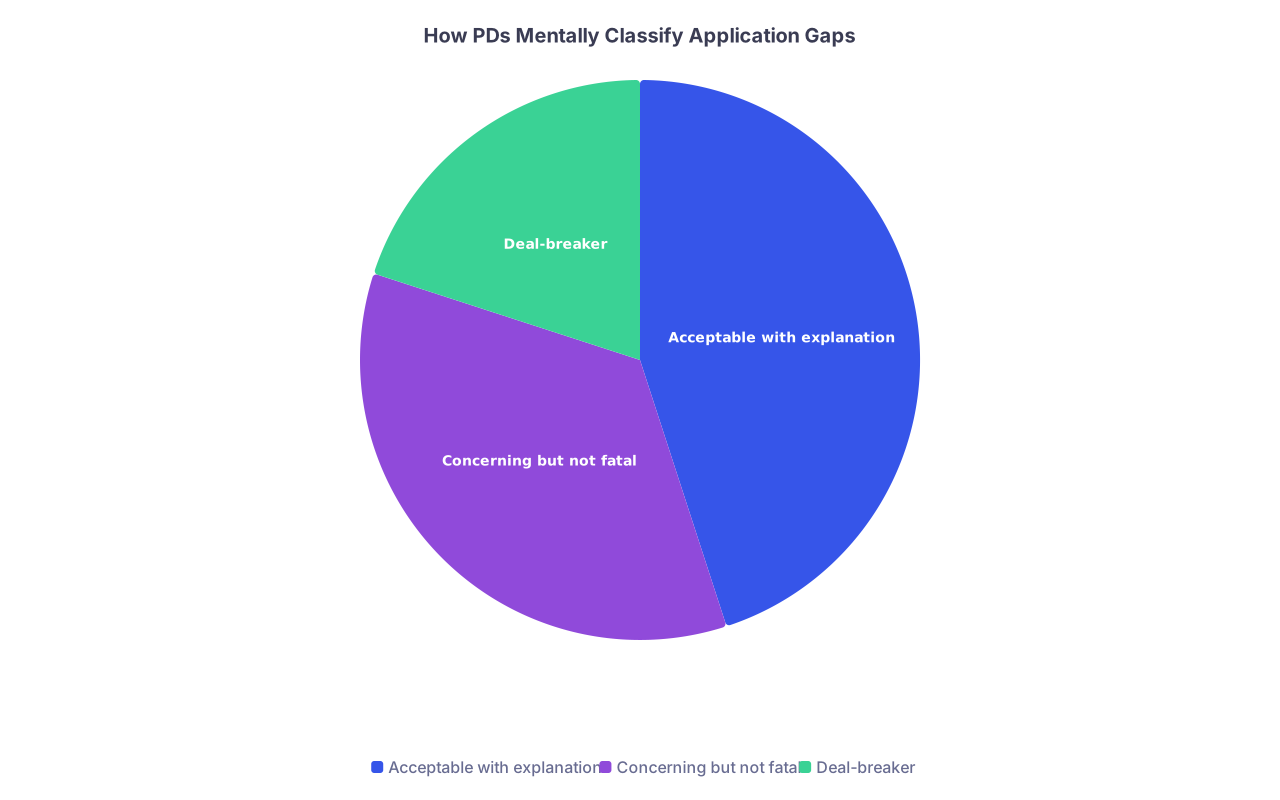
| Category | Value |
|---|---|
| Acceptable with explanation | 45 |
| Concerning but not fatal | 35 |
| Deal-breaker | 20 |
Bucket 1: Acceptable with explanation.
Bucket 2: Concerning but not fatal—needs more digging.
Bucket 3: Deal-breaker.
Your entire job as an IMG with a gap is to keep yourself out of Bucket 3 and, ideally, drag yourself into Bucket 1.
Notice what’s not on that list: “Applicants with no gaps only.” That fantasy is something advisors tell you because it’s convenient. Program directors live in the real world. They know people fail, get sick, get married, immigrate, burn out, get stuck in visa hell.
They don’t care that you have a gap. They care why and what you did with it.
The Gap Equation PDs Use (Quietly)
Most PDs won’t say this out loud, but here’s the internal math almost all of them are doing:
GAP IMPACT = (Length) × (Recency) × (Reason Risk) ÷ (Evidence of Growth)
Nobody’s literally writing that down, but that’s how their brain is working, whether they admit it or not.
Let me break that down the way people talk in a closed-door selection meeting.
Length: How long were you off the radar?
A three-month gap? Honestly, half the time no one cares. They might not even notice if the rest of your file is clean and active.
Six to twelve months? Now people start asking questions. Not automatic rejection, but it becomes a topic of discussion: “What happened here?”
More than two years? You’re in the “this needs a really good story and strong current evidence” category.
Between faculty, I’ve literally heard:
“She has an eight-month gap after Step 1, but then did two years of solid research.” → nobody cared.
“He graduated 2016, nothing clinical until 2022.” → skeptical silence.
The longer the gap, the more you’re fighting the suspicion of skill decay and inertia.
Recency: How close is that gap to today?
Program directors are far more forgiving of something you did five years ago than what you did last year.
If your gap was:
- Before or right after medical school: usually easier to frame as “life circumstances.”
- Immediately after graduation: starts to look like you couldn’t get traction.
- Within the last 1–2 years: everyone is wondering if you’re truly “match-ready” now.
A 2017–2018 gap with active 2023–2025 experience looks way better than a squeaky-clean 2018–2021 record followed by a mysterious 2022–2023 black hole.
Reason Risk: What story does this gap imply?
This is where the “secret” judgments live. Most PDs won’t say this on a panel, but they will say it in a file review:
- “Family emergency” → sympathetic, but they’ll want to see you re-engaged afterward.
- “Burnout / mental health” → mixed reactions. Some are fully supportive. Others quietly worry about residency resilience.
- “Visa issues” → common for IMGs. Usually neutral if you show productivity anyway.
- “Solo Step prep” for 1–2 years with nothing else → big red flag.
- “Failed Step” and then long quiet period → they suspect avoidance rather than recovery.
Their real fear is not the gap itself. It’s what the gap predicts about how you’ll handle call, stress, exams, conflict, and the grind of residency.
Evidence of Growth: Did you convert the gap into something?
This is where you can rescue yourself.
If you used that time to do any of the following and can prove it:
- Clinical observerships or hands-on work (even unpaid)
- US-based research with outputs: posters, abstracts, or at least concrete projects
- Teaching, structured courses, or degrees (MPH, MS, etc.)
- Consistent volunteer clinical work with physician supervision
- Concrete Step score recovery after a failure
Then PDs start reframing you from “risk” to “resilient.”
They love that word. Resilience. If your narrative is “I got hit, I staggered, then I built myself back up and have recent proof,” that plays well. I’ve seen borderline IMG applicants get ranked higher because they bounced back from a gap in a way that impressed the committee.
The Ugly Truth: Gaps Are Not All Treated Equally for IMGs
Here’s the part you won’t hear at information sessions.
For U.S. grads, a one-year research gap at a brand-name institution? People call that “a research year” and nod approvingly. For an IMG from a lesser-known school, the same timing often gets labeled “unmatched gap” or “time out of clinical practice.”
The bias is real.

In many programs, the default assumption for an AMG gap is:
“There was probably a structured reason. Family, research, dual degree, personal choice.”
For an IMG:
“They probably couldn’t match, or there was some problem.”
That’s the bias you’re fighting. Not fair. But very real.
So as an IMG, you have to over-explain and over-document what a U.S. grad can get away with leaving vague.
If you leave a gap unexplained, PDs almost always assume the worst scenario that fits: repeated failures, professionalism issues, or serious performance problems.
The Gaps That Spook PDs the Most
There are certain patterns that reliably make PDs tense up when they see them in IMG files.
1. The “Long Silent Desert” Post-Graduation
Graduated in 2017. First US experience 2023. Nothing meaningful in between.
In a committee room I’ve heard:
“Has he done any clinical medicine in those six years?”
“Last LOR is eight years old. That’s a problem.”
“Are his skills even remotely current?”
It’s not the calendar years alone. It’s the complete lack of contemporary evidence.
If you have a long gap like that and you’re just now starting to add observerships or research, you have to understand: to them, this is you trying to turn the ship at the last second. Some will believe you. Many won’t.
2. The “Endless Studying” Gap
This one is deadly for IMGs.
“I took 18 months to prepare for Step 1.”
“I spent two years preparing to retake Step 2 after failing.”
On paper, this reads like: “Takes a very long time to pass exams that residents must take while working 80+ hours a week.”
PDs immediately imagine you struggling with in-training exams, delayed Step 3, extension of residency, board failures. It’s not about cruelty. It’s about protecting their board pass rate and service coverage.
If your gap is mostly “exam prep,” you need to build other activity on top of that: part-time research, observerships, structured coursework.
3. The “Invisible Failure” Gap
Incomplete transcript entries. Suspicious “leave of absence.” Year off with no mention of context.
PDs are good at reading between the lines. If your MSPE or transcript hints at remediation, professionalism issues, or leaves of absence, and your personal statement says nothing, their trust drops.
I’ve seen PDs reject candidates not for the actual issue, but for the sense that the applicant was hiding it.
The internal monologue goes something like:
“People have problems. Fine. But if they can’t even talk about it now, how are they going to handle future issues openly?”
4. The “Chronic Drifting” Pattern
Not one big gap, but multiple small ones:
- 3 months here
- 4 months there
- A year of part-time this, part-time that
No narrative, no through-line. Just drift.
This raises a subtler concern: inconsistency. Residency is routine and grind. PDs want people who show up and keep showing up. If your application looks like a patchwork of short-lived attempts, they may conclude—fairly or not—that you’ll do the same as a resident.
The Gaps That Are Easier to Forgive (If You Handle Them Right)
On the flip side, there are gaps most PDs will quietly accept, sometimes even respect, if you own them properly.
| Gap Type | Typical PD Reaction |
|---|---|
| Family/health issues | Sympathetic, cautious |
| Visa/immigration delays | Neutral, needs activity |
| Structured research year | Positive if productive |
| Degree (MPH/MS/PhD) | Generally positive |
| COVID-era disruptions | Very understanding |
Family or Personal Health Crises
Cancer in the family. Parent passed away. Your own serious illness. These are human situations.
When applicants explain these directly, without drama but with clarity, most PDs soften. I’ve seen PDs fight for an IMG applicant because they took two years off to care for a dying parent and still came back strong.
But you must show what you did afterward. The emotional reaction buys you empathy, not automatic trust in your current readiness.
Visa and Immigration Chaos
Most PDs working with IMGs know how messy this gets: embassy backlogs, lost paperwork, changing rules.
If your gap is clearly tied to visa issues, they’ll usually accept it—provided you did something productive locally: clinical work in your home country, research, teaching. “I did nothing, I just waited” lands poorly.
COVID-Era Gaps
You’re lucky in one sense: the pandemic is now a shared explanation everyone understands.
“COVID disrupted rotations.”
“Home country hospitals suspended observerships.”
“Board exam schedules imploded.”
All true. PDs saw wave after wave of this.
If your main gap is 2020–2021, they are often quite flexible. But again, they’ll look for: did you find anything to do? Online research, telemedicine, virtual experiences, coursework? Or did you just disappear?
How PDs Want You to Explain the Gap (Even if They Don’t Say So)
Most applicants either overshare or under-explain. Both hurt you.
Let me give you the template PDs wish you’d follow.
Three parts. That’s it:
- Brief, clear statement of what happened
- One sentence on what you learned/changed
- Concrete evidence of what you did after
Here’s an example that plays well in both personal statements and interviews:
“After graduating in 2019, I returned to my home country for 10 months to care for my father during his chemotherapy. During that time I was unable to engage in formal clinical work, but I completed online coursework in evidence-based medicine and prepared for Step 2. Once his health stabilized, I moved to the U.S. and have since completed 6 months of hospital-based observerships and joined an ongoing QI project, which reaffirmed my commitment to internal medicine.”
Short. Direct. No melodrama. And crucially: a very clear before/after story.
Contrast that with what they hate reading:
“I had some personal issues and needed to take time for myself to grow and reflect.”
That’s code for “I’m not going to tell you.” In most PD minds, that’s a red flag.
What Happens In the Room When Your Gap Comes Up
Let me walk you into a rank meeting.
We’re in a conference room. A spreadsheet is projected. Residents, APDs, PD, maybe a coordinator. We’re going through IMG candidates.
Your name pops up. Someone scrolls.
“They graduated… 2020. Then one-year gap. Then observerships.”
Here’s the kind of dialogue I actually hear:
Resident: “I worked with her on wards this year. She was actually really solid. You wouldn’t know she had a gap.”
APD: “What was the gap for?”
Resident: “She mentioned visa issues and family illness in her PS.”
PD: “Has she done anything clinical recently?”
Resident: “Yeah, our hospital observership, plus research with Dr. X.”
PD: “Okay, I’m fine with that if her letters reflect current performance.”
You see what saved her? Recent, strong, credible evidence. The gap becomes a footnote, not the story.
Now compare:
Coordinator: “Next is Dr. Y, IMG, YOG 2017.”
APD: “What has he been doing since?”
Coordinator: “Two years Step prep, failed Step 2 once, then passed. No letters after 2018.”
Resident: “Any USCE?”
Coordinator: “One month observership in 2022.”
PD: “We can’t assess his current level. I’m going to pass.”
Same number of years. Different signal.
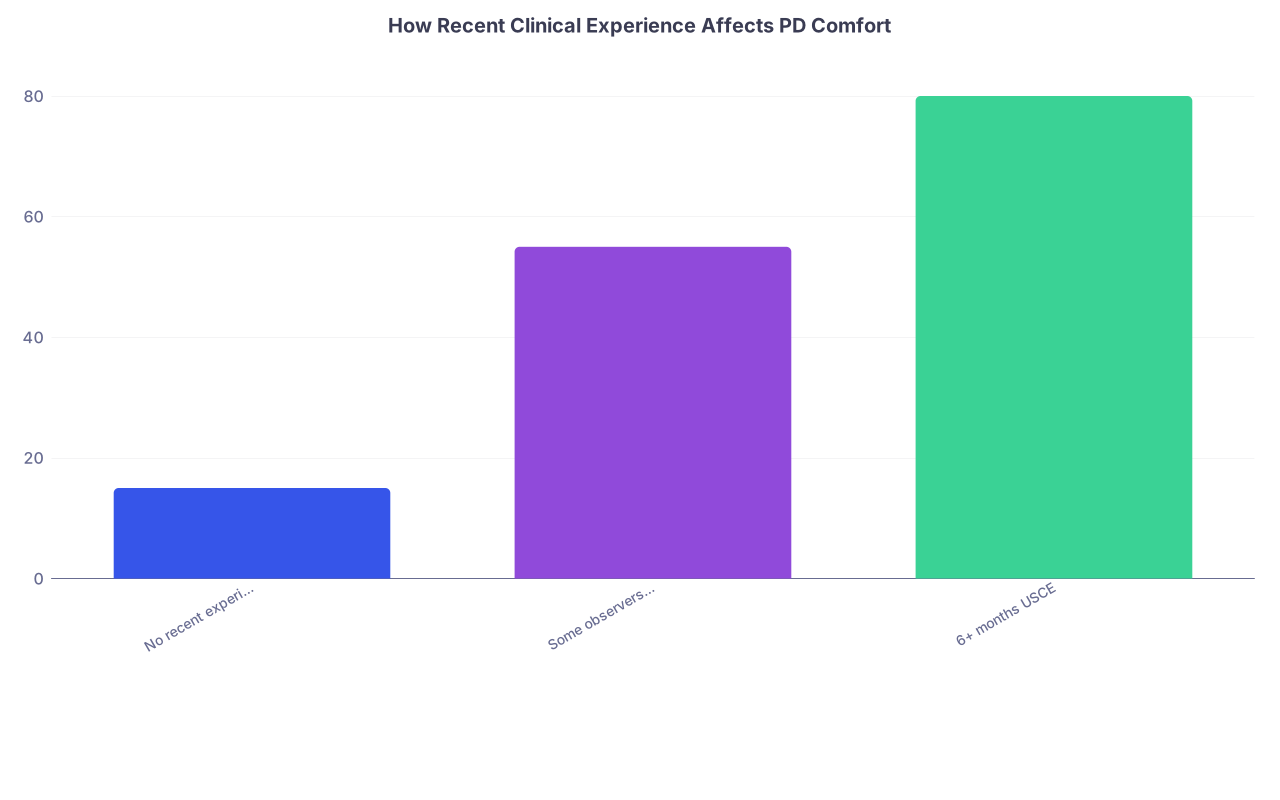
| Category | Value |
|---|---|
| No recent experience | 15 |
| Some observership | 55 |
| 6+ months USCE | 80 |
Translation: the older and more significant your gaps, the more you must overcompensate with fresh, documented performance.
How to Rebuild Trust After a Gap (From the PD’s Point of View)
Program directors are not trying to be cruel. They’re trying to predict one thing:
Will this person show up in July and function safely and reliably?
Every piece of your “gap story” needs to be aimed at answering that.
Here’s what actually helps change their mind.
1. Anchor yourself in the present
You want your application to scream: “I am actively engaged in clinical medicine right now, in a way you can verify.”
That means:
- Recent letters (within the last 12–18 months) from people who saw you clinically
- US-based, if possible, and relevant to your specialty
- Clear timelines in ERAS—no fuzzy overlapping dates
If your best letters are from 2016, PDs worry they’re reading a time capsule.
2. Show a trajectory, not random salvage
PDs respond well to coherent stories.
Bad: “Gap. Then some random observerships.”
Better: “Gap for X reason. Then research in the same field I’m applying for. Then progressive clinical exposure. Then teaching in that same area.”
They want to see intentionality. That you weren’t just flailing, throwing observerships at your CV hoping something would stick.
3. Own the failure without wallowing
If your gap involves a failed exam or academic problem, hiding it is worse than the failure itself.
A PD-friendly version sounds like this:
“I failed Step 2 on my first attempt during a period of significant family stress. I realized I needed to change how I studied and structured my time, so I enrolled in a formal prep course, created a detailed schedule, and sought mentorship from physicians who had gone through similar experiences. I passed on my second attempt with a score of ___, and in subsequent in-training style assessments during my observership I’ve continued to perform well.”
You’re signaling three things: insight, action, and improved result. That’s what they want.

| Step | Description |
|---|---|
| Step 1 | See gap on ERAS |
| Step 2 | Assume worst case |
| Step 3 | Lower priority or reject |
| Step 4 | High risk, likely reject |
| Step 5 | Consider resilient, discuss further |
| Step 6 | Is there a clear reason? |
| Step 7 | Recent strong evidence? |
The One Thing You Must Not Do With a Gap
Do not get cute with dates.
I’ve watched PDs catch this, and when they do, it’s over.
- Overlapping “full-time” experiences that aren’t humanly possible
- Back-dated research that obviously started later
- Shifting graduation dates or training years to “tighten” the timeline
Programs cross-check. They look at letter dates, rotation evaluations, emails, sometimes even your LinkedIn. If something smells off, they move you into the “dishonest” bucket. That’s worse than any gap.
A PD can defend taking a risk on an IMG with a messy path and a good explanation. They cannot defend taking a risk on someone who played games with their CV.
If You Haven’t Filled Your Gap Yet
If you’re reading this and your gap is current, not historical, here’s the cold reality: how you spend the next 6–12 months matters more than how you spent the previous 6–12.
You can’t erase the white space, but you can decide what sits on the right side of it.
Focus on:
- Any clinical adjacency you can get: observerships, assistant roles, even in your home country if the U.S. isn’t feasible yet
- Tangible projects: QI, research, audits—something with your name on it
- Getting at least one supervisor who will write a detailed, specific letter about your current level
Your goal is simple: when a PD looks at your file, the most recent thing they see is not the gap but something that says, “I can handle a ward service right now.”