
The brutal truth: being an IMG with thin research is a big problem for competitive residency programs—but it is not a death sentence if you treat the next 6 months like an academic boot camp.
You do not have time for theory. You need a concrete, realistic, execution-focused plan that turns “limited research” into “credible academic productivity” before programs review your application or rank list.
This is that plan.
Step 0: Define Your Real Starting Point (1–2 Days)
Before you touch a paper or email a mentor, you need a clear diagnostic.
A. Be honest about your status
Write this down on a single sheet:
- Degree: IMG (country, year of graduation)
- Current location: US / outside US
- Timeline:
- Next ERAS application date
- Match cycle you are targeting
- Clinical status:
- Any USCE? (observerships, externships, research electives)
- Current hospital / university affiliation, if any
You are not doing this for motivation. You are doing it because your options and speed depend on these factors.
B. Audit your current academic record
On that same sheet, list:
Publications
- Peer-reviewed articles (PubMed indexed or not)
- Case reports, letters, reviews
- Language (English vs non-English)
Other academic work
- Posters or oral presentations
- Quality improvement (QI) projects
- Theses or dissertations
- Any research experience at all, even if not published
-
- Gaps: “No PubMed papers”, “No US institution ties”, “Graduated 5+ years ago”
- Assets: “Strong Step scores”, “One US attending who likes me”, “Good Excel/Stats skills”
Now circle every asset that could be leveraged for research quickly:
- US attending contact
- Prior thesis data you can re-analyze
- Any ongoing project where someone mentioned “we should publish this”
- Access to a decent hospital or university
This is your launchpad.
The 6-Month Academic Upgrade: Overview
You are going to run three tracks in parallel:
Track A – Low-friction wins (Month 1–2)
- Case reports
- Letters to the editor
- Simple narrative or mini-reviews
Track B – Real research outputs (Month 2–6)
- Retrospective chart reviews
- QI projects
- Survey studies
- Simple database / literature-based projects
Track C – Visibility and credibility (Month 1–6)
- Abstracts, posters, talks
- Professional presence (Google Scholar, ORCID, updated CV)
- How you frame your “research story” in ERAS and interviews
You are not trying to become a basic science PI. You are trying to look like a serious, productive, clinically oriented academic resident candidate.
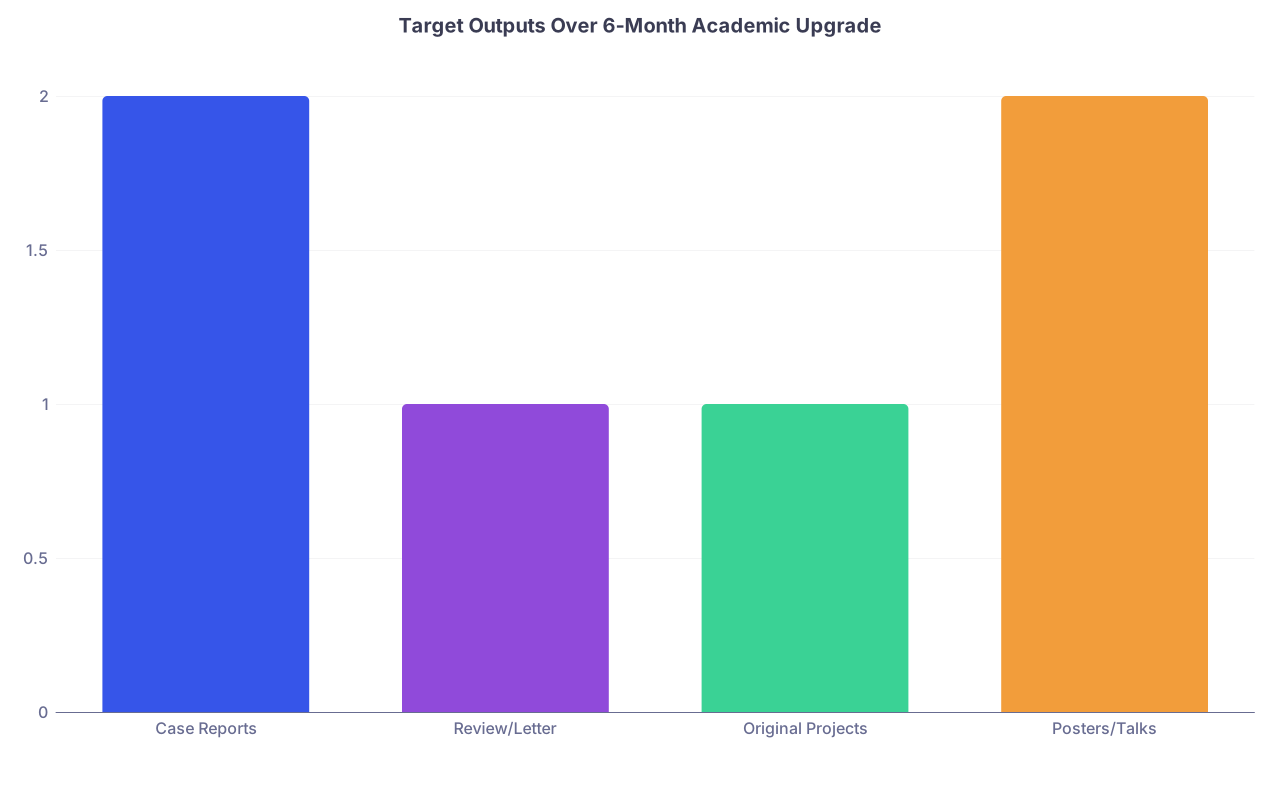
| Category | Value |
|---|---|
| Case Reports | 2 |
| Review/Letter | 1 |
| Original Projects | 1 |
| Posters/Talks | 2 |
Month 1: Set Up Infrastructure and Grab Quick Wins
Month 1 is about two things:
- Building your research environment so you stop wasting time
- Producing at least one concrete, low-barrier piece of academic work
1. Build a basic research infrastructure (3–5 days)
You are going to act like a junior academic from day 3 onward.
Set up:
Reference manager
- Zotero (free) or Mendeley. Install browser connector + Word/Docs plugin.
- Create folders: “Case Report Ideas”, “Review Topic X”, “Project Y Background”.
File structure
- Folder:
Research_2026- Subfolders per project:
Case_Sepsis2026,Review_AFIB,QI_Antibiotics, etc.
- Subfolders per project:
- Inside each:
Data,Drafts,Figures,Notes.
- Folder:
Professional IDs
- ORCID ID (mandatory for many journals).
- Create a basic Google Scholar profile (even if empty now; you will fill it).
This sounds trivial. But I have watched people waste weeks because every draft and PDF is “Final_v9_edited_NEW.docx” on the desktop.
2. Secure mentors and projects quickly (first 2 weeks)
You cannot do this alone. You also do not need a famous NIH PI. You need 1–2 accessible, active clinicians or clinician-researchers.
A. Where to find them
- Any US observership / externship / research elective you have or can get
- Teaching hospital near you (even abroad)
- Program alumni working in US residency programs
- Online:
- PubMed search: “hospital name + specialty + last 2 years”
- Faculty interests pages on hospital / med school websites
- Specialty societies’ resident or fellow sections
B. The email that actually gets answered
Stop sending “I am very passionate about research” essays. Use a tight template like this:
Subject: IMG with time + stats skills – happy to help on current projects
Dear Dr. [Name],
My name is [Name], an international medical graduate from [School, Year] currently in [Location]. I am applying to [Specialty] in the [Year] Match and I am looking for opportunities to contribute to ongoing clinical or QI projects.
I can commit [X hours/week] for the next 6 months. I am comfortable with literature review, data entry, and basic statistics in [Excel / SPSS / R if true]. I am happy to help with any part of the process, including abstracts or manuscript drafting.
If you have any projects that need help or draft manuscripts that need revision, I would be grateful for the opportunity to assist.
I have attached my CV.
Sincerely,
[Name]
[Phone] | [LinkedIn or professional email]
Send 20–30 targeted emails. Not 3. Not 5. Volume matters.
3. Case reports: your fastest real publication
Case reports will not turn you into a physician-scientist. But they are realistic, quick, and count as PubMed-indexed publications if you pick decent journals.
A. Where to find cases
- Ask residents / attendings: “Do you have any interesting or unusual cases we could write up? I can do first draft.”
- Look back at rotations where someone said “I have never seen this before.”
- Rare diseases, rare presentations of common conditions, unusual complications, or strong teaching cases.
B. Journal selection
Target journals that:
- Are PubMed indexed
- Accept case reports regularly
- Have reasonable turnaround
Examples (always verify current policies):
- BMJ Case Reports
- Cureus
- Journal of Medical Case Reports
- Specialty-specific case report journals
C. Execution timeline
You are aiming for this:
- Week 2–3: Identify case + obtain attending agreement
- Week 3–4: Draft case (1500–2500 words) using standard structure:
- Abstract
- Introduction
- Case presentation
- Discussion
- Conclusion
- Week 4–5: Revise with mentor → submit
That is your first meaningful output.
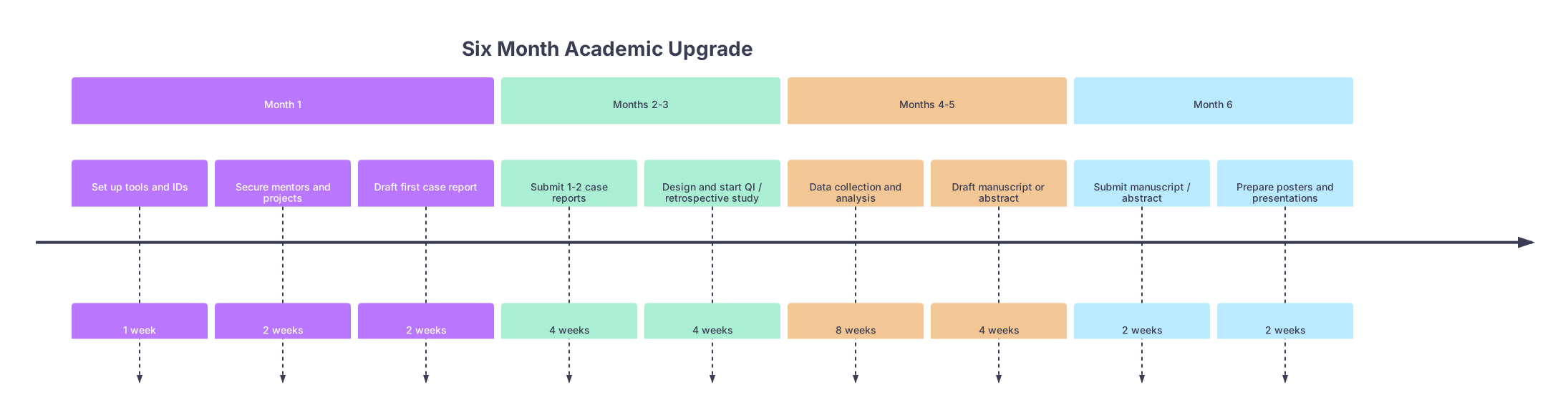
| Period | Event |
|---|---|
| Month 1 - Set up tools and IDs | 1 week |
| Month 1 - Secure mentors and projects | 2 weeks |
| Month 1 - Draft first case report | 2 weeks |
| Months 2-3 - Submit 1-2 case reports | 4 weeks |
| Months 2-3 - Design and start QI / retrospective study | 4 weeks |
| Months 4-5 - Data collection and analysis | 8 weeks |
| Months 4-5 - Draft manuscript or abstract | 4 weeks |
| Month 6 - Submit manuscript / abstract | 2 weeks |
| Month 6 - Prepare posters and presentations | 2 weeks |
Months 2–3: From “I Helped” to “I Led a Project”
Now you move beyond case reports and busywork.
1. Pick 1 main project you can realistically finish
You need one “anchor project” where you can say in interviews: “I designed and led this.” Not as first author on NEJM. As someone who took ownership.
Good options for IMGs in 6 months:
- Retrospective chart review
- Simple QI project
- Survey study among patients or providers
- Pure literature-based meta-research (like bibliometric analysis)
A. How to choose
Use this quick filter:
- Feasible with data access you already have or can get
- Approvals possible within 4–6 weeks (IRB or QI)
- Analysis can be done with Excel / basic stats
- At least one mentor genuinely cares about the topic
If your mentor suggests a project that “needs 2–3 years of follow up,” smile, nod, and say you are happy to help—but pick a second project you can finish.
2. Designing a retrospective chart review (bread-and-butter IMG project)
Example: “Outcomes of patients admitted for acute heart failure before and after implementation of a new diuresis protocol.”
Basic steps:
Refine the question
- Population: Adults admitted with acute heart failure
- Time frame: 12–24 months
- Exposure or grouping: Before vs after protocol
- Outcomes: Length of stay, readmission, in-hospital mortality
Get approvals
- Work with your mentor to determine:
- Is full IRB needed, or is this QI/Exempt?
- What templates does the hospital use?
- Your role: draft the protocol, background, and data collection sheet.
- Work with your mentor to determine:
Build a clean data collection sheet
- Use Excel or REDCap
- Columns:
- Demographics: age, sex
- Clinical: comorbidities, baseline labs
- Process: time to treatment, intervention type
- Outcomes: LOS, ICU need, readmission, mortality
Do basic analysis
- Descriptive statistics: means, medians, percentages
- Simple comparisons: t-test, chi-square (with help if needed)
- Focus on clarity more than complex modeling
3. QI project: the most underused weapon for IMGs
Programs love applicants who can improve systems, not just collect data.
Example QI topics:
- Improve vaccination rates in a clinic
- Reduce unnecessary lab orders on admission
- Improve handoff quality between teams
- Decrease inappropriate telemetry use
QI formula:
- Identify problem (baseline data)
- Analyze root causes
- Plan intervention (education, checklist, protocol change)
- Implement
- Re-measure
- Present results
Even if you cannot complete multiple PDSA cycles in 6 months, you can:
- Collect baseline data
- Implement one intervention
- Show early results
- Write it as a QI abstract for a conference

Months 4–5: Turn Work Into Submissions
By Month 4, you should have:
- 1–2 case reports at various stages (submitted, revising, or nearly done)
- 1 main project with data collection underway or partially complete
- A mentor who recognizes your name and effort
Now the focus shifts sharply: everything must move toward something that can be submitted.
1. Aggressively time-box your tasks
You cannot afford open-ended “I’ll keep working.” You need clear weekly goals.
Example 2-week sprint:
Week A:
- Clean dataset (no missing IDs, consistent units)
- Run descriptive stats
- Generate 2–3 simple tables and 1 figure
Week B:
- Draft Methods (data source, inclusion/exclusion, variables, stats)
- Draft Results (without over-interpreting)
- Send to mentor for feedback with specific questions
Specific questions mean:
- “Is the grouping variable defined the way you want?”
- “Are these the primary outcomes you care about?”
- “Is there any subgroup you especially want analyzed?”
Mentors answer those emails. They ignore “What do you think?”
2. Start writing even before data is “perfect”
Amateurs wait for perfect data, then panic. Professionals write in parallel.
Write in this order:
- Methods
- Results skeleton (section headings, planned tables)
- Introduction (short, 3–4 paragraphs)
- Discussion
If your English is not strong, use a strict structure and short sentences. Do not try to sound fancy. Try to sound clear.
Example Discussion structure:
- One paragraph: Restate main finding in plain language
- Two paragraphs: Compare to 2–3 key prior studies
- One paragraph: Strengths and limitations
- One paragraph: Implications + future directions
3. Abstracts and posters: quicker than full papers
Do not wait for a full manuscript to be perfect before you get visibility.
Targets:
- Local hospital research days
- State chapter meetings (ACP, ACR, AAP, etc.)
- National conferences (with lead times 3–6+ months)
You want:
- 1–2 accepted abstracts
- 1–2 posters or oral presentations where you are first or second author
These become concrete bullets in ERAS, and you can discuss them well in interviews.
| Type of Work | Time to Submission | Difficulty | Typical Role | How Programs View It |
|---|---|---|---|---|
| Case report | 4–8 weeks | Low | First author | Nice but low impact |
| Letter / commentary | 2–4 weeks | Low | First or co-author | Shows engagement with field |
| QI project | 2–6 months | Medium | Co- or first author | Very attractive for clinicians |
| Chart review | 3–6 months | Medium | Co- or first author | Solid academic experience |
Month 6: Package Everything for ERAS and Interviews
You can have 10 projects in limbo and still look weak. Or 3–4 well-packaged outputs and look solid.
Month 6 is about presentation and strategy.
1. Clean, specific, believable CV entries
Programs can tell when someone is inflating. Do this right.
For each activity in ERAS:
Use a clear, accurate role:
- “Co-investigator” if you actually worked on design or analysis
- “Data abstractor and co-author” if you did data and some writing
- Avoid “Principal Investigator” unless it is truly your project and IRB lists you as such.
In the description, emphasize:
- Your responsibility
- Methods skills used
- Outcome (submitted/accepted/presented)
Example:
Retrospective cohort study of 250 patients admitted with acute decompensated heart failure before vs after implementation of a standardized diuresis protocol. I helped design the data collection tool, extracted data from the EMR, performed descriptive analysis in SPSS, and drafted the methods and results sections for an abstract submitted to the [Name] Conference.
That reads like a real, involved project. Because it is.
2. Build a sharp “research story” for interviews
You will be asked: “Tell me about your research.” You need a 60–90 second answer.
Use this structure:
Context – Where you started
- “When I graduated, my research exposure was limited to a small project in medical school and no publications.”
Action – What you did over these 6 months
- “Over the last 6 months, I focused on building practical skills: literature review, basic stats, and QI methodology. I worked closely with [specialty] attendings on case reports, a QI project to improve [X], and a retrospective study of [Y].”
Results – Concrete outputs
- “This led to two case reports submitted to PubMed-indexed journals, one QI abstract accepted at our hospital research day, and an ongoing chart review that we are preparing for submission.”
Future – How it fits residency
- “My goal as a resident is to continue this track record in [program’s specialty], focusing on projects that improve [specific domain relevant to that program].”
You are not selling yourself as a bench scientist. You are selling yourself as a clinically grounded resident who can produce useful academic work consistently.

How To Prioritize When Time And Energy Are Limited
You will not execute a perfect 6-month plan. Life, shifts, visas, exams, and family will interfere. So here is the priority stack.
If you can only do one thing well:
- Lead a single, well-executed QI or chart review project that results in at least an abstract or poster.
If you can do two:
- That anchor project
- Plus 1–2 case reports with you as first author
If you can do three:
- Anchor project
- 1–2 case reports
- One short narrative review or commentary in your target specialty
What to stop doing:
- Massive unpaid “research assistant” work where you are only entering data with no clear path to authorship
- Spinning on complicated projects that will not reach submission in under a year
- Chasing big-name labs that barely respond, while ignoring local or smaller mentors who will actually publish with you
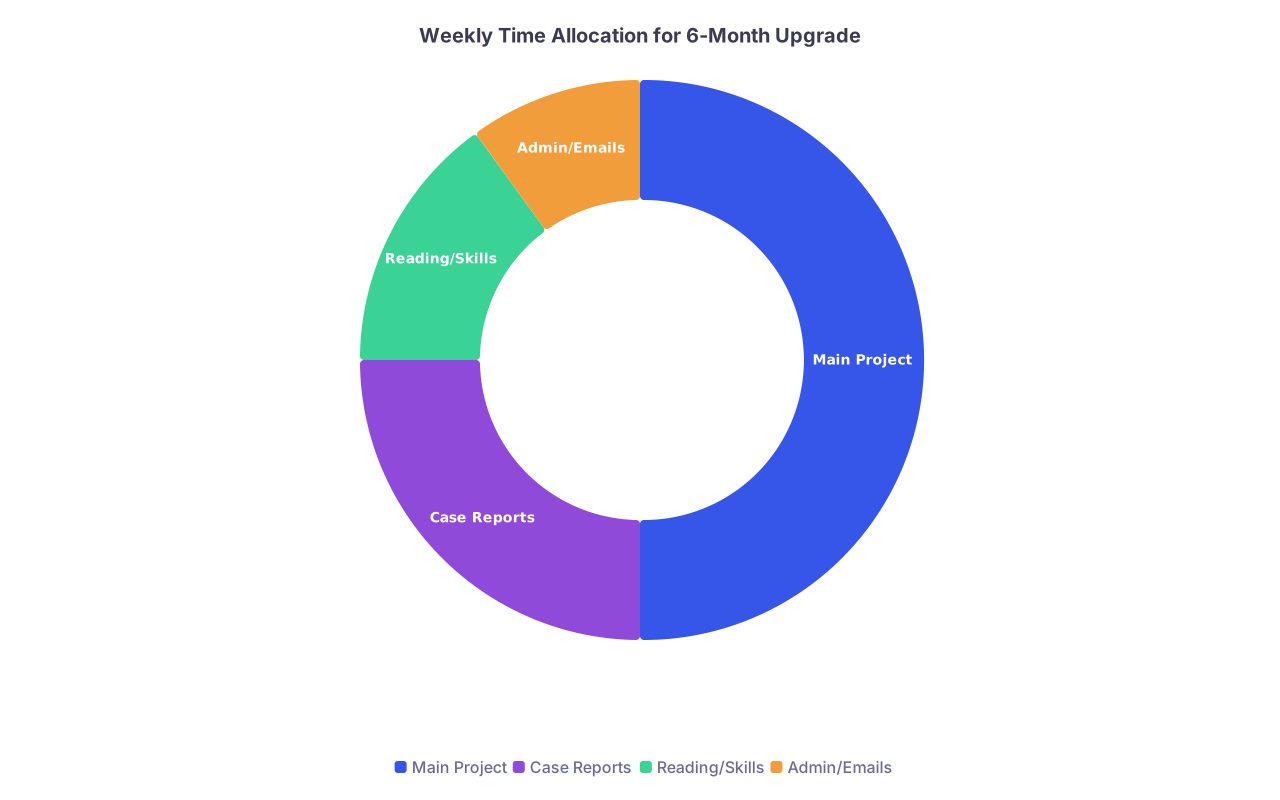
| Category | Value |
|---|---|
| Main Project | 50 |
| Case Reports | 25 |
| Reading/Skills | 15 |
| Admin/Emails | 10 |
Common Pitfalls That Kill IMG Research Progress
I have seen the same mistakes repeatedly. Avoid them.
Waiting for the perfect mentor
- A mid-level hospitalist who publishes 2–3 papers a year is more valuable to you than a world-famous researcher who never answers emails.
Over-valuing basic science
- If you have 6 months, you should almost never be starting wet lab work. You will become cheap labor with no authorship.
Vague roles and expectations
- Before you commit, ask explicitly:
- “If I do X, Y, Z, can I expect to be a co-author?”
- “Who will be first author?”
- “What is the expected timeline for submission?”
- If that conversation feels uncomfortable, that is a red flag.
- Before you commit, ask explicitly:
Not writing things down
- Maintain a one-page “Project Tracker” listing:
- Title
- Role
- Mentor
- Status (Idea / Data / Draft / Submitted / Accepted)
- Deadlines
- Maintain a one-page “Project Tracker” listing:
Ignoring the “limited research” narrative
- Programs do not just see your past weakness. They look for evidence that you recognized it, took ownership, and fixed it.
If You Are Already Inside a Match Cycle
Different scenario: you are 3–4 months from rank lists and feel behind.
Your priorities change:
- Push any ongoing projects to submitted status, even as abstracts or letters.
- Request a letter from your research mentor that highlights:
- Reliability
- Initiative
- Specific contributions
- Prepare crisp, honest answers for interviews:
- Acknowledge limited research historically
- Emphasize the concrete steps you are taking now
- Focus on future potential and specific interests
You can still use this 6-month plan. But now the main benefit is for:
- SOAP outcomes
- Reapplication if needed
- Late additions to your ERAS before some programs finalize rank lists
Final Reality Check
You cannot erase being an IMG. You cannot manufacture a five-year research portfolio in 6 months.
You can:
- Go from “no research” to “credible academic engagement”
- Demonstrate discipline, follow-through, and real intellectual curiosity
- Give programs something concrete to point to when they argue for you in a selection meeting
The IMG with zero publications, vague talk about “interest in research,” and no plan will lose.
The IMG with 1–2 small first-author items, a solid QI or chart review project, and a coherent story will not.
Key Takeaways
- Treat the next 6 months as an academic boot camp: set up tools, secure mentors, and commit to 1 anchor project plus quick-win case reports.
- Aim for submissions, not perfection: abstracts, posters, and small papers create real CV entries and strong talking points for interviews.
- Control your narrative: move from “limited research” to “rapid, focused academic growth” that programs can respect and bet on.