
What do program directors really think when they see a vague, generic LOR from an unknown IMG home institution?
Let me be blunt: they discount it. Sometimes almost entirely.
As an IMG, your letters of recommendation are not “just another part” of the application. They’re one of the only ways a program can cut through all their skepticism: unfamiliar school, different grading system, different clinical culture. LORs either fight for you—or quietly kill you.
US grads can survive mediocre letters because program directors already know their schools, their clerkship structure, their grading. IMGs cannot. The same mistake that’s a minor bruise for a US grad can be a fracture for you.
Let’s walk through 7 LOR mistakes that punish IMGs much harder than US grads—and how to avoid each one before it sabotages your Match.
1. Using Only “Home Country” Letters with No US Clinical Experience
This is the silent killer for otherwise strong IMG applications.
Program directors are asking one big question: Can this person function in a US hospital tomorrow? If every letter is from your home country, they don’t get an answer.
Here’s the problem:
- They don’t know your hospital.
- They don’t know your evaluation culture.
- They don’t know how much English you actually use with patients.
- They don’t know if documentation, teamwork, and systems thinking will translate.
So they assume the worst or, more often, they just move on to the applicant whose letters make their job easier.
US grads don’t face this. Their “home” letters come from people who already exist in the US system. Yours don’t.
Red flags that your LOR mix is hurting you:
- All 3–4 letters are from your home institution.
- “US experience” is just observerships with no US-based LORs.
- Your strongest advocate is a big-name professor back home, but nobody in the US is vouching for your actual clinical performance.
What to do instead:
- Aim for at least 2 strong US clinical letters in the specialty you’re targeting.
- If you’re applying to internal medicine, and your only US letter is from a two-week cardiology observership? That’s weak. You want:
- 4–8 weeks of US hands-on experience (where possible).
- Letters from attendings who saw you present, write notes, and interact with patients and staff.
Do not convince yourself that “a superstar back home” letter replaces US letters. It doesn’t. At best it’s additive. At worst, it just highlights what’s missing.
2. Choosing “Big Names” Who Barely Know You
This one is practically an IMG tradition. And it backfires constantly.
You finally set up a rotation with the Chair of Medicine or some famous professor. You think: “Perfect. I’ll get a powerful letter.” So you do the rotation, have one or two conversations, never present to them directly… and then you ask for a letter.
You get what I see over and over:
“I had the pleasure of working with Dr. X for a brief time. She appears motivated, hardworking and pleasant. I believe she will do well in a residency program.”
That letter is trash. Name or no name.
Program directors have read thousands of letters. They can spot a “favor letter” in 10 seconds. It usually:
- Has generic adjectives with no specific examples.
- Gives almost zero detail about what you actually did.
- Mentions “brief exposure” or “short time.”
- Sounds interchangeable with a letter for 20 other people.
US grads can occasionally get away with that because they might also have two detailed letters from core rotations at well-known institutions. IMGs usually don’t have that cushion. Your “big name, small substance” letter becomes an obvious red flag.
Better strategy: Pick the attending who can write specifics, not the most famous one.
You want someone who:
- Watched you present daily.
- Gave you feedback on notes or plans.
- Saw how you interacted with nurses, patients, and consultants.
- Can say: “I observed her on X, Y, Z and this is exactly how she performed.”
If you must choose between:
- Department chair who knows you for 1 week, barely.
- Associate program director who supervised you closely for 4 weeks.
Pick the second. Every time.
3. Generic, Personality-Only Letters That Don’t Prove You Can Function as a Resident
For IMGs, “hardworking, kind, punctual” is the bare minimum. It will not move your application.
I’ve seen too many IMG letters that sound like this:
“He is polite, respectful, and always on time. He completes his work with diligence and has good communication with staff.”
That sounds nice, but it answers none of the questions US programs actually care about:
- Can you handle the pace?
- Can you synthesize information and create a reasonable plan?
- Can you communicate clearly in English with patients and team?
- Do you recognize when you’re over your head and ask for help?
For US grads, programs assume some baseline familiarity with their training environment. For IMGs, your letters are often the only proof you won’t crash on Day 1.
Fix this before the letter is written: You can’t edit your LOR, but you can shape it by how you work and communicate during the rotation. Give your future letter writer material to work with:
Ask things like:
- “Do you have any feedback on how I present on rounds?”
- “Are there ways I can better structure my assessment and plan?”
- “Was my progress note clear enough? Anything I should change?”
Then actually improve.
When attendings see you respond to feedback, they mention it:
- “She actively sought feedback and incorporated it into her presentations within days.”
- “His progress notes improved significantly after we discussed structure.”
Those lines tell PDs: this person can grow in our system. That’s what you’re selling.
4. Letting Letters Be Vague About Your Role and Level of Responsibility
Huge issue for IMGs.
Most US attendings do not automatically understand:
- What “intern” means in your country.
- What your scope of practice was.
- Whether you were allowed to write notes, place orders, or just observe.
So when a letter says:
“Dr. X was an intern in our ward and took excellent care of her patients.”
US program directors don’t know if that means “actual primary patient care” or “shadowing the real intern.” Many will assume the latter.
US grads usually have clear roles by convention: sub-I, M4, etc. Their letters naturally reflect those expectations. IMGs often fall into a gray zone: extern? observer? house officer? student? No one is sure.
Letter phrases that hurt IMGs:
- “I met her during her observership…” with no clarification of what she actually did.
- “He was present on rounds and demonstrated interest in learning.”
- “She participated in patient care” (what does that mean, exactly?).
What you want instead: Your letter needs to spell out:
- Your role (student/extern/observer/house officer).
- What you were actually allowed to do.
- How closely you approximated an intern’s responsibilities.
Ideal lines look like:
- “Although officially an observer, he was allowed to write notes that I reviewed and edit daily. His documentation was at the level of an incoming intern.”
- “Functioned in a role similar to a US fourth-year sub-intern, carrying 4–5 patients independently with indirect supervision.”
- “Performed initial histories and physicals, presented on rounds, and generated assessment and plans that we frequently adopted with minimal changes.”
You can’t force an attending to write this, but you can prime it by explaining your role before or when you request the letter:
“Just so you have context, during this rotation I was allowed to write notes, present on rounds, and follow my own patients similar to a sub-I. I know PDs often don’t know what IMGs actually do, so I figured that might be useful to clarify.”
Subtle, but effective.
5. Not Tailoring Your LOR Selection to the Specialty You’re Applying To
IMGs love to collect letters like Pokémon. Three internal medicine letters, one surgery, one pediatrics, plus that random research mentor from dermatology—then they upload them all and click randomly.
That’s a mistake US grads make too. But IMGs pay a higher price.
Programs already doubt your “fit” for their specialty. If your letter mix looks unfocused, they assume you’re just trying to secure any residency spot. Desperate applicant energy. Nothing kills confidence faster.
Here’s what I see too often:
- Applying to internal medicine with:
- 1 IM letter from a short US observership.
- 1 surgery letter from home.
- 1 research letter in oncology.
- Or applying to family medicine with:
- 2 IM letters.
- 1 home-country letter from OB/GYN.
US grads sometimes get away with mismatch because PDs already know their core rotations included everything. You don’t get that benefit of the doubt.
Minimum standard for IMGs:
| Target Specialty | Ideal US Clinical LORs | Optional Extra LOR |
|---|---|---|
| Internal Medicine | 2–3 IM attendings | 1 research or home |
| Family Medicine | 2 FM (or 1 FM, 1 IM) | 1 community setting |
| Pediatrics | 2 peds attendings | 1 related subspec |
| Psychiatry | 2 psych attendings | 1 IM/FM |
You don’t need to be perfect. But if you’re applying to IM with:
- 0 US IM letters, and
- 3 home-country mixed-specialty letters…
You’re basically announcing: “I couldn’t secure serious, focused US experience in this specialty.”
That’s a problem.
Fix it:
- Prioritize rotations in the specialty you’re applying to.
- Get at least two US LORs from that specialty.
- If you must include a research or home-country letter, make sure it:
- Talks about skills relevant to the residency you want (clinical reasoning, reliability, communication).
- Doesn’t overshadow the lack of US specialty-specific letters.
6. Using Overly Formal, Stiff, or Non-Standard Language That Raises Communication Concerns
US program directors read letters quickly. Anything that feels “off” stylistically makes them pause—for the wrong reasons.
US grads rarely have this issue because their letters follow familiar patterns. IMGs often get hurt by letters that:
- Sound like they were written from a template used for decades in another system.
- Use awkward, overly formal English.
- Overpraise in a way that seems unrealistic or culturally out of sync.
Example I’ve seen from IMG home letters:
“He is an extraordinary, unparalleled individual, whose brilliance and rare intellect far exceeds his contemporaries. He will be a shining ornament to any program that secures his presence.”
This doesn’t make you look brilliant. It makes the letter look unreliable.
Or the opposite problem—letters full of grammar errors or non-standard phrasing. That might be fine in everyday conversation, but in a formal LOR it makes PDs wonder: how strong is this applicant’s communication, really?
You can’t edit the letter. But you can choose the writer.
Choose people who:
- Are comfortable writing in formal English, or
- Have an assistant/department accustomed to writing US-style letters, or
- Have written for US-bound IMGs before.
During your US rotations, pay attention. Which attendings:
- Are used to having IMGs?
- Have previously written letters that helped people match?
- Communicate clearly in written form (emails, feedback, etc.)?
That’s who you want writing for you.
You’re not being “picky” or “entitled.” You’re protecting yourself. As an IMG, anything that hints at communication problems gets magnified.
7. Asking for Letters Too Late—or Without Any Guided Timing Strategy
US grads are coached from M3: ask early, remind politely, track your letters. Most IMGs? No system. Just hope.
And here’s what happens:
- You finish a great rotation in May.
- You “don’t want to bother” the attending yet.
- You email them in August, when they’re slammed with US students and ERAS season.
- They:
- Forget details about your performance.
- Write a rushed, generic letter.
- Or miss your deadline completely.
US grads have schools breathing down attendings’ necks. Reminder systems. Deadlines. You don’t. When you’re an IMG rotating unofficially or outside a formal system, everything falls on you.
Consequences for you:
- Weak, vague letters because the writer can’t remember specifics.
- Letters that show up late and miss early review cycles.
- Or no letter at all, forcing you to rely on old home-country letters.
Better timeline:
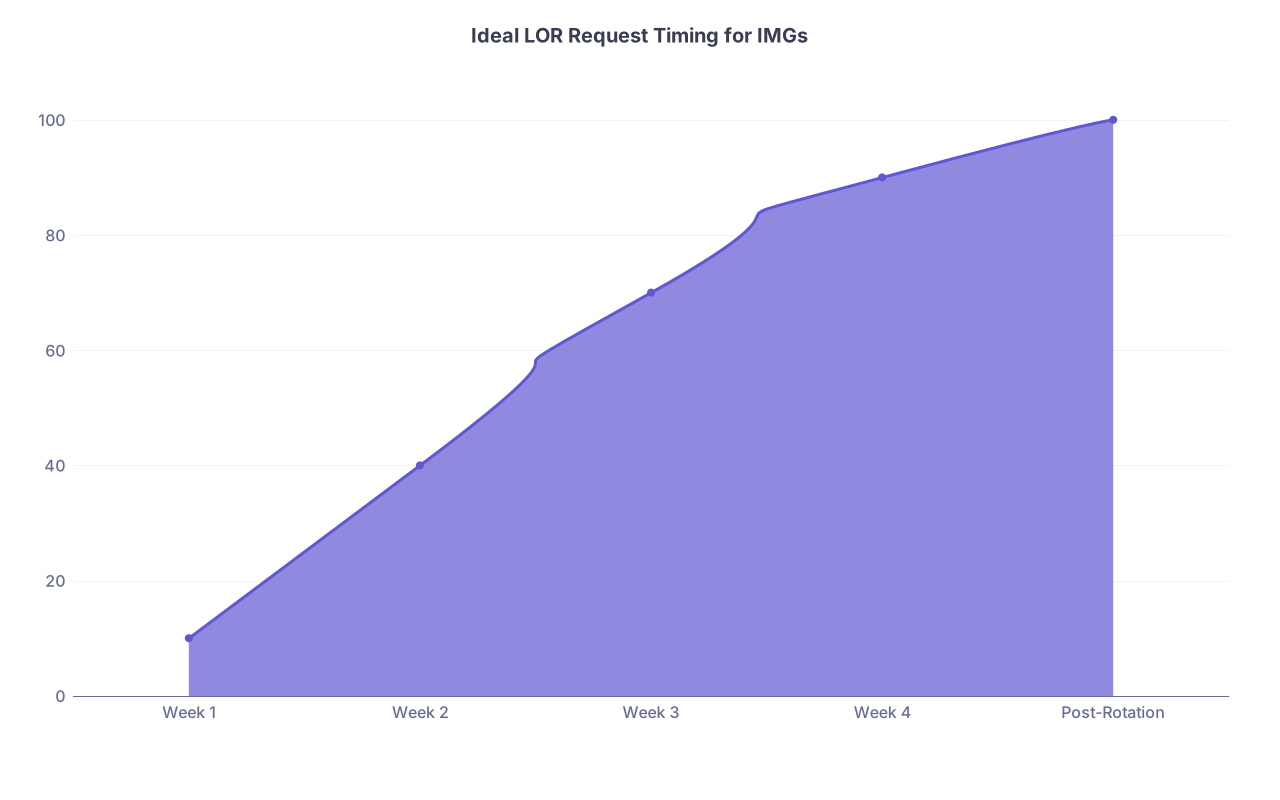
| Category | Value |
|---|---|
| Week 1 | 10 |
| Week 2 | 40 |
| Week 3 | 70 |
| Week 4 | 90 |
| Post-Rotation | 100 |
Think of it this way:
- Week 2–3 of a 4-week rotation: you already have a track record.
- The attending has seen enough to say yes or no honestly.
- You’re still fresh in their mind.
So you say:
“Dr. Smith, I’ve really appreciated the chance to work with you. I’m applying to internal medicine this ERAS cycle and was wondering if you’d feel comfortable writing me a strong letter of recommendation based on my performance here.”
Key word: strong. Give them an out. If they hesitate, that’s your sign to ask someone else.
After they agree:
- Confirm deadlines clearly.
- Send them:
- Your CV.
- Personal statement draft.
- ERAS ID and instructions.
- A brief reminder of specific patients/cases where you contributed well (so they can include details).
Then follow up. Politely but persistently. Because no one else is going to manage this for you.
Visualizing How Harsh This Really Is for IMGs
You might be thinking, “Are letters really that big a deal?” Yes, especially for you.
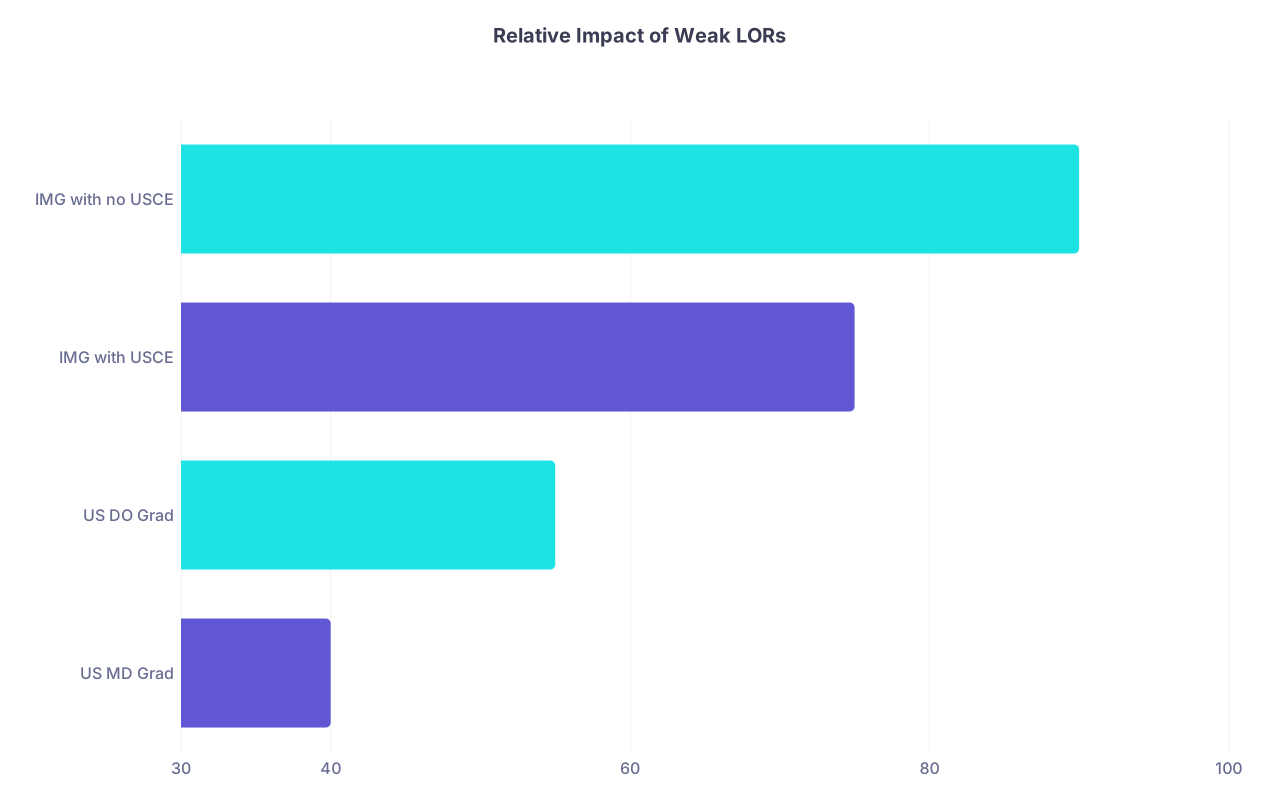
| Category | Value |
|---|---|
| US MD Grad | 40 |
| US DO Grad | 55 |
| IMG with USCE | 75 |
| IMG with no USCE | 90 |
Interpret this as “how badly weak LORs hurt you,” not a real numeric metric, but a pretty accurate representation of reality. Weak letters are mildly annoying for US grads. For IMGs, they’re often fatal.
How to Protect Yourself as an IMG
If you remember nothing else, remember this:
Your LORs must compensate for unfamiliarity.
You’re unknown territory to programs. Your letters must be:- Specific
- Recent
- US-based when possible
- Aligned with your target specialty
Avoid “favor letters” and generic praise.
Big names with vague language hurt you more than modest names with detailed, credible observations.Manage the process like your Match depends on it—because it does.
Ask early. Choose writers strategically. Clarify your role. Provide materials. Follow up.
Do not assume letters are a formality. For IMGs, they’re often the difference between “we’ll take a chance on this person” and “too risky, pass.”