
A single lukewarm letter of recommendation has killed more otherwise-solid IMG applications than any below-average Step score. And the applicants almost never know why.
You worry about scores, CV gaps, visas, “US clinical experience.” That’s what everyone talks about publicly. Behind closed doors, on the other side of that conference room door, there’s something else that quietly decides your fate: how your letters read when the committee is tired, jaded, and sorting through 2,000 files.
For IMGs, a bad or even bland letter is not neutral. It is interpreted as a red flag. Not “no impact.” Negative impact. I’ve watched it happen in real rank meetings, in programs that absolutely swear they “take a holistic view.”
Let me show you how it really works.
What Program Directors Really Do With Your Letters
Here’s the part nobody tells you: most letters are scanned, not read. But the ones that matter get dissected line by line.
On a busy internal medicine selection committee, the workflow often looks like this:
- A coordinator or junior faculty screens for obvious cutoffs (failed Steps, no US letters, insane number of gaps).
- Someone opens your PDF packet, scrolls to the letters, and does a 10-second “smell test” on each.
- If your file is strong and your letters look at least reasonably enthusiastic, you pass into the “interview” or “maybe” pile.
- If something in a letter feels off? The whole room suddenly pays attention.
This is what you probably don’t appreciate as an IMG: your letters are not compared to some abstract ideal. They’re compared to the dozens of IMG letters that same program has seen over the last decade.
I’ve heard versions of this countless times in real meetings:
“Scores are great, research looks strong. But did you read that surgery letter? That’s a no from me.”
The candidate never finds out. They assume “I guess my Step 2 wasn’t high enough” or “maybe they don’t like visas.” Wrong. One attending wrote three bland sentences, and that was enough to poison the file.
Why IMGs Get Less Benefit of the Doubt
For US grads, a mediocre letter may just be interpreted as “busy attending, not a big writer.” For IMGs, that same letter gets read as:
- “They rotated here and nobody was truly impressed.”
- “If this is the best letter they could get, that’s concerning.”
- “We’ve been burned before by glowing CVs and weak letters from IMGs.”
There’s bias baked into this. I’m not defending it. I’m telling you what actually happens.
The committee is always worried about one thing: risk. With IMGs, they’re paranoid about taking a chance on someone who may have communication problems, professionalism issues, or poor clinical independence. Letters are supposed to be the truth serum that reveals that risk.
So one weak letter doesn’t just “subtract points.” It reframes the entire story of your application.
How A Weak LOR Actually Looks From the Inside
You probably think a “weak” letter means someone openly criticizes you. No. A truly bad letter is rare. A weak letter is subtle. Polite. Technically positive. And lethal.
Here’s a rule of thumb most PDs use, whether they say it out loud or not:
- Strong letter: Specific, vivid, comparative, and enthusiastic.
- Neutral/weak letter: Generic, nonspecific, over-formal, or faint praise.
- Problematic letter: Explicit concerns, hesitations, or coded language.
Let me walk you through what that looks like in real wording.
The Silent Assassin: The Generic Letter
I’ve seen this exact pattern derail IMGs who otherwise looked outstanding.
Letter says:
“I had the pleasure of working with Dr. X during their rotation in our internal medicine department. They were punctual, professional, and eager to learn. They will be a good addition to any residency program.”
You might read that and think: “That’s fine. No criticism.”
The committee reads: “This attending had nothing truly strong to say.”
It’s what’s missing that hurts you:
- No examples of cases.
- No mention of clinical reasoning.
- No comparative phrases like “among the best students I’ve worked with.”
- No clear “I would rank this applicant highly in our own program.”
So in a room where they’re deciding between twenty IMGs with similar scores, your generic letter basically says: “pick someone else.”
The Damning Faint Praise
This is even worse. Looks benign on the surface, but the wording is poison.
Common phrases that insiders instantly recognize as negative:
- “With appropriate supervision, they will make a good resident.”
- “Given support and structure, they can succeed in residency.”
- “I did not observe any major concerns.”
- “They were very respectful and interacted well with staff.”
Those sentences are career-ending if they’re the core of your letter. Because they signal one thing:
“I have nothing impressive to say about their clinical brain, so I’m talking about them like a borderline student I’m trying not to fail.”
An IMG with one such letter almost never makes it high on a rank list at a competitive program. At best, you end up in the “we’ll rank them low, just to fill the list” zone.
The “Something’s Off” Letter
Then there’s the letter that doesn’t explicitly criticize you, but smells weird.
I sat in a surgery committee once where the PD paused on a letter and read this line out loud:
“While I cannot comment on their independent clinical decision making, they appeared eager to follow instructions and were always present.”
The room went silent, then someone said: “Hard pass.”
What do they hear?
- “Cannot comment on decision making” = I don’t trust them clinically, or didn’t see enough initiative.
- “Follow instructions” = passive, not proactive.
- “Always present” = bare minimum.
It’s the tonal mismatch that gets them. Scores in the 250s, research solid, but this one sentence put enough doubt in their minds that the application died on the table.
The IMG Problem: You Have Less Margin For Error
For US grads, one weak letter gets diluted by a dean’s letter, home-institution support, and often multiple strong US attending letters.
For IMGs, the structure is different. You usually have:
- 1–3 US letters (often from short rotations, observerships, or externships).
- 1–2 home-country letters that US programs barely credit unless they’re from a known name.
- Sometimes one vague group letter from a “department.”
So each US-based letter has outsized weight. And faculty know this.
Behind closed doors, the conversation sounds like:
“We have three US letters from this person. Two are good, one is lukewarm.”
“If they couldn’t get three strong letters out of three attempts, that worries me.”
Or worse:
“Only one US letter and it’s not very strong. That’s all we really have to go on.”
In other words, a single weak US letter for an IMG isn’t a 33% downgrade. It can be a full stop.
| Category | Value |
|---|---|
| USMD | 20 |
| USDO | 25 |
| IMG | 35 |
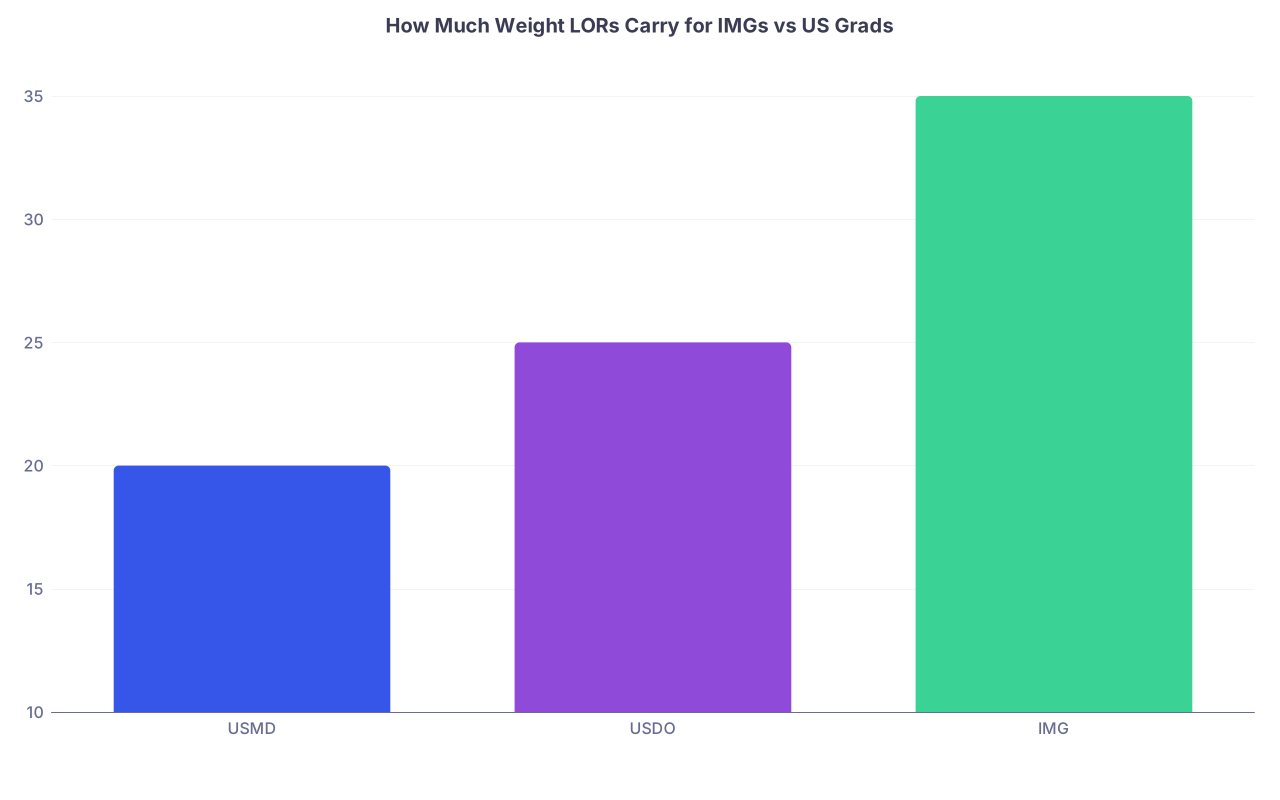
This is roughly how many PDs psychologically weight LORs (as a percentage of decision-making) when they talk about risk. Notice how IMGs get judged harder on letters because they’re seen as the “real-world test” of your performance in the US system.
Where IMGs Go Wrong With Letters
I’ve watched IMGs sabotage themselves in the same preventable ways for years. Not because they’re careless. Because nobody on their side explains how merciless US readers are.
Mistake 1: Choosing the Wrong Letter Writers
You chase “big titles” instead of “people who actually know you.”
So you end up with:
- A world-famous professor who barely interacted with you, writing a two-paragraph generic letter.
- A busy department chair who delegated the letter to a fellow who never saw you on the wards.
- A clinic preceptor who liked you personally but never saw you manage sick inpatients.
From the committee’s angle, what matters isn’t the name at the bottom. It’s the level of detail in the middle.
I’ve seen unknown community attendings write absolute powerhouse letters that move PDs, while big-name professors submit cut-and-paste garbage that gets skimmed and ignored.
If your interaction with the attending was limited to one week of shadowing, don’t expect a letter that can carry an IMG application. You do not have the luxury of “just getting any US letter.”
Mistake 2: Asking Too Early Or Too Late
Another classic IMG trap.
Too early: You ask at the end of a two-week observership, after minimal direct evaluation. The attending says “sure,” then sits in front of a blank screen thinking, “What the hell do I even write about this person?” Result: thin letter, full of fluff.
Too late: You email nine months later, and they barely remember you. Or worse, they confuse you with another student. So they default to clichés and vague praise.
Either way, you get a letter that reads like it could have been written for anybody.
Mistake 3: Not Controlling The Narrative
US grads are coached by their schools. They bring CVs, personal statements, bullet points, and politely guide their letter writers: “Here are some things I was particularly proud of on the rotation.”
IMGs often do the opposite. They feel grateful and deferential, so they say:
“Dear Dr. X, I would be honored if you could please write me a letter for residency.”
Full stop. No context. No talking points. No specifics.
The result? Generic letter. Again.
You’re not cheating by curating your story. You’re helping a time-poor attending remember what actually happened. And you’re subtly steering them away from the worst pitfall: empty phrases.
The Unspoken Codes PDs Look For (And Against)
Residency faculty don’t sit around with a secret handbook of coded LOR phrases. But after reading thousands, everyone develops an internal translation system.
Here’s some of the quiet code you’re up against.
| Letter Phrase | How It’s Interpreted For An IMG |
|---|---|
| “Hardworking and diligent” | Baseline. Tell me something real. |
| “Always present and punctual” | Low bar. Nothing clinically impressive. |
| “Eager to learn” | Passive. Needed lots of teaching. |
| “Will do well with appropriate supervision and support” | Questionable independence. Risky. |
| “I did not observe any professionalism concerns” | Why bring this up? Now I’m worried. |
| “Among the top students I have worked with” | Strong signal. Pay attention. |
| “I would be thrilled to have them as a resident here” | Gold standard. Strongly supportive. |
Nobody writes: “This IMG is mediocre; don’t rank them.” But they don’t have to. The committee can read.
And yes—if the same phrase appears in a US grad’s letter and an IMG’s letter, the IMG is judged more harshly. Because the baseline expectation is different: US grads are assumed “safe” unless proven otherwise, IMGs must prove they’re safe and excellent.
A Realistic Scenario: How One Letter Sinks You
Let me walk you through a case that’s played out with minor variations hundreds of times.
An IMG internal medicine applicant:
- Step 1: 236
- Step 2 CK: 244
- Multiple research posters, one small publication
- 3 months US clinical experience
- Applies to 120 IM programs
Letters:
- Community hospital IM attending – very strong, specific inpatient stories.
- Academic hospital cardiology attending – solid, one good case, some comparisons.
- Academic hospital ICU attending – generic two-paragraph letter, very polite.
Behind the door, at a mid-tier university program, here’s how this actually goes.
File reader: “Scores are fine, research is decent, looks like solid US experience. Let’s check the letters.”
Reads #1: “Among the top IMGs I’ve worked with. Took ownership of patients. Presented concise, accurate assessments. I would happily take them as an intern on my team.”
Heads in the room nod.
Reads #2: “Managed complex cardiac patients, including a challenging hypotensive post-MI patient where they suggested starting norepinephrine early. Good communication with nursing. Strong work ethic.”
More nods.
Reads #3: “Dr. X rotated in our ICU as an observer. They were punctual, respectful, and showed great enthusiasm for critical care. They interacted well with the team and are eager to pursue internal medicine training in the US.”
Room gets quiet. Someone asks: “Observer? So they weren’t actually managing patients?”
Another faculty: “If they were very impressive, the letter would say more than just ‘punctual and enthusiastic.’”
Someone else: “Exactly. If in the highest-stakes setting they only stood out as ‘eager,’ I’m worried.”
Result? Instead of “Strong IMG, invite,” you get “There’s some concern. Put them lower on the invite list.”
And because invitations are finite and they prefer US grads when in doubt, that “lower” ends up meaning “no interview.”
The applicant never ties it to that ICU letter. On paper, they did everything right. But to the committee, the pattern was: two positives, one quiet warning. And with IMGs, any doubt is often enough to push you off the bubble.
How To Prevent A Weak LOR From Ruining You
You can’t control everything. Some attendings are just bad letter writers. Some barely remember you. But you can stack the deck so one mediocre letter doesn’t torpedo your entire file.
1. Ruthless Selection of Letter Writers
Your hierarchy as an IMG should be:
- Attending who directly observed you managing real patients over time and liked you.
- Attending who heard you present repeatedly and trusted your reasoning.
- Known name who actually knows you.
- Known name who barely knows you.
Most IMGs flip that list. They chase prestige. That’s backwards.
If you’re choosing between a big-name department chair who barely remembers you and a mid-career, no-name hospitalist who watched you grind on nights and present clean notes—choose the hospitalist. Every time.
2. Test the Water Before You Ask
Do not blindly ask for letters. You ask this specific question:
“Dr. X, would you feel comfortable writing me a strong letter of recommendation for US residency?”
The word “strong” matters. Watch their face. Listen to the hesitation.
- If they say “Of course, you were excellent” without pause – good sign.
- If they say “Yes, I can write you a letter” with a non-committal tone – be careful.
- If they hedge with “I can write a letter confirming you rotated here” – that is a hard no. That is exactly the kind of letter that kills you.
You’re not being rude. You’re protecting yourself from a polite but lethal document.
3. Feed Them Real Material
When they agree, don’t just send your ERAS ID and CV.
You send:
- A short paragraph reminding them of specific patients or situations.
- Your personal statement or a brief summary of your story and goals.
- Any evaluations or feedback you received under them.
For example:
“Dr. X, you mentioned on rounds that you appreciated my concise presentations and the way I followed up on lab abnormalities quickly. I especially remember the patient with decompensated heart failure whose diuretics we adjusted daily based on urine output and weights…”
That jogs their memory and nudges them toward writing that into the letter. Suddenly the letter becomes specific. Specific means credible. Credible means strong.
The Harsh Truth: You May Need To Drop a Bad Letter
Let me be blunt: if you even suspect a letter might be weak, you are better off not using it, unless you literally have no alternatives.
I’ve seen IMGs cling to a brand-name institution letter that was obviously generic because they were proud they rotated there. The prestige does not rescue you from bland content. In fact, it may hurt you more: “If they were so great, why doesn’t this big-name person sound excited?”
If you have:
- Two strong, specific US letters
- One generic third letter
You do not “balance” the generic with the strong ones. You let it go. Many programs are fine seeing 2-3 letters, especially if the quality is high. They don’t give extra points for hitting the maximum number.
| Category | Value |
|---|---|
| 1 Strong, 2 Weak | 30 |
| 2 Strong, 1 Weak | 45 |
| 2 Strong Only | 55 |
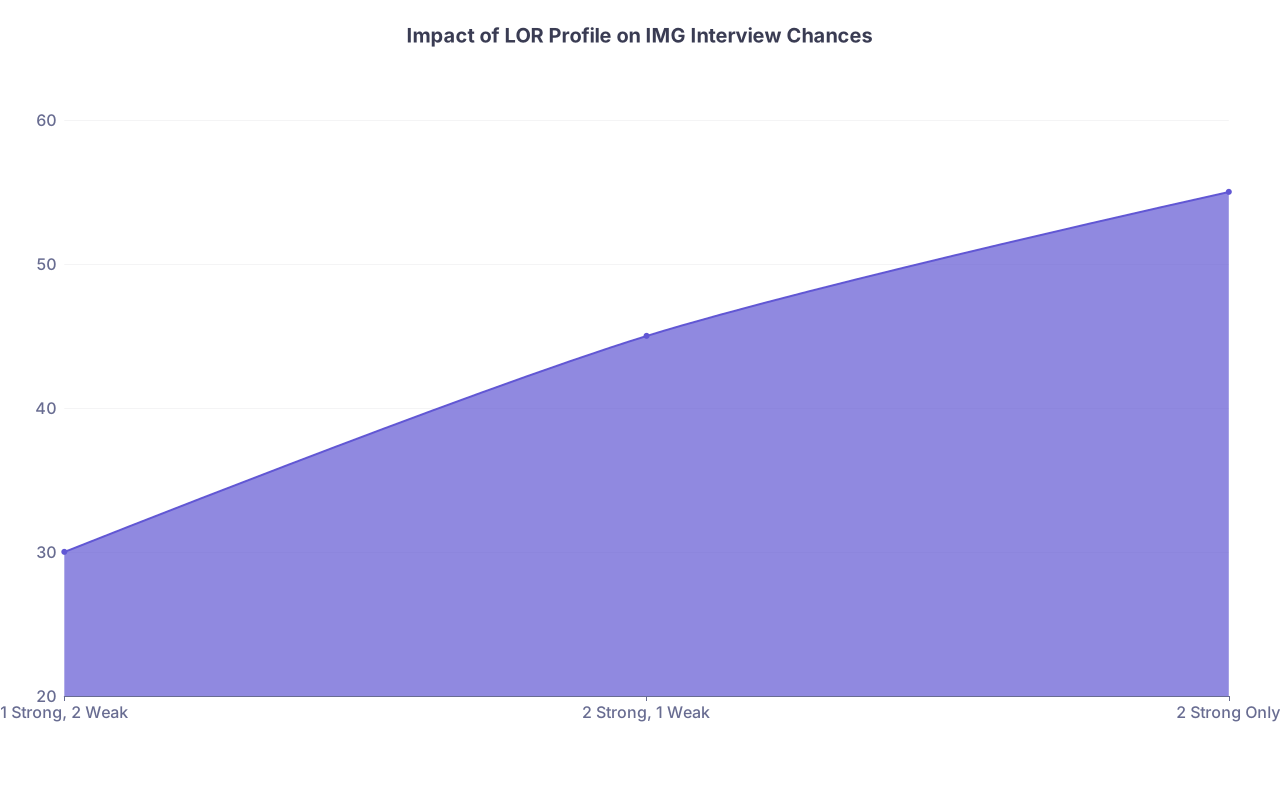
That rough pattern is exactly what PDs describe informally: fewer but clearly strong letters beat a mixed bag.
How This Plays Out On Rank Day
You survive the screening. You got the interviews. You think you’re fine.
Then comes ranking meetings.
For most programs, by the time they’re ranking, everyone has already seen your scores. The new information driving the final decisions:
- How you interviewed.
- How you were on the social/dinner.
- How your letters read once someone finally studies them deeply.
I’ve been in meetings where the PD says:
“I liked them on interview day, but I’m worried about this letter. Put them below the US grads with cleaner letters.”
Or even:
“We can rank them, but not in the top third. Too much risk.”
They will not tell you this. You will get a “Thank you for your interest” email the week after Match and be left guessing.
You might blame your performance on one interview question. Or your visa. Or your Step 1 score. But behind closed doors, a couple of lines in a letter you never saw shifted you from “likely match” to “safety slot” to “off the list entirely.”
The Bottom Line
If you’re an IMG, you cannot afford to be casual about letters of recommendation. They are not a formality. They are your highest-risk variable.
Three things to remember:
- One weak US letter can absolutely sink an IMG file, especially when it’s one of only two or three true US voices in your application.
- Generic = bad. For you, a polite, short, nonspecific letter is not neutral; it’s read as, “No one was truly impressed.”
- You have power. Choose your writers ruthlessly, ask specifically for a strong letter, give them concrete material to work from, and don’t be afraid to drop a suspect letter—even if it has a fancy logo at the top.
You cannot control PD bias, the market, or the number of interview slots. But you can absolutely control whether the words describing you on paper sound like a real resident—or like a name they forget the moment they close the file.