
The system will not save you. If your medical school just lost accreditation, you cannot wait, hope, and “see what happens.” You need a plan this week.
You’re in one of the ugliest IMG situations out there. Programs get nervous. ECFMG gets cautious. Rumors run faster than facts. I’ve watched people in your spot either salvage a career or slowly bleed away two or three years doing nothing strategic.
You’re not going to do that. Here’s how you move, step by step.
1. First: Get Clear on Your Exact Status (No Guessing)
Before you think about the Match or panic about “no residency ever,” you need one thing: clarity. Not from WhatsApp. Not from the loudest person in your class. From primary sources.
You must answer three questions:
- Does ECFMG still recognize my school for my graduation year?
- Will I still be eligible for ECFMG certification if I finish here?
- How are U.S./Canadian residency programs likely to view my situation?
Here’s where you go and what you do.
Check official recognition status
- Go to the World Directory of Medical Schools (WDOMS).
- Find your school by its official English name (not the nickname).
- Scroll down to the ECFMG Sponsor Note.
You’re looking for language like:
- “Graduates of this medical school are eligible to apply to ECFMG for ECFMG Certification and examination, provided they meet all other ECFMG requirements.”
- Or, in worse cases: “Graduates are not eligible…” or specific cutoff dates.
If there’s a cutoff year and your graduation date is after that, you have a serious problem. Not theoretical. Real.
Now cross-check with ECFMG:
- Go to ECFMG’s site and look for any specific statement or advisory about your school.
- If there’s any ambiguity, open a support ticket or email ECFMG with:
- Full name
- USMLE/ECFMG ID (if you have one)
- School’s full name and country
- Your expected graduation date
- Specific question: “Based on current policies, will I be eligible for ECFMG certification if I graduate from [school] in [month, year]?”
Do not ask “Is my school accredited?” Ask about your eligibility and graduation year.
Understand three possible scenarios
Stop thinking in generic “lost accreditation” terms. You’re probably in one of these buckets:
| Scenario | Your Likely Position |
|---|---|
| A. Fully protected | Graduation year explicitly covered in sponsor note |
| B. Transition zone | Wording unclear or dates close to your graduation |
| C. Cut off | Graduation year clearly not recognized |
- Scenario A: You can still become ECFMG certified. Your main challenge is optics (how programs view you), not legal eligibility.
- Scenario B: Risk zone. Policies might change again. You need contingency plans.
- Scenario C: You cannot rely on that diploma for U.S. residency. You need more radical options.
If you’re not sure which you are, you’re not done with this step.
2. Decide: Stay, Leave, or Pause (Brutal but Necessary)
Once you know your status, you have to decide whether to:
- Continue at your current school
- Transfer to another school
- Walk away, regroup, and change paths
Let’s be blunt. Staying because “I’ve already spent so much money” is a sunk cost fallacy. Programs do not care how much you paid. They care if your degree is legitimate and if you’re trainable and trustworthy.
If you’re in Scenario A (still ECFMG-eligible)
You can stay and graduate, but you must:
- Accept that some programs will screen you out on school name alone.
- Compensate with stronger:
- USMLE scores
- U.S. clinical experience (USCE)
- Letters of recommendation from recognized U.S. attendings
- A clean, transparent explanation of the situation
Staying can be rational if:
- You’re in clinical years already.
- Your school has decent match history historically.
- Administration is actively working with ECFMG and providing documentation to students.
Leaving in this scenario is usually overreaction. But coasting is also stupid. You’ll be under extra scrutiny.
If you’re in Scenario B (transition/unclear)
This is where most people freeze.
Here’s my take: you need a dual-track plan.
Continue your training for now while:
- Aggressively collecting documentation about your current status
- Exploring transfer options (more on this soon)
- Front-loading USMLE Step 1/Step 2CK studying in case timelines shift
Set a personal decision deadline:
- For example: “If ECFMG/WDMS status for my grad year is not clearly secured by [X date], I will pursue transfer options or alternative pathways.”
Write that date down. Otherwise you’ll drift for another year while your options shrink.
If you’re in Scenario C (cut off)
This is brutal, but you need to hear it straight: graduating from a school that ECFMG will not recognize for your year makes you effectively ineligible for U.S. residency via normal pathways. Programs cannot fix this for you. Connections cannot fix this.
Your realistic options:
- Transfer to an ECFMG-recognized school before graduation.
- Switch countries and pursue training where your degree is valid and recognized.
- Consider starting over (another medical school) if your long-term goal is strictly U.S. residency.
- Or pivot careers (public health, research, related fields) while reassessing.
“Maybe ECFMG will change their mind later” is not a plan.
3. Talk to the Right People (Not Just Each Other)
In crises like this, students form social media echo chambers that massively distort reality. You’ve probably seen it already.
Instead, you need targeted conversations:
1. Your dean’s office / administration
Ask very specific, written questions:
- “What is the official reason for the loss of accreditation?”
- “What is the school’s plan to regain or change accreditation?”
- “Has the school received any official communication from ECFMG or WDOMS about student eligibility by graduation year?”
- “Will the school provide official letters explaining the accreditation context for residency programs?”
Push for email responses or written memos, not hallway reassurances.
2. ECFMG (again, but focused)
If your school claims “We’re working with ECFMG, don’t worry,” you validate that. ECFMG will not discuss every detail, but they’ll confirm or deny broad eligibility questions.
3. Recent graduates and current residents from your school
You want people 1–3 years ahead of you, currently in U.S. or Canadian residency, not alumni from 15 years ago.
Ask them:
- Are programs asking about the school’s accreditation now?
- Have letters or explanations from the school helped?
- Would they recommend staying or leaving in your current situation?
The answers won’t be pretty, but they’ll be real.
4. How This Affects Your Residency Application Strategy
Let’s assume you’re in a situation where you’re still ECFMG-eligible, or you will be via transfer. Your problem shifts from “Can I apply?” to “Will they touch my app?”
Here’s how you compensate.
Make your file scream “safe, strong applicant”
Programs are risk-averse. An accreditation mess at your school makes them wonder:
- Is the education solid?
- Is the degree legitimate?
- Will there be future legal/credentialing issues?
You counter that by overbuilding proof of competence and legitimacy:
USMLE scores: You cannot be “average IMG” here.
- If your specialty target typically wants 230–235, you should be gunning for higher.
- If your Step 1 is Pass/Fail only, Step 2CK needs to be a clear asset.
U.S. clinical experience (real, not observerships stacked only):
- Core or sub-internship rotations in accredited U.S. hospitals
- Strong letters that compare you directly to U.S. students
Clean paperwork:
- No gaps you cannot explain
- No failed attempts on exams if at all avoidable
- No vague or suspicious dates on your transcript
Address the accreditation issue briefly and directly
You do not hide it. But you also do not turn your personal statement into a 1,000-word legal defense.
Where to address it:
- Personal statement: 1–3 sentences, max.
- Maybe a short program-specific note (for key programs) if they might be particularly worried.
Example language:
“During my clinical years, my medical school underwent changes in its national accreditation status related to government restructuring. Throughout this period, the curriculum, hospital affiliations, and examination standards remained unchanged, and ECFMG has confirmed ongoing eligibility for graduates from my cohort. I’m happy to provide documentation if helpful.”
Short, factual, calm.
If your school has provided an explanatory letter (some do this after scandals or restructuring), you can upload it to ERAS as an additional document or offer to share it if programs ask.
5. If You Need to Transfer: How to Do It Without Wasting Another Two Years
Transferring as an IMG isn’t neat or standardized. But it’s often the only rational move when ECFMG recognition is gone for your year.
You’re aiming for schools that:
- Are clearly listed in WDOMS with positive ECFMG sponsor notes.
- Are willing to take transfer students.
- Will give you enough clinical training time to be credible.
Steps to pursue a transfer
Build a target list:
- Caribbean schools (some well-known ones have structured transfer policies)
- Eastern European / Latin American schools that accept transfers
- Regional options in your home country that still have stable recognition
Contact admissions directly (not just reading websites):
- Ask if they’re currently accepting transfer students from international schools.
- Ask how many years or credits they will accept.
- Confirm that your eventual graduation from their institution will be ECFMG-eligible.
Get your documents ready:
- Official transcripts
- Course descriptions/syllabi if needed
- Dean’s letters from your current school
- Proof of good academic standing
Understand what you’re sacrificing:
- You may repeat a semester or a year.
- You’ll likely spend more money.
- You’ll still carry the “IMG” label, now with a more complex training history.
Transfer is painful. But sometimes it’s the only way to have a credential you can actually use.
6. Realistic Specialty Targeting (Harsh but Honest)
An accreditation hit drops your perceived reliability as a candidate, even if it’s not your fault. Programs in ultra-competitive specialties (Derm, Plastics, Ortho, ENT, etc.) already rarely touch IMGs. Add this on top and you’re almost certainly out.
Your safer lanes:
- Internal Medicine
- Family Medicine
- Pediatrics (still competitive for some IMGs, but possible)
- Psychiatry
- Sometimes Pathology
Even within those, you’ll be more attractive to:
- Community programs
- Newer or smaller programs
- Regions with higher IMG presence (Midwest, parts of the South, less-saturated cities)
You can still build a strong career. But you cannot play delusional games with hyper-competitive specialties while your foundation is shaking.
7. Financial and Time Damage Control
I’ve seen students burn through two, three, four application cycles after an accreditation crisis, spending thousands each year with no significant strategic change. Do not be that person.
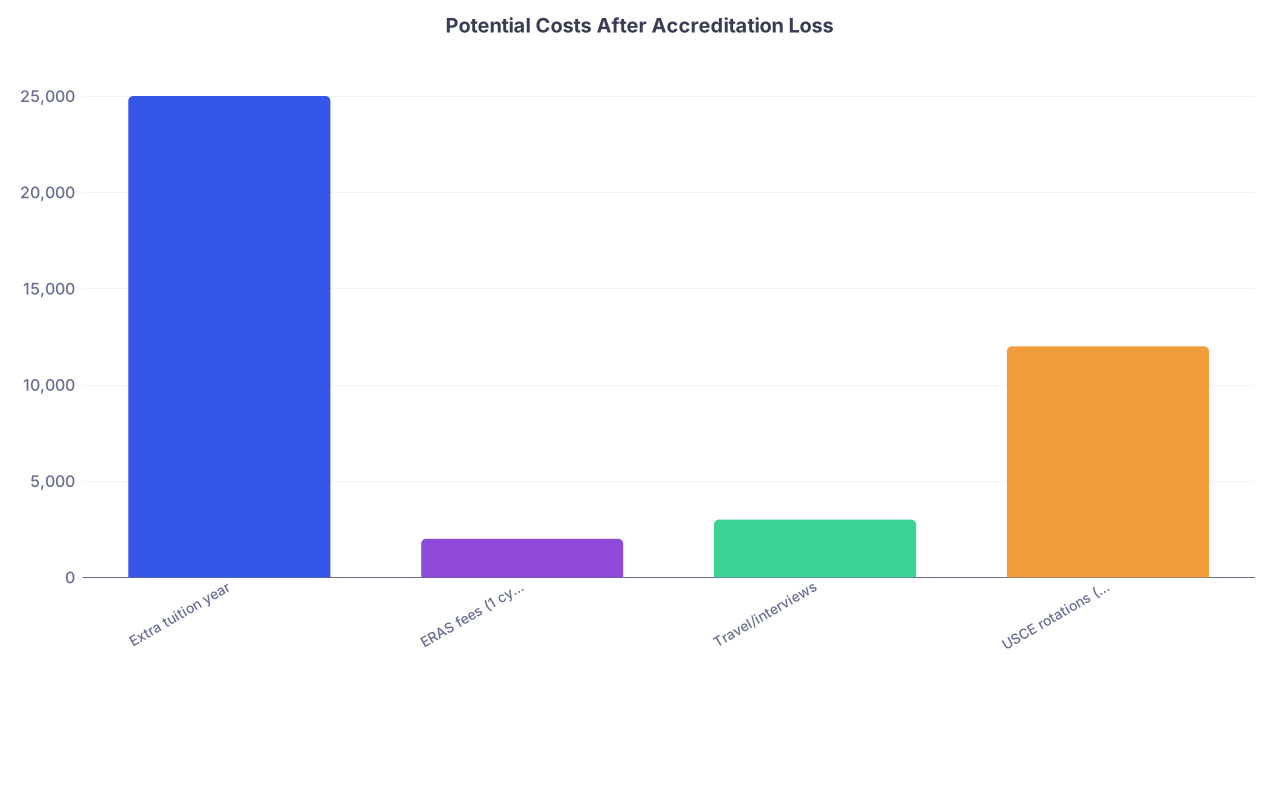
| Category | Value |
|---|---|
| Extra tuition year | 25000 |
| ERAS fees (1 cycle) | 2000 |
| Travel/interviews | 3000 |
| USCE rotations (4 mo) | 12000 |
You need a cap. On both money and time.
Set your personal thresholds
Examples:
- “I will apply to the Match at most twice. If I do not match by then, I will reassess my plan entirely.”
- “I will not spend more than $X total on additional clinical electives and exam retakes without a clear probability of impact.”
If you have family support or loans, have uncomfortable conversations early:
- Show them the WDOMS/ECFMG status.
- Show them the specific options (transfer, stay, leave).
- Show them realistic timelines and costs for each.
Wishful thinking financed by family savings is still wishful thinking.
8. Mental Resilience Without Self-Delusion
I’ve watched strong students fall apart during accreditation crises not because their options were truly zero, but because the uncertainty ate them alive.
Two things can be true at once:
- You’ve been screwed by a system failure outside your control.
- You’re still responsible for your next move.
A few practical things that help:
Limit rumor exposure:
- Set specific times for checking group chats.
- Mute constant panic messages.
- Follow only official updates and a small number of trusted peers.
Keep doing work that moves you forward:
- Studying for Step 2CK if that’s upcoming
- Working on research projects that will be useful no matter what
- Improving your English communication if you’re targeting U.S./Canada
Keep one alternative path in your mind:
- A non-U.S. residency route
- A research-focused path
- A combined clinical/public health track
Not as a sign you’re giving up. As a sign you’re not all-in on a fantasy.
9. What Programs Actually Think (From Their Side of the Table)
Residency programs ask themselves three blunt questions when they see an IMG from a troubled school:
- Will this applicant pass our boards and not get us in trouble with our accrediting body?
- Is their clinical training real and comparable?
- Are we going to regret taking a chance if there’s a scandal around their school later?
You calm those fears by:
- Demonstrating exam performance that is clearly above minimal thresholds.
- Showing extensive, well-supervised U.S. clinical experience.
- Providing clean, straightforward documentation:
- Official transcripts with no odd date gaps
- Clear graduation date
- ECFMG certification (or progress clearly moving toward it)
No one is going to read a long saga about your school politics. They want to know: are you personally solid, and will your degree create legal or board issues for them?
Make their decision easier.
10. Concrete 7-Day Action Plan
You’re probably overwhelmed. So let’s make the next week extremely specific.

| Step | Description |
|---|---|
| Step 1 | Day 1 - Verify WDOMS and ECFMG |
| Step 2 | Day 2 - Email ECFMG with grad year |
| Step 3 | Day 3 - Meet dean or admin |
| Step 4 | Day 4 - Contact 2-3 transfer schools |
| Step 5 | Day 5 - Talk to recent grads in residency |
| Step 6 | Day 6 - Decide scenario A, B, or C |
| Step 7 | Day 7 - Set written 6-12 month plan |
Day 1–2:
- Confirm WDOMS and ECFMG status for your graduation year.
- Send ECFMG a targeted email about your eligibility.
Day 3:
- Schedule and hold a brief, clear meeting (or email exchange) with your dean or academic office.
- Ask for written statements or memos if they exist.
Day 4:
- Identify at least three ECFMG-recognized schools that accept transfers.
- Email them asking about transfer policies and credit recognition.
Day 5:
- Reach out to at least two alumni now in U.S./Canadian residency.
- Ask them specifically how programs reacted to your school name, and what they’d do in your place.
Day 6:
- Decide honestly: are you Scenario A, B, or C?
- Based on that, commit to: stay, stay-while-exploring-transfer, or plan-transfer/exit.
Day 7:
- Write a simple one-page plan:
- Your chosen path
- Your specialty target(s)
- Exam timeline
- USCE plan
- Money/time cap for this pathway
Stick that page somewhere you’ll see it every day.
You do not control what your school did. You do control whether you stay in limbo or move.
Here’s your next step today: open the WDOMS page for your school, scroll to the ECFMG sponsor note, and read every word out loud. Then, based on that exact text, write one sentence: “Given this status, my next move is ______.” Fill in that blank before you go to bed.