
The truth is ugly: some IMG applications never really get “reviewed.” Others get pulled to the top of the pile before the rest of the stack is even sorted. Same ERAS season. Same specialty. Same week. Very different realities.
You see it every year. One IMG posts they got 12 interview invites in the first 48 hours. Another, with similar scores on paper, is sitting at zero, refreshing their email like it’s a vital sign. You tell yourselves it’s random. It isn’t.
Let me tell you what actually happens behind those filters and committee meetings. Because the system doesn’t treat all IMGs equally, and the people running it won’t say this out loud on a webinar.
How Programs Actually Screen IMGs (Not the Polite Version)
Programs don’t start by “holistically” reviewing IMG applications. They start by not drowning.
Most academic IM and FM programs get flooded: 4,000–6,000 applications. Sometimes more than half are IMGs. Nobody has the time—or desire—to read 3,000 generic IMG personal statements. So they build traps and shortcuts.
Here’s the basic hierarchy the faculty won’t spell out on their websites:
- Protect time
- Protect their match stats
- Protect their reputation within the hospital
- Only then…maybe…look for hidden gems
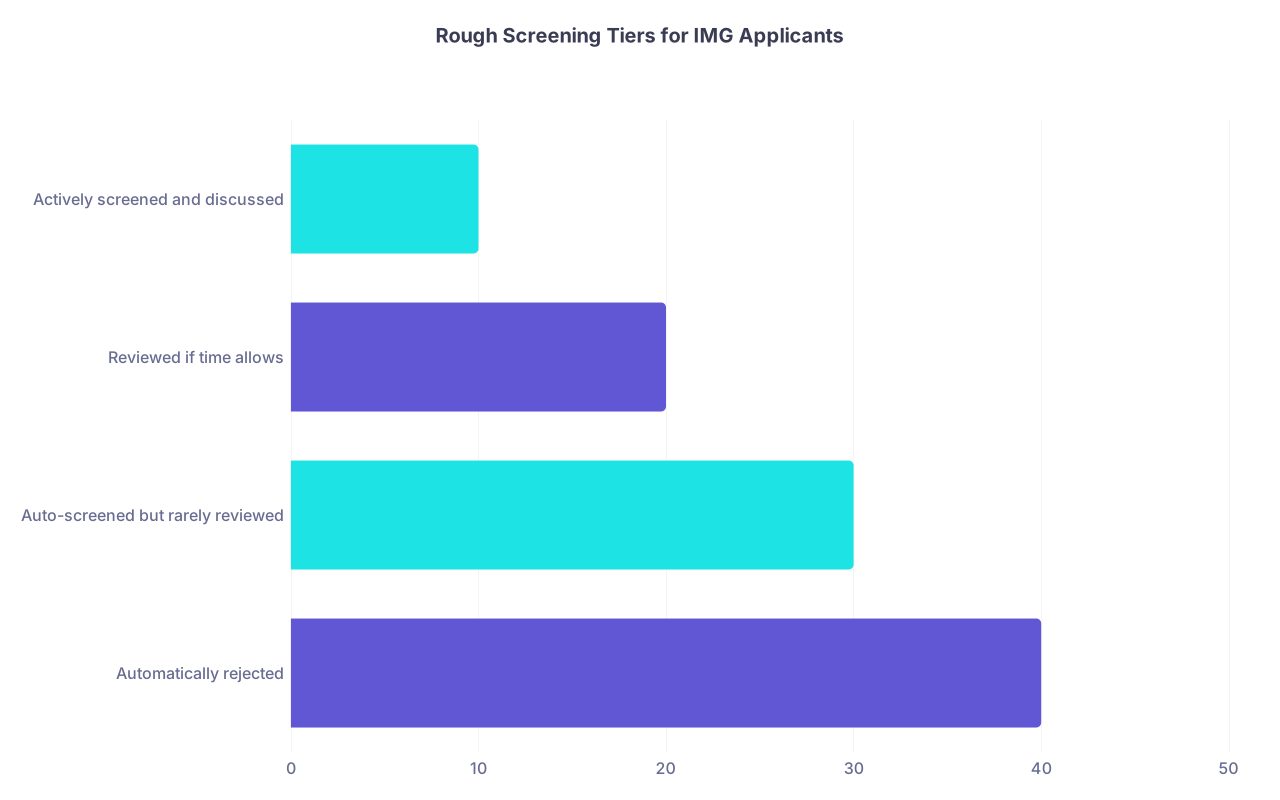
So they create tiers. And whether you get fast-tracked or left in limbo comes down to which tier you quietly fall into.
| Category | Value |
|---|---|
| Automatically rejected | 40 |
| Auto-screened but rarely reviewed | 30 |
| Reviewed if time allows | 20 |
| Actively screened and discussed | 10 |
Those numbers aren’t official, but they’re close to what I’ve seen in real committee rooms. Forty percent never make it past the first filter. Another chunk are technically “under review” but never seriously touched.
The “fast-tracked” group is that last 10%. They get looked at first. They get sent to PDs directly. They get “flagged” by residents or faculty. Their names show up in discussions before anyone opens the mass spreadsheet.
And this is the part no one tells you: the difference between that 10% and the invisible 70% is often not Step scores alone. It’s signals. Prior relationships. Strategic packaging.
The Real Triggers for Fast-Tracking IMGs
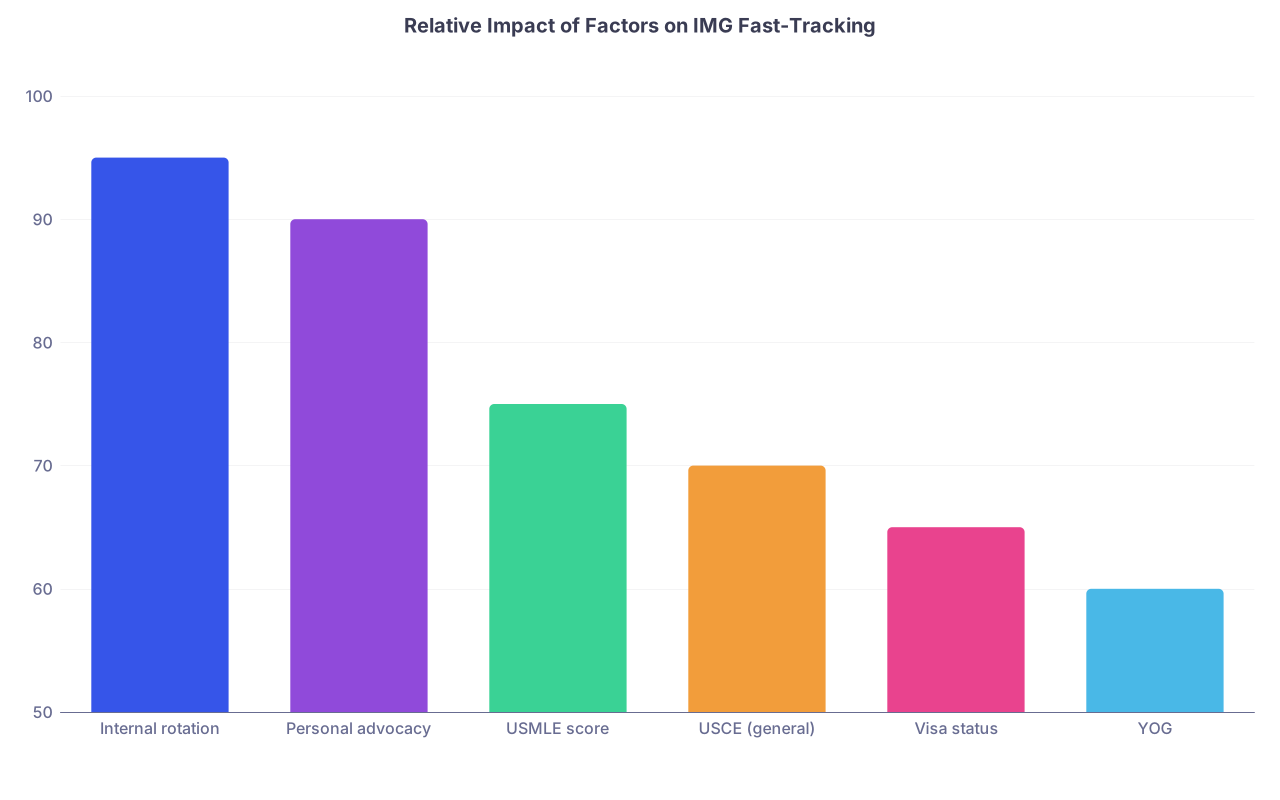
You’ve heard the public version: “strong scores, solid letters, good fit.” That’s not wrong, just incomplete. For IMGs, the game is about triggers.
A trigger is something that makes a coordinator or faculty member say, “Open this one now.”
Let’s walk through the real ones.
1. The Golden Ticket: Internal Experience
If you’ve rotated at that program—or at least at that hospital—and someone credible remembers you, you’re in a different category.
On the program side, it looks like this:
Coordinator: “We’ve got 480 IMG applications after first filter.”
Chief resident: “Who’s rotated with us?”
Faculty: “That student from Jordan who was on wards in March—what’s his name?”
Someone scrolls, finds you, and suddenly your file gets tagged “Interview—strong performance on rotation.”
You just leapfrogged hundreds of strangers with higher scores.
Here’s the ugly truth: a mediocre IMG who actually showed up in that hospital, was pleasant, on time, wrote notes decently, and didn’t scare patients will often get fast-tracked ahead of a stronger-on-paper IMG who’s a complete unknown.
That’s the leverage of familiarity. Programs are terrified of problem residents. Someone they’ve seen functioning on their turf feels lower risk.
If you’ve ever done an observership or hands-on rotation and left without anyone promising “We’ll support your application,” you probably wasted that rotation. The smart IMGs are explicit: “Would you feel comfortable supporting my application here?” They secure a real advocate, not just a line on the CV.
2. The “Vouched For” Email
You want to know what actually bumps an IMG file to the top?
Six words in an email from someone the PD trusts:
“Please take a close look at this one.”
That’s it. That’s the fast-pass.
Could be from:
- A faculty member at that program
- A former resident who’s now faculty somewhere else
- A department chair or program director at another institution
- Sometimes even a senior fellow with political capital
This is why some IMGs from certain schools “mysteriously” always match well. Their deans and attendings are aggressively emailing on their behalf. Not some mass generic form, but short, pointed notes directly to PDs and APDs.
Behind the scenes, it sounds like this:
APD: “We got an email from Dr. X at Cleveland Clinic about this applicant.”
PD: “Okay, invite. They’ve never burned us before.”
You’re competing with that. If you’re sending 300 “Dear Program Director” emails through ERAS and they’re sending three targeted, personal notes with specific names, you’re playing two different games.
The Score Myth: Why 250 Is Not Enough
Everyone obsesses over scores. USMLE, OET, language exams. I’ve seen IMGs with 260+ on Step 2 CK sit without a single university interview while a 230 applicant gets several.
No, it’s not fair. But here’s what’s actually happening.
Programs use scores like a rough cut. Not a final decision.
They might set something like:
- IMGs: Step 2 CK ≥ 235–240 for basic screening
- Step failures: auto-reject unless extraordinary circumstances
- Attempts: heavy bias against multiple attempts
But once you’re past their threshold, your 260 doesn’t guarantee fast-tracking. It just keeps you out of the trash bin.
Between two IMGs above the bar, the tiebreakers are often:
- US clinical experience at that institution or affiliated sites
- Strong, specific letters from US faculty
- Visa needs (yes, this matters brutally)
- Year of graduation
- Clear, relevant specialty commitment
The committee discussion goes like this:
“Two IMGs, both 245+ on Step 2. One’s YOG 2017 with no US experience, needs H-1B. The other is YOG 2023 with three months of US IM rotations, needs J-1. Who do you want on your wards in July?”
The 2017 grad never gets discussed again.
Your score gets you to the door. What fast-tracks you is making yourself low risk and high familiarity to that program.
Year of Graduation: The Quiet Death Sentence
You already know “fresh graduates” do better. You don’t know how brutal some programs are about it.
I’ve watched this in real time:
Coordinator: “We have 350 IMGs above our Step threshold.”
PD: “Filter for YOG 2020 or later.”
Spreadsheet drops to 90 names.
PD: “Good. Start there.”
Are there exceptions? Sure. But they’re rare and usually connected—family in the department, internal research, a faculty champion.
If you’re YOG 2018 and applying like you’re the same as a 2023 graduate, you’re lying to yourself. You need a fundamentally different level of relationship-building and explanation in your application. Otherwise you’re in the “maybe later, if we still have open spots” pile. Which means: probably never.
Visa Status: The Filter Nobody Talks About Honestly
Public-facing line: “We sponsor J-1 and sometimes H-1B.”
Internal reality: they often start by screening as if they’re a US citizen-only program, then loosen up if they need to.
You’ll hear things like:
- “Let’s fill with green card/US citizen first if possible.”
- “Limit H-1Bs to 1–2 per year, we don’t want the legal mess.”
- “Do not touch H-1B unless everything else is stellar.”
US citizens and permanent residents get fast-tracked by default at many community and smaller academic programs. Not because they’re better. Because they’re less work.
Rank this in your head honestly:
- US citizen / Green card, recent grad, decent scores, USCE → often fast-tracked
- J-1 needing sponsorship, strong file, recent grad, USCE → selectively fast-tracked
- H-1B needing sponsorship, older YOG, no strong internal advocate → rarely touched unless desperate late in season
I’ve sat in rooms where a PD literally said, “We already have two visa slots filled; I don’t care if they have a 260, I cannot deal with another H-1B this year.”
You either deal with this reality strategically, or you pretend it doesn’t exist and get crushed by it.
How ERAS Filters Really Kill You (Or Save You)
Programs rarely start by “reading applications.” They start by defending their time with ERAS filters.
Common IMG filters:
- Step 2 CK minimum (usually 230–240 range for competitive IM, 220–230 for community/FM)
- Maximum YOG difference (usually 3–5 years from start date)
- Citizenship/visa type
- Number of exam attempts
- Specific medical schools (whitelisted or blacklisted informally)
If you don’t pass their filter, you don’t exist. Not metaphorically. Literally. Nobody sees your personal statement, your LORs, your heartfelt story. You’re just a number that didn’t show up on the spreadsheet.
| Filter Type | Common Cutoff for IMGs |
|---|---|
| Step 2 CK Score | 235–240+ |
| YOG Maximum Gap | 3–5 years |
| Exam Attempts | 0–1 attempts |
| Visa Preference | J-1 over H-1B |
| US Clinical Months | 1–3+ usually expected |
The “fast-tracked” IMGs clear those filters effortlessly and have something that pings the human side: a note, a connection, a known school, a rotation.
The “waiting forever” IMGs sit just below one or two of those bars and keep believing that if they send enough emails, someone will “holistically” reconsider them. They won’t. Not until very late in the season, if at all.
The Hidden Priority List: Which IMGs Get Read First
Let me order the IMG types in the way committees mentally rank them, even if they’d deny it publicly.
Within IMGs who passed filters, the priority usually looks like this:
- IMGs who rotated at that program and impressed people
- IMGs from schools the program knows and likes, with strong US letters
- IMGs with personal connections to current residents/faculty who advocate for them
- IMGs with exceptional scores plus strong USCE and recent YOG
- IMGs from unknown schools, good scores, minimal USCE but recent YOG
- Older YOG, visa-heavy, or multiple attempts—even with decent scores
Groups 1–3 are gold. They get fast-tracked. Their applications are pulled up individually and discussed.
Groups 4–5 live or die by how many interview slots are left after the “known quantities” are handled.
Group 6 mostly survives on two things: networking and targeting programs known to be IMG-friendly and more forgiving.
If you’re not deliberately trying to move yourself up that internal priority ladder, you’re basically sending your application into a landfill and hoping for an archeologist.
Common Mistakes That Keep You in the “Maybe Later” Pile
Let me be blunt about what I’ve seen tank otherwise salvageable IMG applications.
Generic Personal Statements
If I can swap your name and country with any other applicant and nothing changes, you’ve written wallpaper. No one fast-tracks wallpaper.
Fast-tracked IMGs don’t sound like “I have always been passionate about internal medicine.” They sound like: “During my sub-internship at your institution, I presented X case at morning report and learned Y.” Specific. Grounded. Memorable.
Weak or Vague Letters
A US letter that says “Hard-working, punctual, good team member” is a kiss of death. That’s polite code for “did not stand out.”
The letters that move PDs say things like:
- “I would rank this IMG among the top 10% of rotators I’ve worked with in the last 5 years.”
- “We would strongly consider them for our own residency program.”
- “They functioned at the level of an intern during their month with us.”
If your US rotations aren’t leading to that kind of language, either you’re not performing at that level or you’re choosing the wrong letter writers.
Sloppy Applications and Red Flags
You’d be shocked how easily programs write people off:
- Inconsistent dates
- Gaps not explained
- Poor grammar in personal statement
- Half-hearted descriptions of research or work
- No clear story of why this specialty now
Fast-tracked IMGs look coherent. The file reads like one person with one narrative, not a collage of random experiences.
How Smart IMGs Quietly Get Fast-Tracked
Let’s talk about what the successful ones actually do that you don’t see on Reddit.
They Build a Pre-Existing Presence at Target Programs
They don’t spray 250 applications and “hope.” They build a shortlist of 20–40 realistic, IMG-accepting programs, then work backward:
- Set up rotations or observerships at those hospitals or their affiliates
- Join their virtual conferences, grand rounds, journal clubs
- Reach out months before ERAS with something real to offer or ask: research help, case write-ups, presentations
By the time ERAS opens, at least a few people in that department already recognize their name when it hits the inbox.
They Secure Actual Advocates, Not Just Letters
I’ve watched this work over and over:
A resident emails the chief: “Hey, this IMG rotated with us. Strong worker. Please give them a look.”
The chief forwards to the PD with a short endorsement.
Your entire application experience changes in 10 seconds.
This doesn’t happen by accident. It happens because during your rotation you:
- Showed up early, stayed late
- Carried your own patients responsibly
- Owned your notes, followed up your labs
- Asked for feedback and then visibly improved
- Made it clear you were serious about that program
Then at the end you didn’t mumble “Can you write me a letter?” You asked: “Would you feel comfortable supporting me specifically for this residency program? If so, would you be willing to send a note to the PD when I apply?”
Different energy. Different outcome.
They Shape Their File Around One Story
The IMGs who get fast-tracked don’t submit a pile of random experiences. They submit a narrative:
- “I’m an IMG who has been consistently building toward internal medicine in the US: research in cardiology, two IM rotations, QI project on readmissions, and strong Step scores.”
Or for FM:
- “I have years of real-world primary care exposure, community engagement, and FM-focused USCE that fits exactly what your program does.”
When your story and the program’s mission align, it’s a lot easier for someone internally to say, “This person fits us, not just ‘any residency.’”
If You’re Already in the “Waiting” Group This Season
Let’s be honest. Some of you are reading this mid-cycle. You’ve applied, you’re not getting interviews, and none of what I just said is fixable this month.
So what can you do right now that’s not delusional?
- Stop sending spammy, generic emails. PDs and coordinators are drowning. “Dear Program Director, I am very interested…” gets deleted or ignored.
- Leverage any real tie you have. If you have any prior contact—attended their virtual event, met a faculty member at a conference, did a short observership—write a specific, short email referencing that encounter and updating them on your progress.
- Reach out to current residents from your country/school. Not begging for an interview. Asking for advice. If the conversation goes well, sometimes they’ll say, “Send me your AAMC ID, I’ll mention you to our chief.” That’s the door.
- Be prepared to rebuild if this cycle fails. For many of you, the move is not “apply to 100 more programs next year.” It’s “get one or two strategic US rotations where you can actually earn an internal advocate, then reapply smarter.”
This is the part no one wants to hear: some files are not fixable purely on paper. You fix them in person, on the wards, doing good work in front of the people who later sit in the rank meeting.
The Bottom Line: Fast-Tracking Isn’t Random
If it feels like some IMGs are playing on easy mode, it’s because they’ve aligned themselves with how programs really work, not how brochures describe them.
Programs fast-track IMGs who:
- Clear filters cleanly
- Are recent, low-risk graduates
- Require visa sponsorship that the program is comfortable with
- Have US-based advocates—residents or faculty—willing to say, “Interview this one”
- Have proven they can function in that specific system
Programs leave the rest “in review,” which usually means “we’ll come back if we’re desperate in January.”
You can choose to be angry about that. Or you can design your path around it.
Your challenge now is to stop thinking like an applicant shouting into the void and start thinking like a PD buried under 5,000 files. Ask: “What would make me pull this application out of the stack?”
Once you’re honest about that answer, the next phase of your journey becomes clearer: finding the right programs, getting in front of the right people, and earning that one line in one email that changes everything:
“Please take a close look at this one.”
With that foundation, you’re not just waiting for interview invites—you’re building the kind of profile programs actually fight over in rank meetings. How to do that, step by step, in the months before ERAS opens? That’s another conversation we’ll have. Soon.
| Category | Value |
|---|---|
| Internal rotation | 95 |
| Personal advocacy | 90 |
| USMLE score | 75 |
| USCE (general) | 70 |
| Visa status | 65 |
| YOG | 60 |