
The residency position you fought for can be delayed—or quietly handed to someone else—because of one sloppy visa document.
You are not competing only on scores and letters anymore. At the contract stage, you are also competing on risk. And nothing screams “risk” to a GME office louder than messy, late, or inconsistent visa and status paperwork.
Let me walk you through the most common visa and status documentation mistakes that derail IMG contracts—and how to avoid joining that statistic.
1. Assuming “I Matched” Means “I’m Safe”
You are not safe until HR has cleared your status and the program has a clean, signed contract in hand. Many IMGs underestimate how unforgiving hospital credentialing and immigration timelines are.
Here is the first big mistake:
Mistake #1 – Treating visa paperwork as an afterthought, not as critical as interviews and Step scores.
What this looks like in real life:
- The IMG thinks: “I’ll figure out the visa once I have the contract.”
- They delay sending documents to the GME office.
- Meanwhile HR has internal deadlines with the hospital’s legal and payroll.
- The program starts to worry: “Is this candidate going to clear on time?”
- Result: Delayed contract, conditional offer, or in some bad cases, the program pressures NRMP for relief and looks at backup candidates or prelims.
Do not assume goodwill will fix delays. GME offices are overworked, and they are not going to chase you endlessly.
Preventive moves:
- Before Rank List Certification, know exactly:
- Which visa(s) you’re eligible for (J‑1, H‑1B, other).
- Which visa(s) each ranked program sponsors.
- Have digital copies of every immigration document ready:
- Passport (all pages with stamps/visas)
- I‑94 history (print from CBP website)
- All I‑20s (if F‑1), DS‑2019s (if J‑1), I‑797 approvals.
- The week after Match Day, email GME/HR: ask for their visa checklists and deadlines. Then beat those deadlines by at least 1 week.
If you treat status documentation with the same obsession you used to treat UWorld blocks, you will be fine. If you don’t, you become “the problem IMG” they talk about in office meetings.
2. Misunderstanding What Visa the Program Actually Sponsors
Many IMGs lose weeks because they are confused—or in denial—about visa options.
Mistake #2 – Assuming any program that “takes IMGs” will automatically arrange your preferred visa.
Typical mess:
- You need H‑1B because you have already used J‑1 time.
- The program: “We only sponsor J‑1 through ECFMG.”
- You: “But my friend got H‑1B there.”
- Your friend: citizen/green card holder; did not need H‑1B.
- Result: You waste weeks arguing with the wrong office, while paperwork does not move.
Or:
- You are on F‑1 with OPT.
- You assume the program will file H‑1B in time.
- The program: “We only do J‑1. Contact ECFMG.”
- Your OPT end date and residency start do not align properly. Panic.
| Item | Typical Reality |
|---|---|
| H‑1B for PGY‑1 at community IM | Often *no*; J‑1 only |
| H‑1B for surgical specialty | Often reluctant; J‑1 preferred |
| USMLE Step 3 for H‑1B | Usually required *before* contract finalization |
| J‑1 via ECFMG | Most IMG‑heavy programs accept, but strict timelines |
| Program adjusts to your status | Rare; *you* adjust to program policy, not the opposite |
Preventive moves:
- Before ranking:
- Email the program coordinator directly and ask, in one clear sentence:
“For IMGs requiring visa sponsorship, do you sponsor J‑1 only, or J‑1 and H‑1B?”
- Email the program coordinator directly and ask, in one clear sentence:
- Accept their answer as reality. Do not rely on:
- Old SDN/Reddit threads
- What a friend “heard” three cycles ago
- If you need H‑1B:
- Have Step 3 done before Match if at all possible.
- Understand H‑1B cap vs cap‑exempt issues, especially for July starts.
- If they only sponsor J‑1 and you already had a J‑1 or have 212(e) issues, get real legal advice early. Not after Match.
The error is not “they do not sponsor my visa.” The error is ranking them high anyway and hoping for magic later.
3. Sloppy or Missing Status History (The Silent Contract Killer)
GME offices get very nervous when an IMG’s immigration history looks like a puzzle with missing pieces.
Mistake #3 – Providing incomplete, inconsistent, or poorly documented status history.
What GME actually sees sometimes:
- Three I‑20s missing from your file.
- Name spelled three different ways across documents.
- Gaps between status end dates and new approvals with no explanation.
- Different answers on ERAS, Form DS‑160 history, and the hospital credentialing form.
Programs do not always tell you they are worried. They just quietly slow everything down. Or escalate to their legal department. Or both.
This is where a lot of contract delays come from.
Common red flags you create without realizing:
- You “forget” to disclose a prior visa denial.
- You do not list a previous F‑1 or J‑1 on forms because “it was short.”
- Your I‑94 printout does not match what you wrote on your forms.
- You changed your name and never updated it consistently anywhere.
Preventive moves:
- Build your own “status file” before Match:
- All visas (F‑1, B‑1/B‑2, J‑1, H‑4, etc.) stamped in your passport.
- All I‑20s, DS‑2019s, I‑797s, EAD cards.
- All I‑94 records (old and current).
- Create a one‑page timeline:
- Date ranges for each status.
- Purpose (study, observership, etc.).
- Notes on any gaps or changes.
- Use exactly the same history across:
- ERAS application
- GME/HR forms
- ECFMG J‑1 sponsorship forms (if using J‑1)
- Visa applications (DS‑160, etc.)
If something is messy—out‑of‑status risk, prior denial, overstay—do not hide it. Get an immigration attorney and work with the program’s legal team early. Hiding it almost always makes it worse.
4. Missing or Mishandling ECFMG J‑1 Sponsorship Paperwork
For most IMGs, residency means a J‑1 visa through ECFMG. And ECFMG is very timetable‑driven. They will not speed up because your program coordinator is “really nice.”
Mistake #4 – Waiting too long to start ECFMG J‑1 sponsorship or sending incomplete documents.
I have seen this pattern repeatedly:
- IMG matches in March.
- Program sends instructions: “Start J‑1 sponsorship with ECFMG.”
- IMG waits until May “to gather documents.”
- ECFMG returns application for missing signature or wrong form version.
- Resubmission. More delays.
- DS‑2019 is issued late June.
- First visa interview appointment? Mid July.
- Residency start? July 1.
Problem.
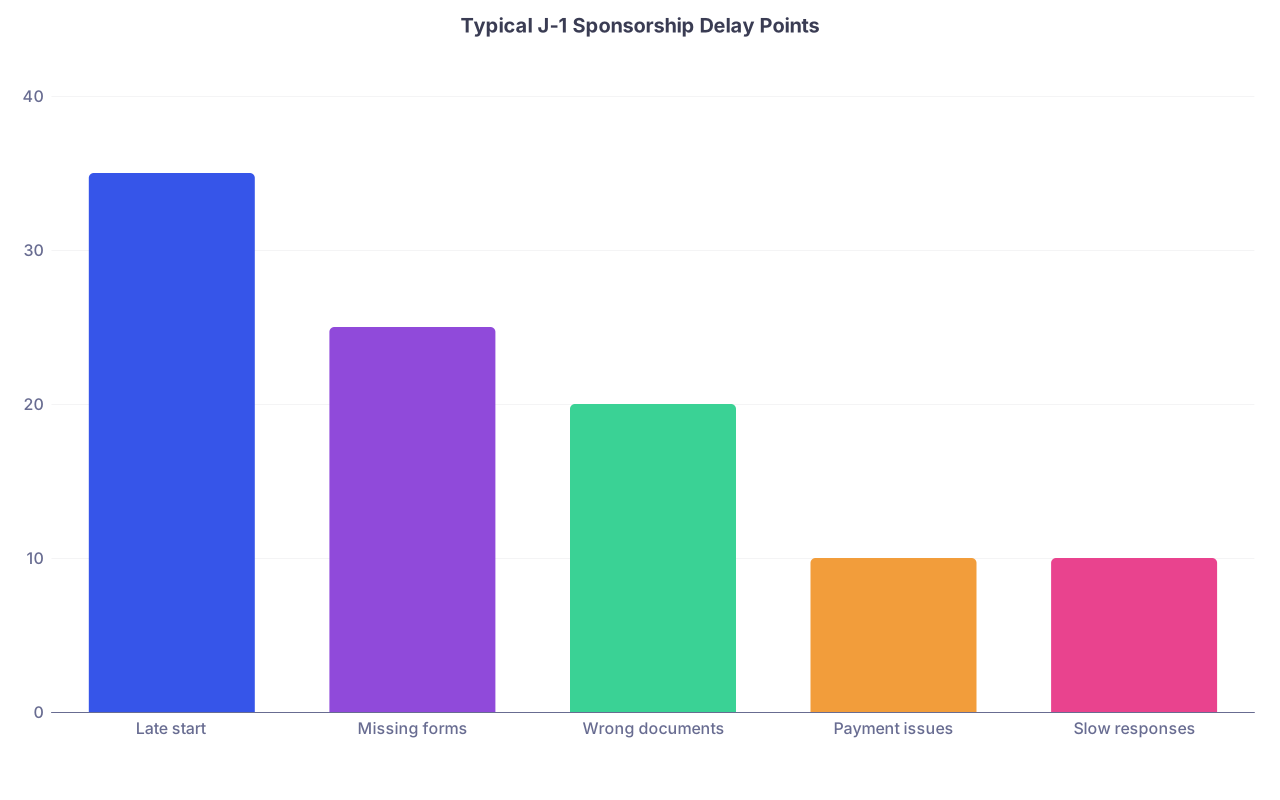
| Category | Value |
|---|---|
| Late start | 35 |
| Missing forms | 25 |
| Wrong documents | 20 |
| Payment issues | 10 |
| Slow responses | 10 |
Key J‑1 mistakes that cost you weeks:
- Not being ECFMG certified in time for sponsorship.
- Using old versions of ECFMG forms downloaded from some random forum.
- Ignoring document format rules (for example, notary, original signatures).
- Delayed responses to ECFMG clarification emails.
- Misunderstanding home country funding / government funding questions.
Preventive moves:
- The week of Match:
- Log into your ECFMG account.
- Download the current J‑1 sponsorship instructions.
- Confirm which forms your program must complete (training program appointments forms, etc.).
- Send your portion of the ECFMG packet:
- Completely filled.
- Signed where required.
- Named consistently (for example, “LastName_FirstName_DS2019support.pdf”).
- Follow up:
- If ECFMG emails a question, answer within 24 hours.
- Confirm receipt and completeness with both ECFMG and your GME office.
If you treat ECFMG like the DMV (“they will get to it, whatever”), you will end up with a delayed contract and a very nervous program director.
5. Name, DOB, and Identity Mismatches Across Documents
This one seems trivial, yet it is one of the most ridiculous sources of delay.
Mistake #5 – Assuming small spelling or formatting differences in your name or birthdate are “no big deal.”
To you, “Mohammad / Mohammed / Muhammad” is normal. To an HR system that must verify your identity, those are three different people.
Where problems show up:
- Your passport says “MOHAMMED AHMED ALI”
- ECFMG says “MOHAMMED A. ALI”
- ERAS says “MOHAMMED ALI”
- Social Security record (if you have one) uses another variation.
- Your medical school diploma uses a different order of names.
Every time a credentialing office cannot match two pieces of data, they pause. And ask for clarification. And another document. And that eats into your start date.
Preventive moves:
- Decide on one standard version of your name:
- Match it to your current, valid passport exactly (including middle names).
- Use that version consistently for:
- ERAS
- ECFMG
- Visa applications
- Hospital HR forms
- If your diploma or older documents have a different version:
- Prepare a notarized name affidavit explaining the variation.
- Share it proactively with credentialing and immigration contacts.
Same with date formats. If your home country writes day/month/year and you accidentally flip month/day/year, you introduce an unnecessary question mark. Programs do not love question marks.
6. Overlooking 212(e) and J‑1 Home Residency Requirements
If you have ever held a J‑1 (for clinical electives, research, exchange programs), you must know your 212(e) status.
Mistake #6 – Ignoring or misunderstanding the J‑1 home residency requirement (212(e)).
Scenarios I have seen:
- IMG had a research J‑1, subject to 212(e).
- Wants H‑1B for residency.
- Only discovers 212(e) problem when H‑1B paperwork is being filed.
- Now everyone is scrambling for either:
- A waiver (which can take months), or
- A switch to J‑1 for residency that the program never planned for.
Or:
- IMG thinks they are not subject to 212(e) because “it was just research”.
- DS‑2019 actually lists “212(e) applies”.
- HR notices during contract processing.
- Legal gets involved. Clock keeps ticking.
Preventive moves:
- If you ever held a J‑1:
- Pull your old DS‑2019s.
- Check the 212(e) section carefully.
- If it says you are subject:
- Accept it. Do not rely on guesswork or “my friend was not subject.”
- Consider a formal Advisory Opinion from the Department of State if there is genuine confusion.
- Before you rank programs that require H‑1B:
- Clarify with an immigration attorney whether you:
- Need a waiver.
- Can realistically obtain it in time.
- Clarify with an immigration attorney whether you:
- Tell your matched program early if a waiver will be needed.
Programs hate being ambushed by 212(e) surprises in May or June. It makes them doubt whether you will be ready for July 1.
7. Underestimating Processing Times for Consulates and Background Checks
The visa system is not built around residency start dates. It never has been. You must work backwards from July 1 and build a timeline.
Mistake #7 – Assuming you can start the visa process in late May or June and still comfortably arrive by July 1.
Reality:
- Slot for U.S. visa interview in your country: maybe 2–8 weeks out, sometimes more.
- Administrative processing (“security checks”): can add weeks or months.
- DS‑2019 or H‑1B approval notice mailing time: more days.
- Travel booking, housing, onboarding: more time.
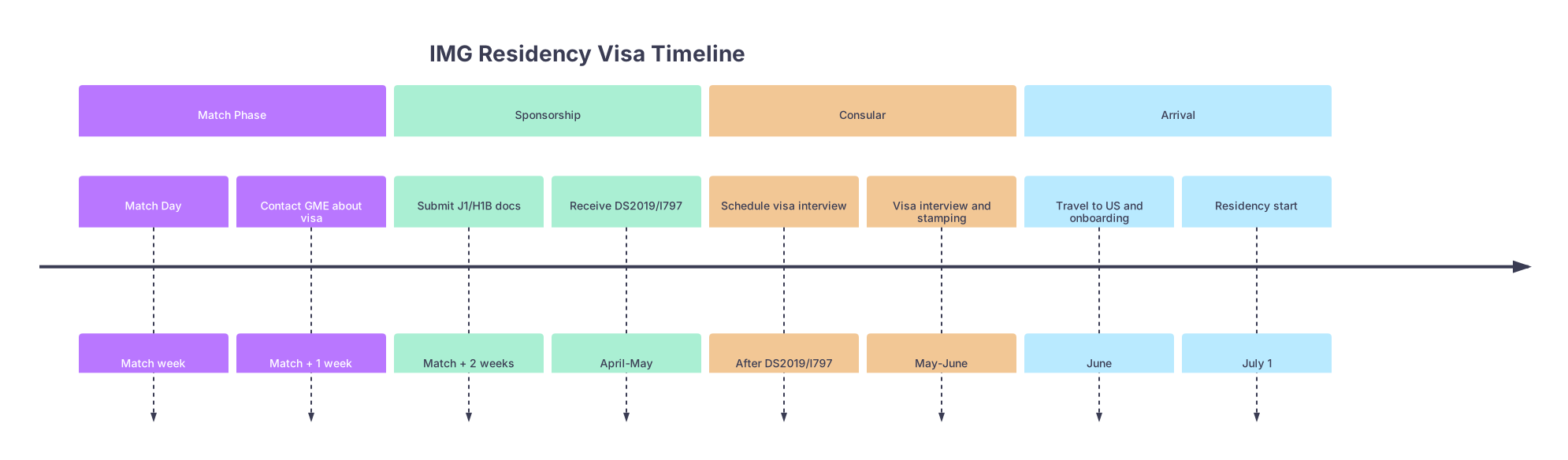
| Period | Event |
|---|---|
| Match Phase - Match Day | Match week |
| Match Phase - Contact GME about visa | Match + 1 week |
| Sponsorship - Submit J1/H1B docs | Match + 2 weeks |
| Sponsorship - Receive DS2019/I797 | April-May |
| Consular - Schedule visa interview | After DS2019/I797 |
| Consular - Visa interview and stamping | May-June |
| Arrival - Travel to US and onboarding | June |
| Arrival - Residency start | July 1 |
If you start the process late, everyone suffers:
- Program cannot finalize your contract.
- You cannot schedule a timely visa interview.
- Legal starts asking whether your position should be deferred or replaced.
Preventive moves:
- The moment you have DS‑2019 or H‑1B approval:
- Check consulate wait times for your city on the official site.
- Book the earliest available appointment immediately.
- If wait times are extreme:
- Discuss with an attorney and your program whether changing consulate is feasible.
- Do not delay visa interview just because:
- You want more time to pack.
- You are waiting on non‑essential documents.
You can recover from many mistakes. Starting the visa process in June for a July 1 start is not one of them.
8. Miscommunication Between You, GME, ECFMG, and Lawyers
Another silent contract killer: everyone assumes someone else is handling “the paperwork.”
Mistake #8 – Relying on others to manage and track your visa/status without active coordination from your side.
What actually happens:
- Program thinks ECFMG is waiting on you.
- You think ECFMG is waiting on the program.
- Lawyer thinks you are not in a rush because no one said “urgent.”
- No one sends a clear status update in writing.
- Clock runs down.
I have heard this line from coordinators:
“He is probably a great resident, but this visa thing… it is a lot of work.”
You never want to be that person.
Preventive moves:
- Keep a simple shared timeline for yourself:
- Date you submitted each document.
- Date GME/ECFMG acknowledged receipt.
- Date of next expected step.
- Send short, focused emails:
- Subject: “J‑1 Sponsorship Status – [Your Name], [Program Name]”
- Body: 3–4 lines max:
- What has been done.
- What is pending.
- What you are requesting (update / confirmation / form).
- If a week passes with no movement on a critical step:
- Follow up—politely but clearly.
- If the program uses an immigration lawyer:
- Get explicit instructions about who you send documents to.
- CC the coordinator when relevant, so everyone sees progress.
Your job is not to “do their jobs.” Your job is to make it impossible for anyone to claim they were waiting on you.
9. Letting Financial or Document Logistics Slow You Down
This one is less talked about but very real.
Mistake #9 – Delays caused by unpaid fees, missing translations, or document legalization.
Hidden time‑sinks IMGs often ignore until it is too late:
- ECFMG J‑1 fees unpaid because your card was declined.
- Bank requiring in‑person visit to allow a large international payment.
- Civil documents (birth certificate, marriage certificate) not translated or not legalized when the consulate demands them.
- Police clearance or background certificate that takes weeks in your home country.
Each of these might steal 3–10 days. Stack a few of them and your contract is in trouble.
Preventive moves:
- Before Match:
- Have a backup payment method (second card or trusted relative) ready for:
- ECFMG fees
- SEVIS fee
- Visa application fee
- Ask home‑country authorities how long police certificates or background checks take.
- Have a backup payment method (second card or trusted relative) ready for:
- Right after Match:
- Order any long‑lead documents immediately, even if you are not yet sure they will be needed.
- Get certified translations done now, not after the consulate or HR asks.
Money logistics and bureaucracy will not adjust to your residency start date. You adjust to them—or you accept delays.
10. Acting Late Because You Are Afraid of Looking “Demanding”
Many IMGs stay silent even when they see delays. They do not want to “bother” the coordinator. This is a mistake.
Mistake #10 – Being overly passive and waiting for the program to chase you.
What I hear from IMGs:
- “I do not want them to think I am difficult.”
- “I am waiting for them to email me next steps.”
What I hear from coordinators:
- “If they are not organized about this, what will they be like as interns?”
- “I cannot chase every resident for documents.”
You are not being “difficult” by managing your own status. You are being professional.
Preventive moves:
Communicate in a way that is:
- Concise
- Respectful
- Solution‑oriented
Example email:
Dear [Name],
I wanted to confirm the status of my [J‑1 sponsorship / H‑1B petition].
As of today, I have:
– Submitted [list key forms] on [dates]
– Received [confirmations]Are there any additional documents or steps needed from my side at this stage? I want to ensure everything is completed well before the program start date.
Best regards,
[Your Name]
No drama. No pressure. Just clear, proactive ownership.
What You Should Do Today To Avoid Contract‑Killing Mistakes
Do not wait until you “have time.” You are already behind.
Today—literally today—do this:
- Create a folder on your computer called “Residency Visa & Status”.
- Add:
- Passport scan (all ID and visa pages).
- All I‑20s, DS‑2019s, I‑797s, EADs, I‑94s you can find.
- Scan of your medical diploma and ECFMG certificate.
- Open a blank document and build:
- A chronological timeline of all your U.S. statuses and visits, with dates.
- Then send one email:
- If you are already matched: to your program coordinator, asking for their exact visa documentation checklist and deadlines.
- If you are not yet matched: to yourself—listing what visa options you are realistically eligible for and what remains unclear (so you can research or seek advice).
Do this now, before one missing document quietly turns your hard‑won Match into a delayed contract—or worse, a lost spot.