
The belief that IMGs need “perfect” English to match is fantasy. And worse than fantasy—it’s a distraction from the things that actually move the needle.
Let me be direct: residency programs do not expect you to sound like a Midwestern news anchor. They expect you to be safe, understandable, and efficient under pressure. That’s it. Everything else—accent shaming, “you must sound native,” obsessing over slang—is noise.
What the data and real outcomes show is very different from the fear stories you hear in WhatsApp groups and Facebook IMG forums.
What Programs Actually Screen For (Hint: Not Flawless Grammar)
Every program director I’ve heard talk about IMGs and language boils it down to three questions:
- Can this person communicate clearly with patients and staff?
- Will they slow the team down or cause errors because of language?
- Will they frustrate patients or colleagues so much that it becomes a problem?
Notice what is not on that list: “Is their grammar flawless?” or “Do they sound American?”
The NRMP’s Program Director Survey gives you a rough proxy for what matters. Things like “communication skills” and “interpersonal skills” rank high. “Accent” is nowhere on the list. Because there’s no checkbox for “sounds like Netflix.”
Programs judge communication through:
- US clinical experience (what attendings actually say about working with you)
- Interview performance (can they understand you without effort?)
- Letters of recommendation (phrases like “excellent communicator,” “trusted with family discussions,” “handles difficult conversations well”)
- Sometimes standardized tests that already require functional English (USMLE, OET where applicable)
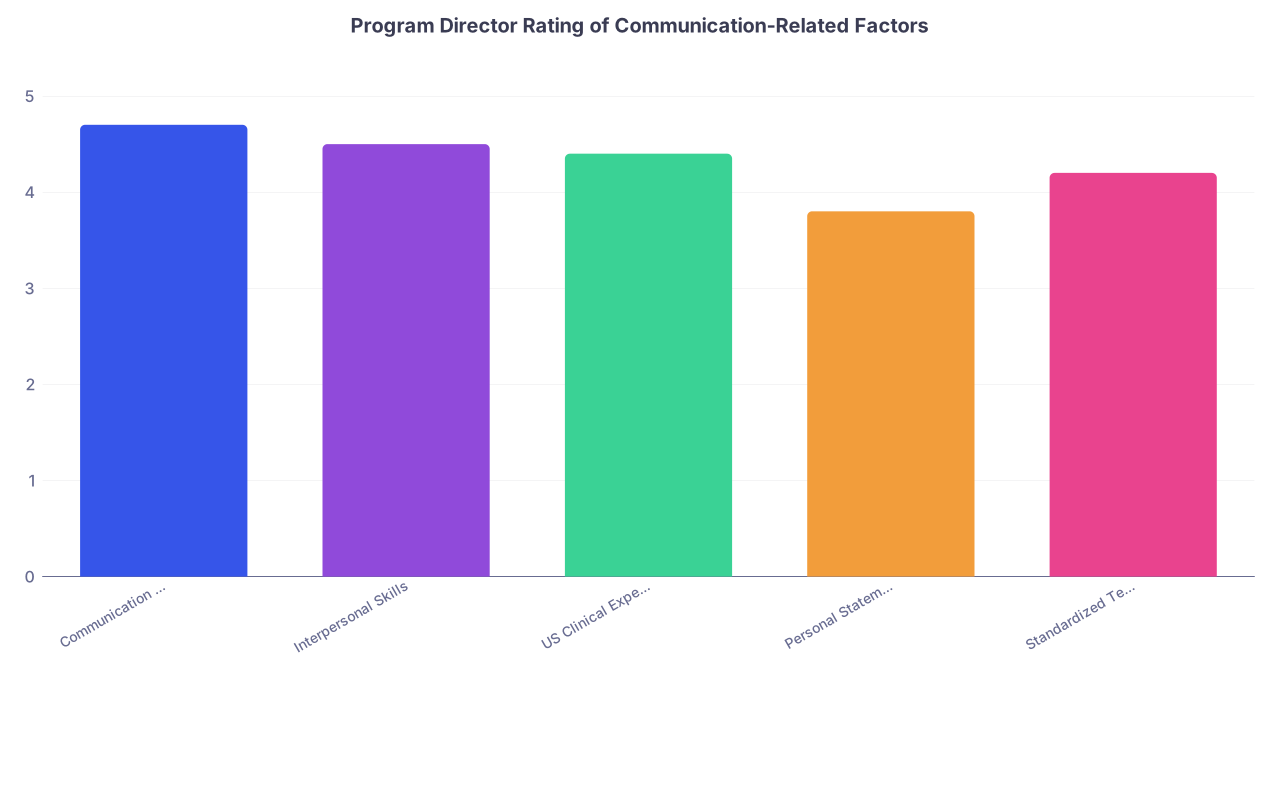
| Category | Value |
|---|---|
| Communication Skills | 4.7 |
| Interpersonal Skills | 4.5 |
| US Clinical Experience | 4.4 |
| Personal Statement | 3.8 |
| Standardized Test Scores | 4.2 |
You can be slightly halting. You can search for words. You can have a heavy accent. You can still match—if you’re clearly understandable and handle clinical communication safely.
I’ve seen residents whose English would make a language teacher cry, but nurses loved them and patients trusted them. They matched and finished just fine. Why? Because their communication worked where it mattered: on the wards.
The Accreditation Reality: Safety, Not Perfection
There’s a regulatory backdrop here that no one on social media mentions.
Residency programs are bound by ACGME requirements. They’re evaluated on things like:
- Patient safety and quality of care
- Communication and professionalism
- Outcomes and complaints
If your English leads to repeated misunderstandings, medication errors, or constant conflicts with patients and staff, that’s a direct threat to accreditation and reputation. So yes—language matters.
But the bar is functional, not “perfect.” The system is built around risk, not aesthetics.
Here’s the informal grading scale programs are actually using, whether they admit it or not:
| Level | Description | Match Outlook |
|---|---|---|
| Unsafe | Frequently misunderstood, confuses key terms, struggles to understand instructions | Practically impossible |
| Strained | Understandable but requires effort, miscommunications in fast or complex situations | Possible only with strong compensating strengths and supportive letters |
| Functional | Accent present but clear, handles daily tasks and pages, clarifies when unsure | Very matchable if overall app is solid |
| Strong | Communicates smoothly, handles family meetings, good rapport | A clear asset and often mentioned in letters |
Notice where “perfect” would even fit. Nowhere. No one cares.
They care that:
- The nurse does not have to repeat “2 units not 10” three times.
- The patient understands “take this twice a day with food.”
- You can explain “heart failure” in plain terms, not textbook jargon.
If you can do that, you’re fine. If you cannot, you have a real problem. But the problem is not perfection; it’s safety.
Who Actually Struggles? The Patterns I Keep Seeing
Let’s talk outcomes, not folklore.
IMGs with language problems who struggle to match usually fall into one of three patterns I’ve watched play out repeatedly:
The “high score, low communication” candidate
260+ on Step 2, beautiful CV, but during USCE feedback you hear the same lines: “Hard to understand on the phone,” “struggles in fast-paced multidisciplinary rounds,” “avoids patient conversations when emotional.”
These candidates often still get interviews. Then bomb them.The “no USCE, overconfident” candidate
They’ve never really worked in English in a hospital, only passed exams. They apply without any US clerkships or observerships. Their first real test of English in a clinical context is the interview. Bad idea.The “frozen under pressure” candidate
Conversationally fine. But once you increase stress—rapid-fire questions, rapid code situations, phone sign-outs at 2 a.m.—their language collapses. Not vocabulary. Processing speed and clarity.
What’s common across these three? None of them failed because their English wasn’t “perfect.” They failed because their English was unreliable under real-world conditions.
There’s a difference.
Evidence from the Field: Accents vs Outcomes
You want real-world proof that “perfect” English is not required to succeed?
Walk into any large internal medicine program in New York, New Jersey, Michigan, or Texas. Take a quiet moment in the resident workroom. You’ll hear:
- Heavy South Asian accents
- Thick West African accents
- Middle Eastern, Eastern European, Latin American, East Asian mixes
Some residents will mispronounce drug names. Some will mix up verb tenses constantly. Some will ask the nurse, “Can you please repeat?” more than you think is ideal.
Yet they’re:
- Signing out 15–20 patients in 10 minutes
- Leading cross-coverage on night float
- Calling consults and negotiating plans with cardiology and surgery
- Delivering bad news with empathy that actually lands
If programs wanted “perfect” English, half the IMG-heavy residencies in the country wouldn’t exist. But they do. And they function.
What’s different about those successful IMGs?
They’ve solved for clarity and workflow, not for beauty of language. They become good at:
- Using standard phrases that nurses recognize instantly
- Confirming understanding: “So you will give 5 units now, correct?”
- Avoiding idioms and sticking to direct, simple sentences
- Asking for repetition without shame when the line is bad or the accent is thick on the other side
That’s what keeps them employed. Not sounding like they were born in Ohio.
The Interview: Where Language Really Gets Tested
Let’s be blunt: the interview is the main “language filter” in the Match.
Programs do not care whether your personal statement has one or two clunky phrases. They do care if your interview:
- Forces them to mentally “decode” every sentence
- Makes them worry you’ll struggle on patient calls
- Shows that under moderate stress (questions, follow-ups), your English crumbles
Here’s how interview language actually gets evaluated behind closed doors. I’ve sat in on these post-interview debriefs.
You hear things like:
- “I had to ask him to repeat three times on simple questions. That’s going to be rough on nights.”
- “Content was fine, but I was working hard to understand her. I’m not sure how that will go with elderly patients.”
- “Strong knowledge, but when I pushed on complex scenarios, he got lost in English, not medicine.”
Or, on the positive side:
- “Accent is thick, but she’s completely clear and adjusts if you look confused.”
- “He asked me to repeat a question once instead of faking it. I actually liked that.”
- “Great with patients. You can tell he’s used to explaining things in simple terms.”
Notice something. No one is saying, “Their English wasn’t native-level.” They’re saying, “I could understand them without extra effort” or “This will or won’t work at 3 a.m.”
If your current “English prep” for interviews is YouTube slang and TikTok accents, you’re wasting time. You should be practicing:
- Case presentations in English, timed and structured
- Sign-out style communication: “Sick, not sick, what do you worry about?”
- Explaining a basic diagnosis in patient-friendly language
That’s the real test.
OET, USMLE, and the Myth of the Magic Score
Another popular myth: “If I pass OET or the USMLE, that proves my English is enough.”
No. These exams prove that:
- You can read and understand clinical English;
- You can communicate at a basic and structured level (especially OET);
- You can function in a quiet testing center with headphones, not on a chaotic ward at 2 a.m.
I’ve met IMG residents who crushed Step scores, passed OET comfortably, and still had early remediation because of:
- Miscommunication on phone orders
- Confusing patients during consent
- Struggling with multidisciplinary rounds when many people speak quickly and interrupt
Exams give you entry-level validation. Programs then look for real-world validation:
- USCE evaluations
- Letters specifically commenting on communication
- Interview behavior—how quickly you process questions, how cleanly you answer
You can’t hide behind a test score if your spoken English in real time is far behind your exam English.
Where IMGs Waste Time (And What Actually Works)
I’ve watched IMGs pour hundreds of hours into the wrong targets:
- Trying to remove every trace of their accent instead of making their accent understandable
- Memorizing American slang instead of clinical phrases
- Obsessing over grammar perfection while still mumbling key orders on the phone
What actually helps you match and function:
Standardizing your clinical English
Learn and rehearse stock phrases you’ll use daily:- “Let me summarize to make sure I understand…”
- “For this patient, the main concern is…”
- “We are recommending… because… The risks include…”
These are the phrases attendings and nurses listen for. Not your perfect small talk.
Improving processing speed, not just vocabulary
Many IMGs know the words. Their problem is speed.
You need to practice hearing a fast question in accented English and responding clearly, without freezing. That’s where mock interviews, simulated sign-outs, and case discussions in English help.Practicing under pressure, not in your comfort zone
Speaking slowly with a friend is useless if you crumble under mild stress.
You should regularly put yourself in uncomfortable English scenarios: group discussions, mock rounds, timed presentations. Feel your brain scramble. Then adapt.Getting brutally honest feedback
“Your English is fine” from your cousin in New Jersey means nothing. You need:- A US-based physician or nurse to say, “Here’s where your English will cause problems on the floor.”
- Someone to tell you: “You mumble at the end of sentences,” or “Your volume drops when you’re unsure.”
Programs are not rejecting you because of a missing article. They’re reacting to the friction people feel when they interact with you.
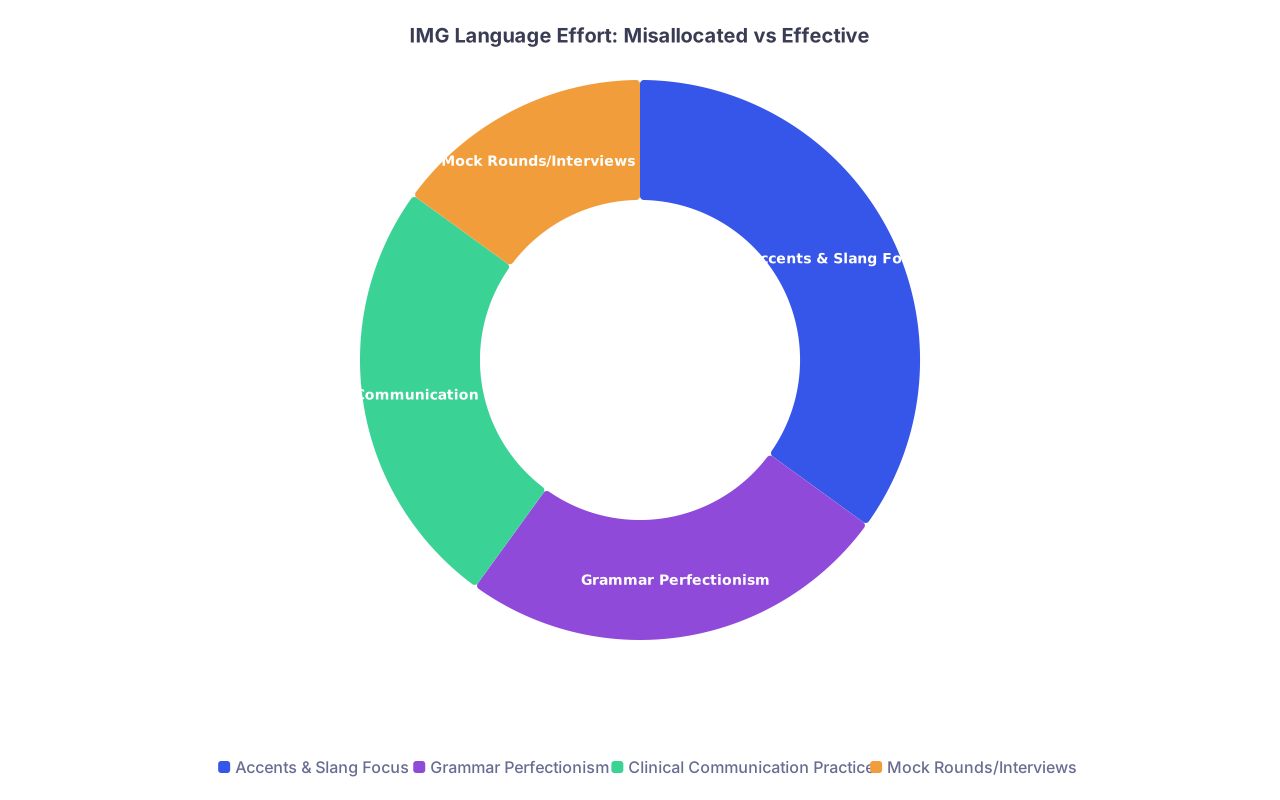
| Category | Value |
|---|---|
| Accents & Slang Focus | 35 |
| Grammar Perfectionism | 25 |
| Clinical Communication Practice | 25 |
| Mock Rounds/Interviews | 15 |
Too many IMGs dump 60% of their “English effort” into the first two categories. The residents who thrive put most of their effort into the last two.
The Harsh But Useful Line: Discrimination vs Reality
Let’s not pretend bias doesn’t exist. Some interviewers do favor native-sounding English. Some patients do get impatient with accents. Some nurses will complain about the IMG more quickly than the US grad with similar communication issues.
You’re not imagining that.
But here’s what the actual outcomes show: IMGs with clear, functional English and strong clinical skills still match in large numbers, even with accents and imperfect grammar. If “perfect” English were required, the IMG Match would collapse.
The line programs draw has less to do with accent bias and more to do with one blunt question:
“Will this resident’s communication create headaches and risk—enough that it’s not worth the trouble?”
Your job is not to become linguistically perfect. Your job is to be so clinically useful and so functionally clear that any lingering bias looks petty and irrational.
You will not beat all bias. You can absolutely beat most of the real-world concerns that drive decisions.
A Quick Reality Check Before You Panic
Here’s how to self-assess your situation with some honesty.
Ask yourself:
- Can I call a nurse and give a clear, concise order in less than 20 seconds without repeating myself twice?
- Can I explain pneumonia to a non-medical person, out loud, in under 2 minutes, without slipping back into textbook language?
- Can I present a new admission in 5 minutes, in English, with structure and without getting lost?
- Do people who are not my friends or family ask me to repeat myself often?
If the answer to most of those is yes, you probably don’t need “perfect” English. You need reps, confidence, and letters that prove you can function.
If the answer to most is no, then you don’t need an accent coach. You need targeted, brutal, practical communication training—focused on clinical situations, not on sounding like a native speaker in a coffee shop.

| Step | Description |
|---|---|
| Step 1 | Worried About English |
| Step 2 | Focus on Clarity and Volume |
| Step 3 | Practice Fast Clinical Scenarios |
| Step 4 | Get USCE and Real Evaluations |
| Step 5 | Stop Chasing Perfection and Apply |
| Step 6 | Frequently Misunderstood? |
| Step 7 | Struggle Under Pressure? |
| Step 8 | No USCE Feedback Yet? |
The Bottom Line
You do not need “perfect” English to match as an IMG. You need:
- Functional, reliable communication that holds up under clinical pressure.
- Proof—from USCE, letters, and interviews—that patients and staff can work with you safely.
- A shift in focus from accent and grammar obsession to clarity, processing speed, and standardized clinical language.
Fix what actually matters. Ignore the myths. The data—and the residents already in the system with heavy accents and imperfect grammar—are very clear on this.