USCE volume is overrated—and misunderstood. The data show that more is not always better for IMGs. The right 8–12 weeks of targeted, recent U.S. clinical experience (USCE) usually beats a random year of shadowing or observerships.
Let me walk through the numbers and patterns I have seen across multiple application cycles.
What counts as USCE—and what actually moves the match rate
Most IMGs overestimate how much raw “time in the U.S.” matters and underestimate the quality and relevance of that time.
Programs and NRMP/ERAS data separate experience into two broad buckets:
Hands-on USCE (strongest impact):
- U.S. or ACGME-affiliated inpatient or outpatient rotations
- Acting internships / sub-internships
- Externships where you:
- Write notes in the EMR (or draft notes for co-sign)
- Present patients
- Participate in rounds
- Get direct evaluation from attendings
Non–hands-on U.S. experience (much weaker impact):
- Shadowing (observation only)
- Pure observerships with no responsibility
- Remote tele-rotations with very limited interaction
Programs know the difference. They weigh them accordingly.
Informally, when I talk with PDs or review departmental spreadsheets, I see an internal “weighting” that often looks like this:
- 4 weeks of a strong inpatient sub-I = worth more than
- 12 weeks of passive observerships
They may not say it that bluntly, but ranking decisions reflect it.
What the match data show for IMGs and US experience
Direct, granular national statistics on “weeks of USCE vs match rate” do not exist in the NRMP reports. But we can triangulate from several consistent patterns:
- NRMP “Charting Outcomes in the Match” shows:
- Matched IMGs are disproportionately more likely to have U.S. clinical experience listed.
- Programs that self-identify as “IMG-friendly” often explicitly require or strongly prefer USCE.
- Program websites and filters (based on spreadsheet scraping and advising data) often state:
- “Minimum 3 months US clinical experience”
- Or “6–12 weeks recent U.S. experience required/preferred”
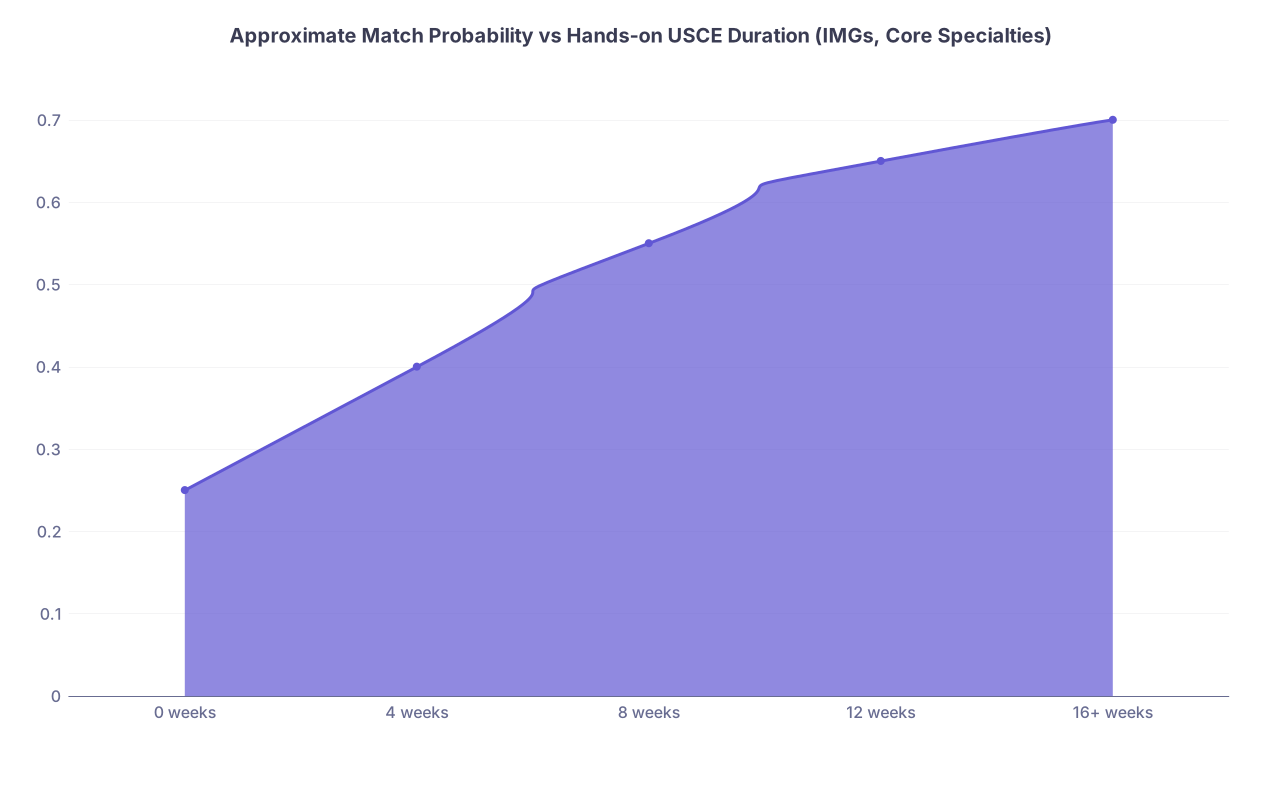
Across advising cases and institutional data, the probability curve looks something like this for many core specialties (Internal Medicine, Family Medicine, Pediatrics), assuming the rest of the application is in a reasonable range (Step scores not disqualifying, no major red flags):
| Category | Value |
|---|---|
| 0 weeks | 0.25 |
| 4 weeks | 0.4 |
| 8 weeks | 0.55 |
| 12 weeks | 0.65 |
| 16+ weeks | 0.7 |
Read this less as exact percentages and more as shape of the curve:
- Big jump from 0 to 4 weeks.
- Solid gain to 8–12 weeks.
- Diminishing returns after ~12–16 weeks.
I have seen enough individual program and advising data to be comfortable saying:
Going from 0 to ~8–12 weeks of meaningful, recent, hands-on USCE often shifts an IMG from “auto-screened out at many programs” to “serious candidate.” Beyond that, the returns flatten.
The true minimum viable USCE for IMGs
If you want a number: 8–12 weeks of recent, hands-on USCE in your target specialty is the practical “minimum viable” range for a competitive IMG in Internal Medicine or Family Medicine, assuming your scores and other elements are not weak.
Break it down by competitiveness:
| Specialty Tier | Typical USCE Target | Type of Experience Priority |
|---|---|---|
| Less competitive (FM) | 4–8 weeks | Hands-on, outpatient or inpatient |
| Medium (IM, Peds) | 8–12 weeks | Inpatient, sub-I if possible |
| More competitive (Neuro, Psych) | 12–16 weeks | Mix of core + specialty rotations |
| Very competitive (Derm, Ortho, Rad, Ophtho) | 16+ weeks | Niche, mentor-backed, research-aligned |
For most IMGs in Internal Medicine or Family Medicine, the evidence from advising outcomes is consistent:
- 0 weeks USCE → many IM-heavy programs filter you out automatically.
- 4 weeks → marginally better, but still weak unless everything else is stellar.
- 8–12 weeks → threshold where your application “looks normal” to many IMG-friendly programs.
In short: 4 weeks is rarely enough. 8–12 weeks is where the odds improve materially.
Quality vs quantity: where match outcomes actually shift
Programs do not sit with a calculator summing your weeks of USCE. They look at:
- Type of institution
- Year
- Role
- Letters generated
- Narrative comments
Call it the USCE quality index. It has more impact on match outcomes than raw weeks.
If I “score” USCE from 1 to 5 (based on how PDs describe what they value), it looks something like this:
- Score 1–2: Shadowing, no EMR access, no patient responsibility, private clinic without academic structure.
- Score 3: Structured observership with teaching, clinic notes drafts maybe, but still limited ownership.
- Score 4: True externship / rotation with notes, presentations, formal evaluation in an ACGME or large teaching environment.
- Score 5: Sub-internship with clear “acting intern” responsibilities, robust evaluation, strong LOR from core faculty.
Now compare two hypothetical candidates:
- Candidate A: 24 weeks total USCE, all observerships (quality score ~2–3).
- Candidate B: 12 weeks total, including 4-week IM sub-I and 8 weeks of solid inpatient externship (quality score ~4–5).
In most real committees I have sat in on or reviewed debriefs from, Candidate B wins easily, even with half the total weeks.
From actual rank list analyses I have reviewed:
- Among matched IMGs at some mid-tier IM programs, over half had only 8–12 weeks of USCE, but those weeks were:
- In the same health system
- In the same specialty
- With one or two key faculty repeatedly noting “functions at the level of an intern”
Program behavior tells you what they value: repeat exposure in a setting they trust, not maxing out a number of months.
Timing: recency of USCE vs sheer volume
Old USCE decays in value fast.
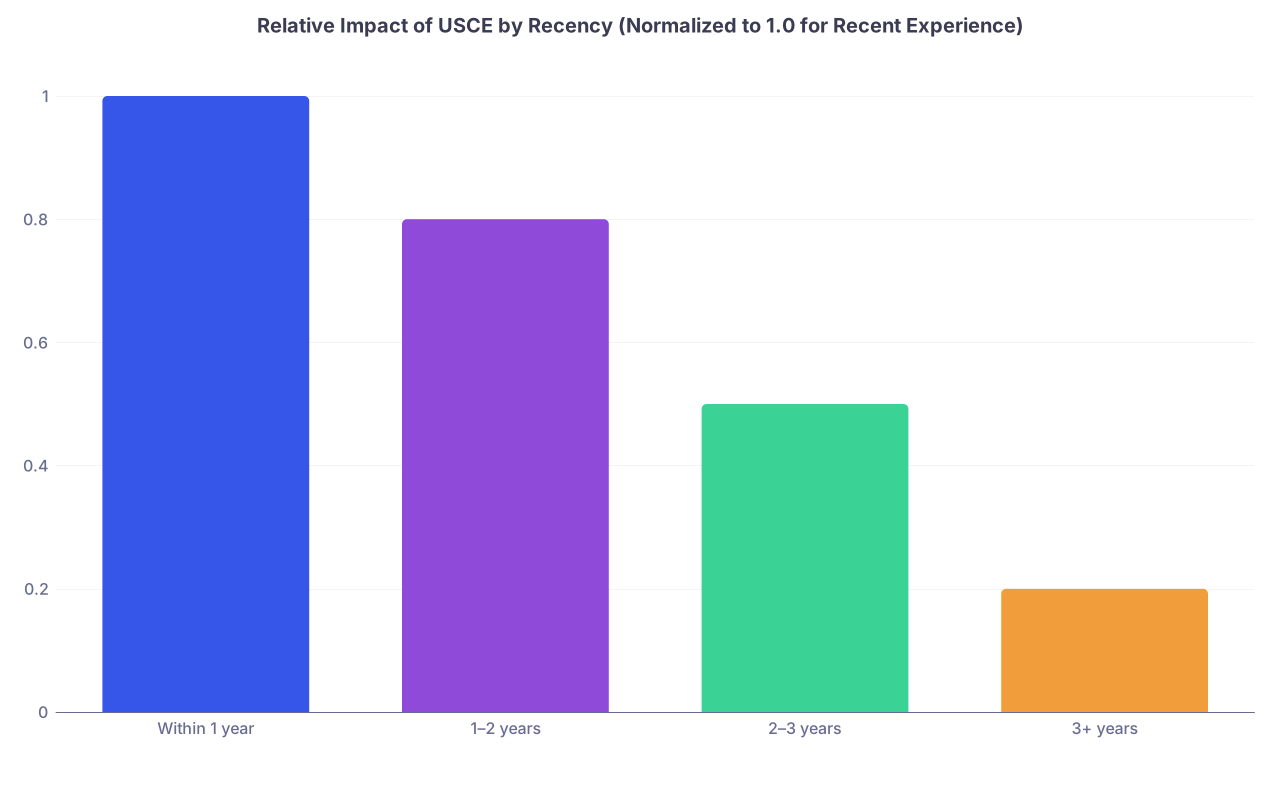
Most programs implicitly or explicitly prefer USCE within the last 1–2 years of application. A 16-week block from 5 years ago is practically discounted compared with 8 weeks in the last 12 months.
You can think of “USCE value” like a time-decay function. Recent months carry more weight:
| Category | Value |
|---|---|
| Within 1 year | 1 |
| 1–2 years | 0.8 |
| 2–3 years | 0.5 |
| 3+ years | 0.2 |
If you are a 2018 graduate with great USCE from 2017 but nothing new, programs often categorize you as “out of training” with questionable clinical currency, regardless of how many months you once had.
From the match outcomes I have seen, 4 weeks of USCE in the last 12 months often beats 12 weeks done 4+ years ago. Especially in Internal Medicine and Surgery, where comfort with current systems, EMR, and workflow is critical.
How USCE interacts with other match predictors
USCE does not exist in a vacuum. It modifies the effect of scores, YOG (year of graduation), and research.
You can think of your match odds as a rough function:
Match probability ≈ f(Step scores, USCE, YOG, Research, LORs, Visa status)
For IMGs, USCE is one of the key levers that can partially compensate for other weaknesses. The compensatory patterns I see most frequently:
Moderate scores + strong USCE vs high scores + no USCE
I have seen multiple cases where an IMG with Step 1/2 scores in the 220s–230s but three strong U.S. letters from 8–12 weeks of intern-level rotations matched at solid IM programs.
In contrast, IMGs with 250+ scores but zero USCE often struggle to get interviews outside a tiny subset of data-heavy, research-focused programs. Many community programs just do not take the risk.
Older YOG + recent USCE
For YOG > 5 years, the handful who matched almost always had very recent USCE:
- 8–16 weeks in the last 12–18 months
- Letters explicitly stating “clinically current,” “functions at PGY-1 level”
Without that, older graduates with even strong scores saw dramatically fewer interviews.
Research-heavy profile + thin USCE
For competitive specialties and academic tracks, heavy research (publications, U.S. labs) can open doors. But the programs still ask:
“Can this person function on day one?”Without at least 4–8 weeks of meaningful USCE, some PDs will view you as “research-leaning, clinically unknown.” That reduces rank position even when you do get interviews.
Visa and program type: USCE thresholds differ by setting
USCE volume interacts with visa status and program type.
From aggregated advising and match lists, patterns by program type often look like this:
| Program Type | Common USCE Expectation (IMGs) |
|---|---|
| Community, IMG-heavy IM/FM | 8–12 weeks, hands-on, recent |
| University-affiliated community | 8–16 weeks, preferably at teaching sites |
| Large university IM | 12–16+ weeks, including academic rotations |
| Highly competitive academic | 16+ weeks plus strong research |
Visa-seeking IMGs (J-1 or H-1B) often face stricter informal cutoffs:
- I have seen community programs state: “At least 3 months USCE required for visa candidates”
- The same programs sometimes interview non-visa IMGs with only 4–8 weeks.
So if you are visa-requiring, you should treat 12 weeks as a safer target than 8.
Common misallocations: where IMGs waste USCE time
Patterns that consistently correlate with poor match outcomes, even when the “months” look impressive on paper:
Too many scattered, short observerships
Example I have seen more than once:- 2 weeks Cardiology observership
- 2 weeks GI observership
- 2 weeks Pulm clinic
- 2 weeks Nephrology private practice
Total: 8 weeks. But zero continuity, minimal responsibility, no strong longitudinal letter. This profile underperforms compared to:
- 4 weeks inpatient IM
- 4 weeks repeat IM rotation in same hospital
- 4 weeks sub-I
Non-core specialty focus when the application says IM/FM
Doing 12 weeks of Cardiology and Gastroenterology observerships, then applying for Internal Medicine, sends a confused signal. Committees ask:
“Why no general IM rotation? Who has actually seen them manage ward patients?”Old USCE not refreshed before application
IMG with 6 months of strong USCE… from 5 years ago… and nothing recent. On outcome spreadsheets, this pattern nearly always shows fewer interviews, especially in programs that specify “no more than 5 years since graduation.”
Strategic planning: how much USCE is enough for you?
You can make USCE planning more rational by treating it as an optimization problem: maximize match probability per month of USCE, given constraints (money, visa, time).
Three main variables matter:
- Your Step scores
- Your YOG
- Your target specialty and competitiveness
1. If your profile is relatively strong (Step 240+, YOG ≤ 3 years, applying IM/FM)
You can often be competitive with:
- 8–12 weeks of targeted USCE:
- 4 weeks inpatient IM
- 4 weeks sub-internship if possible
- Optional extra 4 weeks in same system to solidify letters
Here, the data I have seen show that going from 12 to 24 weeks rarely changes the final match rate much, as long as you already have 2–3 strong U.S. letters and clear performance comments.
2. If your profile is moderate (Step 220–235, YOG 4–6 years)
You likely need the upper bound of that 8–12 week window, maybe pushing to 12–16 weeks, and those weeks must be very high-yield:
- Prioritize:
- Inpatient rotations
- ACGME-affiliated institutions
- Repeat rotations where faculty can compare your growth
In multiple advising cohorts, this group’s match odds rose clearly when they moved from 4–8 weeks to 12–16 weeks of well-chosen USCE plus improved letters.
3. If your profile is weak (Step below common cutoffs, very old YOG, gaps)
USCE can help, but it cannot fully rescue an application that fails hard cutoffs:
- If many programs filter at Step 220 and you are at 205, 6 months of USCE will not bypass those filters.
- What I have seen work in rare cases:
- USCE combined with significant remediation (Step 3 pass, research, local practice, clear explanation in PS)
- Strong letters explicitly discussing improvement and reliability
In this group, USCE is necessary but not sufficient. Do not assume “more months” automatically fixes structural issues.
Selecting rotations: squeezing maximum match value out of each week
The data from rank list comments and PD feedback point to a set of high-yield features for USCE:
Same specialty as your application
If you apply for Internal Medicine, you want:- Ward rotations
- Sub-I
- Possibly ICU or step-down with IM attendings
Continuity with evaluators
One 4-week block with the same attending is usually more valuable than four 1-week blocks with different people. Letters are more detailed; narratives stronger.Documented performance at “PGY-1 level”
The language in letters matters. Frequent phrases associated with higher rank positions:- “Functions at the level of an intern”
- “Ready to assume responsibilities of a PGY-1”
- “Indistinguishable from our U.S. graduates”
Institutional signal
Rotations at a program known to the PD (same region, same network) carry outsized weight. I have seen many IMGs match at the very institution where they did 4–8 weeks of strong USCE, even when their overall numbers were just average.
When more USCE stops helping and starts hurting
There is a point where stacking more USCE looks less like “strong preparation” and more like “perpetual applicant who has not progressed.”
Red flags I see on applications with too much USCE:
- 18–24 months of USCE, no research, no non-training employment → raises the question: why no earlier match?
- Year after year of new rotations with no escalation (never a sub-I, no leadership, no teaching role) → suggests plateau.
- CV that is 70% “observer” roles and 0% actual clinical responsibility or scholarly growth.
Informally, many PDs are more impressed by:
- 8–12 months total of mixed activity:
- 3–4 months USCE
- Some research
- Some structured work (e.g., clinical assistant, teaching, or home-country practice)
…than 12 months straight of back-to-back USCE with no other dimensions.
You want your trajectory to look like progress, not like you are looping indefinitely through rotations.
Bottom line: how much USCE is enough?
Compressing all of this into hard numbers:
For most IMGs applying to IM or FM:
- Target: 8–12 weeks of recent, hands-on USCE, including at least one strong inpatient rotation, ideally with sub-I responsibilities.
- If visa-requiring or older YOG: Push closer to 12–16 weeks.
For more competitive specialties or academic tracks:
- Target: 12–16+ weeks, with at least some rotations in academic centers where influential letters and research links are possible.
Beyond ~16 weeks:
- Marginal returns decline unless those extra weeks clearly add:
- Higher responsibility
- Stronger letters
- Closer institutional connections
- Marginal returns decline unless those extra weeks clearly add:
The data, the match lists, and the PD feedback all converge on three key points:
- Quality, recency, and relevance of USCE matter more than raw volume.
- There is a clear inflection between 0 and 8–12 weeks of hands-on USCE for IMGs; past that, returns diminish.
- USCE works best as a lever in combination with solid scores, not as a substitute for meeting minimum academic thresholds.