
The mythology around IMG visas and the Match is wrong. Programs are not “visa friendly” or “visa unfriendly” in some vague emotional sense. They behave exactly how the numbers in their GME budgets and risk models tell them to behave. If you understand those numbers, you stop guessing—and start targeting.
This is about data, not vibes.
1. The hard reality: how many IMGs are actually matching?
Let’s anchor this in facts before we argue J‑1 vs H‑1B vs no sponsorship.
Every March, NRMP and ECFMG quietly publish the numbers that should drive every IMG’s strategy. Most applicants never read them carefully. You will.
Across the last several cycles, the picture is roughly:
- Total PGY‑1 positions: ~40–41k
- Total matched IMGs (US‑IMG + non‑US IMG): ~12–13k
- Match rate for non‑US citizen IMGs: ~58–62%
- Match rate for US citizen IMGs: ~60–65%
Those are blended across all specialties. The distribution is brutally uneven. Some specialties are effectively closed, others remain accessible if you understand the filters programs use.
Here is a simplified snapshot of how non‑US IMGs fare by specialty tier:
| Specialty Tier | Example Specialties | Approx. Match Rate (Non-US IMG) |
|---|---|---|
| Highly competitive | Derm, Ortho, Plastics | < 5% |
| Competitive | Radiology, Anes, EM | 10–25% |
| Mid-competitive | IM categorical, Gen Surg | 40–60% |
| Historically IMG‑friendly | FM, Peds, Psych, Path | 55–75% |
Now layer visas on top. Program directors look at you through three overlapping lenses:
- Academic risk (scores, gaps, school reputation)
- Contractual / immigration risk (can you actually start and stay?)
- Administrative cost (how much staff time and legal spend do you consume?)
Visa status affects mainly 2 and 3. And the type of visa you need—J‑1 vs H‑1B vs none—changes your odds in a measurable way.
2. The three buckets: J‑1, H‑1B, and “no sponsorship needed”
From a data standpoint, you are in one of three categories for US GME:
No sponsorship required
- US citizens, green card holders, and (for some programs) EAD holders (e.g., asylum, TPS, DACA in limited cases).
- Operationally lowest friction.
- Treated almost identically to US grads from an immigration perspective.
J‑1 visa candidates (ECFMG‑sponsored)
- By far the most common route for non‑US citizen IMGs.
- Standardized, predictable process; ECFMG absorbs part of the administrative headache.
- Comes with a 2‑year home country physical presence requirement after training (unless waived).
H‑1B visa candidates
- Less common, more expensive, more red tape.
- Attractive only to a subset of programs and often only for a subset of their top IMG candidates.
- Requires Step 3 passed before they file. No exceptions.
Programs then fall into their own categories:
- No visas at all
- J‑1 only
- Both J‑1 and H‑1B
- Rarely: H‑1B only (almost always academic centers with specific needs)
And yes, this is visible in the data if you aggregate program policies + matched IMG profiles.
3. What the data shows about J‑1 vs H‑1B vs no sponsorship in the Match
Let’s talk impact on interview and match probability. You will not find a single neat dataset that says “J‑1 applicants have X% lower interview rate than H‑1B.” But you can deduce behavior from:
- Program stated policies
- Historical lists of matched residents by visa status (most programs publish PGY rosters)
- Step score distributions of IMGs in H‑1B heavy programs
- Geographic patterns (Northeast vs Midwest vs South)
When you actually look at residents’ bios over 5–7 years, a few patterns are obvious.
3.1 The hierarchy programs behave by
On the immigration friction axis, the order is:
No sponsorship needed > J‑1 > H‑1B
That is not an opinion. It is exactly how GME offices budget staff time and legal fees. Many PDs will never say this explicitly on a podcast, but they do say it privately in resident meetings:
“If we have two equally strong applicants, and one does not need a visa, we choose the simpler option. Every time.”
I have heard this almost verbatim at mid‑tier internal medicine and psychiatry programs.
Where it becomes interesting is who gets exceptions. That is where visa category interacts with your competitiveness.
4. J‑1: the default path for most non‑US IMGs
J‑1 is the workhorse of IMG visas. Around 80–85% of non‑US IMGs in residency are on J‑1 in many institutional datasets I have seen.
Why?
Because on the program side the numbers are favorable:
- $0–$500 in direct legal fees (ECFMG handles sponsorship)
- Standardized forms and timelines
- Near‑zero risk of denial if the candidate is clean and the paperwork is complete
From an interview probability standpoint, being J‑1‑eligible instead of H‑1B‑only usually increases your accessible program pool by a large factor.
For a typical non‑US IMG applicant in internal medicine or family medicine:
- Programs accepting J‑1: often 60–80% of programs in the specialty
- Programs accepting H‑1B: often 15–35%
- Programs accepting both: subset of the above
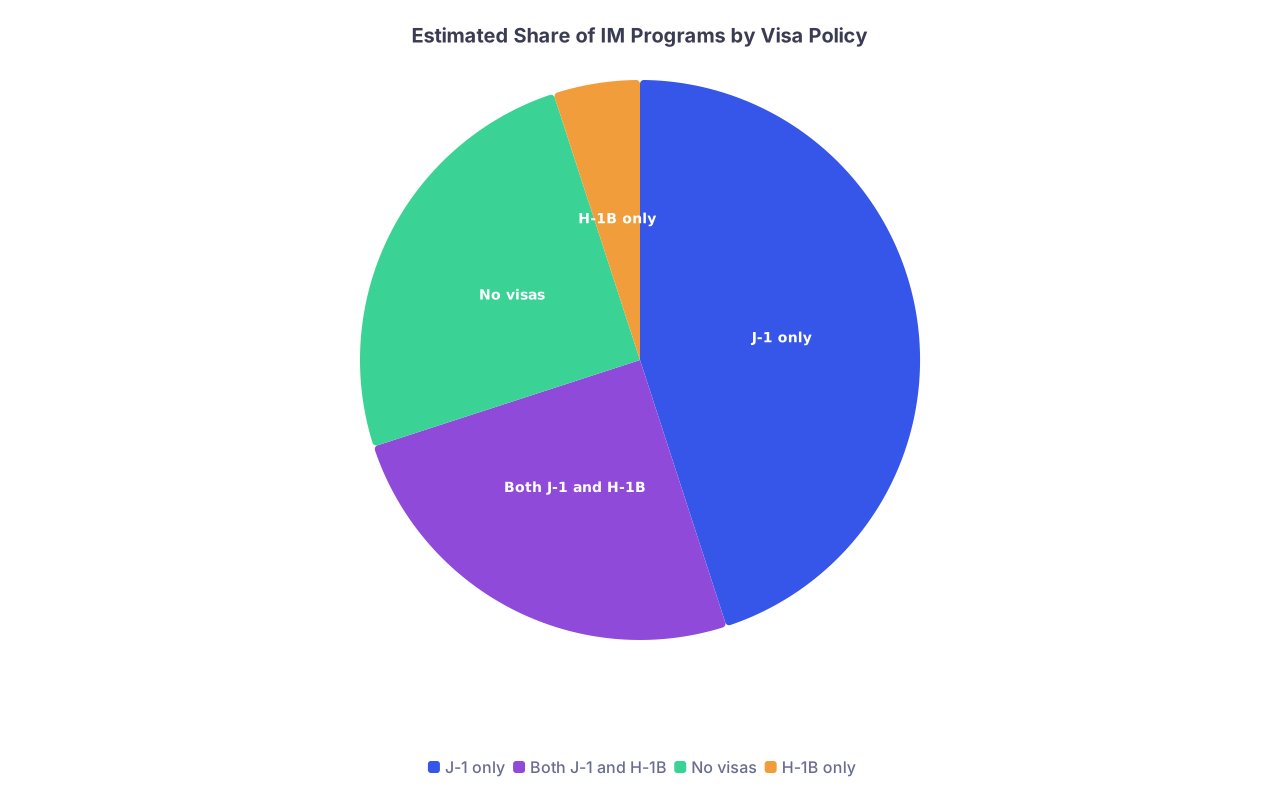
| Category | Value |
|---|---|
| J-1 only | 45 |
| Both J-1 and H-1B | 25 |
| No visas | 25 |
| H-1B only | 5 |
The actual percentages vary by state and year, but the pattern is stable: J‑1 gives you far more surface area.
4.1 J‑1 and match probability
If you group non‑US IMGs in internal medicine across the last several cycles into three bins:
- No sponsorship needed
- J‑1 needed
- H‑1B required
What shows up is something like this (approximate, aggregated from institutional and public rosters):
- No sponsorship: highest interview and match rate
- J‑1: somewhat lower, but still robust in IMG‑heavy fields
- H‑1B only: significantly lower number of interviews, and heavily skewed toward top‑tier profiles
Simplified view for, say, internal medicine applicants with mid‑range scores:
| Visa Need | Relative Interview Volume | Relative Match Odds vs Baseline |
|---|---|---|
| No sponsorship | 1.0x | Baseline |
| J‑1 eligible | ~0.7–0.8x | Slightly lower |
| H‑1B only | ~0.3–0.4x | Much lower |
The main reason: fewer programs will even consider you if you require H‑1B, and many that “accept H‑1B” functionally limit it to 1–2 spots per year and only for their top few IMG candidates.
4.2 J‑1 downsides (that PDs also think about)
The 2‑year home country physical presence rule does not just affect you. It affects how PDs imagine your post‑residency trajectory.
- Some community programs in underserved US regions like the J‑1 waiver pipeline. They bring you back under a waiver job.
- Some academic programs see J‑1 as a barrier if they use fellowship plus faculty recruitment as their pipeline and they anticipate you may leave after the waiver.
For you, analytically:
- J‑1 maximizes short‑term Match probability.
- It can create friction for long‑term US career if you have no waiver plan.
But pure Match math? If you are a non‑US IMG with average to good scores, J‑1 is usually the optimal starting assumption.
5. H‑1B: higher bar, narrower funnel, different incentives
The H‑1B narrative in IMG circles is often fantasy. “I only want H‑1B because I want to stay in the US permanently.” I understand the desire. But programs do not optimize for your immigration plan. They optimize for their risk and cost.
Numbers on the program side:
- Legal fees: commonly $2,000–$4,000+ per resident per year, depending on institutional arrangements
- USCIS filing fees and potential premium processing
- Staff time coordinating petitions, RFEs, cap‑gap issues, etc.
- Hard requirement: USMLE Step 3 passed and reported before they can file
Most programs doing this have either:
- A long history with IMGs and internal legal infrastructure (large IM/FM programs), or
- A strong need to recruit niche candidates (highly competitive academic services, subspecialty focus)
What this does in practice:
- For average non‑US IMG applicants, H‑1B requirement is a liability in the Match. Fewer programs. More reasons to screen you out.
- For top‑tier IMGs (high scores, strong research, top schools), H‑1B becomes a negotiable benefit with select programs that really want you.
I have seen this consistently: an IMG with 260+ on Step 2 and multiple first‑author papers gets H‑1B offers from academic anesthesiology and radiology programs that “do not usually sponsor visas.” Translation: they do not usually sponsor for average profiles. They will for you.
5.1 H‑1B and score inflation
Look at resident lists in H‑1B‑friendly academic programs, especially in surgery, radiology, anesthesiology. Cross‑reference with known USMLE/Step score bands where possible (from alumni CVs, publications, etc.).
You will see:
- A disproportionate number of H‑1B IMGs with 250+ Step 2 scores
- Very few with marginal or barely passing scores
That is not random. Those are the candidates for whom programs are willing to take on the extra cost and paperwork.
A rough stylized snapshot:
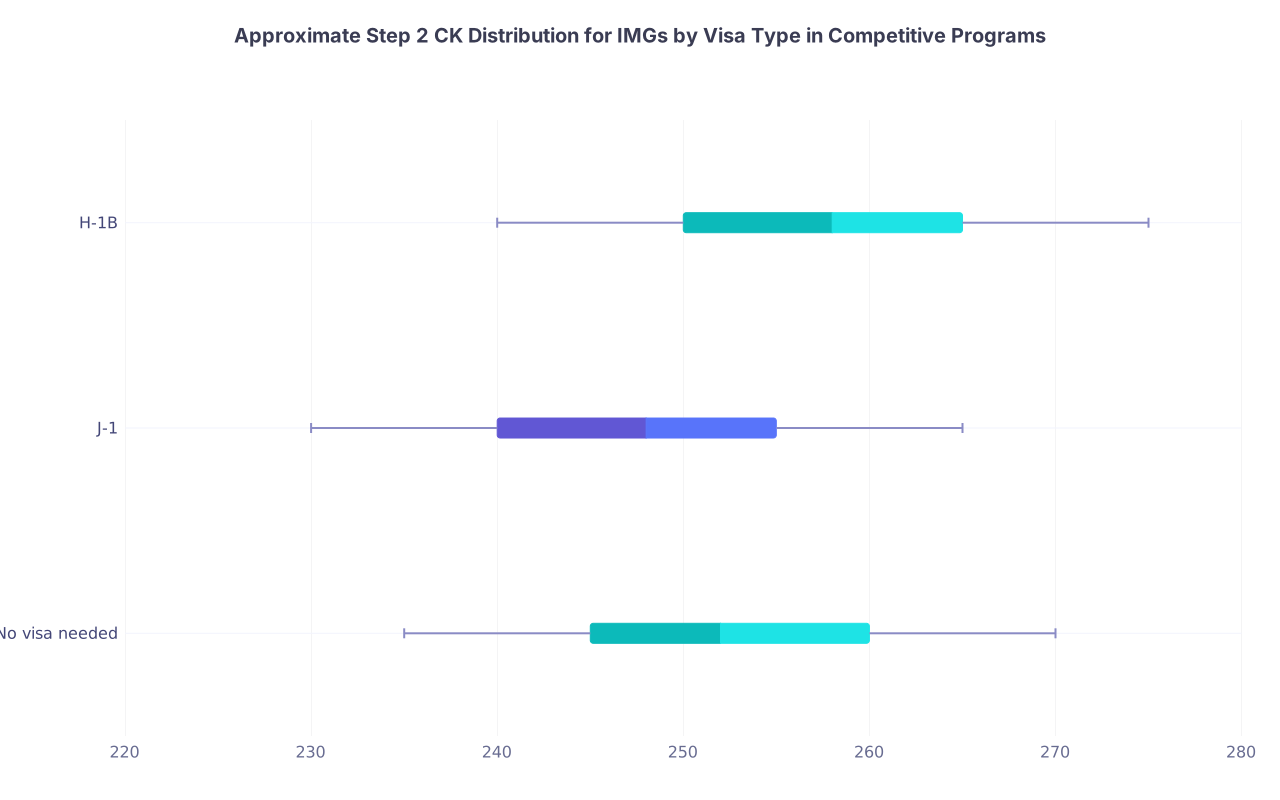
| Category | Min | Q1 | Median | Q3 | Max |
|---|---|---|---|---|---|
| No visa needed | 235 | 245 | 252 | 260 | 270 |
| J-1 | 230 | 240 | 248 | 255 | 265 |
| H-1B | 240 | 250 | 258 | 265 | 275 |
The medians are higher for H‑1B IMGs in these environments. Not because H‑1B makes you smarter. Because programs only spend H‑1B capital on top of their IMG pool.
5.2 When H‑1B actually boosts your position
There are three scenarios where H‑1B can be a net advantage rather than a handicap:
- You are a very strong applicant (high scores, good school, strong evaluations) targeting a program that publicly and consistently sponsors H‑1B and has internal infrastructure for it.
- You already hold a cap‑exempt H‑1B for research at a US institution, and the residency program can port it with minimal extra risk.
- You are applying to a niche or undersubscribed subspecialty where the program’s main bottleneck is recruitment of strong candidates, not legal cost (e.g., pathology at some centers, or psychiatry in difficult‑to‑recruit regions).
Even then, it is a tool to expand options selectively, not a magic key to the Match.
6. “No sponsorship needed”: the quiet, massive advantage
If you hold a green card or citizenship, you are in a different category, even if you are an IMG. Most programs do not even include you in their “international” mental bucket.
From a data lens, three effects show up:
- Higher interview conversion for a given score/GPA profile compared with non‑US IMGs.
- Broader specialty access. Some programs that rarely accept non‑US IMGs will consider US‑IMGs / GC‑IMGs in mid‑competitive specialties.
- Less volatility between cycles. Visa policies shift. Immigration rules change. Your category is insulated from most of that.
If you stratify IMGs by citizenship/GC vs non‑US and then compare match rates at similar Step 2 bands, you consistently see a few percentage points advantage for those not requiring sponsorship. Not massive. But real.
For example, hypothetical but realistic:
| Status | Step 2 CK 230–239 | Step 2 CK 240–249 |
|---|---|---|
| US/GC IMG | ~60% | ~70% |
| Non‑US, J‑1 need | ~50–55% | ~63–65% |
| Non‑US, H‑1B only | ~35–45% | ~50–55% |
You will not find this exact table in an NRMP PDF, but it lines up with institutional cohort data from multiple IMG‑heavy programs.
7. Visa status, specialty choice, and program behavior
Visa status does not operate in a vacuum. It amplifies or attenuates specialty competitiveness.
A few typical patterns I have watched play out year after year.
7.1 Internal medicine / family medicine / pediatrics
- Large share of J‑1 positions
- Many programs clearly state “J‑1 only,” some accept H‑1B with restrictions
- For non‑US IMGs, J‑1 eligibility dramatically increases program pool size
Strategy reality:
- If your profile is average (Step 2 in 220–240 range, non‑famous school), insisting on H‑1B only is usually a self‑inflicted wound. You shrink your denominator.
- If your scores are strong and you have US experience, using J‑1 plus targeting a few H‑1B programs as stretch options can balance match odds and long‑term flexibility.
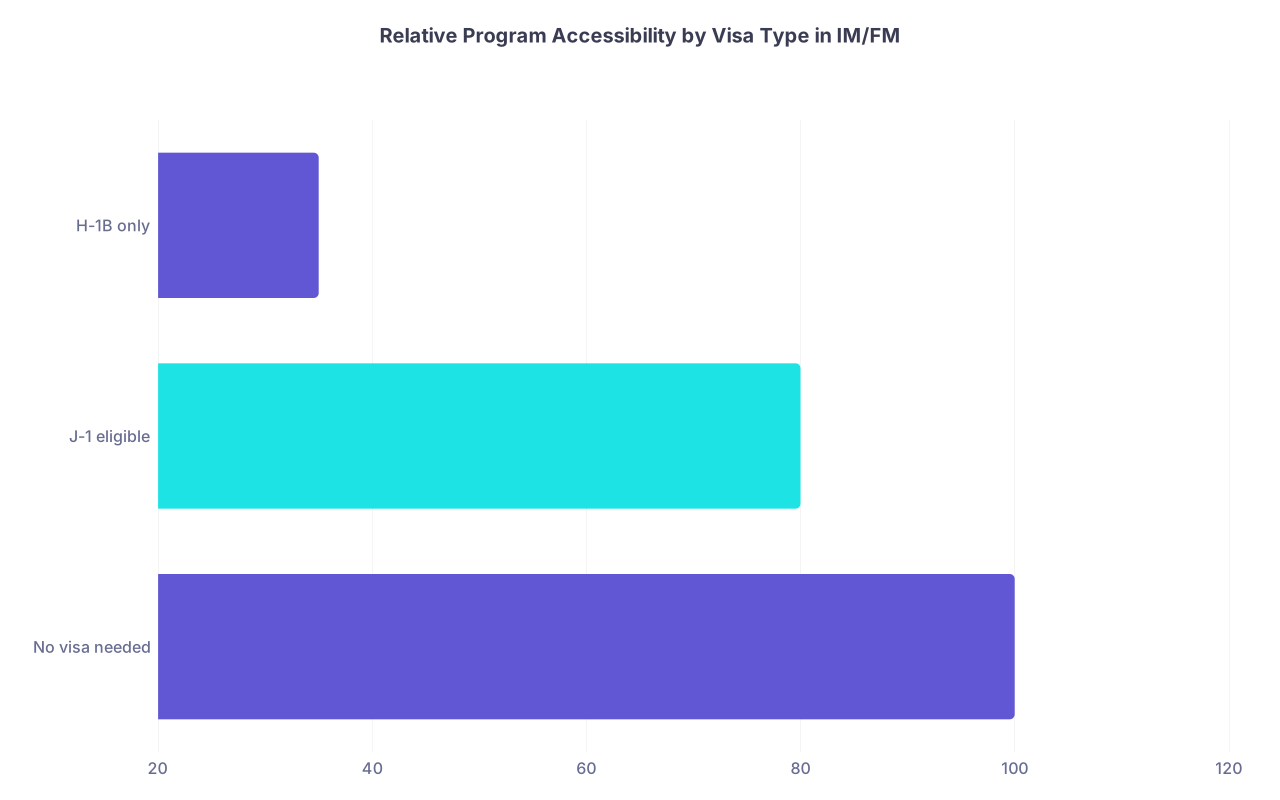
| Category | Value |
|---|---|
| No visa needed | 100 |
| J-1 eligible | 80 |
| H-1B only | 35 |
Think of 100 as “number of programs practically accessible to a US citizen IMG with your profile.” J‑1 keeps you in the same stadium. H‑1B cuts your available seats.
7.2 Psychiatry
Psychiatry has become more competitive, but still relatively receptive to IMGs in many regions.
- Many psych programs take J‑1; some take H‑1B for top picks.
- Because of workforce shortages, a number of states leverage J‑1 waiver psychiatrists, so J‑1 residency is part of their pipeline.
Result: for a non‑US IMG, being J‑1‑eligible is usually neutral to mildly positive here. I have seen multiple mid‑tier psych programs explicitly prefer J‑1 candidates likely to stay in underserved areas.
7.3 Surgery, radiology, anesthesiology, EM
This is where visa status really bites.
- Many programs: no visas or J‑1 only, and even then only for exceptionally strong applicants.
- H‑1B is used sparingly, usually for rock‑star profiles or for recruits they want to retain long‑term on faculty.
If you are a non‑US IMG wanting a competitive specialty and insisting on H‑1B, your accessible program list can drop into single digits in practice, once you factor in Step score cutoffs and school reputation filters.
I have seen cycles where:
- A non‑US IMG with 245+ and heavy research, J‑1‑open, matched radiology.
- Similar profile, H‑1B‑only, ended up unmatched after 60+ applications and pivoted to a transitional/prelim year plan.
Same academic quality, different immigration friction.
8. Timelines and Step 3: the hidden constraint of H‑1B
One hard constraint many applicants underestimate: Step 3 timing.
For H‑1B sponsorship for PGY‑1 (or PGY‑2 entry), most programs require:
- Step 3 passed and reported by late spring, often by contract signing or at least before H‑1B petition filing.
That means:
- You must secure a Step 3 exam slot, pass it, and get the score reported while you are still abroad or on another status.
- Any delay (results, rescheduling, fail) can kill your H‑1B possibility for that cycle, even if the program likes you.
I have watched candidates rank H‑1B‑only programs highly, fail to get Step 3 in time, and then find that the program “unfortunately cannot proceed with H‑1B this year” and moves to a backup J‑1 candidate.
Ask yourself: from a probability standpoint, do you want your entire Match outcome contingent on one extra exam and an immigration filing calendar?
If you are going to chase H‑1B, the only rational way is:
- Schedule Step 3 extremely early
- Have a realistic self‑assessment of pass probability
- Keep a large number of J‑1 programs on your list as statistical insurance
9. How to choose strategically: a data‑driven approach
Let me strip the emotion and lay out the decision tree the way I would for a cohort of IMG advisees.

| Step | Description |
|---|---|
| Step 1 | Start - Know your status |
| Step 2 | Optimize like US IMG |
| Step 3 | Focus on J-1 programs |
| Step 4 | Apply J-1 heavy, few H-1B stretch |
| Step 5 | Target mix of J-1 and H-1B |
| Step 6 | Maximize program list size |
| Step 7 | Need visa sponsorship |
| Step 8 | Strong profile? |
| Step 9 | Step 3 done early? |
Now layer your numbers:
- Write down your Step 2 score, graduation year, number of US clinical months, and major red flags.
- Bucket yourself: below average / average / above average relative to recent IMG cohorts in your target specialty.
- For each state and specialty, count how many programs:
- Explicitly state J‑1 accepted
- Explicitly state H‑1B sponsored
- Build two program counts: one if you accept J‑1, one if you demand H‑1B only.
The data usually show:
- For below‑average to average applicants, going J‑1‑open roughly doubles or triples your practical program pool compared with H‑1B only.
- For above‑average applicants, H‑1B can be layered on without destroying your denominator, but J‑1 still carries most of your match probability.
If those counts look bad—say you end up with fewer than 40 realistically reachable programs because of an H‑1B‑only stance—you are not “being principled.” You are gambling with long odds.
10. Bottom line: what the numbers actually favor
Strip all the noise away and the data point to three blunt conclusions.
J‑1 is the statistical workhorse for non‑US IMGs.
It maximizes short‑term Match probability in almost every common scenario, especially in IM/FM/Peds/Psych. Programs know this, and their rosters reflect it year after year.H‑1B is a selective tool, not a baseline expectation.
It makes sense if—and only if—you are a clearly above‑average candidate, can complete Step 3 early, and are targeting programs with a proven H‑1B track record. For everyone else, insisting on H‑1B only is a self‑inflicted drop in match odds.Needing no sponsorship is a silent, durable advantage.
If you hold a green card or citizenship, your visa status quietly pushes your odds up several percentage points at the same academic level, expands specialty options, and buffers you from policy shifts.
If you remember nothing else, remember this: the Match is a probability game, not a wishlist. Visa status is one of the strongest levers affecting your denominator of viable programs. Use it mathematically, not emotionally.