
The biggest reason strong IMGs fail to match is not scores. It is administrative chaos six months before ERAS opens.
You are already late if you think “I’ll start once ERAS opens in June.” The serious IMGs start half a year earlier and treat admin like a second job. At this point, you are not “getting ready someday.” You are on a six‑month countdown.
Below is exactly what you should be doing month by month, week by week, from six months before ERAS opens until launch day.
Global Overview: Your Six‑Month Admin Timeline
At this point you should think in phases, not random tasks.
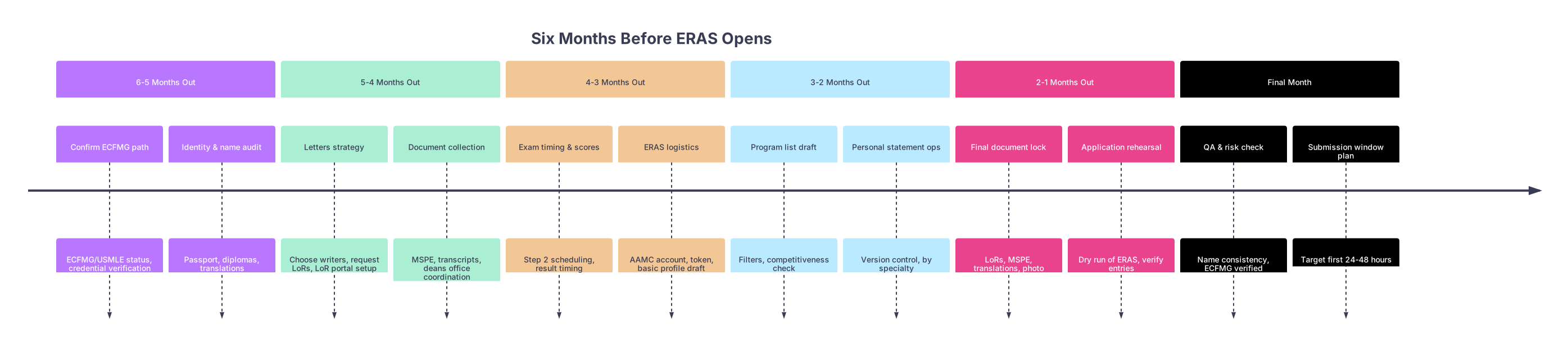
| Period | Event |
|---|---|
| 6-5 Months Out - Confirm ECFMG path | ECFMG/USMLE status, credential verification |
| 6-5 Months Out - Identity & name audit | Passport, diplomas, translations |
| 5-4 Months Out - Letters strategy | Choose writers, request LoRs, LoR portal setup |
| 5-4 Months Out - Document collection | MSPE, transcripts, deans office coordination |
| 4-3 Months Out - Exam timing & scores | Step 2 scheduling, result timing |
| 4-3 Months Out - ERAS logistics | AAMC account, token, basic profile draft |
| 3-2 Months Out - Program list draft | Filters, competitiveness check |
| 3-2 Months Out - Personal statement ops | Version control, by specialty |
| 2-1 Months Out - Final document lock | LoRs, MSPE, translations, photo |
| 2-1 Months Out - Application rehearsal | Dry run of ERAS, verify entries |
| Final Month - QA & risk check | Name consistency, ECFMG verified |
| Final Month - Submission window plan | Target first 24-48 hours |
Now let’s break it down in the order you actually live it.
Six Months Before ERAS Opens: Fix Identity, ECFMG, and Documentation
At this point you should lock your legal identity and ECFMG path. Everything else builds on that.
Week 1–2: Identity and Name Consistency Audit
You would be shocked how many IMGs delay or lose opportunities because of a name mismatch.
Go document by document:
- Passport
- Medical school diploma
- Medical school transcript
- Any internship/house job certificates
- Previous visas or US documents (if any)
- ECFMG record
Your goal: one exact legal name format everywhere. Same spelling, same order, same middle names or initials.
If anything is off:
- Contact your medical school registrar/dean’s office and ask what is required to reissue a corrected document.
- If your passport name changed (marriage, etc.), start getting official name change documents and translations now.
- Check ECFMG’s name change rules and submit a name change request early if needed. These are not processed overnight.
Delay here will block everything: ECFMG certification, USMLE scheduling, and even your visa.
Week 2–4: ECFMG & USMLE Status Check
At this point you should know your exact ECFMG status, not “I think everything is fine.”
Log into your ECFMG account and verify:
- Medical school listed correctly
- Graduation status correct
- Credentials sent and verified or pending
- USMLE exams passed, scores posted
- No unresolved communications from ECFMG
Then ask one blunt question:
“Will I be ECFMG certified or clearly on track by September 15?”
Breakdown:
- If you have not passed Step 1 and Step 2 CK → stop thinking about ERAS admin. Your top priority is an aggressive exam timeline that still leaves enough time for score reporting.
- If Step 2 is pending but scheduled → check the score report time frame against ERAS opening and your target programs’ policies.
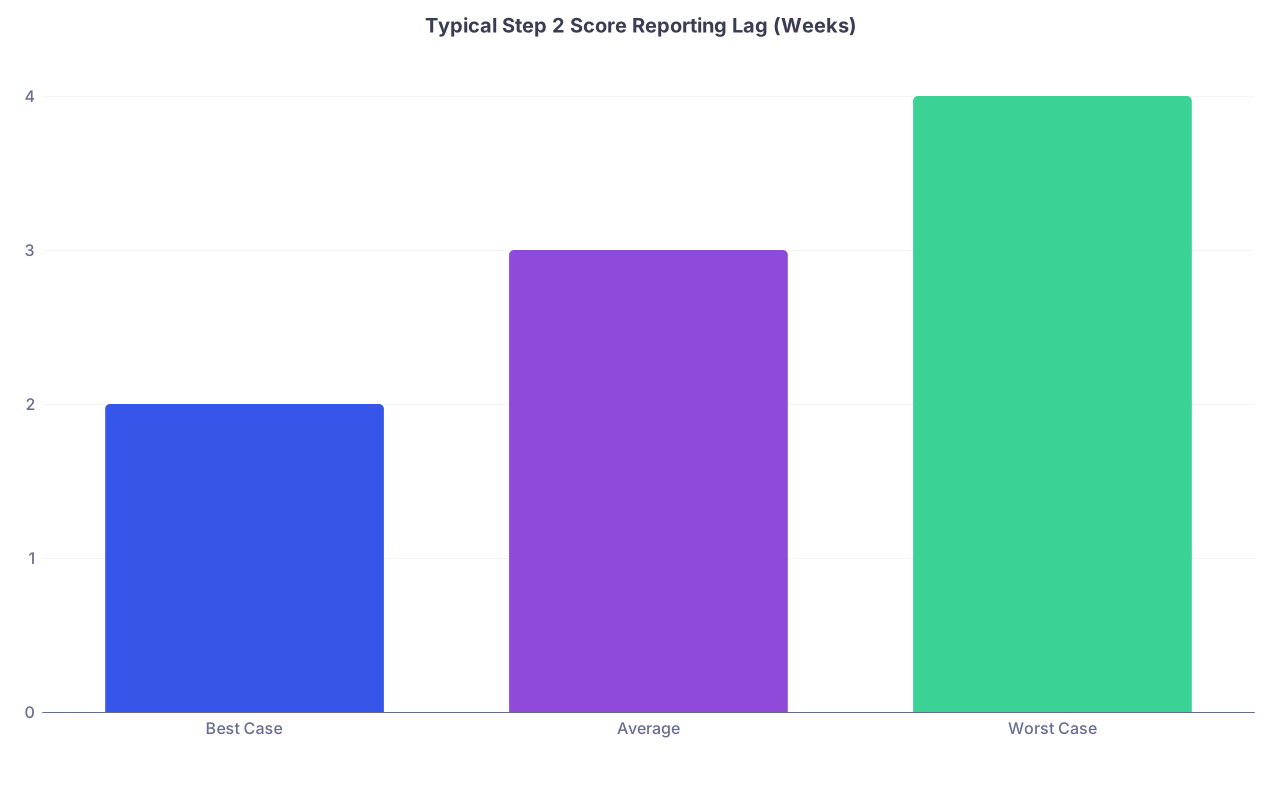
| Category | Value |
|---|---|
| Best Case | 2 |
| Average | 3 |
| Worst Case | 4 |
If your score report would land after programs start reviewing (late September–October), you are in a weaker position. Sometimes still workable, but you need to know, not guess.
Five Months Before ERAS Opens: Letters and Institutional Documents
Now the clock turns to other people’s delays: your dean’s office and letter writers. This is where IMGs get burned.
Week 1–2: Letters of Recommendation Strategy
At this point you should know:
- How many LoRs you are targeting
- How many will be US‑based vs home country
- Which specialty each letter will support
Standard target: 4 LoRs, at least 2–3 in your target specialty, with at least 2 US clinical experiences if possible.
Make a simple LoR grid:
| Letter # | Writer Type | Country | Specialty Focus | Status |
|---|---|---|---|---|
| 1 | US Attending | USA | Internal Med | Confirmed |
| 2 | US Attending | USA | Internal Med | Requested |
| 3 | Home Consultant | Home | Internal Med | Drafted |
| 4 | Dean/Chair | Home | General | Not requested |
Week 1 action items:
- Email each potential writer with:
- Your CV
- USMLE scores summary
- Brief statement of your target specialty
- Deadline that is 4–6 weeks earlier than you actually need it
- Ask them directly:
- “Would you be comfortable writing a strong, supportive letter for my US residency applications in [specialty]?”
If someone hesitates or delays even replying, move on. A weak or late letter is worse than no letter.
Week 3–4: MSPE and Transcript Coordination
IMGS mess this up constantly because their schools barely know what an MSPE is.
At this point you should:
Identify the office or person responsible at your school
- Dean of academic affairs
- Registrar
- International office
Schedule a short video call or in-person meeting if possible. Do not rely on one vague email.
Send them:
- ERAS and AAMC official pages about MSPE and transcripts
- Clear deadlines and upload instructions
You want to know:
- Will your school actually issue an MSPE? Some will refuse and only give a generic letter or just a transcript.
- Who will upload to ERAS (if they are registered) vs who will email to ECFMG?
- How long they usually take to prepare documents. Ask for a specific time frame, not “soon.”
If your school has never done MSPEs before, assume the first draft will be late and imperfect. Starting five months out gives you a buffer to push and clarify.
Four Months Before ERAS Opens: Exams, Tokens, and System Setup
Now you shift from external people to systems and deadlines.
Week 1–2: Finalize Exam Timing (Step 2 CK / OET / Others)
If any exam is pending, at this point you must align test dates with ERAS and score reporting.
- Step 2 CK latest reasonable test date for most IMGs: mid‑July
- OET/English requirements: check the visa and state licensing requirements for your target states
- Some J‑1 or H‑1B visa pathways need specific timing for ECFMG certification. Verify with official sources, not your friend’s WhatsApp group.
If your exam is later than mid‑July, ask yourself whether applying this cycle is genuinely strategic or just emotional. A last‑minute reported score can cripple your competitiveness.
Week 2–3: ERAS Account and AAMC Registration
At this point you should:
- Create or confirm your AAMC account
- Verify your email and contact information
- Make sure your password and security questions are accessible from outside your home country (some email providers block in the US)
Then:
- Track when your ECFMG ERAS token will be available (usually in spring).
- The week tokens are released, purchase yours immediately. Do not wait “until I finalize everything.” You want full ERAS access early.
Week 3–4: Skeleton ERAS Profile
You are not writing essays yet. You are eliminating surprises.
Inside ERAS:
- Fill out:
- Personal information
- Medical education details
- Citizenship and visa status (even if “will require visa sponsorship”)
- Identify any fields that are confusing or do not match your situation as an IMG. Create a list of questions to clarify with ECFMG / AAMC.
You are doing a dry run to see where you might get stuck in August, while you still have spare time.
Three Months Before ERAS Opens: Program List and Supporting Documents
Now the application starts to take shape.
Week 1–2: Build a First Draft Program List
At this point you should have hard filters. Not fantasy lists.
Use basic criteria:
- States that are friendly or neutral to IMGs
- Programs that have historically matched IMGs (check match lists, not just reputation)
- Visa sponsorship clearly stated (J‑1 vs H‑1B)
- Step score cutoffs when available
Make three buckets:
- Reach programs
- Reasonable targets
- Safety programs with a high proportion of IMGs
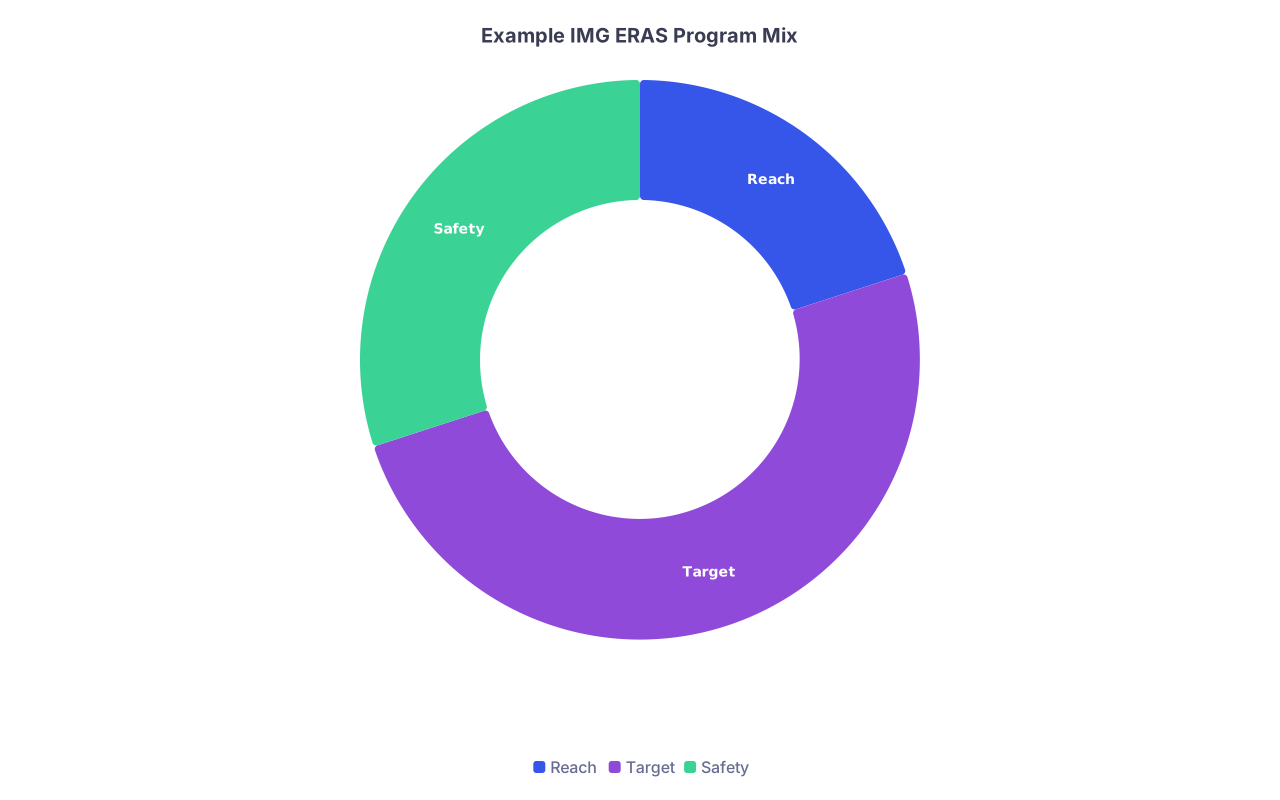
| Category | Value |
|---|---|
| Reach | 20 |
| Target | 50 |
| Safety | 30 |
Aim for something like the above distribution. Sixty “super famous” reach programs and five soft community hospitals is the fastest way to end up unmatched.
Week 2–3: Personal Statement Operations (Admin Side)
I am not talking about content here, just logistics.
You should:
Decide how many versions you need (usually 1 per specialty, occasionally 1 per special circumstance like “categorical vs preliminary”).
Set up a file naming system that prevents mix‑ups:
PS_IM_Categorical_FINAL_2026_01.docxPS_FM_FINAL_2026_01.docx
Decide who will review (ideally at least one US physician in your specialty or a senior resident).
Why this matters:
You must attach the correct personal statement to the correct program in ERAS. I have seen applicants accidentally send a psychiatry PS to a surgery program because they had 12 versions named “final2_real_final.docx”.
Week 3–4: LoR Status Check and Gentle Pressure
By now, some letters should already be uploaded or close.
At this point you should:
- Log into ERAS LoR portal and see what is actually uploaded.
- Send polite but direct reminders to any writer who has not submitted, reminding them of your (fake earlier) deadline.
- Identify at least one backup letter writer in case someone disappears.
Many IMGs lose a month because a “promising” LoR never arrives. Three months out is your time to cut your losses and switch if needed.
Two Months Before ERAS Opens: Lock Documents and Clean Up Details
This is where the strong applications separate from the chaotic ones.
Week 1–2: Finalize All Core Documents
At this point you should aim for:
- All LoRs uploaded and assigned in ERAS
- MSPE and transcript sent from your school (or at least confirmed timelines and drafts)
- Personal statements in nearly final form
- ERAS photo taken or scheduled with a professional
ERAS photo mistakes are common among IMGs: casual clothes, odd backgrounds, selfies. Use a clean, professional headshot: solid background, formal clothing, neutral expression.
Week 2–3: Verify ECFMG and Credential Status Again
Things do change. Systems glitch.
Log into ECFMG and double‑check:
- Credentials: verified, not just “received”
- All passed exams listed correctly
- No outstanding requests for additional documents or clarifications
If anything is hanging:
- Open a support ticket or call.
- Document each interaction. Date, time, person, reference number.
- Follow up weekly until resolved.
You are protecting yourself from silent administrative disasters.
One Month Before ERAS Opens: Rehearsal and Quality Control
At this point you should act as if you are submitting tomorrow. Then fix every problem you find.
Week 1: Full Application Dry Run
Sit down for 2–3 uninterrupted hours and go through ERAS as if it were submission day.
Step by step:
Check every entered date (graduation, rotations, employment).
Look for gaps in your timeline greater than 3–6 months. If present, be ready to explain or briefly note in experiences.
Confirm each experience entry:
- Correct role (observer, extern, resident, etc.)
- Correct country and institution name
- Accurate hours per week
Attach:
- Correct LoRs to each program type
- Correct personal statement versions
Ask one trusted person to do a screen‑share review and try to “break” your application by finding inconsistencies.
Week 2: Visa and Citizenship Narrative
Programs care whether you are a visa headache. You do not solve that by hiding it.
At this point you should:
- Clarify your actual status (citizen, permanent resident, other visa, or needs visa).
- If you already have a status that removes visa issues (green card, Canadian PR with TN possibilities, etc.), make sure it is visible where allowed and appropriate.
- If you will need a J‑1 or H‑1B, accept that and be transparent when programs ask.
Do not waste time applying heavily to programs that clearly state “No visa sponsorship.” One or two exceptions is fine. Twenty is denial.
Week 3–4: Final Name, Address, and Contact Check
Last chance to avoid missed interview emails.
At this point you should:
- Confirm that your primary email inbox is reliable in the US (Gmail, Outlook, etc. – avoid unstable local providers).
- Set up a professional voicemail greeting in English on a stable phone number (Google Voice, US number via VoIP if needed).
- Check your address format; make sure it does not confuse automated systems.
Any time you change an email or phone number within 4–6 weeks of ERAS opening, you increase the risk of lost communication.
Final Two Weeks Before ERAS Opens: Tighten and Wait
This is the quiet but critical period. No big changes. Just precision.
10–14 Days Out: Lock Everything
At this point you should:
- Freeze your personal statement versions (unless a major red flag is found).
- Avoid adding new experiences unless absolutely necessary; last‑minute additions create inconsistencies.
- Confirm that your MSPE and transcripts are either:
- Already visible in ERAS, or
- Confirmed by ECFMG/your school with an exact sending date.
If something key is still missing, you need a back‑up plan: alternative LoR, explanation for delayed MSPE in interviews, etc.
3–7 Days Out: Submission Day Game Plan
Decide:
- Exact day and approximate time you will submit once ERAS opens (ideally within the first 24–48 hours).
- Which final list of programs you will apply to immediately versus which may be added later if needed.
Do one last slow walkthrough of every ERAS section. Then stop editing. You want a clean, stable version, not something that changes five times a day.
ERAS Opening Week: Execute, Do Not Experiment
When ERAS actually opens for application submission:
- Submit to your main program list early. Do not “wait to see if something changes.”
- Verify that all documents are correctly assigned after submission.
- Download or screenshot your final application PDF for your own record.
Then the administrative work shifts to interview season logistics. Different war. Different timeline.
Three Things to Remember
- Six months out is not “early” for an IMG; it is standard if you plan to match once, not twice.
- Your biggest threats are not always low scores but slow institutions, confused deans, and missing documents. You control those only if you start early.
- At each point in this six‑month timeline, ask one question: “If ERAS opened tomorrow, what would block me?” Then fix that first.