
It’s January. You’re an IMG staring at a calendar that runs from now to next March. You see words like “ERAS,” “NRMP,” “Match Day,” “ECFMG certification,” and you know one thing: if you guess the timing wrong, you’ll lose a year.
Let’s not lose a year.
Here’s your application year, month by month, from January through Match Day, with “at this point you should…” level detail. I’m assuming you’re targeting the regular NRMP Match (not SOAP-only, not SF Match) and planning to submit ERAS around September.
Big-Picture Timeline (IMG Edition)
First, zoom out. This is the rough arc of an IMG application year.
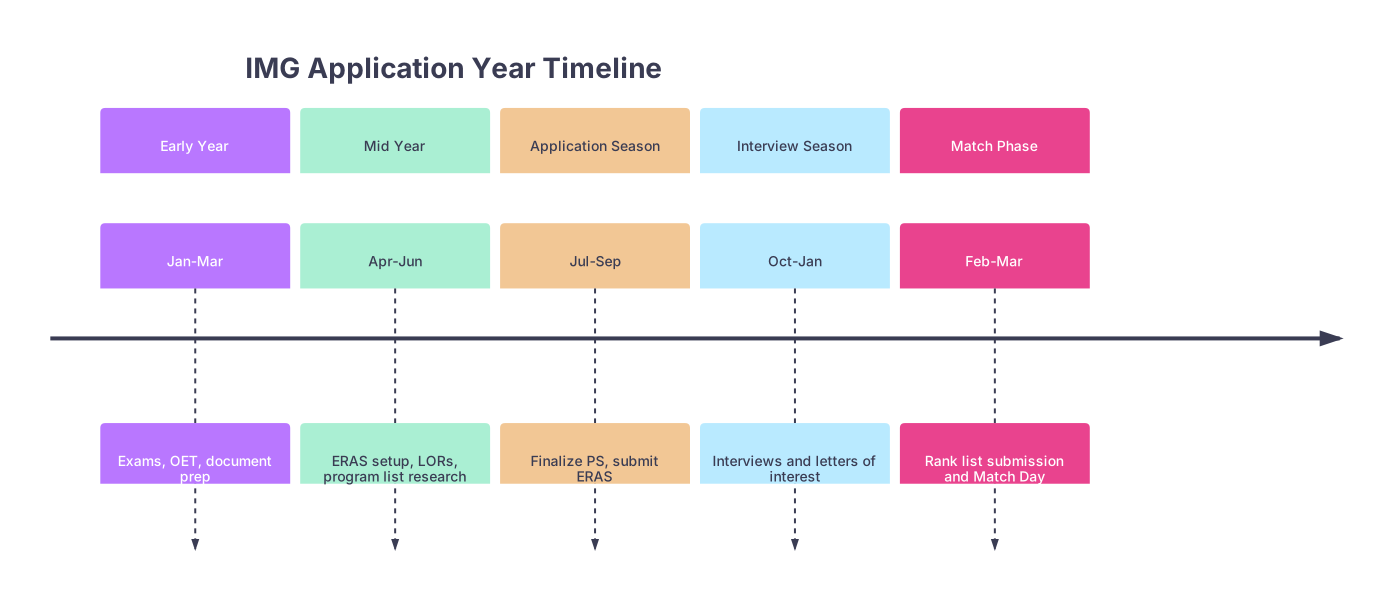
| Period | Event |
|---|---|
| Early Year - Jan-Mar | Exams, OET, document prep |
| Mid Year - Apr-Jun | ERAS setup, LORs, program list research |
| Application Season - Jul-Sep | Finalize PS, submit ERAS |
| Interview Season - Oct-Jan | Interviews and letters of interest |
| Match Phase - Feb-Mar | Rank list submission and Match Day |
At this point you should understand:
- Jan–Mar is about eligibility and exams.
- Apr–Jun is building the application.
- Jul–Sep is submitting and fixing gaps.
- Oct–Jan is interviews and follow-up.
- Feb–Mar is ranking and backup strategy.
Now we go month by month.
January: Lock In Eligibility and Weak Points
At this point you should:
Know your exam situation cold
- Step 1: Passed? If not, your entire year pivots to finishing this asap.
- Step 2 CK: Programs want this done before they interview you. As an IMG, waiting until after September is a mistake.
- OET Medicine: If required for ECFMG certification in your situation, plan the date now.
Ideal Exam Status by January for IMGs Component Ideal Status Still Acceptable Step 1 Already passed Test scheduled within 3 months Step 2 CK Scheduled by March Scheduled by May OET Medicine Scheduled by Feb Scheduled by Apr ECFMG Certification In progress Started (forms + docs) Start or finish ECFMG paperwork
- Make sure:
- Your medical school is listed in World Directory with ECFMG-eligible status.
- You’ve submitted Form 186 (online certification) through ECFMG.
- You know what your diploma/degree timing will be if you’re still a student.
- Make sure:
Audit your CV honestly Pull up a blank document and write:
- US clinical experience: none? observership? externship?
- Research: publications/posters? Zero?
- Gaps: Any big holes after graduation?
At this point you should identify:
- Are you a fresh grad (<3 years from graduation) or **old grad** (>5 years)? That matters a lot for IMGs.
- Do you have any US clinical experience? If not, you’re behind. Not doomed, but behind.
Plan US clinical experience (USCE) for this year If you have zero or weak USCE:
- Start emailing programs and hospitals for observerships/externships.
- Use platforms (AMO, FMG Portal, etc.) cautiously—some are fine, some are overpriced.
- Target months between March–August for rotations so you can get LORs in time.
Create a realistic target specialty list
- High-risk for IMGs with average profiles: Dermatology, Ortho, Plastics, ENT, Neurosurgery. Be honest.
- More realistic: Internal Medicine, Family Med, Pediatrics, Psych, Path, Neurology, some community Gen Surg.
At this point you should pick:
- 1 main specialty
- 1 backup specialty (at least consider it)
February: Exam Dates, USCE, and Document Infrastructure
At this point you should:
Schedule exams if not done
- Step 1 and/or Step 2 CK need actual calendar dates, not vibes.
- Work backward: you want Step 2 CK score back no later than August.
- NBME → Score release is ~3–4 weeks.
- That means test by early July at the absolute latest, earlier is better.
Lock USCE dates
- Aim for:
- At least 1–2 months of USCE before August.
- Ideally one rotation at a site known to write strong LORs (ask past IMGs, not just the coordinator’s brochure).
- Confirm:
- Start dates
- Whether they’ll write LORs
- Whether letters can be uploaded to ERAS.
- Aim for:
Start your ERAS “data brain dump” You won’t have access to the new ERAS season yet, but you can:
- Draft:
- Work/volunteer experiences
- Research entries
- Leadership/teaching roles
- For each, write:
- Your title
- Dates
- 2–3 bullets of actual impact, not fluff.
- Draft:
Gather document proofs At this point you should be:
- Collecting:
- Transcripts
- Proof of graduation or expected graduation
- Any translations (certified, if needed)
- Scanning everything clearly as PDFs. Blurry scans = delays.
- Collecting:
March: Personal Statement Skeleton and Reference Strategy
At this point you should:
Draft your personal statement outline Not the final thing. But the spine:
- Why this specialty? With one or two specific clinical stories.
- Why the US system?
- What you bring as an IMG? (resilience, language skills, unique patient experience — not generic “I work hard.”)
Identify potential letter writers
- Home country attendings who:
- Actually know you
- Know what US residencies care about (clinical ability, work ethic, reliability, communication)
- Planned USCE supervisors:
- Let them know up front you’ll be applying this year and would value a letter if things go well.
- Ask directly: “If I perform well, are you comfortable writing a strong letter for US residency?”
- Home country attendings who:
If you’re still waiting to pass an exam, intensify
- By end of March, you should not still be “thinking about scheduling” Step 1 or Step 2 CK.
- The IMG graveyard is full of people who were “not quite ready” for 2–3 extra years.
Check ECFMG/ERAS calendar Dates vary slightly by year, but around:
- May–June: ERAS opens for applicants to start working on applications.
- September: Programs receive applications.
Put these in your calendar now with reminders.
April: Build the Application Skeleton
At this point you should:
Finalize your specialty and backup plan
- Example:
- Main: Internal Medicine
- Backup: Family Medicine or Neurology
- Or:
- Main: Psychiatry
- Backup: Internal Medicine
If you’re an old grad or have multiple failures, a backup specialty is not optional. It’s smart.
- Example:
Start researching programs seriously Use:
- FREIDA
- Program websites
- IMG forums (signal, not gospel)
Track:
- IMGs accepted? (Yes/No and how many)
- Visa sponsorship? J1 vs H1B
- US grad year limits (often “within 3–5 years of graduation”)
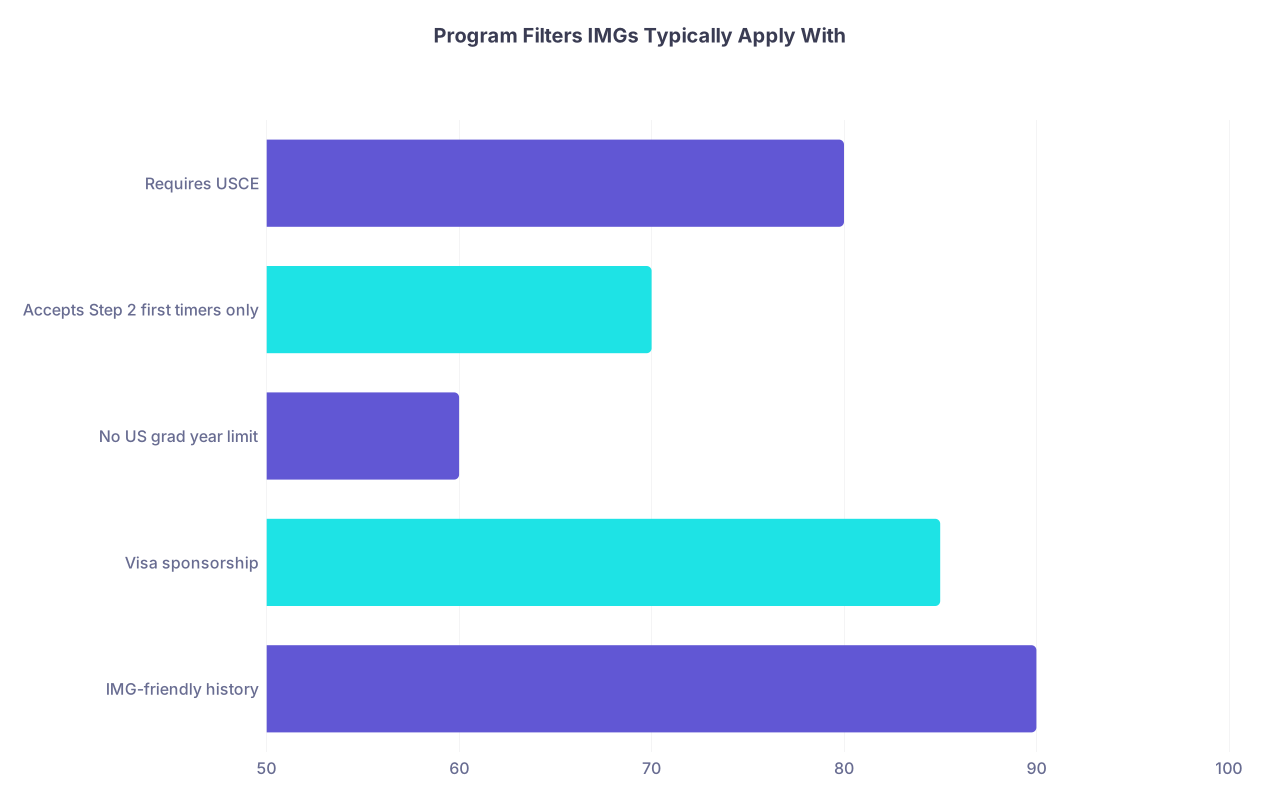
Program Filters IMGs Typically Apply With Category Value IMG-friendly history 90 Visa sponsorship 85 No US grad year limit 60 Accepts Step 2 first timers only 70 Requires USCE 80 Create a program list draft (wide net) For IMGs, a typical initial list:
- Main specialty: 120–180 programs
- Backup: 40–80 programs
You’ll refine later. Right now, cast wide but realistically:
- Avoid university programs that explicitly say “We do not sponsor visas” if you need a visa.
- Avoid programs with zero IMGs for years unless you’re a superstar.
Outline your CV sections
- Education
- Exams and scores
- Clinical experiences (home and US)
- Research and publications
- Volunteer and leadership
At this point, you should see your weaknesses in writing. That’s good. Gives you 4–5 months to do something about them.
May: ERAS Profile, Real Drafts, and USCE Execution
ERAS typically opens to applicants around this time (for the coming Match). You can start filling but not submit.
At this point you should:
Create your ERAS account as soon as the season opens
- Start filling:
- Biographics
- Medical school info
- Exam scores (once available)
- Experiences (use the brain dump you made earlier)
- Get used to the layout. You don’t want to learn ERAS in September.
- Start filling:
Write a full personal statement draft
- One PS for your main specialty.
- If your backup specialty is very different (Psych vs IM, for example), plan a second PS later.
Your PS should:
- Tell one or two real stories
- Avoid clichés like “Ever since I was a child…”
- Clearly answer: Why this specialty + why you’ll be a safe, teachable resident.
Be active in USCE (if you’re on rotation) While on rotation, at this point you should:
- Show up early, leave late when appropriate.
- Volunteer to present patients.
- Ask for feedback mid-rotation, not just at the end.
- Signal interest in a letter if things are going well:
- “I’m applying for residency this cycle—if you feel you can write a strong letter, I’d be honored.”
Track which letter writers you’ll use for which specialty
- IM letter is ideal for IM applications.
- Psych letter ideal for Psych, etc.
- Generic “good student” letters are weak.
June: Letters, Documents, and Polish
At this point you should:
Lock in 2–3 letter writers
- Goal by end of June:
- At least 2 strong letters confirmed (verbal agreement).
- A third one pending from another US or strong home-country attending.
Follow up politely:
- Provide your CV and PS draft for context.
- Confirm they know how to upload to ERAS (via LoRP).
- Goal by end of June:
Tighten your ERAS experience entries Each experience should:
- Have a clear role (Student Physician, Research Assistant, etc.)
- 1–3 punchy bullets highlighting:
- Clinical skills
- Responsibility
- Initiative
Check your ECFMG certification path
- Are all documents submitted and verified?
- Any pending forms?
- Any name discrepancies between passport, diploma, and ECFMG profile? Fix now.
Start a “program communication” file
- Spreadsheet with:
- Program name
- ACGME code
- City/state
- IMG status
- Visa policy
- Any specific requirements (USCE, Step 2 deadline, cutoffs, etc.)
- Spreadsheet with:
July: Final Exam Push and Application Fine-Tuning
This is a compression month. At this point you should:
Have all major exams taken or scheduled very soon
- Step 2 CK: Ideally already taken.
- If not, test by early July at the latest. You’re cutting it close.
- Step 2 CK: Ideally already taken.
Refine personal statement with feedback
- Get 1–2 people to review (not 10).
- Preferably: someone who trained or practices in the US.
- Fix:
- Grammar
- Overly dramatic language
- Paragraphs that say nothing.
- Get 1–2 people to review (not 10).
Finalize your core program list
- Start moving from 200–250 “maybe” to a realistic:
- 120–180 main specialty
- 40–80 backup
- Start moving from 200–250 “maybe” to a realistic:
Remind letter writers politely
- “Just a reminder I’ll be certifying my ERAS application in early September; I wanted to make sure you still feel comfortable writing a letter.”
Do not send spammy weekly reminders. Every 3–4 weeks is acceptable.
August: Application Assembly and Damage Control
At this point you should:
Have most of your letters uploaded or promised
- At least 2 letters actually uploaded to ERAS by late August is ideal.
- Third or fourth can come in early September.
Complete all ERAS sections
- Demographics
- Medical school and transcript request
- Experiences
- Licensure, if any
- Publications (triple-check accuracy; no inflated authorship)
Handle exam score timing
- If Step 2 CK score is pending:
- Fine, as long as it’ll be back by mid-September.
- If Step 2 CK is not yet taken:
- Hard truth: you’re in trouble for this cycle. Programs may not rank without a score for an IMG.
- If Step 2 CK score is pending:
Polish program list At this point you should:
- Remove:
- Programs explicitly not taking IMGs
- Programs not sponsoring your visa type
- Prioritize:
- Community programs
- Historically IMG-friendly programs
- Places where your school has matched before.
- Remove:
Early September (Before ERAS Submission Opens to Programs)
This is the week applications open for submission but are held until the “programs can see apps” date (usually mid-September).
At this point you should:
Upload final PS and assign correctly
- Check each program:
- Correct specialty PS attached
- Correct letters assigned (max 4 per program).
- Check each program:
Proofread every field in ERAS
- Name, email, phone
- Dates (make sure they make sense chronologically)
- No duplicated activities to pad length.
Have your photo ready
- Professional
- Neutral background
- No white coat flex photos.
Get ready to submit on Day 1 For IMGs, submitting late September instead of opening day is a self-inflicted wound. You don’t need perfection; you need “excellent and on time.”
Mid–Late September: Submitted and Waiting
By now ERAS has released applications to programs.
At this point you should:
Stop “fixing” your application
- You can’t rewrite your PS every 3 days.
- Focus on what you can still influence:
- New Step scores uploading
- Additional letters (if they appear, programs can see them).
Prepare for interviews you don’t have yet
- Practice:
- “Tell me about yourself.”
- “Why this specialty?”
- “Why this program?” (generic but tailored frames)
- Make sure your tech setup is ready for virtual interviews:
- Quiet space
- Decent webcam
- Headphones that work.
- Practice:
Consider very selective, polite interest emails For a few top-choice programs:
- Brief message:
- Who you are
- Why you’re particularly interested in them (specific, not copy-paste)
- One highlight that fits their profile (USCE, research interest, language skills matching patient population).
- Brief message:
October–January: Interview Season
This is where many IMGs panic if October is quiet. The curve is not linear.
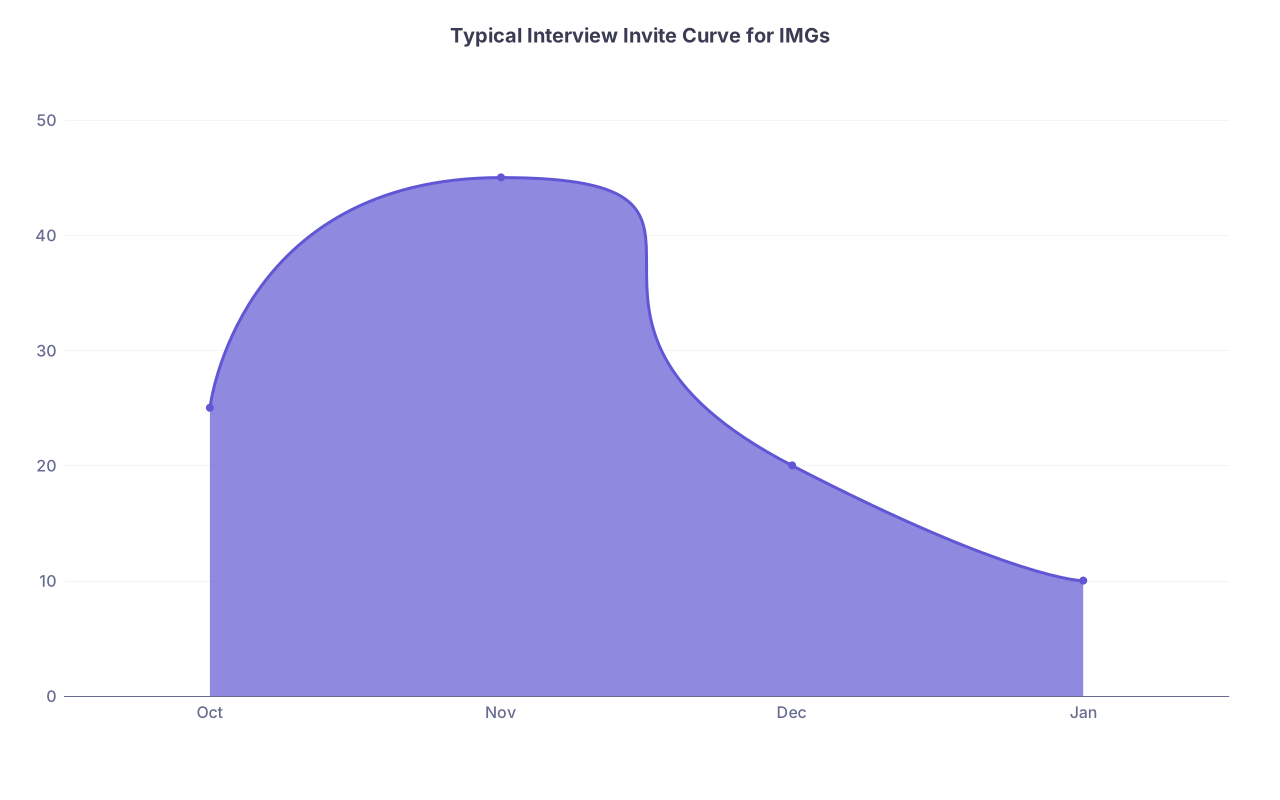
| Category | Value |
|---|---|
| Oct | 25 |
| Nov | 45 |
| Dec | 20 |
| Jan | 10 |
At this point you should:
Track every invite and response
- Use a spreadsheet:
- Date received
- Dates offered
- Your response
- Program priority.
- Use a spreadsheet:
Don’t hoard low-interest interviews too early
- But also: as an IMG, you probably can’t afford to be too picky.
- If you have:
- 0–3 interviews: take almost everything.
- 8+ interviews: you can start prioritizing.
Send targeted interest letters (not spam) If by mid-November you have few interviews:
- Carefully pick:
- Programs where you’re at least somewhat realistic.
- Programs where your profile matches (e.g., strong research, strong USCE, language match).
- Write:
- 1–2 short paragraphs + ERAS ID.
- No “please, I beg you” tone. Professional interest only.
- Carefully pick:
Interview performance On each interview day, you should:
- Be able to:
- Explain your path as an IMG without sounding defensive.
- Discuss any gaps or failures directly:
- “I failed Step X, here’s what changed and what you’ve seen since.”
- Ask sane questions that show:
- You read their website
- You understand their patient population
- You’re actually picturing yourself there.
- Be able to:
February: Rank Order List Strategy
NRMP rank list submission is usually mid–late February.
At this point you should:
Rank every program where you’d be willing to train
- Don’t play “game theory” as an IMG.
- If you’d go there, rank it.
- If you truly would not go, don’t rank it. But be honest with yourself.
Stop obsessing over “love letters”
- A short “this is my top choice” email to your genuine #1 is ok.
- Blasting 10 programs claiming they’re your #1 is dumb and unethical.
Have a SOAP plan in writing
- If you do not match, at this point you should already know:
- Will you participate in SOAP?
- Are you open to prelim or transitional spots?
- Are you willing to change specialty during SOAP?
Write this down before emotions cloud your judgment.
- If you do not match, at this point you should already know:
March: Match Week and After
Match Week is brutal for IMGs who don’t prepare mentally.
At this point you should:
Before Monday of Match Week
- Know:
- Your NRMP login works
- Your SOAP-eligible status (if applicable)
- Have:
- Updated CV
- Short, professional email template ready for SOAP if needed.
- Know:
If you Match
- Celebrate. Then:
- Follow program instructions immediately.
- Start visa process if required. Do not procrastinate; consulates move slowly.
- Celebrate. Then:
If you Do Not Match
- Monday:
- Read the “Did I Match?” status calmly.
- If “No,” go straight into SOAP plan mode.
- During SOAP:
- Apply to every program in specialties you previously decided were acceptable.
- After SOAP:
- If still unmatched, give yourself a week to decompress.
- Then map out:
- What changed this year (new USCE, research, Step 3, stronger letters)
- What you’ll fix for the next cycle.
- Monday:
One More Visual: What You Should Be Doing When
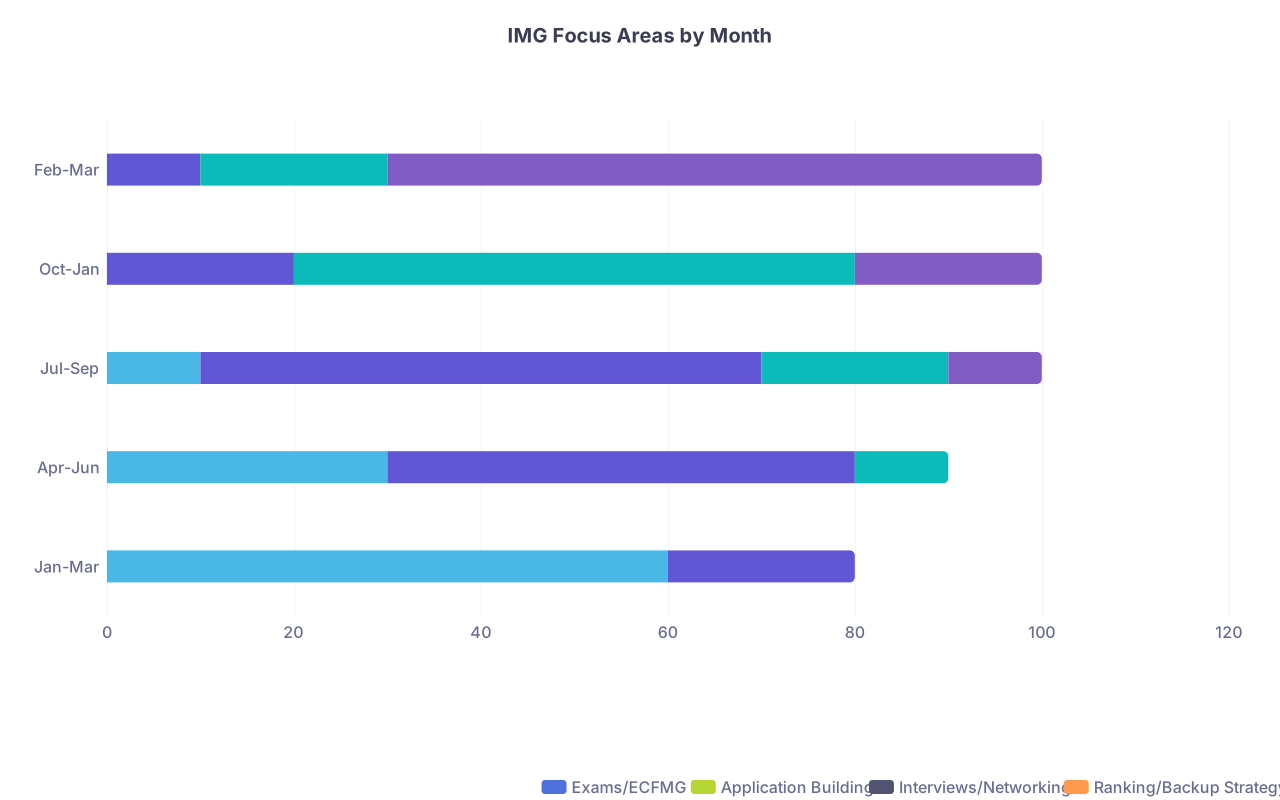
| Category | Exams/ECFMG | Application Building | Interviews/Networking | Ranking/Backup Strategy |
|---|---|---|---|---|
| Jan-Mar | 60 | 20 | 0 | 0 |
| Apr-Jun | 30 | 50 | 10 | 0 |
| Jul-Sep | 10 | 60 | 20 | 10 |
| Oct-Jan | 0 | 20 | 60 | 20 |
| Feb-Mar | 0 | 10 | 20 | 70 |
Core Takeaways
- By June, you should have your basic application structure, exam plan, and letters lined up. If you don’t, you’re playing from behind.
- For an IMG, on-time and complete beats “perfect but late.” Submit early September with strong core pieces; stop tweaking endlessly.
- Have a written backup plan (specialty, SOAP, reapplication strategy) before February. Emotions on Match Week destroy people who plan only for best-case scenarios.