The silence in your inbox by November is not “bad luck.” It is data. And at this point, you must treat it like data and act accordingly.
If you are an IMG with zero or very few interviews by early November, your season is not “over,” but your original plan is. You need a contingency plan with dates, decisions, and hard pivots—not vibes and wishful thinking.
Here is the month‑by‑month and week‑by‑week breakdown of what to do when interviews are not coming. I will assume:
- You are an IMG (US or non‑US)
- You applied in September for a July start
- It is now somewhere between early November and Match Week
Adjust dates by a week or two depending on the exact ERAS/calendar year, but the sequence stays the same.
Big Picture: Reality Check Timeline
Before we zoom in, here is what the typical IMG interview curve looks like.
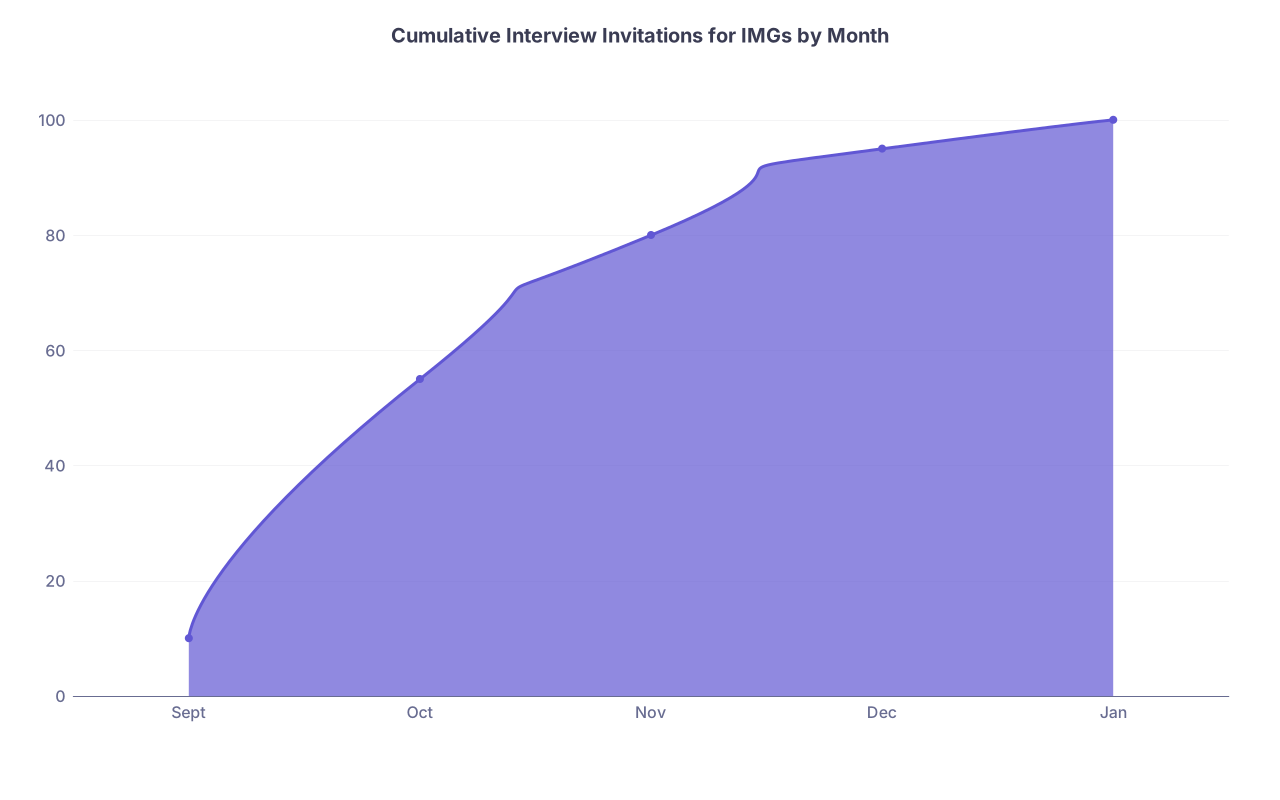
| Category | Value |
|---|---|
| Sept | 10 |
| Oct | 55 |
| Nov | 80 |
| Dec | 95 |
| Jan | 100 |
If you have 0 interviews by early November, your probability of a successful Match this cycle is already low. Not zero. But low.
So the strategy from now on has two tracks:
- Salvage This Cycle – aggressive, targeted moves for late invites, prematch, or SOAP.
- Build Next Cycle – USCE, exams, networking, and narrative that fix the underlying issues.
You will run both tracks in parallel.
Early November (Nov 1–15): Triage and Damage Report
At this point you should stop guessing and audit your application like a PD would.
Step 1: Cold, brutal assessment (1–2 days)
Sit down with your ERAS and answer, on paper:
- Scores
- USMLE / COMLEX: Step 1 (P/F or numeric), Step 2 CK, any fails?
- Any pending exams (Step 3)?
- Attempts
- Any exam failures or multiple attempts? (Programs care. A lot.)
- Year of graduation (YOG)
- 0–3 years, 4–5, 6+?
- US clinical experience (USCE)
- How many months of hands‑on USCE (not observerships)?
- Any LORs from US academic faculty?
- Specialty choice & spread
- How many programs total?
- How many per specialty?
- Any “backup” specialty?
- Red flags
- Visa issues, gaps, professionalism issues, failed rotations.
Then compare yourself to something realistic.
| Factor | More Competitive IMG | Borderline IMG | High-Risk IMG |
|---|---|---|---|
| Step 2 CK | 240+ | 225–239 | <225 or fail |
| YOG | 0–3 years | 4–6 years | >6 years |
| USCE (hands-on) | ≥ 3 months | 1–2 months | 0–1 month |
| Exam failures | None | 1 attempt | ≥2 attempts |
| Programs applied (IM) | 120+ | 80–120 | <80 |
If you are mostly in the “High‑Risk IMG” column and applied primarily to competitive specialties (e.g., categorical surgery, radiology, derm), then the current no‑interview reality is expected, not surprising.
Step 2: Categorize your situation (same week)
By November 10–15, place yourself in one of these buckets:
Bucket A – Strong but unlucky
- Good scores (e.g., Step 2 CK ≥ 240)
- YOG ≤ 3–4 years
- 3+ months solid USCE
- Applied to 100+ programs in a primary care field (IM/FM/Peds)
No interviews = probably application strategy errors, poor personal statement, poor program list, or timing.
Bucket B – Middle of the pack
- Step 2 CK 225–239
- YOG 3–6 years
- 1–3 months USCE
- Some red flags or fewer applications than you should have sent
No interviews = expected difficulty, but not hopeless with better targeting and more USCE.
Bucket C – High risk
- Step 2 CK <225 or multiple exam failures
- YOG >6 years
- Little to no USCE
- Applied late or to very few programs
No interviews = predictable outcome. You need a multi‑year build, not a minor tweak.
Be honest. The point is not self‑loathing. It is to know which levers you actually have.
At this point you should:
- Decide whether you will:
- Stay in the US, invest in USCE/research, and reapply stronger
- Return home or pursue alternate careers if the deficit is too large
Mid–Late November (Nov 15–30): Aggressive Mid‑Cycle Moves
This is where most IMGs either waste time refreshing email or actually change their trajectory.
Targeted outreach (1 week, tightly focused)
Cold emails will not magically fix a broken profile, but smart outreach can help borderline cases.
At this point you should:
Identify 20–40 realistic programs in your chosen specialty (or backup) that:
- Historically rank IMGs
- Are community‑based or university‑affiliated community programs
- Are in less competitive regions (Midwest, South, smaller cities)
Send concise, non‑desperate emails to:
- Program coordinators
- Occasionally the PD or APD if their email is public
Content should be:
- 1–2 sentences of who you are (IMG, YOG, Step 2, current location)
- 1 sentence of connection/fit (regional, language, research interest, etc.)
- 1–2 sentences asking if they have received your ERAS and if they consider IMGs with your profile.
Do not send a 1,000‑word life story. I have seen coordinators openly mock those.
Result expectations: maybe 1–3 helpful replies if your profile is borderline. Radio silence if you are severely off their filter.
Start planning for SOAP now (yes, in November)
If you end up with 0 interviews by February, your only official shot this cycle will be SOAP. You do not “decide” to think about SOAP in March; you lay groundwork now.
At this point you should:
- Confirm your ERAS token and account will still be active.
- Review NRMP and ERAS SOAP rules on:
- Eligibility (must be unmatched or partially matched, registered for Match)
- How many programs you can apply to per SOAP round
- Start assembling a SOAP‑ready document set:
- A shorter, adaptable personal statement for prelim/TY/backup specialties
- A CV in PDF format
- Contact list of mentors who can update letters quickly if needed
This planning does not mean you “gave up.” It means you are not naive.
December: Dual Track – Salvage + Build
By December 1, the majority of IMG‑friendly programs have already sent most invites. Late invites happen, but they are rare and usually to applicants already on the radar.
So in December you do two things at once.
Track 1: Keep the door open (Dec 1–31)
- Keep your email/ERAS up to date (phone, location, visa status).
- If you are physically in the US, maintain availability for last‑minute interviews (some programs invite in late December/early January if others cancel).
- If you are doing USCE:
- Impress people. Show up early. Read overnight. Be visible but not annoying.
- Explicitly ask attendings, “If your program or colleagues need a prelim/TY/SOAP candidate, may I reach out to you in March?”
Track 2: Build for next cycle (Dec 1 onward)
This is where serious IMGs separate from the “maybe next year will be different” crowd.
You set specific goals by month:
- USMLE
- If Step 2 CK is low or has a fail, consider:
- Step 3 (if visa and finances allow) to show upward trend
- Serious Step 3 prep starting Dec–Jan for an exam by spring
- If Step 2 CK is low or has a fail, consider:
- USCE
- Start emailing for electives, externships, or observerships for January–June.
- Aim: 2–4 months of continuous USCE by next application season.
- Research
- If near an academic center, ask attendings about chart review projects, case reports, QI projects. Publications help more for some specialties (neuro, psych, IM in academic centers).
- CV holes
- Address long gaps by starting something:
- Clinical research assistant
- Scribe
- Volunteer clinic
- Teaching or tutoring USMLE
- Address long gaps by starting something:
January: Hard Reality Check and Backup Specialties
By early January, the interview trickle has usually dried up.
At this point you should:
Week 1–2: Decide your true target specialties
If you applied to:
- Categorical surgery
- Radiology
- Anesthesia
- Neurology with weak scores
- Or any competitive field with no interviews
You must decide: Do I seriously want a clinical career in the US? If yes, you probably need:
- A switch to a more IMG‑friendly field (IM, FM, psych, peds) or
- A bridge route (prelim/TY + research + reapply) which is risky and expensive
Do not wait until February to realize “maybe I should have applied to FM.” Programs see that panic.
Week 3–4: Concrete 12‑month plan
Lay out a month‑by‑month plan from February to next January with:
- Exam targets (e.g., Step 3 by May with target 225+)
- USCE blocks (e.g., March–April IM externship, May–June FM observer, July–Aug psych externship)
- Research timeline (abstracts by fall conferences if possible)
Here is a simple example for a high‑risk IMG who will reapply to Internal Medicine:
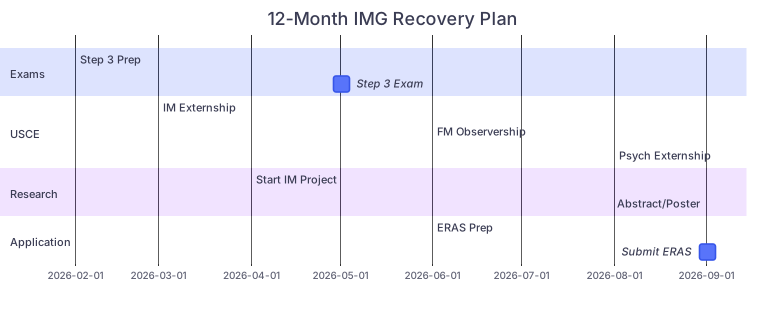
| Task | Details |
|---|---|
| Exams: Step 3 Prep | a1, 2026-02, 3m |
| Exams: Step 3 Exam | milestone, 2026-05, 1d |
| USCE: IM Externship | b1, 2026-03, 2m |
| USCE: FM Observership | b2, 2026-06, 2m |
| USCE: Psych Externship | b3, 2026-08, 2m |
| Research: Start IM Project | c1, 2026-04, 5m |
| Research: Abstract/Poster | c2, 2026-09, 2m |
| Application: ERAS Prep | d1, 2026-06, 3m |
| Application: Submit ERAS | milestone, 2026-09, 1d |
Customize, of course, but you get the structure.
February: Pre‑Match Edge Cases and SOAP Prep
Some specialties/regions still interview into February. As an IMG with no interviews, you are now mainly playing for:
- Rare very late invites
- SOAP and next cycle
By February 1:
At this point you should:
- Confirm your NRMP registration and that your ERAS account is active.
- Clean up your ERAS:
- Fix typos, update experiences, add any new USCE or research.
- Upload any new, stronger LORs (especially from recent USCE).
Mid–February: SOAP targeting strategy
Do not wait for “unfilled list shock” in March to think about where you will apply.
You should:
- List likely SOAP specialties you would actually accept:
- Prelim medicine
- Prelim surgery (only if you truly want that grind)
- Transitional year
- Family medicine
- Psych (sometimes has SOAP spots, sometimes not)
- Decide now what you will NOT accept:
- Fields you would hate or that have no realistic long‑term path for you
You are allowed to have standards, but they must be reality‑based.
Early March: Match Week Minus One – Two Parallel Plans
Now the countdown starts. You cannot control the algorithm, but you can control your moves.
One week before Match Week
At this point you should:
Finalize SOAP materials
- SOAP‑specific personal statement tailored to:
- Prelim/TY + future plan (e.g., reapply to neuro, cards, etc.)
- FM/IM “I am committed to this specialty” version
- Updated CV with all recent USCE and research
- SOAP‑specific personal statement tailored to:
Alert your support network
- Tell mentors and letter writers:
- Your exact situation (no or few interviews)
- That you may ask for advocacy emails or quick reference calls during SOAP
- Have their updated emails and phone numbers handy
- Tell mentors and letter writers:
Technical prep
- Reliable computer, scanner, and Internet
- Familiarity with the SOAP portal and timeline
Match Week: If You Are Unmatched
Let me be clear: being unmatched as an IMG is common. It is devastating. It is also survivable if you treat it like a structured project, not a personal collapse.
Monday – Unmatched result and SOAP Round 1
By Monday 11 a.m. ET, you learn your status.
If you are unmatched or partially matched, at this point you should:
- Take one hour to feel whatever you feel.
- Then switch into execution mode.
SOAP Round 1 (usually Monday afternoon):
Review the List of Unfilled Programs as soon as it is released.
With or without an advisor, build your SOAP target list:
- Prioritize programs that:
- Have historically taken IMGs
- List visa sponsorship if you need it
- Are in realistic specialties for your profile
- Prioritize programs that:
Submit the first wave of 45 applications (or whatever the limit is that year) strategically. Do not spray randomly across 8 specialties.
Your priorities:
- Programs that match your strongest experiences (e.g., IM if you have IM USCE).
- Programs with a reputation for not being strictly Step‑score‑obsessed.
- A balance of prelim/TY and categorical if available.
Tuesday–Thursday – SOAP Rounds 2–4
Between rounds:
- Answer phone calls immediately.
- Have a 30–60 second pitch ready:
- Who you are
- Your USMLE status
- Your USCE/highlights
- Why their program and specialty
- Expect many calls to lead nowhere. That is normal.
- Reallocate applications between rounds based on:
- Who actually called you
- Where you feel any hint of interest
Friday – Post‑SOAP Reality
By Friday, one of three things happens:
You SOAP into a position.
- Celebrate, then immediately start planning how to:
- Excel in that program
- Build a path to your ultimate career goals (fellowship, reapplication, etc.)
- Celebrate, then immediately start planning how to:
You do not SOAP but got a few interviews that did not convert.
- You clearly did something right to get attention. You need targeted fixes (interview skills, letter strength, earlier applications).
You do not SOAP and had zero interviews all year.
- You are now on the long‑term building track. One full year at least.
Post‑Match (April–June): Long‑Term Rebuild
Once the SOAP dust settles, you must decide if you stay in the US system and fight for another cycle.
April: Honest debrief
At this point you should:
- Sit with someone experienced (advisor, faculty, senior resident) and go through:
- Scores
- YOG
- USCE
- Research
- Visa needs
- Program list from this past cycle
Ask them bluntly: “If I fix X, Y, and Z by September, do I have any realistic chance?”
If the answer is “not unless you change everything,” listen. For some older grads with multiple fails, the US residency path is functionally closed. Pretending otherwise just burns years and money.
May–June: Commit to a rebuild plan or exit strategy
Lock in:
- USCE blocks for the summer and fall
- Step 3 exam date (if helpful for your situation)
- At least 2–3 solid LORs from US faculty
Start pre‑writing:
- A new personal statement that addresses:
- Growth since last cycle
- Concrete changes (USCE, Step 3, research)
- A clearer, more focused specialty interest
- A new personal statement that addresses:
If you decide to exit the match race:
- Shift energy to:
- Alternative careers (public health, research, industry, home country practice)
- Certifications or degrees that leverage your medical background
Do not linger in the “maybe I will, maybe I won’t” zone for years. That limbo is where I see people lose their twenties and thirties.
Quick Timeline Recap: What You Should Be Doing When
| Timeframe | Primary Focus |
|---|---|
| Early Nov | Application audit, risk category |
| Late Nov | Targeted outreach, initial SOAP prep |
| December | Salvage late invites + build next cycle |
| January | Decide specialties, 12-month rebuild plan |
| February | SOAP strategy, ERAS/NRMP readiness |
| Match Week | Execute SOAP aggressively |
| April–June | Debrief, commit to rebuild or exit |
Final Takeaways
- No interviews by November is not bad luck; it is a diagnostic finding. Treat it like a lab value that demands action, not denial.
- From November onward you run two tracks at once: salvage this cycle and build the next. Waiting to “see what happens” is how people lose years.
- You need dates, decisions, and pivots on a calendar, not vague hope. If you map your next 12 months week by week, you give yourself a real chance. If you just keep refreshing your inbox, you already know how that story ends.