
It’s late November. The ERAS downloads are in, the interview invites are mostly out, and the program coordinator has printed out a color‑coded spreadsheet that looks like a tax audit of your soul. The residency selection committee files into a cramped conference room with bad coffee and worse bagels.
They start scrolling through a list of names. Next to each applicant: Step scores, medical school, visa status… and one line that keeps getting read out loud:
“USCE: none.”
“USCE: 3 months observership.”
“USCE: 2 months hands‑on, US LORs from IM attendings.”
Let me tell you what actually happens in that room when your “US Clinical Experience” line comes up. Because it’s not what gets said on the glossy website blurb about “holistic review.”
What Program Directors Really Mean by “USCE”
First problem: most IMGs don’t even realize that “USCE” means very different things to different people on that committee.
To the average IMG, USCE is anything that has “clinical” and “USA” in the same sentence: observership, shadowing, externship, research with some rounding, even that week you spent sitting in the back of a clinic watching patients walk by.
Inside the selection meeting, here’s how the hierarchy really works, whether people say it out loud or not:
| USCE Type | Typical Value in Screening |
|---|---|
| U.S. hands-on electives | Very high |
| Structured externships | High |
| Inpatient observerships | Moderate |
| Outpatient shadowing | Low |
| Pure research only | Very low for USCE |
If you worked in an actual EMR, wrote notes, placed orders under supervision, called consults, presented patients on rounds — that’s “real” USCE in their eyes.
If you stood in the corner, didn’t touch a chart, and your “evaluation” is basically, “hard‑working, punctual, a pleasure to have,” that’s tourism. It might still help, but don’t kid yourself: it’s not weighed the same.
In screening meetings, no one is parsing your CV line by line at first. They see the short labels the coordinator typed in from your experiences. That one compressed label — “observership,” “elective,” “externship,” “none” — drives the first yes/no decisions far more than applicants realize.
How USCE Shapes the First 30 Seconds of Your Application
You think they sit and carefully study every ERAS before screening? No. The first pass is brutal and fast. Especially at community programs that get 4,000–5,000 applications for 10–20 categorical spots.
Here’s closer to what actually happens.
The coordinator has sorted a spreadsheet by Step 2 score, sometimes also filtered by “IMG” vs “AMG.” They’re scanning from top down, but in a room with three or four attendings, the PD, maybe an APD, someone will say things like:
- “Any US experience?”
- “Do they need a visa?”
- “Where did they train?”
USCE is one of the three or four quick filters that decides whether anyone bothers to open your actual ERAS PDF.
Typical sequence for an IMG on that list:
- Look at Step 2
- Look at visa status
- Glance at med school name/region
- Glance at USCE line
If you’re an IMG with average scores (say 225–235 Step 2 in IM, or 230 in FM), that “USCE: none” line quietly shoves you into the “probably no interview” pile at a lot of programs — especially those that have been burned before.
Nobody announces, “We do not consider IMGs without USCE.” Some programs do write that on their websites; many don’t. But the pattern in the room is consistent: IMGs without any US experience are seen as higher risk. Not academically. Culturally, practically, and liability‑wise.
USCE is not “nice to have” for most IMG‑heavy programs. It’s the price of admission to be taken seriously unless you’re a unicorn with 260s and big‑name research.
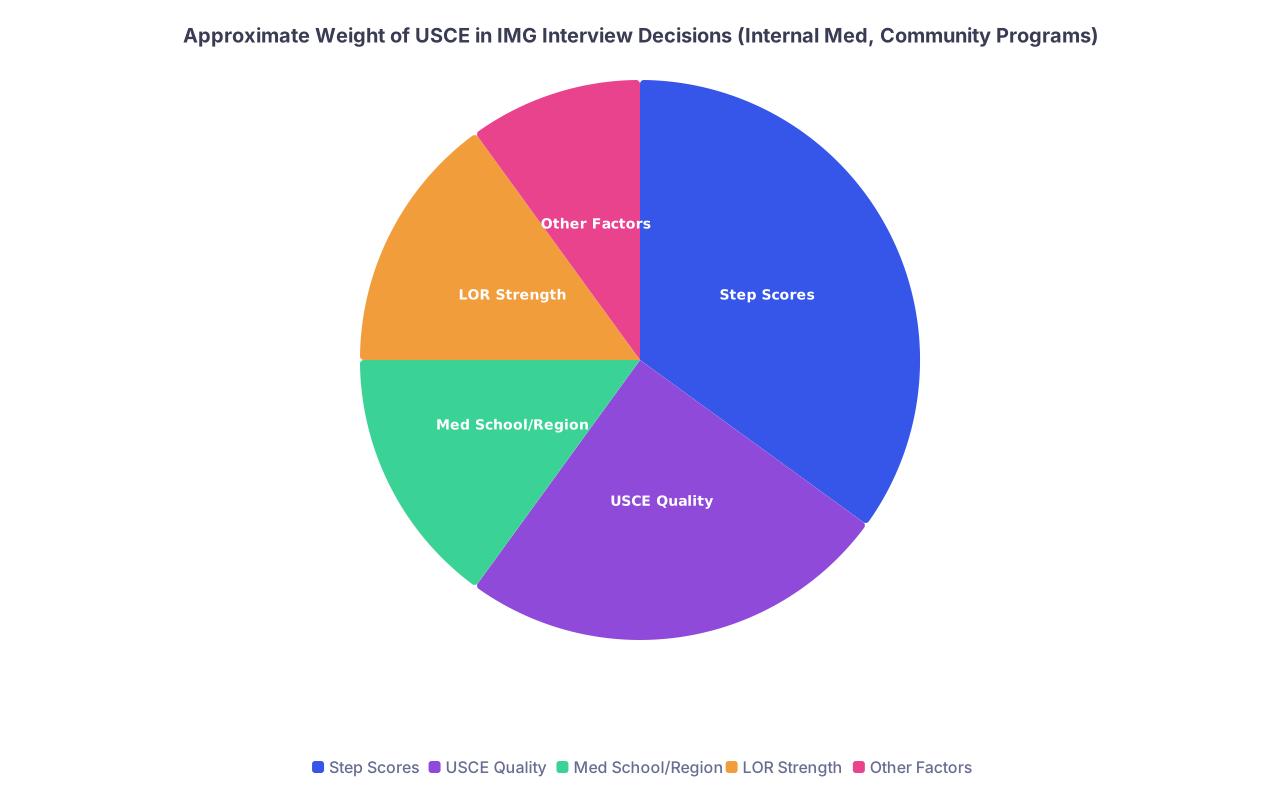
| Category | Value |
|---|---|
| Step Scores | 35 |
| USCE Quality | 25 |
| Med School/Region | 15 |
| LOR Strength | 15 |
| Other Factors | 10 |
Those numbers aren’t from a published paper. They’re from how people talk when the doors are closed and they’re tired of reading applications.
What USCE Actually Signals to Program Directors
On paper, USCE is “evidence of familiarity with the U.S. healthcare system.” That phrase shows up on every website FAQ. Inside the room, it means something more specific.
It answers four questions faculty care about but won’t put in writing:
- Will this person be a safe intern on day one?
- Will this person slow down my team because they don’t understand the basic workflow?
- Will they struggle with communication, documentation, and U.S. norms?
- Do I have any American colleague I trust who has seen this person in action?
When you’ve got USCE with strong letters, what you’re really providing is a voucher. A currency of trust. Some U.S. attending is effectively saying:
“I supervised this person. They showed up; they didn’t drown; they weren’t a disaster socially. You can work with them.”
Big difference between that and a dean’s letter from a school in a country the committee barely knows.
Program directors have long memories of the worst‑case scenarios:
The IMG who has never opened Epic before July 1.
The intern who can’t call a consultant appropriately.
The one who documents like they’re still in their home country — or barely documents at all.
USCE, especially inpatient hands‑on, tells them you’ve already broken through that first cultural and practical wall.
How Different Types of Programs Treat USCE
Not every program sees USCE the same way. This is where applicants get misled by generic advice.
Let me break down how the conversations actually go in three broad buckets.
1. Community Programs with Many IMGs
These are the places where USCE often matters the most at the screening stage.
They’ve had enough experience to know the pattern: IMGs with strong U.S. experience adapt faster, document better from day one, and require less hand‑holding.
In screening:
- No USCE + visa + average scores = near‑instant reject in many of these meetings.
- Solid USCE (3+ months, inpatient) + good LORs can rescue a borderline score more than you’d expect.
I’ve watched PDs say, “Scores are a little low, but they’ve got 3 months inpatient USCE at a U.S. academic center with strong letters. I’ll take that over a 245 with no US experience and no letters from here.”
Not always, but more than you think.
2. University Programs / Big Academic Centers
Here the equation shifts a bit. They’re often drowning in AMGs, top scores, and international applicants with publications.
They still like USCE — especially if it’s at a recognizable name. But they’re slightly less obsessed with it at the pure screening level if your academics are stellar and your research is flashy.
However, that’s the trap: many IMGs apply here imagining “they value academics more than USCE.” True, to a point. But if you’re not at the top of the score stack, USCE becomes a differentiator very quickly.
In the meeting, it sounds like:
- “This IMG has 250+ and a paper in a big journal. Any USCE?”
- “Yes, two months at [their own institution or similar tier]. Strong letter from Dr. X.”
That combo gets attention.
Same score, no USCE, vague letters from overseas? There’s less appetite to “take a chance” when an AMG with easier onboarding is available.
3. Programs Claiming “We Don’t Require USCE”
Some genuinely don’t. Most that publicly state this still quietly favor it.
Here’s the internal logic. If a program puts “USCE required” on their website, they shrink their applicant pool overnight, especially from certain countries. That sounds nice in theory but can backfire. They want flexibility.
So they put: “USCE preferred but not required.”
Inside the room, that becomes: “If they have it, great. If they don’t, they better be exceptional somewhere else.”
Do some IMGs match with zero USCE? Yes. It happens every year.
It usually requires at least one of the following:
- Very high Step 2 (for the specialty/program tier)
- Strong research, especially tied to U.S. institutions
- An inside connection, prior observership with an unofficial mentor, or someone on the faculty vouching offline
But those are exceptions, not expectations.
How USCE Plays in the Real Screening Conversation
Let’s go inside a hypothetical screening block for internal medicine at a mid‑tier community program that takes a fair number of IMGs.
Applicant A:
- IMG, Step 2 240
- No visa needed
- USCE: None
Applicant B:
- IMG, Step 2 233
- Needs H‑1B
- USCE: 3 months inpatient elective + 1 solid U.S. LOR from an IM residency program director
Applicant C:
- IMG, Step 2 222
- No visa
- USCE: 6 months observership, all outpatient clinics, local private doc, generic letters
The committee is deciding their final wave of interview invites. They have space for maybe 10–15 more interviews for IMGs.
Who gets discussed seriously? Not in the fantasy world. In the real one where tired faculty weigh how much they want to chase visas and remediate interns.
Applicant A: They’ll say, “Scores are decent, no visa, but no U.S. experience. We have ten others with USCE. Any reason to invite?” Usually no one fights hard here.
Applicant B: “Lower score, needs visa, but good USCE and a PD letter from a U.S. program. Let’s invite. They’ve been vetted inside our system.”
Applicant C: “Long observerships but private outpatient, letters say charming and punctual, Step 2 borderline.” This one gets the “maybe” shrug. If they’re short on candidates, maybe. If not, they disappear.
The brutal truth: Applicant B with slightly worse numbers often wins because USCE from credible inpatient settings + strong letters is seen as a better predictor of whether they’ll function as an intern.
The Visa + USCE Combination: The Quiet Multiplier
If you need a visa, USCE matters even more. Nobody says this in a brochure because it sounds discriminatory. But I’ve heard versions of this exact sentence many times:
“If we’re going to go through the trouble and cost of sponsoring, they better have proven they can function here.”
For visa‑needing IMGs, USCE with strong letters isn’t just helpful. It’s often what moves you from “theoretical risk” to “actual known quantity.”
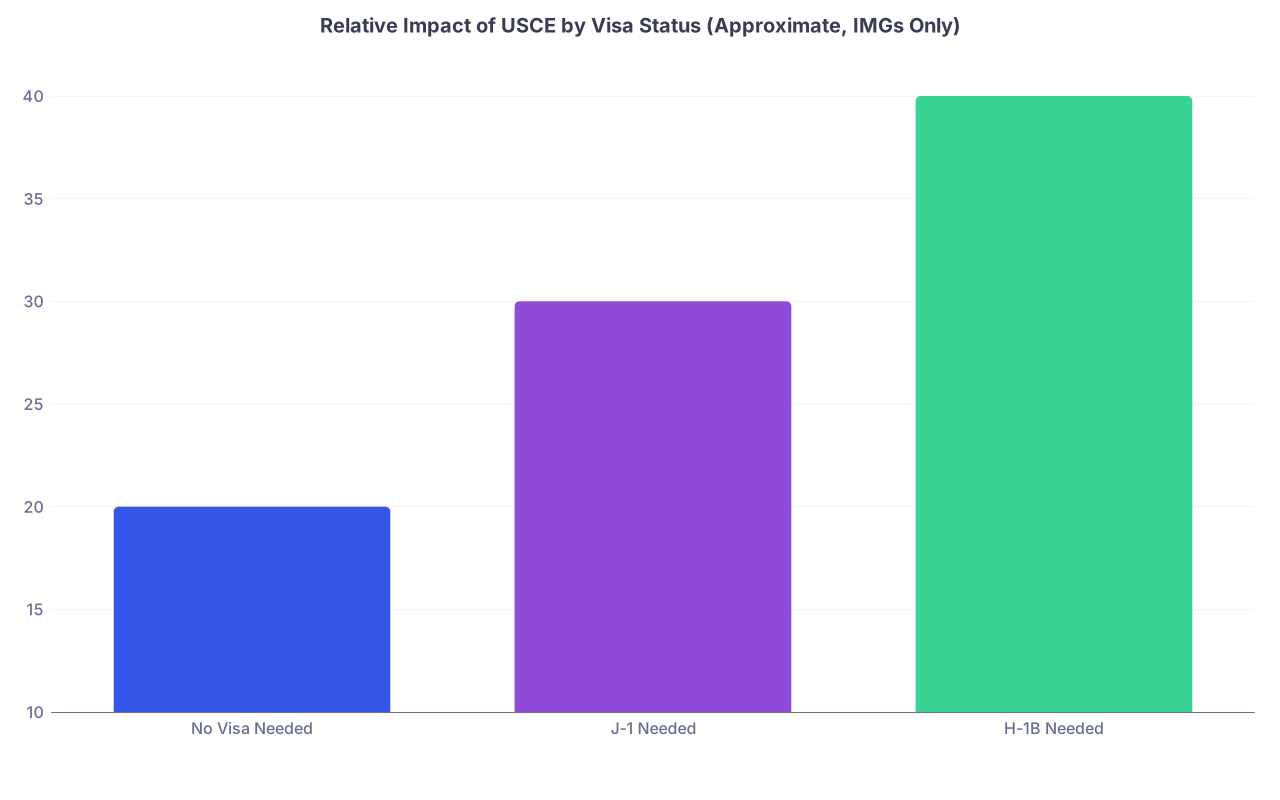
| Category | Value |
|---|---|
| No Visa Needed | 20 |
| J-1 Needed | 30 |
| H-1B Needed | 40 |
Those numbers are a rough representation of how heavily people in that room subconsciously weigh USCE when they see “requires visa” next to your name. The more friction you bring logistically, the more they want proof you’ll deliver clinically.
What Faculty Actually Look For Inside Your USCE
Another myth: just having “3 months USCE” fixes everything. That’s not how it plays out.
Once you pass the initial filter and someone actually opens your ERAS, they care about three details:
Where you did it
- An elective at a recognizable teaching hospital or university‑affiliated site carries real weight.
- Repeated observerships at sketchy “IMG clinics” or paid externship mills? They’ve seen the same three letter writers sign off 100 identical letters. They’re less impressed.
What you actually did
When they read the Description section (assuming they get that far), they’re scanning for words like:- “Presented patients on rounds”
- “Documented in EMR (Epic/Cerner/etc.) under supervision”
- “Participated in sign‑out, wrote progress notes, pre‑rounded independently”
Versus:
- “Observed patient care”
- “Had the opportunity to see various pathologies”
Translation: you were in the room but not in the workflow.
What the letters say — specifically
The best USCE isn’t the experience. It’s the letter behind it.A letter that says, “She functioned at the level of a sub‑intern, took ownership of patients, and I would gladly have her as a resident in our program,” carries ten times the weight of, “He is punctual, polite, and hardworking.”
Faculty are not idiots. They know exactly what “punctual and pleasant” means. It means “I don’t want to say anything negative but I’m not willing to stake my reputation on them.”
How USCE Interacts with Red Flags, Gaps, and Older Grads
Here’s another place USCE plays a bigger role than people realize: damage control.
If you’re an older grad (let’s say >5 years since medical school), or you’ve had a gap, the room wants to know if you’re still clinically sharp and trainable.
USCE done in the last 12–18 months is how you answer that.
I’ve watched PDs talk through this:
- “Grad 2016, no recent clinical experience. That’s a pass.”
- Versus: “Grad 2015, but did six months recent USCE in 2024 with great letters. Okay, they’re still in the game.”
Without recent USCE, older grads look like a project. With it, you become a known entity again.
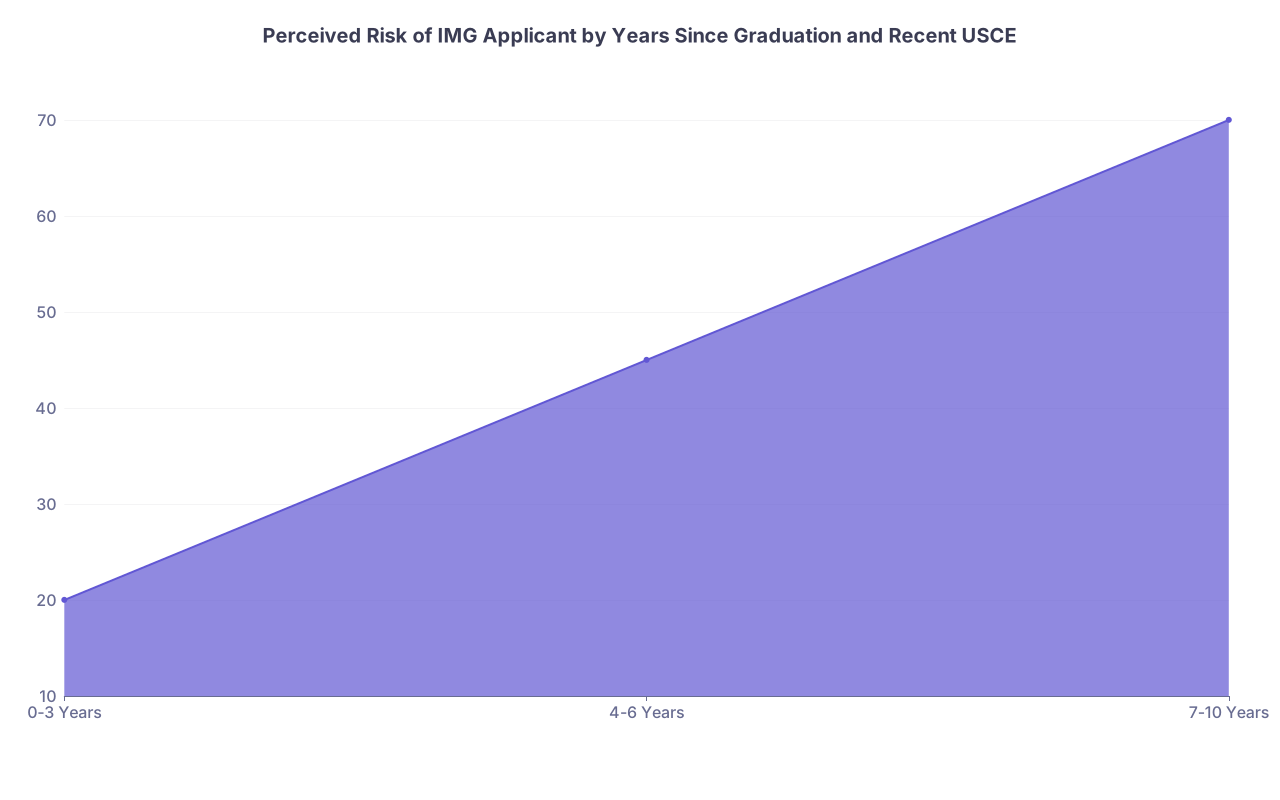
| Category | Value |
|---|---|
| 0-3 Years | 20 |
| 4-6 Years | 45 |
| 7-10 Years | 70 |
Mentally, that “risk score” drops if they see strong, recent USCE. No one quantifies it, but it’s there in the discussion.
Common IMG Misreads About USCE
There are a few recurring blind spots I see every cycle.
“I did research in the U.S.; that counts as USCE.”
No, not for most PDs. It’s valuable. It looks good. But if it’s bench or chart review with zero real clinical exposure, they don’t check the same mental box as true USCE.“I have 12 months of observerships; that must be amazing.”
Quantity doesn’t fix low quality. If all 12 months are passive, outpatient, and produce generic letters, you’ve basically padded your CV without adding real screening value.“Any U.S. letter is as good as a USCE letter.”
Letters from U.S. basic science or research mentors are nice. But for residency selection, a U.S. clinical letter, from someone who saw you with patients, is the currency that counts in that room.“Programs say they do holistic review, so USCE is optional.”
Holistic review is real at some places, but no one holistically reviews 5,000 files line by line. They skim, filter, and only then get holistic with the survivors.
So How Much USCE Is “Enough” To Change That Room Conversation?
The honest answer: it depends on what else you’re bringing. But there are patterns.
For most IMGs targeting IM/FM/peds/neurology/psych at community or mid‑tier academic programs, this tends to be the tipping point:
- 2–3 months of real, inpatient‑weighted USCE
- At least 2 strong U.S. clinical letters, ideally one from a PD or associate PD
- Completed within 1–2 years of applying
That package is usually enough to change how your name is handled. Instead of “unknown risk,” you move into “legit candidate, we can work with this.”
More than 4–6 months isn’t magic. If it gets you more strong letters and deeper experience, great. But no one is giving extra interview points past a certain threshold. They just need to be comfortable you’ve been battle‑tested in this system.