
The way most IMGs list USCE and observerships on their CVs makes them look desperate, not competitive.
If you’re an IMG, this is one of the fastest ways to quietly get screened out.
You’re told “Get US clinical experience. Get observerships. Network.” That part is true. But nobody tells you how bad it looks when you cram every shadowing day, every “online observership,” every glorified hospital tour into your CV like it’s a chief residency.
I’ve watched programs roll their eyes at CVs like this. I’ve heard faculty say, “This person just collected certificates.” You do not want to be that person.
Let’s walk through the big ways IMGs misuse USCE/observerships—and how to fix it before your application season kills your chances.
1. Confusing USCE With “Anything I Did Near a Hospital”
](https://cdn.residencyadvisor.com/images/articles_svg/chart-common-weak-vs-strong-usce-patterns-in-img-cvs-4226.svg "Common Weak vs Strong USCE Patterns in IMG CVs")
| Category | Value |
|---|---|
| Only Observerships | 45 |
| Mixed but Observership-Heavy | 30 |
| Mostly Hands-On | 15 |
| [Hands-On + Research](https://residencyadvisor.com/resources/img-applicant-challenges/img-with-limited-research-a-practical-6-month-academic-upgrade) | 10 |
The first mistake is definitional. You think everything counts as USCE. Programs do not.
Here’s the ugly truth:
- True, strong USCE (for residency selection):
- US hands-on inpatient or outpatient rotations (electives, sub-I, externships) with real patient contact, documentation, or orders under supervision.
- US transitional/prelim year experience.
- Weak or borderline:
- Pure observerships (no patient contact, no orders, no documentation).
- “Shadowing” arranged privately.
- Short “clinical exposure” visits where you mostly watched or sat in conferences.
- Basically worthless or suspicious:
- “Online observerships.”
- Non-structured “virtual shadowing.”
- Paid “observer programs” with zero clear role described.
- Two-day “introduction to US healthcare” courses marketed as “clinical experience.”
The mistake: you throw all of those in one section called “US Clinical Experience” or worse, you label everything “Externship” because you think the word sounds stronger.
Programs know the difference. You are not fooling anyone. You’re only damaging your credibility.
How to avoid this
Separate them clearly. Label them honestly. Do not inflate.
| Situation | Wrong Label | Honest Label |
|---|---|---|
| No-touch hospital-based observer | Clinical Externship | Observership |
| Remote lectures from US-based doctor | Online Clinical Externship | Virtual Clinical Seminar |
| 2-week casual shadowing | USCE Rotation | Short-term Shadowing |
| EMR notes + presentations + orders (supervised) | Observership | Clinical Externship / Hands-on USCE |
If you mislabel, faculty assume either:
- You don’t understand how US training works, or
- You’re willing to exaggerate.
Both are bad.
Do not upgrade an observership into an externship just to look stronger. That’s not strategy. That’s dishonesty.
2. Turning Your CV Into a Certificate Scrapbook
I’ve seen IMG CVs where half the document is observerships like this:
- 1-week observership – Dr. X, Clinic A
- 2-week observership – Dr. Y, Hospital B
- 5-day “exposure” – Clinic C
- 4-day “online observership” – Platform D
- 1-week “virtual USCE” – Company E
It reads like someone panic-buying clinical experiences off the internet.
Program directors see that and think:
- “They’re trying way too hard.”
- “This is padding.”
- “No sustained involvement anywhere.”
You’re broadcasting insecurity and a lack of depth.
The desperation signals
These patterns are red flags:
- Dozens of very short experiences (less than 4 weeks each).
- Anything that looks like “certificates collection.”
- Multiple “online observerships” or “virtual USCE” entries.
- Very long lists in the Experience section that are all observation-only.
Here’s the key: more lines does not mean more value. It often means more desperation.
What you should do instead
Condense and prioritize:
- Emphasize longer, continuous experiences (4+ weeks).
- Highlight hands-on ones.
- Group tiny shadowing experiences in one short line (or leave them off entirely).
For example, instead of:
- 1-week observership – Internal Medicine, XYZ Clinic
- 1-week observership – Cardiology, XYZ Clinic
- 1-week observership – Nephrology, XYZ Clinic
Write:
- 3-week clinical observership – XYZ Clinic, Internal Medicine subspecialty services (cardiology, nephrology, general IM)
Then stop listing every micro-rotation as if it were separate USCE.
3. Over-selling Roles and Using Dishonest Titles
This is where people really get themselves into trouble.
I’ve seen CVs where an IMG writes:
“Internal Medicine Externship, ABC Hospital – Managed patient care, wrote orders, and followed patients independently.”
Then I call the attending and they say:
“They stood behind me during rounds and occasionally looked up labs.”
Programs talk. Faculty talk. If your description doesn’t match reality, word spreads.
Common over-selling moves that hurt you
- Calling yourself “sub-intern” when you were an observer.
- Writing “direct patient management” when you only watched and maybe talked to patients.
- Saying “authored admission and progress notes” when you wrote drafts that never made it into the chart.
- Claiming “independent decision-making” as a student or observer.
You don’t need to lie. It’s enough to say what you actually did—if what you did was meaningful.
The safe, honest way to describe observerships
Use modest, accurate verbs:
- “Observed inpatient rounds and outpatient clinics”
- “Participated in case discussions and teaching conferences”
- “Assisted with literature review and case presentations”
- “Reviewed EMR data under supervision” (only if you actually touched the EMR)
Here’s how to fix an over-sold entry.
Wrong:
Clinical Externship, Cardiology – independently managed inpatients, wrote progress notes, ordered tests, and adjusted medications.
Better:
Clinical Observership, Cardiology – observed inpatient and outpatient cardiology practice, participated in bedside teaching, and presented selected patients during rounds.
It looks less “impressive” on paper, but it protects your integrity. Programs will trust you more. And they care more about trust than puffed-up experiences.
4. Making USCE the Star Instead of the Support
Another subtle mistake: you build your entire identity around USCE and observerships.
Your CV and personal statement scream:
- “Look at my USCE.”
- “Look how much I want to be in the US.”
- “Please like me; I did five observerships.”
You bury the fact that you actually completed a solid medical education, maybe did real clinical work in your home country, maybe handled complex patients as a junior doctor. That matters more.
An observership is seasoning. Not the main course.
The hierarchy programs care about
Roughly speaking, programs usually value:
- Clinical performance in real, hands-on roles
- USMLE scores and exam performance
- Letters of recommendation from people who actually supervised you
- Evidence you can function in a system similar to theirs
- USCE/observerships as context and reassurance, not the core of your identity
If your CV is 60% observerships and 10% real work, you’ve flipped the order and made yourself look like a professional observer, not a functioning clinician.
5. Listing Weak or Fake-Looking “Online Observerships”
Online observerships are the new plague.
Most programs view “online observership,” “virtual clinical externship,” and similar products as:
- Educational at best
- CV pollution at worst
You can learn from them. You can mention them in your narrative if they genuinely changed how you think. But stacking them on your CV as if they’re equivalent to real USCE looks naive and, yes, desperate.
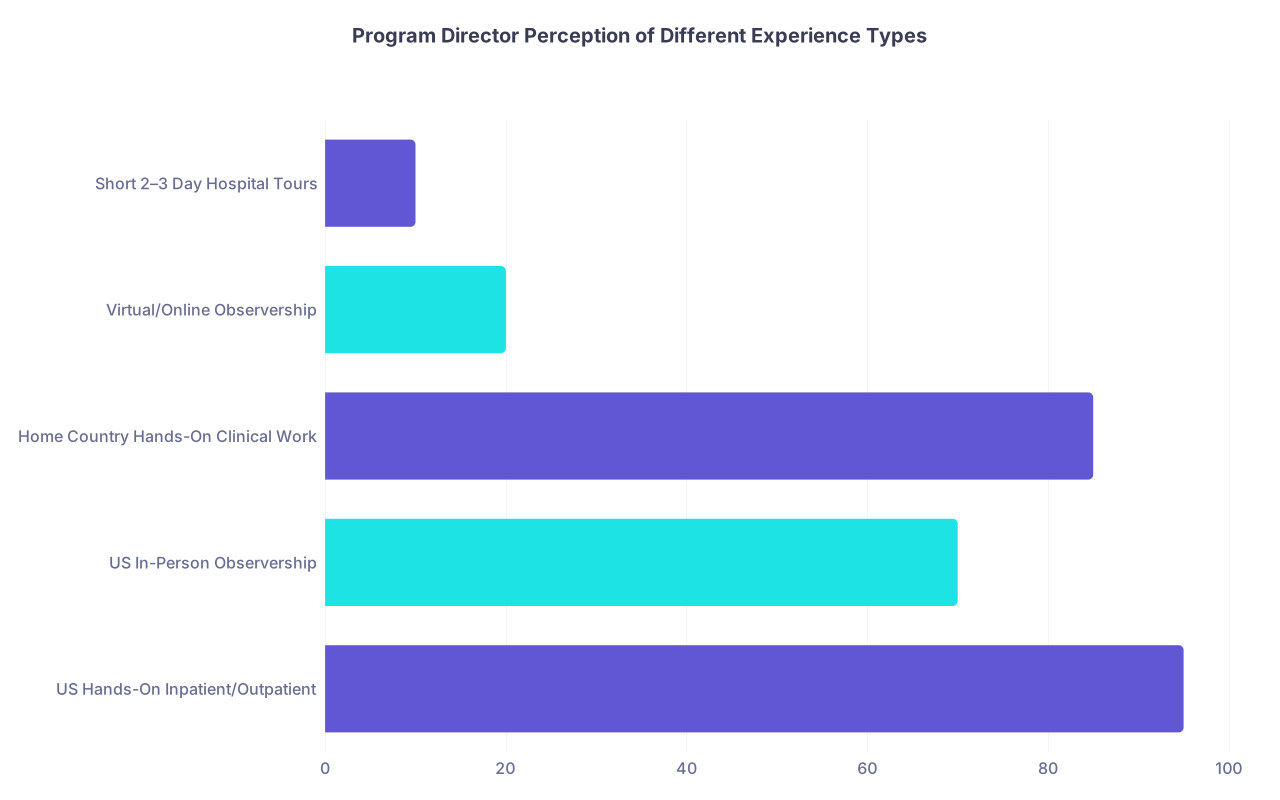
| Category | Value |
|---|---|
| US Hands-On Inpatient/Outpatient | 95 |
| US In-Person Observership | 70 |
| Home Country Hands-On Clinical Work | 85 |
| Virtual/Online Observership | 20 |
| Short 2–3 Day Hospital Tours | 10 |
Most PDs I’ve heard from mentally weight experiences roughly like that. Still think 4 different online observerships at random “academies” belongs in the main Experience section?
How to handle virtual experiences without looking ridiculous
If you must include them, put them under:
- “Additional Educational Activities”
- “Selected Online Coursework”
- “Continuing Education”
Give them one line, not a full “experience” with bullet points about “patient exposure.”
Example:
- “Virtual clinical case-discussion course, Internal Medicine – XYZ Platform (40 hours of case-based teaching with US faculty)”
That’s it. No pretending you managed patients over Zoom.
6. Using Observerships as a Substitute for Real Relationships
Here’s the quiet truth nobody selling observerships will tell you:
Most observerships do not give you a strong letter of recommendation.
You show up. You stand around. You nod. You leave. The attending barely remembers your name. But then you ask them for a letter.
Result? A painfully generic LOR that says:
- “Hard-working.”
- “Punctual.”
- “Interested in medicine.”
I’ve watched PDs skim these and move on instantly. They can tell when the “relationship” was 3–4 weeks of silent standing in the back of rounds.
The mistake: using observerships primarily to chase letters, not to learn and build actual trust.
How not to look like a letter-harvester
During any USCE/observership:
- Show up prepared (read the patient list, know the common conditions).
- Ask targeted, not constant, questions.
- Offer to help with something real: literature review for a case, short talk, a simple QI idea.
- Be consistent over time—same faculty, multiple weeks.
Then, when you do ask for a letter, be honest:
“Dr. Smith, I really valued working with you during my observership. I know I wasn’t in a hands-on role, but if you feel you got to know my work ethic and clinical reasoning enough, I’d be very grateful for a letter. If not, I completely understand.”
That last sentence is crucial. You’re giving them an out. Desperate IMGs never do that. Mature candidates do.
7. Writing Cringeworthy Descriptions That Scream “Please Pick Me”
Some CV lines and personal statement sentences sound almost needy. I’ve seen things like:
- “I did this observership to prove how committed I am to US residency.”
- “I pursued multiple observerships to show programs how serious I am.”
- “These experiences demonstrate that I will work very hard if given a chance.”
This kind of language turns your USCE into begging material.
The worst part? You waste the chance to show what you learned in those settings.
Replace desperation with reflection
Instead of:
“Multiple observerships show my dedication to becoming a US resident.”
Use:
“During my 4-week observership in internal medicine at XYZ Medical Center, I observed structured multidisciplinary rounds and EMR-based workflows that clarified how continuity of care is managed in a US academic hospital.”
Concrete. Specific. Zero begging. It tells the reader:
- You paid attention.
- You understood the system.
- You can translate observation into insight.
That’s what they want to see.
8. Ignoring the Timeline and Making Your Career Look Chaotic
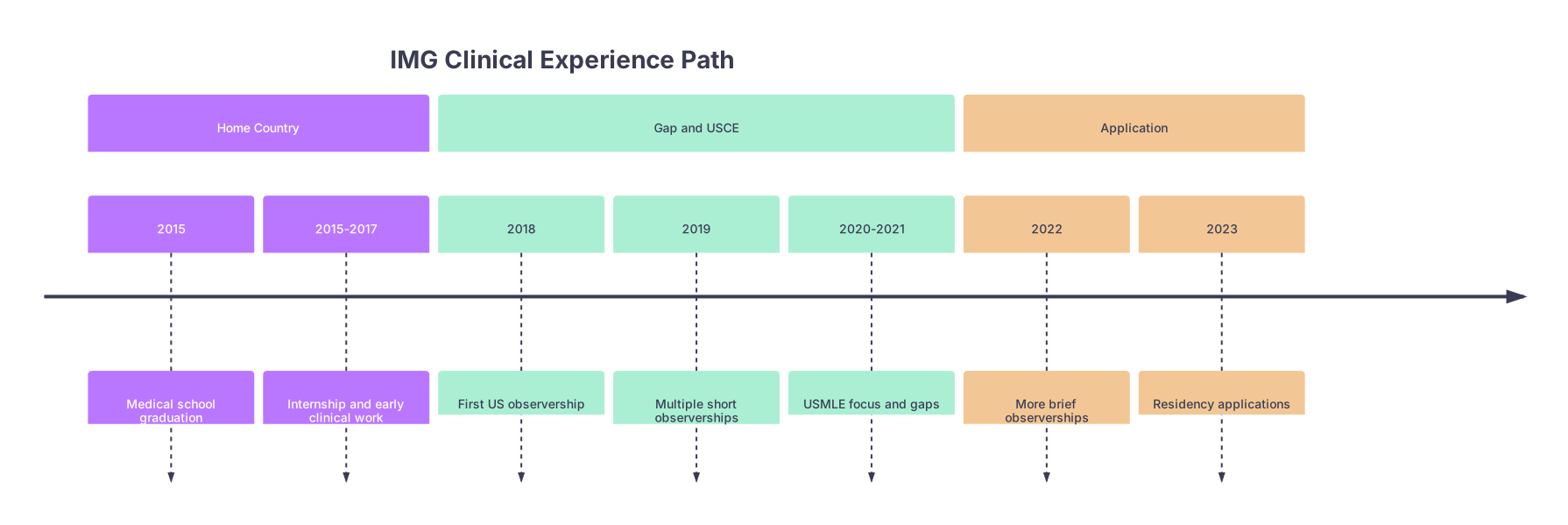
| Period | Event |
|---|---|
| Home Country - 2015 | Medical school graduation |
| Home Country - 2015-2017 | Internship and early clinical work |
| Gap and USCE - 2018 | First US observership |
| Gap and USCE - 2019 | Multiple short observerships |
| Gap and USCE - 2020-2021 | USMLE focus and gaps |
| Application - 2022 | More brief observerships |
| Application - 2023 | Residency applications |
Programs are not just looking at what you did. They’re watching when and how you did it.
Red flags they see on many IMG CVs:
- 3–5 years of almost nothing but intermittent observerships and exam prep.
- Long gaps in real, hands-on work while stacking short USCE snippets.
- Bouncing around cities and hospitals for one- or two-week stints with no longitudinal commitment anywhere.
It gives the impression that you’re chasing the US dream full-time, not practicing medicine.
You look like a full-time applicant, part-time doctor.
A better way to structure your timeline
You’re much safer if your CV says:
- Consistent clinical work in your home country (even part-time),
- Plus selected, meaningful USCE experiences strategically placed,
- Plus exam progress and maybe some academic activity.
So instead of 12 tiny observerships over 3 years, you’d be better with:
- 1–2 solid, 4–8 week US experiences, and
- Ongoing actual practice or training at home.
Do not let observerships replace your identity as a clinician.
9. Failing to Connect USCE to the Specialty You’re Applying For
Another common mistake: random, scattered observerships with no narrative.
You’re applying to Internal Medicine, but your CV shows:
- 2 weeks – Pediatrics observership
- 1 week – Dermatology observership
- 2 weeks – Family Medicine shadowing
- 1 week – Radiology observership
- 3 days – “Surgical exposure”
It looks like you were just grabbing whatever you could get. And maybe you were. But you cannot present it that way.
Programs want to see alignment. A story. Not a scavenger hunt.
How to avoid looking scattered
If your experiences are mixed:
- Highlight the ones that match your chosen specialty in the main Experience section.
- Push unrelated ones lower or group them together briefly.
- In your personal statement, explain your path clearly and own your decisions.
For example:
“Although I gained early exposure to pediatrics and family medicine observerships while exploring different fields, my longer, 8-week internal medicine observership at XYZ Hospital confirmed my decision to pursue internal medicine because…”
You’re not fooling anyone by pretending you never tried anything else. But you can frame it as exploration leading to clarity—not as flailing.
10. Not Understanding How Your CV Actually Gets Read

Here’s a hard reality: your CV is not being read like a novel. It’s being skimmed at speed.
Most faculty:
- Look at degrees, graduation year, exams.
- Then scan experience for red flags and green lights.
- They’re not counting how many observerships you did—they’re asking:
- Does this person have at least some US exposure?
- Does anything look dishonest, desperate, or inflated?
- Do I trust this person’s self-report?
If your USCE section throws off desperation vibes, they don’t sit there admiring your hustle. They move on to the next file.
So your job is not to look hyperactive. Your job is to look:
- Coherent
- Honest
- Clinically grounded
- Thoughtful about your path
USCE and observerships should quietly support that impression. Not hijack it.
11. How to Present USCE and Observerships Without Looking Desperate
Let’s put this together into a concrete structure.
| Element | Stronger Choice | Weaker (Desperate) Choice |
|---|---|---|
| Role Description | Honest, specific, modest | Inflated, vague, over-claiming |
| Virtual/Online Items | Grouped under Education/Other | Listed as core clinical experience |
| Specialty Alignment | Mostly in your target specialty | Random mix with no explanation |
And here’s what a cleaner entry might look like:
Clinical Externship, Internal Medicine
ABC Medical Center, City, State – 4 weeks
- Participated in inpatient ward rounds with attending and resident teams
- Conducted focused histories and physicals under supervision and presented patients on rounds
- Prepared brief literature reviews for teaching discussions on common conditions such as heart failure and COPD
Compared to this train wreck:
USCE – Internal Medicine Externship
- Independently managed multiple complex patients
- Wrote notes and orders in EMR
- Demonstrated strong passion and dedication to US healthcare system
One of those sounds like a real rotation, written by a grounded adult. The other sounds like wishful thinking and sales copy.
FAQs

1. Should I leave short observerships off my CV completely?
If an observership was:
- Less than 1–2 weeks,
- Not in your target specialty,
- And did not lead to a meaningful letter or clear learning outcome,
then yes, you can safely leave it off or just group it in a single brief line (e.g., “Short-term clinical observations in X and Y – 2019–2020”). Quality beats quantity. You won’t be rejected because you didn’t list every 3-day hospital visit. You can be rejected for looking like a certificate collector.
2. How many observerships or USCE experiences “look good” without looking desperate?
There’s no magic number, but in practice:
- 1–2 substantial, 4–8 week US experiences in your target specialty look solid.
- 3–4 total experiences is probably the upper limit before it starts to look scattered—unless you can clearly explain the progression.
- Above that, especially if many are very short or unrelated, you risk looking unfocused or desperate.
Aim for depth and continuity, not a huge count.
3. Can I still match with mainly observerships and no true hands-on USCE?
Yes, it’s possible—but only if the rest of your application is strong: solid scores, no major gaps, real clinical work at home, and good letters (even if non-US). The key is to present observerships honestly and strategically:
- Label them clearly as observerships.
- Don’t pretend they’re equivalent to hands-on intern work.
- Use them in your narrative to show that you understand how US training and systems work.
You won’t be rejected just for having observerships instead of externships. You’ll be rejected for exaggerating them, overloading your CV with them, or using them to shout your desperation instead of showing your maturity.

Keep this simple:
- USCE and observerships should be honest, limited, and clearly labeled.
- Depth, alignment, and integrity beat long lists and inflated titles.
- Your identity is a clinician, not an observer—don’t let your CV say otherwise.