
Does Applying to 300+ Programs Really Help IMGs Match—or Just Burn Cash?
How many times have you heard this: “You’re an IMG. Just apply everywhere. 300+ programs. Bombard ERAS. That’s how you match.”
Let me be blunt: that “strategy” is one of the most expensive myths in the IMG world.
Not because applying broadly is always wrong. But because there’s a very real point of diminishing returns where every extra program adds almost zero chance of matching and massively increases:
- Cost
- Stress
- Burnout from interviews you’ll never get
And yes—the data backs this up.
You don’t need magic. You need to understand where the curve flattens for you.
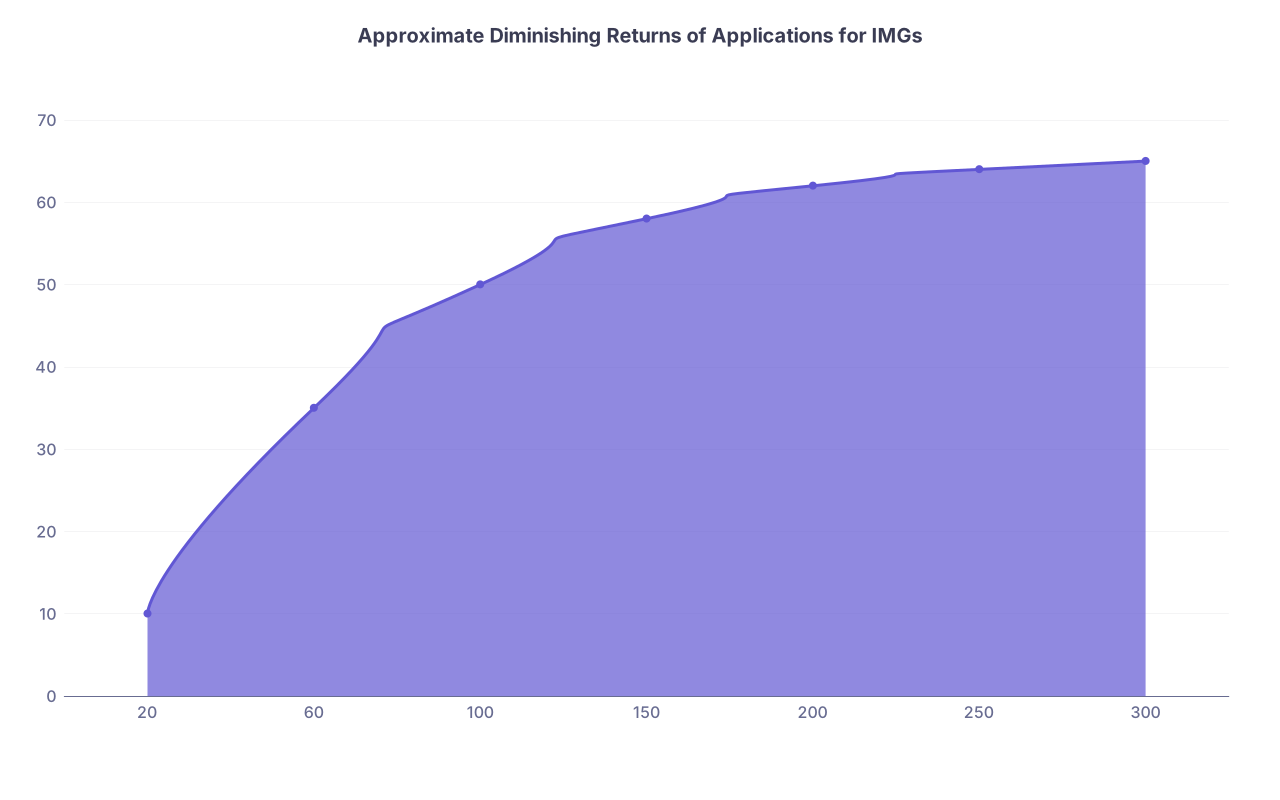
What the Data Actually Shows About More Applications
First, let’s kill the idea that “more applications = always more interviews = higher match rate.”
That was never true. For IMGs, it’s especially false.
NRMP and AAMC have published multiple reports (Charting Outcomes, Program Director Surveys, ERAS data summaries) that show the same pattern over and over:
- As you apply to more programs, your chance of matching initially goes up.
- Then the curve flattens hard.
- After a certain number of applications, each additional program buys you almost nothing.
| Category | Value |
|---|---|
| 20 | 10 |
| 60 | 35 |
| 100 | 50 |
| 150 | 58 |
| 200 | 62 |
| 250 | 64 |
| 300 | 65 |
Are these exact numbers universal? No. They’re approximate to illustrate the trend. But the shape of the curve—that’s very real.
I’ve seen IMGs go from 80 to 180 applications and double their interviews.
I’ve also seen IMGs go from 250 to 450 and gain… one extra interview. Sometimes zero.
The myth comes from survivors’ bias. The person who applied to 400, matched, and now tells everyone “Just apply everywhere!” conveniently forgets they had:
- US clinical experience at strong sites
- Decent scores
- No massive red flags
They didn’t match because they applied to 400. They matched despite wasting money on 150+ programs that were never going to touch their file.
Why Blanket Applying Backfires for Many IMGs
“Apply to all internal medicine programs” sounds safe. It’s not. It’s lazy strategy disguised as hustle.
Here’s why blasting 300–400 programs is usually a bad move.
1. Program filters will kill you before a human sees your name
Most IM and FM programs are flooded with applications. Many use hard filters:
- USMLE Step 1 / Step 2 CK cutoffs
- Year of graduation limits (YOG)
- Visa status
- Prior attempts or failures
Program directors don’t read 5,000 applications one by one. They screen.
If a program:
- Doesn’t sponsor visas
- States IMG-unfriendly policies
- Has hard cutoffs above your scores
- Rarely interviews IMGs
…your application is dead before it lands. Paying $20–30 to get auto-filtered is not a “strategy.” It’s a donation.
| Program Type | You Apply? | Realistic Interview Chance |
|---|---|---|
| No visa sponsorship | Yes | ~0% |
| Requires 240+ CK, you have 221 | Yes | ~0–1% |
| Last IMG matched 8 years ago | Yes | Near 0% |
| Community IM, historically IMG-heavy | Yes | Reasonable |
| New program, low name recognition | Yes | Often higher |
Blanket applying ignores this reality. Targeted applying respects it.
2. Money and emotional bandwidth are not infinite
Let’s talk cost, because no one does this honestly.
The ERAS fee structure punishes “spray and pray.” For IM for example, once you cross certain thresholds, every extra program gets more expensive. Add in:
- Multiple specialties
- Extra documents
- Token “back up” fields you’re not even serious about
…and you’re easily into $3,000–$8,000 territory. That’s before you buy a single plane ticket or pay for hotels.
For many IMGs, that’s money borrowed from family in another country. Or credit card debt. For a fantasy that 350 programs will be “safer” than 180 intelligently chosen ones.
And there’s another cost people love to ignore: mental bandwidth.
You apply to:
- 320 programs
- Across 3 specialties
- With 5–7 different versions of your personal statement
Now tracking interview invites, dates, emails, rejections, rank lists… while trying not to lose your mind.
More applications don’t just cost more money. They cost more sanity.
Where the Diminishing Returns Kick In (Based on Who You Are)
The right number of applications is not random. It depends on:
- USMLE scores / attempts
- YOG and gaps
- US clinical experience
- Visa needs
- How “IMG-friendly” your specialty is
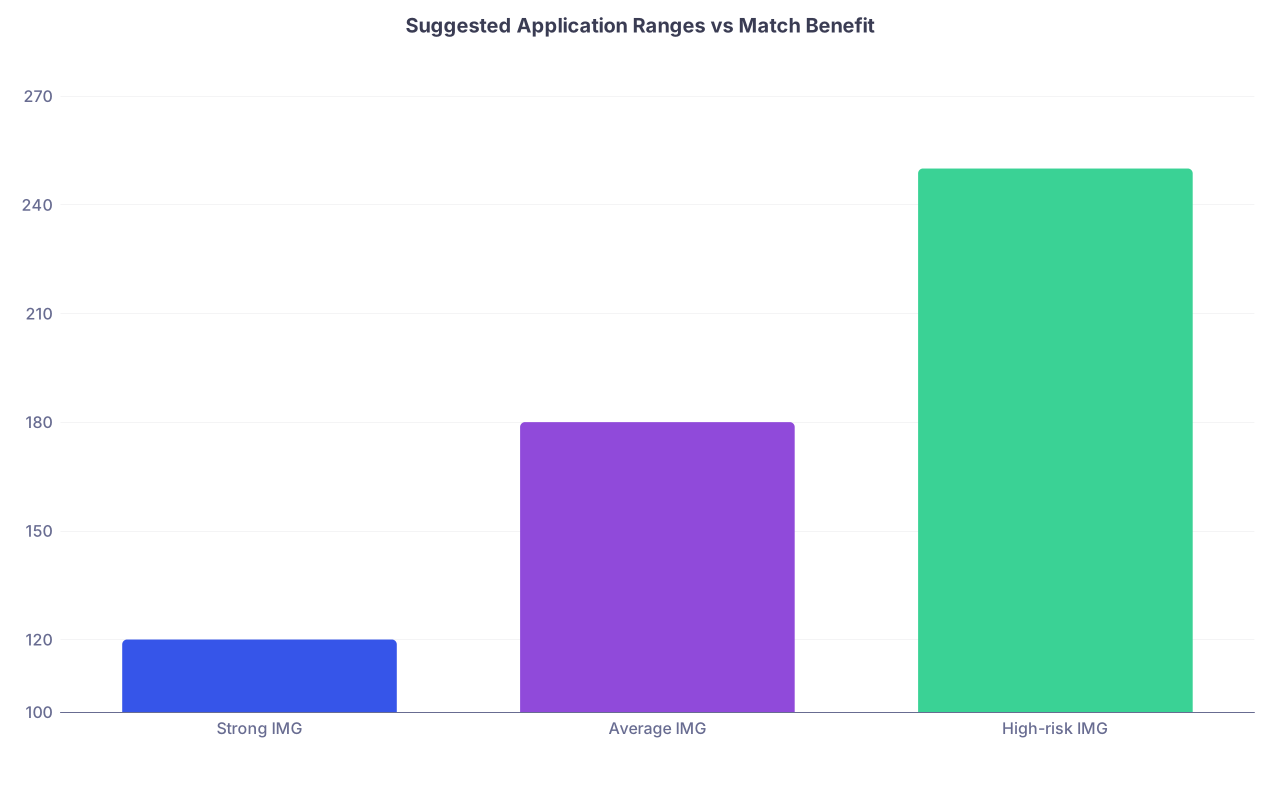
Let’s break this into realistic bands. These are not absolute, but they’re a far better starting point than “300 for everyone.”
| Category | Value |
|---|---|
| Strong IMG | 120 |
| Average IMG | 180 |
| High-risk IMG | 250 |
Stronger IMG profile
Think:
- CK ≥ 235–240
- No failures
- Recent grad (≤ 3 years)
- Solid US clinical experience
- Good English, reasonably strong letters
You don’t need 350 programs. You’re wasting money at that point.
A lot of well-positioned IMGs in this group match solidly with:
- 80–150 well-chosen internal medicine / FM / peds programs
- Maybe 150–180 if you’ve got some risk factor (visa, older grad, niche specialty)
Once you hit ~150 targeted applications, the marginal benefit per added program gets tiny.
Mid-range / typical IMG
Think:
- CK around 220–235
- Maybe 1 attempt somewhere
- YOG 4–7 years
- Some USCE
- Needs visa (often)
This is the group that usually thinks they need 300–400. In reality, they usually need:
- Around 160–220 programs, but selected intelligently
- Mostly community and IMG-friendly university-affiliated programs
- Areas less saturated with competitive US grads (Midwest, South, rural)
If your CV is middle-of-the-pack, adding a 280th program that screens out anyone below 240 CK is symbolic, not strategic.
High-risk IMG
Think:
- Low CK (< 215–220) or multiple attempts
- YOG > 7–8 years
- Significant clinical gaps
- Weak or minimal USCE
- Needs visa sponsorship
Here’s the truth: this is the only group where 250–300 might be reasonable. Not because it’s efficient—but because your overall odds are low no matter what, and you’re swinging wildly for any open door.
But even then, you still need targeting. Applying to 400 programs, 150 of which have never interviewed an IMG in the last 5 years, isn’t “giving yourself the best chance.” It’s denial.
IMG Reality: Interviews, Not Applications, Drive Match Odds
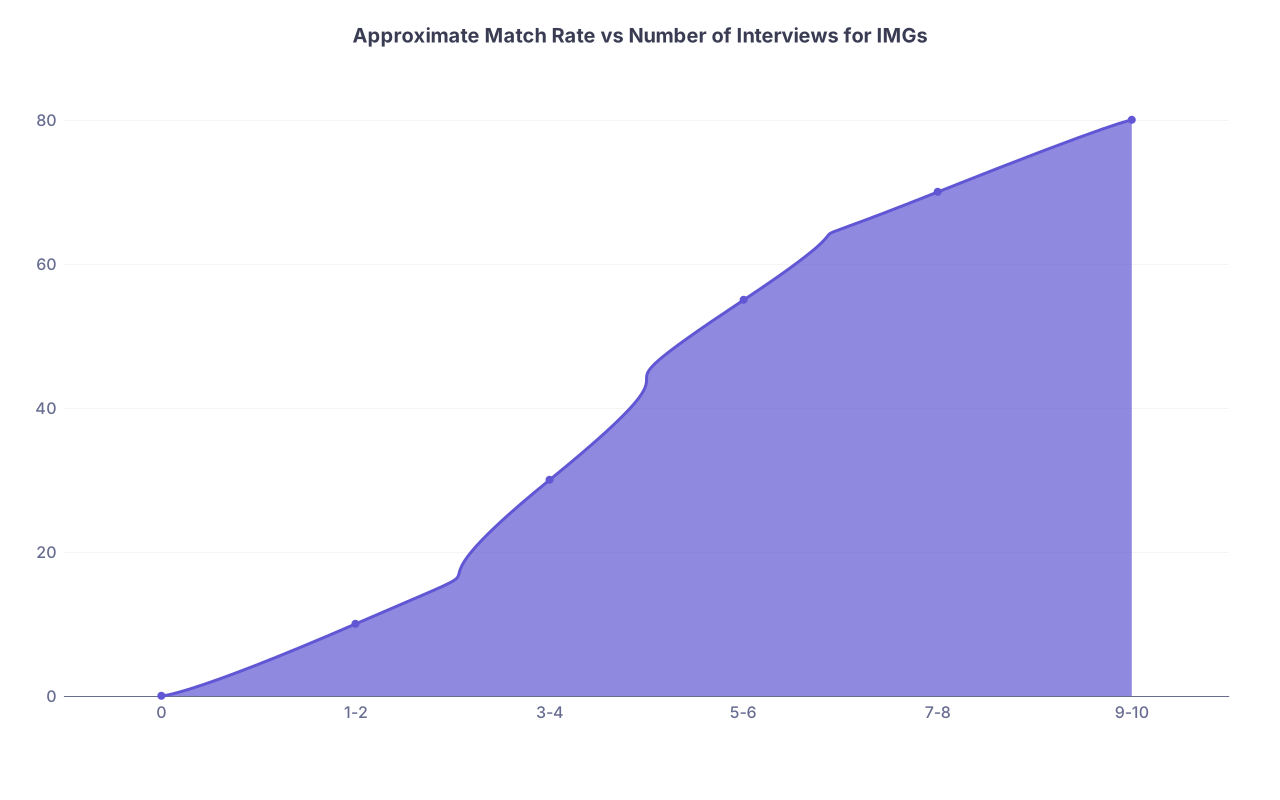
ERAS doesn’t match you. Interviews do.
There’s a consistent pattern in NRMP data: once applicants reach a certain number of interviews, their match probability skyrockets. For IMGs, that “sweet spot” is usually around 6–10 interviews.
Not 300 applications. 6–10 interviews.
| Category | Value |
|---|---|
| 0 | 0 |
| 1-2 | 10 |
| 3-4 | 30 |
| 5-6 | 55 |
| 7-8 | 70 |
| 9-10 | 80 |
Again, rough numbers. Directionally accurate.
So the real game is:
- How do I convert my application money into the maximum number of interviews possible?
- At what point do more applications not translate into more invitations?
Once your incremental invite rate drops to nearly zero—for example:
- First 120 programs → 6 interviews
- Next 80 programs → 1 interview
- Next 80 programs → 0 interviews
…you’ve found your personal “diminishing returns” zone.
Ask yourself honestly: if the next 50 programs will probably yield zero interviews, why are you funding ERAS’s retirement plan?
How to Be Strategic Instead of Desperate
I’m not saying “apply to 20 and manifest your way into a match.” That’s just the opposite flavor of bad advice.
You should apply broadly within reason, but intelligently. Here’s how that looks in practice.
1. Ruthless filter matching
Before you even think about a number, do this:
- Check if the program sponsors your visa type (H-1B vs J-1)
- Look at their last 2–3 years of residents – how many IMGs, and from where?
- See if they publicly state score or YOG cutoffs
- Use tools like FREIDA, program websites, even resident LinkedIn profiles
If you find:
- No IMGs at all for several years
- All residents are US MD/DO with 250+ scores
- No visa sponsorship
…stop romanticizing that program. Cut it.
2. Build tiers, not a random dump list
You’re not throwing darts. You’re building TARGETS.
Rough structure for an IMG aiming at IM:
- Tier 1 (10–20 programs): Most realistic + slightly aspirational
- Tier 2 (60–100 programs): Solid community and IMG-heavy university-affiliated
- Tier 3 (40–80 programs): Newer programs, less popular locations, very IMG-friendly historically
If you have serious red flags, you may extend Tier 3 further. But still with filters, not fantasy.
3. Watch your marginal return as invites come in
Let’s say you applied to 180 programs.
By December:
- You have 8 interviews
- 90% of programs have already responded (invite or silence = rejection)
In January, you’re still refreshing your email and muttering “Maybe I should have applied to 350+…”
Reality check: If 180 didn’t get you any more interviews after December, another random 120 probably wouldn’t have either—unless they were better targeted, not just more.
And next season? Take your invite yield seriously:
- If 120 applications → 0 interviews: your main issue is profile strength, not application count
- If 120 → 3 interviews and 180 → 5 interviews: 220 might be your realistic upper bound
- If 160 → 8 interviews: piling to 320 next time isn’t going to double that
The Ugly Truth: Many People Use Application Volume to Avoid Fixing Their CV
Here’s the part no one likes to hear.
A lot of IMGs use “I’ll apply to 350+ programs” as a psychological crutch. It feels proactive. It lets you avoid dealing with the harder problem:
- Weak US clinical experience
- Below-average Step 2 CK for your specialty
- No research or evidence of academic engagement
- Poor personal statement or clumsy application
- Communication issues during interviews
If you didn’t match with 280 largely random applications one year, the default move is not “Next year I’ll do 420.”
The default move is:
- Fix English / communication if they’re holding you back
- Get strong USCE with real letters, not “observer in the corner for two weeks”
- Rewrite your personal statement with honest feedback, not AI fluff
- Focus on specialties and programs that have actually taken people like you before
More of the same is not strategy. It’s superstition.
So, Does Applying to 300+ Programs Help IMGs Match?
Sometimes. But far less than people claim—and usually only for very high-risk cases, and even then with terrible efficiency.
Here’s the blunt summary:
- There’s a clear point of diminishing returns. For most IMGs, that point is well below 300 applications. Very often in the 150–220 range when targeted properly.
- After that point, extra applications mostly buy you anxiety and debt—not interviews. If your invite rate is poor, your profile and targeting are the problem, not the raw number.
- Strategic, filtered, data-driven applications beat blind “apply everywhere” every single time. Interviews—not application volume—drive your match odds.
If you want a rule of thumb:
Apply to enough programs that could realistically take you, then spend your remaining energy on being the person programs actually want to interview.
Because no one ever matched from “Application #347” that was auto-filtered and never opened.