The match does not care that you graduated “during COVID” or that “it was hard to get USCE.” Programs see a big clinical gap and quietly move your file to the reject pile.
If you are an IMG with sparse clinical experience after graduation, you do not need sympathy. You need a repair plan. A concrete, month‑by‑month fix that turns a weak timeline into something a PD can defend in a rank meeting.
This is that plan.
Step 1: Diagnose How Bad the Gap Really Is
You cannot repair what you have not measured. “Some gap” is not a diagnosis. You need specifics.
1. Map your clinical timeline
Take 30 minutes and write this out on paper or in a spreadsheet:
- Date of medical school graduation (month/year)
- Each clinical activity since graduation:
- Job title / role
- Setting (hospital, clinic, telemedicine, research unit)
- Country
- Dates (month/year to month/year)
- Hours/week (realistic average)
- Any long gaps with no clinical contact
Then categorize your time:
| Category | Months | Notes |
|---|---|---|
| Direct patient care (paid) | e.g., MO, GP, hospitalist | |
| US clinical experience | Obs/extern/assistant | |
| Non-US clinical experience | Home country work | |
| Research / non-clinical | Labs, admin, teaching | |
| Completely non-medical | Other jobs, family leave |
Now you can answer the real questions PDs ask:
- How long since this person last touched a patient?
- How much of their experience is recent (past 12–24 months)?
- How much of it is US-based?
- Do they look like someone clinically “rusty” or clinically “active but nontraditional”?
2. Understand the thresholds programs care about
This is where people lie to themselves. Do not.
Most PDs in competitive or mid-tier programs get nervous when:
- Graduation year is more than 5 years ago
- No meaningful clinical work in the last 12–24 months
- All experience is non-US for a US residency application
- Only “observerships” from 4–5 years ago and nothing recent
Less competitive or community programs can be more flexible, but they still want to see:
- Continuous involvement in medicine
- Recent patient-facing activity
- Some clear link to the specialty you are applying for
So put your situation into one of these buckets:
| Level | Profile |
|---|---|
| Mild | Grad ≤3 years, some recent clinic work, limited USCE |
| Moderate | Grad 3–5 years, 6–18 month gaps, minimal recent USCE |
| Severe | Grad >5 years, >2 year gap, mostly non-clinical activity |
Be brutally honest. Your repair strategy depends on this.
Step 2: Choose a Repair Strategy That Fits Your Reality
Stop chasing what sounds fancy. You need what is realistic, obtainable, and defensible on paper in the next 6–18 months.
The hierarchy of clinical repair (best to worst)
From a PD perspective, fixing sparse experience looks like this:
Recent paid clinical work with real responsibility
- US: clinical assistant, medical scribe in a real clinical role, clinical research with patient contact, limited license roles in certain states
- Abroad: hospitalist, GP, MO with clear duties, documented and verifiable
Structured, long-term US clinical experience (USCE)
- 3–6+ months in the same clinic/hospital
- Observerships where you are truly integrated: notes, presentations, rounds
Short-term but intensive USCE + strong letters
- 4–8 weeks per site
- Direct supervision, documented performance, concrete letters
Less ideal but sometimes necessary:
- Sporadic shadowing, telemedicine volunteering, short observerships scattered over time
Your job is to climb as high on this ladder as your visa, finances, geography and personal situation allow.
Step 3: Build a 12-Month Clinical Repair Blueprint
Let us get specific. Here is what a serious repair plan can look like.
0–1 Month: Stabilize and Plan
Tasks for this month:
- Finalize your timeline as in Step 1.
- Pick a specialty (no, you cannot apply “IM or FM or psych” in most cases; pick one primary).
- Audit your current assets:
- US visa / ability to travel
- Savings / family support (how many months can you work unpaid?)
- Geography (can you relocate for 3–6 months?)
- Existing contacts (any attendings, alumni, program coordinators?)
Then decide: Are you building primarily US-based repair or home-country-based repair?
If you can physically be in the US for at least 3–6 months in the next year, US-based is strongly preferred.
US-Based Repair Track
1–3 Months: Get a foothold inside a clinic or hospital
You are aiming for one of these:
- Clinical research assistant with patient contact
- Full-time medical scribe (ER, IM, FM, specialties related to your target field)
- Longitudinal observership/externship (3+ months)
Concrete actions:
Scribe / Clinical Assistant roles
- Apply aggressively to:
- ScribeAmerica, ProScribe, Aquity, etc.
- Local health systems’ “clinical assistant / patient care coordinator / medical assistant” roles that do not require US licensure
- Customize resume to highlight:
- Clinical clerkships
- Any EMR exposure
- English fluency and medical terminology
- Apply aggressively to:
Clinical research roles
- Target departments that match your specialty in large academic centers.
- Email PIs directly—short, sharp email:
- Who you are (IMG grad year, country, exam scores if decent)
- One-line interest in their specific research area
- Offer: “I am seeking a full-time role combining clinical exposure and research; I can start by [date] and commit for at least 12 months.”
Observership / externship hunt
- Prioritize:
- Programs that explicitly mention strong LORs and daily patient involvement
- Longer blocks (≥4 weeks)
- Avoid:
- Random agents promising “USCE packages” with no hospital names or concrete duties
- Use:
- Hospital websites (search “International observership,” “Visiting physician program”)
- FM residency clinics in underserved areas
- Prioritize:
You want something locked in by the end of Month 3.
4–9 Months: Deep, continuous presence in one system
Once you are in, the goal is not variety. It is duration and depth.
Over these 6 months, aim for:
- 30–40 hours/week in the same institution
- Increasing responsibility:
- Presenting patients
- Drafting notes (even if not signed under your name)
- Daily interaction with attendings and residents
Your priorities:
Behave like a resident, not a tourist
- Show up early, stay a bit late.
- Volunteer for weekend clinics or extra shifts.
- Develop a clear role: “the IMG who always follows up labs, calls families, summarizes charts.”
Target 2–3 high-yield letters
- You want:
- One letter from someone who directly supervised your clinical work.
- Ideally, a PD, APD, or core faculty in your chosen specialty.
- Ask after 4–8 weeks of sustained work, not on day 3.
- You want:
Create objective output
- Case reports, QI posters, simple chart reviews.
- It does not have to be NEJM; it just has to be real and tied to your clinic/hospital.
By the end of Month 9, you want your CV to show:
- 6+ months continuous US clinical work in your specialty
- Strong, named letters from U.S. physicians
- Evidence that your skills are up to date
9–12 Months: Application Packaging and Gap Explanation
These months are where you translate your repair work into an application that makes sense.
What you need:
Coherent ERAS entries
- That 6-month USCE or job should be one of your top 3 experiences.
- Use bullets that show:
- Patient volume
- Specific tasks (H&P, follow-ups, presenting, quality projects)
- Systems familiarity (EPIC, Cerner, etc. if true)
A clean, honest gap explanation
- In the Additional Information or PS, your mission is:
- Do not sound defensive.
- Do not over-explain.
- Make the gap look purposeful or at least understandable.
Example outline:
- 1–2 sentences: State what happened (e.g., visa barriers, COVID-related system collapse, family illness).
- 2–3 sentences: Show how you maintained connection to medicine (self-study, occasional volunteering, online CME).
- 2–3 sentences: Highlight the intense, recent clinical work that corrected the gap.
- In the Additional Information or PS, your mission is:
Letters that say what you cannot
- Ask your letter writers to comment specifically on:
- Your current clinical competence despite time since graduation.
- Your work ethic and reliability.
- Your ability to function at an intern level.
- Ask your letter writers to comment specifically on:
Home-Country-Based Repair Track
If US travel is impossible or very limited, you still have options. But you must remove “invisible” work from your life. PDs cannot give you credit for things that cannot be verified.
1–3 Months: Lock in a real clinical role
Priority targets:
- Hospitalist/Medical Officer in a secondary or tertiary care hospital
- Primary care / FM clinic with significant patient volume
- ED shifts, inpatient wards, or ICU exposure if possible
Your non-negotiables:
- You must have:
- Official position or contract
- Clear start date
- Supervisor(s) who can write letters on letterhead
- Aim for:
- ≥30 hours/week
- Direct patient care, not just admin or research
If you already have this job but never documented it properly, fix that:
- Request updated HR letters stating:
- Title, dates, full-time vs part-time
- Clinical duties
4–9 Months: Build “U.S.-readable” clinical credibility
Your work is abroad, but the story must make sense to a US PD.
Focus on:
Clinical structure
- Rotate through:
- Wards
- Outpatient clinics
- ER (if possible)
- Keep personal logs:
- Patient volume per day
- Types of cases
- Procedures observed/performed
- Rotate through:
US-aligned documentation
- Use English whenever feasible in personal notes and logs.
- Get involved with:
- Protocol development
- Guidelines implementation
- Audit or QI projects
Research/QI that converts abroad → US language
- Antibiotic stewardship audits
- Diabetes or hypertension management projects
- Readmission reduction projects
This translates well into ERAS bullets.
9–12 Months: Secure Letters and Add Some USCE if Possible
If you can visit the US even briefly:
- Plan 4–8 weeks of targeted observerships near application season.
- Schedule them to finish just before letters are needed, so faculty remember you.
If you cannot:
- Make your home-country letters heavy on:
- Complexity of cases
- Your independent responsibility levels
- Any leadership or teaching you provided
At this stage you should have:
- 9–12 months of continuous, documented clinical work post-gap.
- 2–3 strong letters from supervisors.
- 1 letter from a US physician if you were ever in the US for prior observerships, tele-rotations, or conferences.
Step 4: Fix How the Gap Looks on Paper
The same timeline can look either disastrous or understandable depending on how it is framed.
1. Resume / ERAS entry mistakes that kill you
Common errors:
- Listing nothing for months or years: looks like you did nothing.
- Burying recent clinical experience under old stuff.
- Vague entries: “Clinic volunteer” with no duties, no hours, no supervisor.
- Over-selling shadowing as “externship” when it clearly was not.
Better approach:
- Fill every major time block with something truthful.
- Prioritize recent, continuous, and clinically relevant roles at the top.
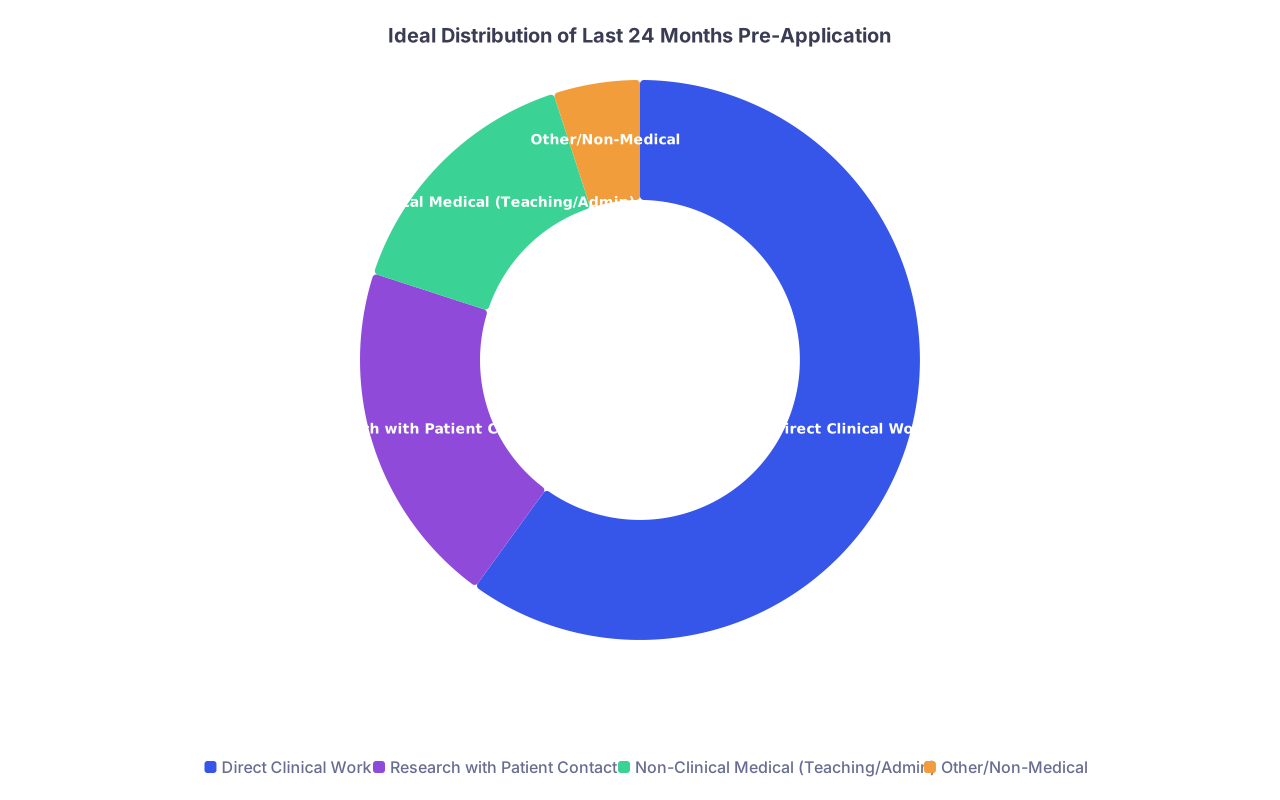
| Category | Value |
|---|---|
| Direct Clinical Work | 60 |
| Research with Patient Contact | 20 |
| Non-Clinical Medical (Teaching/Admin) | 15 |
| Other/Non-Medical | 5 |
2. Personal Statement: One paragraph, not a confession
You do not need a long tragic backstory. PDs are busy.
Use one focused paragraph to:
- Briefly mention the circumstance (no melodrama).
- Emphasize how you stayed connected to medicine.
- Highlight the intensive recent clinical work that corrected the gap.
- Pivot to why you are now ready “today,” not in theory.
Bad version:
“I graduated in 2017, but due to personal and financial difficulties, I was unable to practice medicine for several years. I felt lost and unsure…”
Better version:
“I graduated in 2017. For two years after graduation, I faced significant visa and financial barriers to practicing clinically in the United States. To stay connected to medicine, I completed online CME, prepared for USMLE, and volunteered intermittently in local clinics. Over the past twelve months, I have worked full time as a medical officer in a 300-bed internal medicine department, managing high-acuity patients and leading our unit’s diabetes quality improvement project. This recent experience has sharpened my clinical judgment and confirmed my commitment to internal medicine training in the United States.”
Short. Direct. Shows recovery.
Step 5: Decide If You Need a Two-Cycle Strategy
Some gaps are so large or so poorly explained that you cannot realistically fix them in one ERAS season. You might need a deliberate two-cycle repair plan.
Warning signs you probably need 2 cycles:
- Graduation >7–8 years ago
- No consistent clinical work for >3 years
- Your first meaningful clinical repair has not started yet and ERAS opens in <6 months
If this is you, forcing an application this year “just to see” is usually a bad idea. You burn programs, waste money, and put weak letters in the system.
A better two-cycle plan:
Cycle 1 (This Year): Quiet Build
- Focus 12–18 months on:
- Full-time clinical work (home or US)
- 1–2 research/QI outputs
- Language/accent refinement if needed
- Possibly apply to very limited programs that:
- Are local to your USCE site
- Have faculty who know you well
- Goal: Build relationships and letters, not necessarily match.
Cycle 2 (Next Year): Aggressive, Targeted Application
- By now you should be able to say:
- “For the past 18 months I have been working full time in [X role], seeing [Y] patients per day, under [Z attending].”
- That is what PDs want to hear from an older grad.
Step 6: Parallel Tracks – Do Not Just “Wait for Match”
Repairing sparse experience is not only about hours in clinic. You need to run parallel tracks.
A. Exam and knowledge integrity
If Step 2 score is borderline or old, you cannot afford to look rusty.
- Do:
- Regular question blocks in UWorld / AMBOSS or equivalent
- Shelf-style cases in your specialty
- CME in your field (ACP, AAFP, APA, etc.)
Mention this in:
- PS: “I maintain my clinical knowledge with regular board-style questions and CME in [specialty].”
- Interviews: be ready to discuss specific guidelines or articles.
B. Communication and professionalism
PDs worry that IMGs with long gaps are either:
- Out of practice clinically, or
- Not adaptable to US systems, OR
- Weak communicators
So actively fix:
- Accent and clarity:
- Record yourself presenting patients, polish until clear and concise.
- Professional norms:
- Watch grand rounds, resident case presentations from US programs on YouTube.
- Learn how US teams structure sign-out, progress notes, and presentations.
C. Networking with intent
Do not spam PDs with boilerplate emails.
Instead:
- Focus on attendings and fellows where you actually rotate or work.
- After proving yourself clinically, ask:
- “Are there programs you think I might be a reasonable applicant for, given my background?”
- Attend local/state specialty conferences:
- Present a poster from your clinic/QI work.
- Meet faculty in real life; this carries more weight than cold emails.
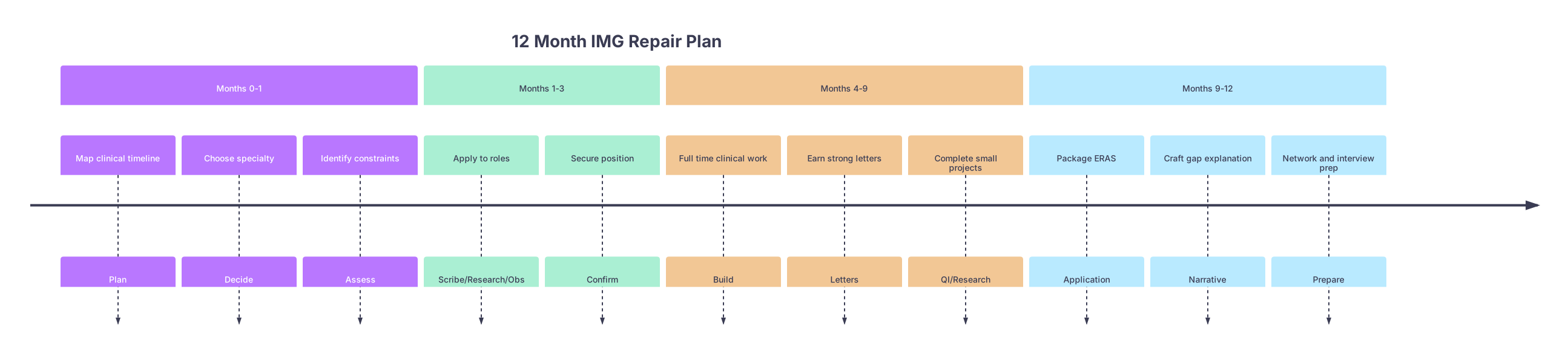
| Period | Event |
|---|---|
| Months 0-1 - Map clinical timeline | Plan |
| Months 0-1 - Choose specialty | Decide |
| Months 0-1 - Identify constraints | Assess |
| Months 1-3 - Apply to roles | Scribe/Research/Obs |
| Months 1-3 - Secure position | Confirm |
| Months 4-9 - Full time clinical work | Build |
| Months 4-9 - Earn strong letters | Letters |
| Months 4-9 - Complete small projects | QI/Research |
| Months 9-12 - Package ERAS | Application |
| Months 9-12 - Craft gap explanation | Narrative |
| Months 9-12 - Network and interview prep | Prepare |
Step 7: Know When the Story Is “Good Enough”
Perfect is not the goal. Defensible is.
Your gap is “repaired enough” when you can state, with a straight face and no apology:
- “I have been working full time in clinical medicine for the past year.”
- “Here is exactly what I do, how many patients I see, and who supervises me.”
- “Here is how that work translates into readiness for internship in your program today.”
If you cannot say those three sentences convincingly, your repair is not done.
Final Tight Summary
- A “sparse” post-graduation record is not abstract. Map it, measure your gaps, and categorize your severity level honestly.
- The only credible repair is sustained, recent, verifiable clinical work—preferably in the US, but continuous home-country practice plus strong letters and clear documentation can still work.
- Your end product must be a coherent story: 9–18 months of continuous clinical activity, 2–3 strong letters, and a short, direct explanation that turns a messy timeline into a trajectory of recovery and readiness.