
Long graduation gaps do not kill your match chances. Sloppy documentation and a weak story do.
You are not losing interviews because you graduated in 2015. You are losing them because programs cannot quickly understand what you did since 2015, cannot verify it, and cannot see how it makes you a safer, more committed resident than the fresh grad next to you.
I am going to fix that.
This is a playbook for IMGs with:
- 3+ years since graduation (especially 5–15 years)
- Multiple failed attempts, visa needs, career changes, or family interruptions
- Fragmented experience across countries, jobs, or specialties
You will get:
- A documentation strategy that withstands program director skepticism
- A story strategy that turns your “red flag” into a reason to trust you
- Concrete language to use in ERAS, personal statements, and interviews
If you follow this, your profile may still be less “shiny” than a fresh US grad, but it will be coherent and low risk. That is what wins interviews.
1. Understand How Programs Actually See Long Gaps
Let me be blunt: most programs are not philosophically opposed to non‑traditional IMGs. They are practically opposed to risk.
Here is how a program director reads “Graduated 2014. Applying 2026.”
In their mind, three questions fire instantly:
- Can this person function clinically on July 1?
- Are their knowledge and skills current enough not to harm patients?
- Are they committed or desperate?
- Are they applying because they want this field in this system, or because every other option failed?
- Will they finish residency without drama?
- No sudden returns home, licensing trouble, professionalism issues, or chronic test failure.
Long gaps can be fine if you answer those three questions clearly, consistently, and with evidence. If you do not, they assume the worst. And they move on.
So your entire application strategy boils down to:
Reduce perceived risk with ruthless clarity and documentation.
2. Before You Write Anything: Build the Master Timeline
You cannot fix your story until your own understanding is clean.
Step 1: Draft a brutally honest personal timeline
Open a blank document and list every single period since graduation:
- Month/Year – Month/Year
- Country
- Primary activity (clinical, non‑clinical, exam prep, family, visa, illness, other)
- Institution / employer / context
- Approximate hours per week
Example (this is what yours should look like, privately):
- 06/2015 – 05/2016 | Pakistan | Rotating Internship | Government Teaching Hospital | 60–70 hrs/week
- 06/2016 – 12/2016 | Pakistan | USMLE Step 1 prep | Home + Kaplan Center | 40 hrs/week
- 01/2017 | Pakistan | Step 1 failed 198 | test center
- 02/2017 – 09/2018 | Saudi Arabia | General practitioner | Private Clinic | 45–50 hrs/week
- 10/2018 – 03/2019 | Pakistan | Family care (father illness), informal clinic locum | Mixed, ~20 hrs/week
- 04/2019 | Pakistan | Step 1 passed 223
- 05/2019 – 12/2020 | UAE | GP + ER shifts | City Hospital | 50 hrs/week
- 01/2021 – 12/2022 | Canada | Non‑clinical research assistant | University X | 40 hrs/week
- 01/2023 – Present | US | Observerships + Step 2 + CS equivalent | 30 hrs/week
No sugarcoating. This is not what you will show programs word-for-word. This is your internal source of truth.
Step 2: Identify the “problem zones”
Mark in red every stretch that looks bad to a PD:
6–9 months with no clearly documented work or training
- Repeated exam failures with nothing else happening
- Non‑medical jobs with no obvious progression back to medicine
- Frequent jumps between countries and short stints
Those are your “must‑explain” segments. Not in a defensive way. In a factual, structured way.
Step 3: Convert into an ERAS‑compatible timeline
Now simplify each continuous activity into something that can be entered as an Experience entry:
- Clinical roles (paid or unpaid)
- Research
- Teaching
- Leadership / administration
- Major family responsibility, health event, or immigration barrier that truly limited activity
- Dedicated exam prep only if:
- It was at least half‑time (20+ hrs/week), and
- It led to a clear outcome (exam attempt), and
- You can layer in something else (volunteer, part‑time clinic) for future cycles
3. Documentation Strategy: Turn Every Year into Verifiable Experience
Your new rule: If it is not verifiable, it might as well not exist.
A. Build anchor experiences for each year
Every calendar year since graduation should have at least one of:
- A clinical experience with a supervisor who can confirm:
- Dates
- Approximate hours per week
- Your role and reliability
- A research experience with:
- PI or mentor who can write a LOR
- A formal job with HR contact
- A structured academic activity (post‑grad diploma, MPH, MSc)
- If genuinely necessary: a “life event” with a clear frame (more on this later)
If you have bare years (nothing at all), your job for the next cycle is clear: create at least one anchor experience for the current and upcoming year.
B. Evidence checklist for each major activity
For each experience you intend to list, collect or arrange:
Official letter or certificate
- On letterhead, with dates and supervising physician’s name and contact
- Even for unpaid observerships or volunteer roles
Contactable reference
- Someone who would actually reply if a PD or coordinator emails them
Concrete outputs (if applicable)
- Case logs (de-identified)
- Quality improvement projects
- Presentations or posters
- Research abstract or publication
Consistency across documents
- Dates, titles, and institutions must match across:
- CV
- ERAS entries
- LORs
- Personal statement
- Any visa or credentialing paperwork
- Dates, titles, and institutions must match across:
If two documents give two different start dates for the same job, you have just inflated your risk profile. PDs remember inconsistencies more than your Step score.
C. How to package “messy” roles
Not everyone has clean titles like “Resident” or “Research Fellow.” That is fine. But vague or inflated titles kill trust.
Use honest, clear, modest language:
- Instead of “Resident” when you were a GP in a hospital:
- “General Practitioner – Emergency Department”
- Instead of “Research Scientist” when you were unpaid:
- “Research Volunteer” or “Research Assistant (volunteer)”
- Instead of “Assistant Professor” when it was informal teaching:
- “Clinical Tutor” or “Lecturer (sessional)”
You gain more respect by being precise than by overselling.
4. Story Strategy: Reframe the Gap as Intentional Growth
Once the documentation is clean, you need a narrative that ties it together. PDs are scanning for one thing:
Does this path make sense, or does it look like chaos?
Your job is to turn chaos into a sequence:
Exposure → Disruption → Deliberate Decisions → Convergence on this specialty and this system.
A. The 4‑part narrative structure for long gaps
Use this structure in your personal statement and interviews:
- Origin hook – when you finished medical school and what you initially pursued
- The detour – what pulled you away from US residency or delayed it
- The turning point – what specifically brought you back on this path
- The current alignment – how your present self is a stronger candidate because of that journey
Example outline for someone 10 years out:
- Graduated 2014, started as a GP in rural clinic (origin)
- Spent 5 years in Gulf region working in emergency and primary care to support family, no clear US path yet (detour)
- Cared for a stroke patient without rehab access → realized interest in PM&R, began USMLE and structured rehab observerships (turning point)
- Now with US‑based PM&R exposure, updated exams, and rehab research, applying specifically to programs with strong outpatient neuro rehab (current alignment)
No drama. No excuses. Just cause → effect.
B. How much personal detail to include
- Health issues: brief, factual, framed in past tense and fully resolved
- Family obligations: valid, but must transition into action
- Immigration issues: mention only if they clearly explain geography or timing
Bad version:
“I suffered personal and family problems that made it difficult for me to continue my career, but now I am ready.”
Better version:
“From 2018 to 2020 I returned to my home country to care for my mother during chemotherapy. During that period I took only locum clinic shifts. Once she completed treatment and became stable, I resumed my USMLE exams and arranged US clinical observerships. That experience sharpened my interest in outpatient internal medicine, especially continuity of care for complex patients.”
You are not writing a confession. You are writing a professional trajectory with context.
5. Where to Put What: ERAS, Personal Statement, and Interviews
You must keep the story consistent but not repetitive across platforms.
A. ERAS: Pure structure and accountability
Use ERAS to:
- Cover every year since graduation with some legitimate activity
- Label gaps honestly when nothing else fits
For “unavoidable life event” gaps (illness, relocation, war, etc.), you can create an Experience entry like:
- Position Title: Family Caregiver and Exam Preparation
- Organization Name: Personal / Home
- Location: City, Country
- Dates: 07/2019 – 03/2020
- Average Hours/Week: 20–30
- Description:
“Returned to home country to provide daily support for parent undergoing cancer treatment. Coordinated appointments, medication schedules, and home care. Maintained part‑time USMLE study schedule and completed [X] coursework.”
Do not abuse this. Use it when there truly is no formal role. And be specific, not melodramatic.
B. Personal statement: Integrate, do not list
Your personal statement is not a second CV. It is where you:
- Explain the logic of your decisions
- Show growth from your detours
- Connect your past work to how you will function as a resident
Keep it anchored in today. You are not asking for sympathy about what happened. You are demonstrating readiness built through it.
A simple structure that works:
- Patient / experience vignette that reflects your current specialty interest
- Brief context of your graduation and early path
- The big gap or detour explained in 1–2 paragraphs with clear actions you took
- Concrete present: what your last 2–3 years look like (USCE, exams, research, teaching)
- What you want from residency and what you offer as a more mature candidate
Avoid making your statement a chronological diary. Program directors do not care what you did in 2016 as much as what you have done from 2022–2026.
C. Interviews: Own the gap before they weaponize it
You will be asked: “You graduated in 2015. Can you tell me about your path since then?”
Here is the formula:
One‑sentence overview
“I graduated in 2015, worked initially as a general practitioner in [X], spent several years in [Y] gaining [Z] experience, and in the last three years I have focused fully on preparing for and transitioning to internal medicine in the US.”Two or three key phases, each with a purpose
- “First, I worked in a rural clinic where I managed undifferentiated complaints and learned independence.”
- “Then, I moved to [country] for emergency work, which exposed me to high‑acuity medicine and solidified my interest in hospital‑based care.”
- “Once I decided to pursue US training, I updated my exams, completed observerships at [institutions], and joined research in [topic].”
Close with why you are better now
“So while my path has been longer, I bring a decade of real‑world clinical decision making, comfort with diverse populations, and a very deliberate choice to commit to internal medicine in the US.”
Say it cleanly once. Then stop. Do not over‑apologize.
6. Specialty‑Specific Realities for Long Gaps
Some specialties are more forgiving than others for older grads. You ignore this at your peril.
| Specialty | Typical Gap Tolerance* | Relative Openness to Older IMGs |
|---|---|---|
| Internal Medicine | 5–10+ years | Higher |
| Family Medicine | 5–10+ years | Higher |
| Psychiatry | 5–10+ years | Moderate–High |
| Pediatrics | ~5–8 years | Moderate |
| Neurology | ~5–8 years | Moderate |
| General Surgery | ≤3–5 years | Low |
*These are not rules; they are patterns I have seen in real match lists and PD comments.
If you are 12 years out, aiming for categorical general surgery with no US clinical experience and only average scores, that is not “ambitious.” It is delusional. Strategy means aligning with reality.
For long‑gap IMGs, the most realistic core specialties:
- Internal Medicine
- Family Medicine
- Psychiatry
- Pediatrics (depending on region)
- Neurology, PM&R in some programs
You can still try prelim or transitional spots in competitive fields, but your main list must include programs that historically take older IMGs.
7. Tighten the Present: What You Must Be Doing Now
Programs forgive old gaps if your current trajectory is undeniably serious.
Here is what your last 12–24 months should ideally show:
A. Fresh, solid exam performance
- Step 2 CK (or equivalent) taken recently with a respectable score for your field and profile
- No long unexplained delay between exams
- If you had earlier failures, a clear upward trend
If you are re‑applying and your most recent exam is from 4 years ago, do something:
- Step 3
- Specialty‑relevant certification (ACLS, PALS, BLS are basic; add something meaningful if possible)
B. Recent, structured clinical experience in the US (or target country)
Minimum target:
- 2–3 rotations (8–12 weeks total) of documented US clinical exposure in your chosen specialty
- Include at least one setting similar to typical residency work (inpatient or continuity clinic)
Avoid stacking 6 observerships in 6 months with no depth. Better:
- 1–2 longer rotations where you built trust and can get strong letters
- Ideally at community or university‑affiliated hospitals that actually take IMGs
C. Evidence of active learning and contribution
You do not need a PhD, but you need some “recent academic oxygen”:
- Small QI project during observership
- Case report with attending
- Poster at a local or regional conference
- Audit or protocol development in your prior practice
These show that your brain is alive in 2025, not stuck in 2013.
8. Risk Control: Common Mistakes That Sink Long‑Gap IMGs
Let me be harsh for a moment, because I have seen these ruin otherwise salvageable applications.
Mistake 1: Hiding or compressing dates
Do not play games with dates to shrink your graduation year or mask an exam failure. Credentialing and background checks are brutal. You will be caught.
Instead: be precisely honest and then show what you did with the time.
Mistake 2: Overloading the personal statement with excuses
If half your personal statement is about tragedy, illness, or unfairness, you have already lost the PD. They see 10–20 of these a year.
Your adversity belongs in:
- 1–2 clean paragraphs
- Framed around what you did, not what happened to you
Mistake 3: Applying too narrow or too high
Older IMGs often pair long gaps with:
- A hyper‑competitive specialty
- Almost no community programs on their list
- Geographic snobbery (“only big coastal cities”)
Then they are shocked by zero interviews.
Fix it:
- Apply broadly: academic + community + IMG‑friendly programs
- Use data (NRMP Charting Outcomes, program websites, past match lists)
- Have at least 30–50 programs in realistically receptive specialties if you have big gaps
Mistake 4: Generic LORs from 8 years ago
Letters older than 3–4 years scream “no recent supervision.”
Replace them with:
- Recent US supervisors
- Recent research mentors
- If you must use an older strong letter, pair it with newer ones so the most recent voice is current.
9. A Practical Build‑Out Plan (12–18 Month Strategy)
If you are 5–15 years out and not matching, here is what the repair path looks like.
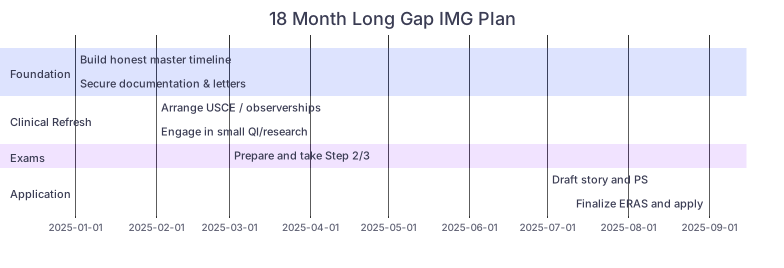
| Task | Details |
|---|---|
| Foundation: Build honest master timeline | a1, 2025-01, 1m |
| Foundation: Secure documentation & letters | a2, after a1, 3m |
| Clinical Refresh: Arrange USCE / observerships | b1, 2025-02, 6m |
| Clinical Refresh: Engage in small QI/research | b2, after b1, 6m |
| Exams: Prepare and take Step 2/3 | c1, 2025-03, 6m |
| Application: Draft story and PS | d1, 2025-07, 2m |
| Application: Finalize ERAS and apply | d2, 2025-09, 1m |
Month 1–3:
- Build your honest timeline
- Identify gaps and problem zones
- Start contacting old supervisors for documentation and potential letters
Month 2–8:
- Secure 2–3 blocks of USCE (or target-country CE)
- During each rotation:
- Show up early
- Ask for small projects
- Ask directly for feedback and, later, for a letter
Month 3–9:
- Prepare for and take whichever exam strengthens your recency profile (often Step 2 CK or Step 3)
- Avoid long unproductive stretches between studying and testing
Month 7–10:
- Draft personal statement around the 4‑part narrative
- Cross‑check all dates across docs
- Have your story stress‑tested by someone who will not sugarcoat it
10. Visual Snapshot: What Programs Want to See in Your Recent Years
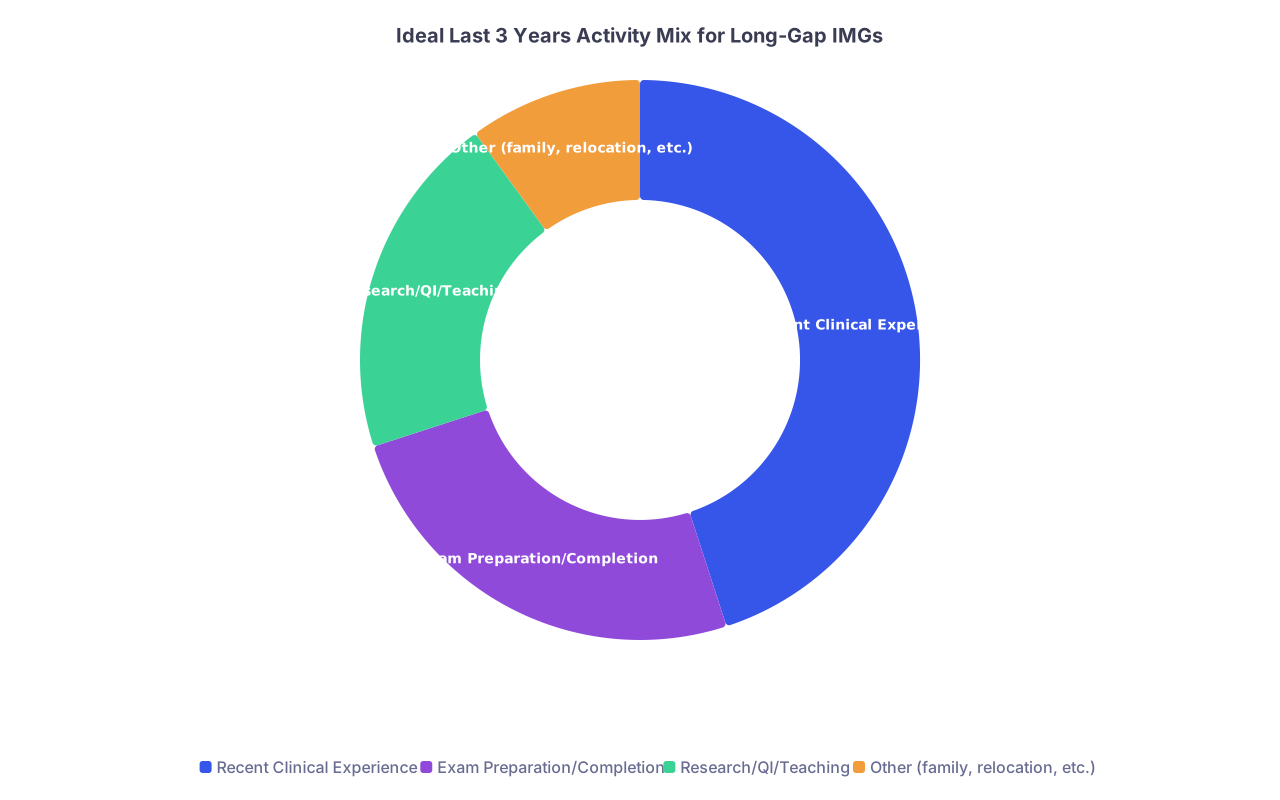
| Category | Value |
|---|---|
| Recent Clinical Experience | 45 |
| Exam Preparation/Completion | 25 |
| Research/QI/Teaching | 20 |
| Other (family, relocation, etc.) | 10 |
That distribution is what “low risk” looks like: most of your recent time in at least semi‑clinical work, with documented exams and some academic engagement. Life happens, but it should not dominate the last three years.
FAQ (4 Questions)
1. How long is “too long” a gap for IMGs to still match?
There is no hard cutoff, but once you cross 5 years since graduation, many programs become cautious; beyond 10 years, the pool narrows further. I have seen IMGs 12–15 years out match internal medicine and family medicine, but only when their recent 2–3 years were strong: fresh exams, solid USCE, coherent narrative, and realistic program list. The older you are, the more your current performance must scream “ready and reliable.”
2. Should I list pure exam‑prep years on ERAS as experience?
Only if you can legitimately describe them as at least half‑time structured study with a concrete result (exam attempt or completion) and they are not the only activity over multiple years. You can create a brief “USMLE Preparation” entry for a defined window, but it is smarter to pair study with part‑time clinical or research work. A 2‑year block of “just studying” with no exams taken looks very bad.
3. How do I explain repeated USMLE failures over a long gap?
Do not pretend they did not happen, and do not blame external factors for every attempt. A credible explanation looks like: identifying what went wrong (poor strategy, underestimating content), describing specific changes (formal prep course, question‑bank discipline, protected study time), and then showing a materially improved score on a later attempt or different exam. Pair that with recent strong performance in clinical or academic work to prove the change is real, not theoretical.
4. If I took non‑medical jobs (Uber, retail, etc.), should I include them?
You can include them briefly if they filled time and helped survival, but do not make them the centerpiece. One concise ERAS entry covering that period is enough, focusing on transferable skills (communication, reliability, time management). More important is to overlay or follow those jobs with clearly medical, supervised roles that reconnect you to patient care. The message must be: “I did what I had to do, but I deliberately rebuilt my clinical profile and I am fully back in medicine now.”
Key points:
- Long graduation gaps are survivable if you convert every year into verifiable, coherent experience and pair it with fresh exams and recent clinical exposure.
- Your story must be clean: origin, detour, turning point, and current alignment with your chosen specialty and training system.
- Programs do not need perfection; they need proof you are low risk on July 1—documented, consistent, and obviously ready to work.