
The residency system does not care that you do not have a home program. It just cares whether someone credible is willing to stick their neck out and sponsor you. Your job is to manufacture that sponsorship from scratch.
Most IMGs without a home program approach this backwards. They scatter applications and hope someone “takes a chance” on them. That almost never works. Programs do not “take chances” on unknown IMGs. They invest in people who already feel like part of their network.
You cannot magically create a home program. You can absolutely build sponsorship that functions like one.
Here is the step-by-step blueprint.
Step 1: Accept the Reality – Then Plan Around It
You are at a structural disadvantage. Pretending you are not will just cost you a Match cycle.
Here is what “no home program” really means in the US system:
- No built-in US faculty who know you well
- No default US letters from your own institution
- No chair/PD phone calls on your behalf
- No guaranteed clinical exposure in your target specialty
- No automatic “we know this school / we trust their graduates” bias
Programs substitute all of this with one thing: trusted sponsorship.
“Sponsorship” here is not visa sponsorship. I mean:
A US-based physician or group of physicians willing to:
- Supervise you clinically
- Write strong, specific letters
- Email / call PDs about you
- Say, “I would absolutely take this person in my own program”
That is what you are missing. That is what we are going to build.
Before we go into tactics, be honest about your starting point:
| Factor | Strong Position | Weak Position |
|---|---|---|
| USMLE | ≥ 235 / Pass on first attempt | Borderline / multiple attempts |
| US Clinical Exp | 8–12 weeks supervised, recent | None or only observerships |
| Research | US-based, with MD co-authors | None or only home-country case reports |
| Networking | US mentors who know you well | Only email contacts / CV-only relationships |
If you are mostly in the “weak” column, you are not applying in 4 months. You are building a 12–24 month plan. That is the difference between one desperate unmatched cycle and a real shot.
Step 2: Define One Clear Target – Not Five
IMGs without a home program often say: “I will apply to IM, FM, psych, maybe peds… whatever takes me.” That is how you signal “no one has seriously mentored me.”
You need one primary target specialty. Maybe a secondary backup. Not more.
Here is how to choose, practically:
List your honest constraints
- Step scores / attempts
- Visa needs
- Graduation year
- Financial reality (can you afford 1–2 unpaid research years?)
Match those with specialty competitiveness
- Radiology / derm / ortho: forget them as an IMG with no home base
- IM, FM, psych: realistic if you build real sponsorship
- Neurology, peds, pathology: possible with the right hooks (research, mentorship)
Run a quick data sanity check
- Look up NRMP Charting Outcomes for IMGs (latest version)
- Look at:
- Match rate for IMGs in that specialty
- Median Step scores
- How many programs actually rank IMGs
Decide and commit
- 1 main specialty (for 80–90% of your effort)
- 1 backup only if there is a rational way to get letters / experience there too
You cannot build sponsorship in three different specialties at once. That is fantasy.
Step 3: Convert “Nobody Knows Me” into a Targeted Contact Map
You are not going to cold-email 500 attendings and pray. You will build a short, strategic contact map aligned with your target specialty.
3.1 Build a short list of realistic institutions
Your initial goal is not “top programs.” It is “someone who will actually let me show up and work.”
Filter by:
- Programs with a track record of IMGs
- Geographic areas where IMGs commonly rotate (NY/NJ, Florida, Texas, Chicago, etc.)
- Community and university-affiliated community hospitals (they often have fewer formal barriers)
Use:
- FREIDA (filter for programs that accept IMGs)
- Program websites: look at their resident photos and bios (how many IMGs?)
- Alumni networks from your med school – any graduates at these places?
Aim for 20–30 programs to start. Not 100.
3.2 Identify actual humans, not just institutions
For each program, find:
- 1–2 attendings in your target specialty
- 1 program director or associate PD
- Possibly 1 chief resident (more accessible, can introduce you upward)
Sources:
- Program websites faculty pages
- PubMed: search “[Hospital Name] [Specialty]” for recent papers, note first/last authors
- LinkedIn (many physicians list their institution and interests)
Now you have a list of actual names, not vague “US contacts.”
Step 4: Become Someone Worth Sponsoring (3–12 Months)
If you want an attending to sponsor you, you must make their life easier, their research more productive, or their team stronger. Before you ask for anything.
This is where most IMGs fail. They ask for LORs, observerships, or “a chance” before offering any value.
4.1 Pick your primary value channel
You will lead with one of these:
- Research support – best if you can commit 10–20 hours/week
- Clinical productivity – best via paid clinical assistant/scribe/MA roles
- Reliability and legwork – for small community attendings who need help with QI, presentations, teaching
If you have zero research background and poor English writing, do not lead with “I will write your papers.” If you live abroad and cannot come for paid work yet, do not pretend you can start a job next month.
Be honest about what you can do. Then overdeliver.
Step 5: Outreach That Does Not Sound Like Begging
You are not sending generic “Dear Sir/Madam I am IMG seeking observership” emails. Those go straight to trash.
You are writing surgical messages that show:
- You know who they are
- You understand their work
- You can solve a small, concrete problem for them
5.1 Prepare your basics first
Before you email anyone, have:
- A clean, 1–2 page CV (US-style, no photos, no high school, no personal data like marital status)
- A 1-page “portfolio” document:
- 2–3 bullet points: clinical experience
- 2–3 bullet points: research / QI / teaching
- Short paragraph: what you are looking for (mentored experience in X specialty)
- A professional email (firstname.lastname@…)
If your CV looks chaotic, get it reviewed by someone who has matched or works in the US.
5.2 The outreach template that actually works
You do not copy this word-for-word, but you follow the structure.
Subject line options (pick one):
- “Prospective IMG volunteer – support for [project/paper/topic]”
- “Help with [specific research area] – IMG with [skill]”
- “Interested in supporting your work on [very specific area]”
Body:
- Line 1: who you are in 1 sentence
My name is [Name], an international medical graduate from [school, country], currently [location / visa status if relevant], interested in [specialty].
- Line 2–3: why them, not mass email
I read your recent paper on [short title] in [journal] and your work on [topic] aligns closely with my interests. I was particularly struck by [very specific detail – one sentence].
- Line 4–6: what you can do for them, concretely
I am looking for opportunities to contribute as a remote research assistant or local volunteer. I have experience with [data collection / chart review / basic statistics in SPSS or R / manuscript editing], and I can commit [X] hours per week, including evenings and weekends.
- Line 7–8: small ask
If you have any ongoing projects that could use reliable support, I would be grateful for the chance to help. I have attached my brief CV and a one-page summary of my experience for your reference.
- Line 9: close
Thank you for your time and consideration. I would be happy to adapt to your team’s needs if there is any way I can be useful.
Short. Specific. Respectful. Not groveling.
You will send 30–50 of these carefully crafted emails over several weeks. If you get 3–5 serious replies, that is a win.
Step 6: Turn “Sure, You Can Help” into Real Sponsorship
Getting someone to say “Yes, you can help with this project” is not the finish line. It is the starting line.
Your only job now: become the most dependable person this attending has worked with in years.
6.1 Rules of engagement once someone gives you a chance
- Response time: Reply to emails within 24 hours, even if just to say “Received, I will have this by [date].”
- Deadlines: If you say you will send something Friday, send it Thursday night. Consistently.
- Questions: Ask clarifying questions early, instead of returning wrong work later.
- Documentation: Keep a running list of tasks you have done:
- “Performed chart review on 76 patients for HF readmission project”
- “Drafted methods section for QI manuscript on XYZ”
- “Created data dictionary and cleaned dataset for…”
You will need that list when it is time to ask for a letter.
6.2 Signal long-term commitment
You want to move from “random helper” to “my mentee.”
Concrete ways:
- After 4–6 weeks of reliable work, request a brief Zoom meeting:
- Discuss your background, goals, and ask for feedback
- Volunteer for annoying tasks:
- Abstract submissions
- IRB documents
- PowerPoint prep for talks
Busy attendings remember the person who fixed the slide deck at 1 AM before Grand Rounds.
Step 7: Add Clinical Exposure Strategically, Not Randomly
Research alone will not get you sponsored into residency. They need to see you with patients.
You are going to layer on clinically focused experiences that produce letters from US attendings in your target specialty.
7.1 Prioritize experiences that come with real supervision
Order of strength (from strongest to weakest):
- Hands-on externship with documentation in the EMR and responsibility for notes / orders (supervised)
- Formal sub-internship / audition elective (for those still in medical school)
- Structured observership with daily attending interaction and teaching
- Informal shadowing with minimal interaction (weak, but better than nothing)
Ask your research mentor first:
“Once we have worked together a bit longer, would there be any possibility of spending time in your clinic or on your service to gain supervised clinical experience and better understand US practice?”
If they like you, they will often find a way. If not them, they may introduce you to a colleague who can.
7.2 If you are abroad and cannot travel yet
Do not waste time collecting low-quality online observership certificates. Instead:
- Build deeper remote research relationships
- Attend the department’s online conferences / journal clubs consistently
- Turn on video, ask 1–2 thoughtful questions per month
- Become a familiar name on their Zoom screen
Then when you can travel, you are not a stranger asking for a favor. You are “the IMG who has been helping our team for 8 months.”
Step 8: Engineer Letters of Recommendation that Actually Move the Needle
Weak, generic letters kill IMGs. You cannot afford “To Whom It May Concern, this student rotated with us and was punctual…”
You will actively manage towards strong, specific letters.
8.1 Identify your letter writers early
You want:
- At least 3 US letters, ideally:
- 2 from your target specialty
- 1 from a related field or research mentor who can comment on your work ethic and reliability
From each potential writer, you should have:
- 2+ months of repeated interaction (research, clinic, or both)
- At least one situation where you went beyond what was asked
8.2 How to ask for a strong letter
Never ask: “Can you write me a letter of recommendation?”
Ask:
“Do you feel you know my work well enough to write a strong and detailed letter supporting my application in [specialty]?”
This gives them permission to say no. That is what you want. A reluctant letter is more damaging than no letter.
When they say yes, hand them:
- Updated CV
- Personal statement draft
- One-page “evidence sheet”:
- Short bullets: research tasks you completed
- Specific patient interactions they observed
- Any presentations, abstracts, or projects you did with them
You are not writing the letter for them. You are refreshing their memory with facts. This is how you get lines like:
“She independently reviewed and abstracted data from over 250 patient charts with 100% accuracy on random audit.”
Those specifics change how PDs see you.
Step 9: Turn Mentors into Sponsors
A mentor advises you. A sponsor advocates for you when you are not in the room.
You need at least one real sponsor.
Here is how you upgrade a mentor into a sponsor:
9.1 Be explicit about your goals
After several months of working together, schedule a short meeting and say something like:
“My goal is to match into [specialty] in [year]. I value your guidance tremendously. I wanted to ask frankly how competitive you think my application can become and what gaps I absolutely must fix in the next 6–12 months.”
Let them critique you. That builds trust.
9.2 Ask for targeted advocacy, not vague “support”
Concrete asks:
- “Would you feel comfortable emailing programs X, Y, Z where you have connections to let them know you are strongly supporting my application this year?”
- “If I receive interviews at [programs], would you be willing to send a short email or make a brief call on my behalf?”
Some will say yes. Some cannot. That is fine. You need one or two who fully adopt you.
Step 10: Build a Program Target List Aligned with Your Sponsorship
Now you do not apply blindly. You build your program list around where your sponsorship carries the most weight.
You will rank programs into tiers:
| Tier | Description | Example Count |
|---|---|---|
| Tier 1 | Direct connections via sponsors/mentors | 15–30 |
| Tier 2 | Proven IMG-friendly, aligned with your profile | 40–60 |
| Tier 3 | Reach / aspirational programs | 10–20 |
Tier 1: Programs where:
- Your letter writers trained or previously worked
- Your mentors know the PD or faculty personally
- Your mentor has sent previous students successfully
Tier 2: Programs that:
- Have multiple IMGs in current residents
- List your visa type as accepted
- Are in your geographic region or where you have some tie
You will:
- Apply broadly, yes. But
- Invest most of your communication and signal energy into Tier 1
Step 11: Application Materials That Reflect Your Strategy
Your ERAS application must tell a consistent story:
“I had no home program, so I built my own sponsorship by deeply engaging with X department and Y projects, while gaining Z direct US clinical experience in [specialty].”
Your personal statement should not whine about lack of opportunity. It should show initiative.
Outline:
- Brief opening clinical story (1–2 paragraphs)
- One paragraph: your path as an IMG and the structural barrier (no home program)
- Larger section: what you did about it
- Sought out Dr. X’s research group, contributed to [projects]
- Joined Y clinic / observership, saw [types of patients], learned [US system specifics]
- One paragraph: what mentors say about you (without naming them, but echoing their themes)
- Closing: why you will be a low-risk, high-yield resident for their team
Do not write poetry. Write evidence.
Step 12: Pre-Interview Communication Without Being Annoying
You now have:
- US clinical experience
- US letters
- At least one sponsor
Before and during interview season, you coordinate subtly.
12.1 Before interview invitations
Once your ERAS is submitted and letters are in, send short, tailored messages to a very small set of programs (mostly Tier 1).
Example to PD or APD:
Dear Dr. [Name],
My name is [Name], an IMG who has been working closely with Dr. [Sponsor] on [brief description – project or clinical setting] as I prepare to apply to Internal Medicine this cycle.
Your program stands out to me because of [specific reason – curriculum detail, patient population, research area], and I have submitted my application with great interest. Dr. [Sponsor] has kindly agreed to support my application and speak to my fit for residency.
Thank you for your consideration.
[Name, AAMC ID]
Then let your sponsor know exactly where you have applied and where you would most value their advocacy.
12.2 After interviews
If you get interviews at programs where your sponsor has any connection, you notify them:
- Send the dates
- Ask, “If you know anyone there and feel comfortable, I would be grateful if you could share your honest impression of my work with them.”
Do not script them. Sponsors hate that. Just keep them informed and make it easy.
Step 13: If You Are Still 1–2 Years Away – Build a Real Timeline
Many IMGs reading this are not applying this September. Good. That gives you time to do this properly.
Here is a realistic 18-month build-out:
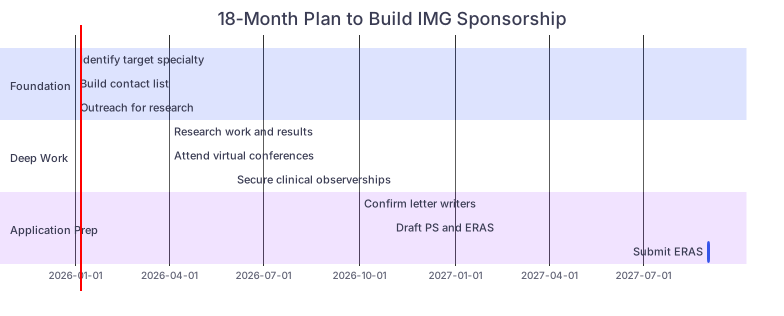
| Task | Details |
|---|---|
| Foundation: Identify target specialty | a1, 2026-01, 1m |
| Foundation: Build contact list | a2, after a1, 1m |
| Foundation: Outreach for research | a3, after a2, 2m |
| Deep Work: Research work and results | b1, 2026-04, 8m |
| Deep Work: Attend virtual conferences | b2, 2026-04, 12m |
| Deep Work: Secure clinical observerships | b3, 2026-06, 4m |
| Application Prep: Confirm letter writers | c1, 2026-10, 2m |
| Application Prep: Draft PS and ERAS | c2, 2026-11, 3m |
| Application Prep: Submit ERAS | c3, 2027-09, 1d |
You adjust dates, but you get the principle: each phase builds on the previous one. No random moves.
Step 14: Track Your Progress Like a Project, Not a Dream
You are not “hoping it works out.” You are managing a project.
Use a simple spreadsheet or Notion board with:
Contacts:
- Name, role, institution
- Date first contacted
- Last interaction
- Type of relationship (cold, warm, active mentor, sponsor)
Activities:
- Research tasks and milestones
- Clinical experiences (dates, hours, setting)
- Teaching/presentations
Outcomes:
- Abstracts submitted/accepted
- Papers submitted/accepted
- Letters secured (yes/no, from whom, date requested, date uploaded)
Aim for measurable output every month:
- 1 data task completed
- 1 meeting or email with mentor
- 1 new exposure or small win (conference, case report, presentation)
Momentum matters. Sponsors feel it.
Two Final Points
- You do not need a home program. You need 1–2 real sponsors who can say, with a straight face, “I would be thrilled to have this IMG as my resident.” That is what programs listen to.
- Sponsorship is built, not gifted. You build it by showing up consistently, solving real problems for real physicians, and giving them something very rare in their world: a trainee who makes their life easier, not harder.