
The belief that only “clinical” jobs count for IMGs is wrong—and it is costing people matches every single year.
If you are an IMG stuck in a non‑clinical role—medical assistant with no real patient care, clinical research coordinator mostly doing paperwork, scribe, call center, pharmacy tech, front desk, EHR trainer, quality analyst, whatever—you are not doomed. But you are wasting time if you treat that job as just a paycheck instead of a strategic residency tool.
Let me show you how to turn that supposedly “non‑clinical” job into match‑relevant experience that makes program directors stop and actually read your application.
1. First, Get Ruthlessly Clear On What PDs Actually Care About
Most IMGs guess wrong here. They chase the wrong things and ignore the easy wins sitting in their current job.
Residency programs do not primarily care what your job title is.
They care whether your recent work shows:
- You understand and function in the US healthcare system
- You are safe, teachable, and reliable
- You work with patients, teams, and systems, not around them
- You are actively connected to clinical medicine, not drifting away from it
- You can communicate, document, and follow protocols
Translate that into concrete elements they look for:
| Programs Actually Want | IMGs Often Chase Instead |
|---|---|
| Recent US healthcare involvement | Any “MD-sounding” job title |
| Evidence of teamwork & communication | Fancy hospital name |
| Comfort with EMR & protocols | Short-term observer ships |
| Continuity and reliability | Multiple scattered 1–2 month stints |
| Contact with attendings & residents | Unpaid 'clinical' shadowing only |
Your job—whatever the title—is raw material. You shape it into one of two things:
- A generic paycheck you try to hide on ERAS
- A targeted story that screams: “I understand your world and I already function in it”
We are going for option two.
2. Diagnose Your Current Job: Clinical Proximity Audit
Before trying to “spin” anything, audit what you are already doing. Many IMGs are sitting on highly match‑relevant tasks and do not recognize them.
Do this in writing. One page, no excuses.
Step 1: List Your Actual Daily Activities
Forget the HR job description. Write the truth. For example, a “clinical research coordinator” might list:
- Call patients to schedule study visits
- Obtain informed consent (under supervision)
- Enter data into REDCap and Epic
- Prepare charts for PI visits
- Communicate with nursing staff for lab draws
- Attend weekly PI or sub‑I meetings
- Assist with IRB submissions
- Track adverse events and report to sponsor
A “front desk associate” in a clinic might list:
- Register patients and verify insurance
- Update medication lists in EMR (per patient responses)
- Flag abnormal symptoms for nurse/physician
- Coordinate referrals and imaging
- Manage incoming calls from pharmacies
- Print after‑visit summaries and reinforce instructions
Now you have the raw material.
Step 2: Mark What Is Match‑Relevant
You are looking for things that show:
- Patient interaction
- Care coordination
- Interprofessional communication
- EMR usage
- Exposure to clinical decision‑making
- Quality / safety / process improvement
- Teaching or training others
Use three markers:
- P – Patient‑facing or patient‑related
- T – Team / communication
- S – Systems / EMR / quality / protocols
Most IMGs discover that 30–60% of what they already do is directly relevant to residency. You just never labeled it that way.
3. Convert “Random Tasks” Into Residency‑Ready Skills
Programs read skills and behaviors, not vague job duties. You must translate tasks into competencies.
Here is the mental template:
“Through [task], I developed [skill] that is directly applicable to [residency situation].”
A few examples.
Example: Call Center for a Hospital System
Raw tasks:
- Answer patient calls
- Triage appointment types
- Escalate urgent issues
- Document messages in EMR
Converted to residency language:
- Developed structured triage communication (SBAR‑style) when escalating urgent symptoms
- Gained experience distinguishing routine follow‑up concerns from red‑flag symptoms requiring immediate clinical evaluation
- Used Epic to route messages to physicians, nurses, and care teams efficiently
- Maintained professionalism during high‑volume, emotionally charged calls
This suddenly sounds a lot like day‑one intern work. Because it is.
Example: Non‑clinical “Medical Assistant” Role
Some MA positions let IMGs do almost nothing clinical. You can still extract value.
Raw tasks:
- Room patients
- Take vitals with automatic machines
- Clean rooms
- Handle forms and paperwork
Converted:
- Managed clinic flow and patient throughput for high‑volume primary care practice
- Performed standardized vital sign measurements and documented into EMR for 25–30 patients daily
- Identified and communicated abnormal vitals to supervising nurse or physician
- Coordinated completion of disability / FMLA / school forms, ensuring accuracy and compliance with clinic policies
You are showing reliability, workflow understanding, and patient‑facing responsibility. That matters.
4. Engineer Your Job To Become More Match‑Relevant (Without Getting Fired)
You cannot change your title easily. You can change what you actually do over the next 6–12 months.
The mistake IMGs make? They passively accept the narrowest possible version of their job.
Stop doing that.
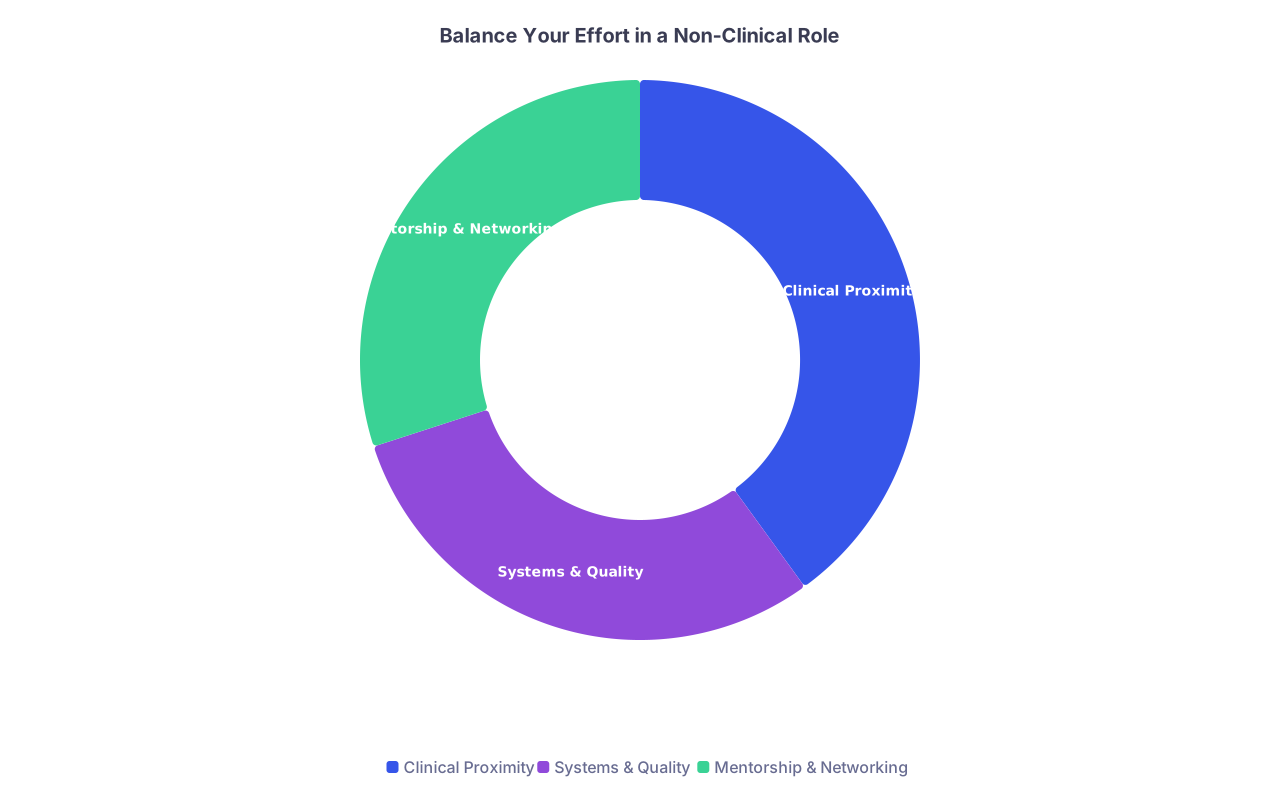
You are going to strategically expand your role in three directions: clinical proximity, systems work, and relationships.
| Category | Value |
|---|---|
| Clinical Proximity | 40 |
| Systems & Quality | 30 |
| Mentorship & Networking | 30 |
4.1. Increase Clinical Proximity
Goal: Be as close to real patient care and physician decision‑making as your role and regulations safely allow.
Concrete plays:
Ask to sit in on provider huddles or pre‑clinic meetings
- Script: “I am an IMG preparing for residency applications. Would it be possible for me to quietly observe pre‑clinic huddles so I understand how the team organizes patient care?”
Offer to prepare charts or “pre‑visit planning”
- You pull lab results, imaging, old notes, and organize them before the visit. That shows clinical thinking, even if you are not making decisions.
Volunteer to help with patient education materials
- Draft simple handouts based on physician instructions
- Translate materials if you are bilingual (with proper approval)
Shadow within your department off the clock
- Many supervisors will allow you to sit quietly in exam rooms if patients consent and legal risk is low, as long as you are not billing or touching patients. Ask.
You are not sneaking into clinical work. You are asking for educational exposure that also helps the clinic.
4.2. Take Ownership Of A Small “System” And Actually Improve It
Residency is about functioning inside complex systems. Show that now.
Look for:
- Bottlenecks: appointment no‑shows, missing labs, incomplete referrals
- Errors: frequent prescription clarifications, repeated patient confusion
- Inefficiencies: duplicated forms, repeated calls, unclear handoffs
Then:
- Track it for 2–4 weeks (simple Excel or Google Sheet)
- Quantify the problem
- Propose one small change
- Implement with your supervisor’s approval
- Re‑measure
Example: You notice 30% of new patients forget to bring prior records → delays care.
You:
- Create a standardized pre‑visit phone script
- Draft a simple email/letter template attached to appointment confirmation
- Track % of patients bringing documents before and after
Now you have a micro quality‑improvement (QI) project. PDs like that. Especially in fields like IM, FM, peds, psych.
You can write this in ERAS under “Experiences” as a QI project, not just hidden inside job duties.
4.3. Build Relationships That Lead To Strong Letters
Most non‑clinical IMGs know a bunch of attendings’ names. Very few turn them into advocates.
You want two things from your current job:
- Someone who can write a US‑style letter of recommendation
- Someone who can verbally vouch for you if a program calls
How to build that:
- Show up consistent, on time, prepared. Every day. Boring but non‑negotiable.
- Ask smart, limited‑time questions occasionally:
- “I noticed Dr X ordered this test instead of that one for chest pain. What was the thinking?”
- After 2–3 months of trust:
- “Dr Y, my long‑term goal is internal medicine residency. Would you be comfortable giving me feedback on what I should improve to be a stronger applicant?”
- Later, if feedback goes well:
- “If you feel you know my work well enough by then, I would be very grateful for a letter of recommendation when I apply.”
You are not begging. You are asking professionals, after demonstrating value.
5. Frame The Experience Properly On ERAS
Most IMGs sabotage themselves in how they describe their work, even if the work itself is decent.
Two common disasters:
- Copy‑pasting HR job description (generic, useless)
- Over‑inflating responsibilities (sounds fake, raises red flags)
You want specific, grounded, clinically adjacent bullets. Three to four bullets are enough.
Structure For Each Experience Entry
- Context: Where and what type of setting
- Core responsibilities (with numbers)
- Clinical or systems angle
- Impact or improvement
Example – Call Center Representative, Tertiary Care Hospital:
- Handled 80–100 daily calls from patients regarding medication refills, lab results, new symptoms, and appointment requests for a large internal medicine practice.
- Used Epic to document patient concerns and route structured messages to physicians, nurses, and advanced practice providers.
- Applied basic triage principles to identify red‑flag symptoms requiring same‑day evaluation and escalated to nursing staff per protocol.
- Developed and implemented a call documentation template that reduced incomplete messages by 25% over three months.
This is honest. Measurable. Clinically relevant.
Do Not Do This
- “Did triage” when you are just transferring calls.
- “Managed patients” when you only roomed them.
- “Performed procedures” when you watched someone else do them.
PDs have seen 10,000 ERAS entries. They know fluff when they see it. You want credibility.
6. Handle The “Why Were You Non‑Clinical?” Question Head‑On
You will get this in interviews. Or in their heads, even if they never say it.
“I see you have been working as a [non‑clinical job] for the past 2 years. Why?”
You need a clean, confident, two‑part answer:
- Constraint
- Growth
Example:
“When I first arrived in the US, I needed stable income and a position I could start quickly while I prepared for Step exams and understood the US system. This role as a patient services representative allowed that, but more importantly, it put me inside a busy primary care practice. Over time I took on more responsibility with pre‑visit planning, EMR documentation, and care coordination. It has given me daily exposure to how US physicians manage chronic disease and work within insurance and referral systems. Now I am ready to move back into a full clinical role with that systems perspective already in place.”
Notice:
- No apology
- Clear reason
- Direct connection to residency‑relevant skills
Practice your version out loud until it sounds like normal speech, not a memorized script.
7. Supplement Non‑Clinical Work With Targeted Clinical Touch Points
Your non‑clinical job can be the backbone of your “US experience.” You still need some clearly clinical activities in the last 1–2 years.
You do not need 12 different observer ships. You need 2–3 meaningful, well‑used ones.

| Step | Description |
|---|---|
| Step 1 | Non clinical healthcare job |
| Step 2 | Targeted observership 1 specialty aligned |
| Step 3 | Targeted observership 2 |
| Step 4 | Small QI or systems project |
| Step 5 | Strong letter 1 |
| Step 6 | Strong letter 2 |
| Step 7 | Discuss in personal statement and interviews |
Strategy:
- Aim for one observership closely related to your intended specialty
- Add another if possible in a different but relevant setting (inpatient vs outpatient)
- Keep them 4–8 weeks if you can; depth beats breadth
Then in your application:
- Explain how your job gave you daily systems exposure
- Explain how your observerships gave you bedside and team exposure
- Tie both together as a coherent trajectory, not random gigs
8. Practical Scripts And Moves You Can Use Tomorrow
You probably want concrete words. Here.
A. Asking Your Supervisor To Expand Responsibilities
“I would like to grow into more responsibility in my current role. I am very interested in understanding how our clinical team manages patient care, especially in [your target specialty or clinic type]. Are there any tasks related to pre‑visit planning, EMR documentation, or care coordination that I could start helping with, even on a trial basis?”
B. Requesting To Observe Clinical Work
“As you know, my long‑term goal is to enter residency in the US. Would it be possible for me to quietly observe some of the clinic sessions or team huddles occasionally, outside of my assigned duties, so I can better understand how physicians here approach patient care? I would of course follow all privacy rules and only attend with your approval.”
C. Starting A Small QI Project
“I have noticed that [describe simple recurring problem] seems to happen quite often and affects [patients / staff / clinic flow]. Would you be open to me tracking this over the next month and proposing a small change to see if we can reduce it? I can do the data tracking myself and share a brief summary with you.”
These are professional, modest, and realistic. Use them as is or adapt.
9. Example Transformations: From “Useless Job” To Match‑Relevant Experience
Let’s take three typical IMG situations and rebuild them.
Case 1: Hospital Registration Clerk
Before:
- Register patients
- Verify insurance
- Collect copays
- Answer phones
After 9–12 months of intentional work:
- Register 40–60 patients per shift in a large academic emergency department, verifying insurance and capturing required demographics and consent.
- Use Epic to update medication lists, allergies, and primary care information based on patient interviews, improving accuracy for ED clinicians.
- Identify patients with high‑risk complaints (chest pain, shortness of breath, suicidal ideation) and immediately alert triage nurse or charge nurse per department protocol.
- Led a small project to standardize registration scripts, reducing missing primary care provider data from 35% to 18% over two months.
Now this is clearly ED, systems, triage‑adjacent. Very relevant for IM, EM‑adjacent fields, FM.
Case 2: Clinical Research Assistant With Mostly Paperwork
Before:
- Handle study documents
- Schedule visits
- Enter data
After intentional structuring:
- Coordinated 3–4 ongoing clinical trials in cardiology, scheduling and conducting follow‑up visits for patients with heart failure and coronary disease.
- Collected and entered clinical data (vital signs, lab values, imaging results, medication changes) into REDCap and Epic under PI supervision.
- Identified and reported potential adverse drug events to PI, participating in decisions about study medication discontinuation.
- Developed a tracking spreadsheet that reduced missed follow‑up visits from 22% to 10% within six months.
Now this looks very much like real, supervised, clinically anchored work.
Case 3: Pharmacy Technician In A Community Pharmacy
Before:
- Fill prescriptions
- Answer phones
- Handle insurance rejections
After reframing and smart expansion:
- Processed 150–200 prescriptions daily in a high‑volume community pharmacy, verifying patient identities, allergies, and potential duplications.
- Communicated with prescribing physicians and their offices to clarify dosing, interactions, and prior authorizations, improving prescription accuracy.
- Counseled patients on pick‑up process, refill timing, and basic medication adherence strategies under pharmacist supervision.
- Participated in a workflow redesign for automatic refill reminders that increased on‑time refills for chronic medications by 15%.
Now you can argue you understand medication safety, chronic disease management, and interprofessional communication.
10. Put It All Together: Your Non‑Clinical Experience Strategy
Let me condense the protocol into something you can actually follow.
Over The Next 2–3 Weeks
- Do the clinical proximity audit of your current job
- Rewrite your tasks into skills and impact language
- Identify one process problem you can track and improve
Over The Next 3–6 Months
Ask to expand your role slightly toward:
- Pre‑visit planning
- EMR documentation
- Care coordination
- Participation in huddles or meetings
Start and complete one tiny QI / workflow project
Begin building two relationships with physicians / senior staff for future letters
Over The Next 6–12 Months
Secure 1–2 observerships that align with your specialty
Integrate your job + observerships into one coherent story:
- “Here is how I stayed in medicine”
- “Here is how I learned the US system”
- “Here is how I am ready to function as an intern”
Rewrite your ERAS entries and personal statement to reflect this strategy, not random survival jobs
None of this is theoretical. I have watched IMGs go from “random front desk” to categorical IM/FM/Psych matches by doing exactly this. The difference is not luck. It is deliberate design.