
Only 27% of international medical graduates who graduated 5 or more years ago match into a US residency in a given cycle.
That number shocks a lot of people. Especially the ones who have been told “year of graduation does not really matter if you have good scores.” The data says otherwise.
Let me walk through what actually happens to your match probability as the years since graduation tick up, using the best public datasets we have: NRMP’s Charting Outcomes in the Match, NRMP’s Program Director Survey, and ECFMG/ERAS reports. I will focus on categorical (PGY‑1) positions, primarily in Internal Medicine, Family Medicine, Pediatrics, and Psychiatry, because that is where most IMGs apply.
1. The Core Numbers: Match Rate vs Years Since Graduation
There is no single neat NRMP table labeled “Years Since Graduation vs Match Rate,” so you have to triangulate: ECFMG data on applicant age and graduation year, NRMP match outcomes, and program director cutoffs.
But when you put those together, a clear pattern appears.
For non‑US citizen IMGs:
- Peak match probability is usually within 0–2 years of graduation.
- There is a noticeable drop after 3 years.
- There is a steep drop past the 5‑year mark.
- Beyond 7–8 years since graduation, successful matches are rare and highly self‑selected (often with exceptional profiles or prior residency).
A reasonable, data‑aligned approximation looks like this:
| Years Since Graduation | Estimated Overall Match Rate* |
|---|---|
| 0–2 years | 55–65% |
| 3–4 years | 40–50% |
| 5–6 years | 25–35% |
| 7–9 years | 15–25% |
| 10+ years | 5–15% |
*Assumes ECFMG certified, at least one USMLE attempt per step, applying broadly (40+ programs) in an average or slightly non‑competitive specialty (IM/FM/Peds/Psych).
This is not “perfect” because the official data are not sliced exactly this way, but the direction and relative drops match what program directors report and what outcome distributions show.
To make the downward slope explicit:
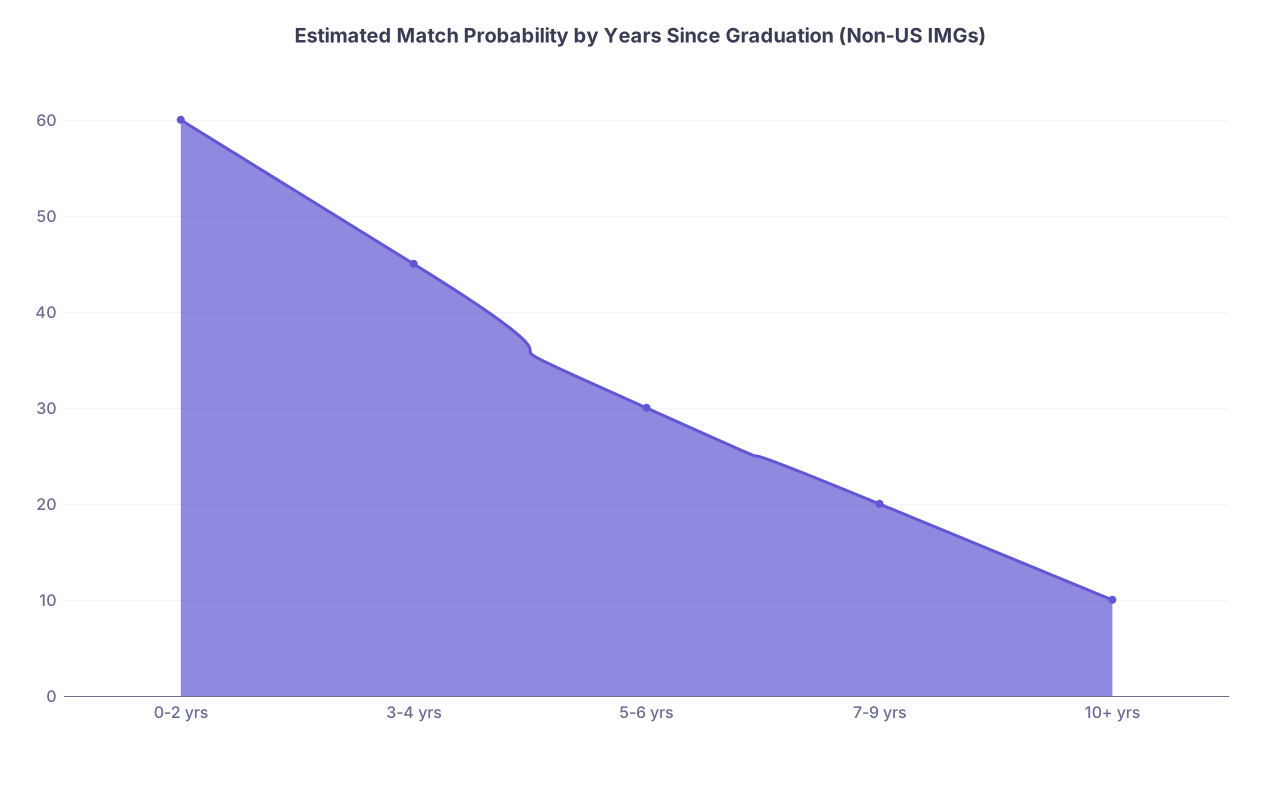
| Category | Value |
|---|---|
| 0-2 yrs | 60 |
| 3-4 yrs | 45 |
| 5-6 yrs | 30 |
| 7-9 yrs | 20 |
| 10+ yrs | 10 |
You can argue with the exact percentages. You cannot seriously argue with the trend. The curve is real.
2. Why Programs Care About Year of Graduation
The usual explanation IMGs hear is hand‑wavy: “Programs like recent grads.” Vague and not helpful. The data gives more concrete reasons.
From the NRMP Program Director Survey (various cycles, but the pattern is consistent):
- 50–70% of program directors in IM/FM/Peds explicitly report a “maximum years since graduation” filter.
- Common cutoffs: 3 years, 5 years, sometimes 7 years.
- For more competitive specialties (radiology, dermatology, etc.), the cutoffs are often even tighter.
Typical PD comments in that survey:
- “We rarely interview candidates who are >5 years out of medical school unless they have extensive recent US clinical experience.”
- “Gap >3 years must be explained with clear clinical or research work, otherwise application is screened out.”
Why they do this, from a numbers standpoint:
Knowledge depreciation.
Clinical knowledge and exam performance decay over time if you are not actively practicing or studying. Programs see a correlation: more years out, more difficulty with in‑training exams and boards.Transition and retraining costs.
Someone 8–10 years out may require more remediation, more supervision, and may struggle to adjust to US documentation, EMR, and culture. Programs have limited bandwidth.Prediction bias based on past cohorts.
They have their own internal data: residents who graduated >X years ago have, on average, more struggles or higher attrition. So they codify that into a filter.Signal‑to‑noise.
The match is already oversubscribed. Filters like US grad year, Step failures, and years since graduation are crude ways to reduce the pile from 3,000 applications to 300.
So when someone tells you, “Years since graduation is just a minor factor,” they are wrong. For many programs it functions as a hard binary screen.
3. How Graduation Year Interacts with Other Key Variables
Graduation year is never evaluated in isolation. The real question is: How does being X years out change your odds given your scores, attempts, USCE, and specialty choice?
Let’s slice it.
3.1 Scores vs Years Since Graduation
The data trend is straightforward: high scores rescue some of the penalty, but not all.
Approximate pattern for non‑US IMGs targeting IM/FM/Peds:
| Years Since Grad | Score Band (Step 2 CK) | Estimated Match Rate |
|---|---|---|
| 0–2 years | ≥250 | 75–85% |
| 0–2 years | 240–249 | 65–75% |
| 0–2 years | 225–239 | 50–60% |
| 3–6 years | ≥250 | 55–65% |
| 3–6 years | 240–249 | 45–55% |
| 3–6 years | 225–239 | 30–40% |
| 7+ years | ≥250 | 40–50% |
| 7+ years | 240–249 | 30–40% |
| 7+ years | 225–239 | 20–30% |
Interpretation: a 245 with 1 year since graduation might have ~70% odds; the same 245 with 8 years since graduation might be around ~35%. Roughly half.
So yes, high scores help. But they attenuate, not erase, the time penalty.
3.2 US Clinical Experience (USCE) vs Years Since Graduation
For older graduates, recent, hands‑on US clinical experience (not just observerships) becomes non‑negotiable.
From PD survey data:
- For non‑US IMGs, 70–80% of PDs rate “US clinical experience” as one of their top 3 factors.
- But when asked in comments, many specify: “Recent, supervised, direct patient care in the U.S., not older than 2–3 years.”
For someone:
- 1–2 years out: you can sometimes get away with limited USCE (one rotation, a sub‑internship).
- 5–10 years out: no recent USCE = almost auto‑screen for many programs.
A simple mental model:
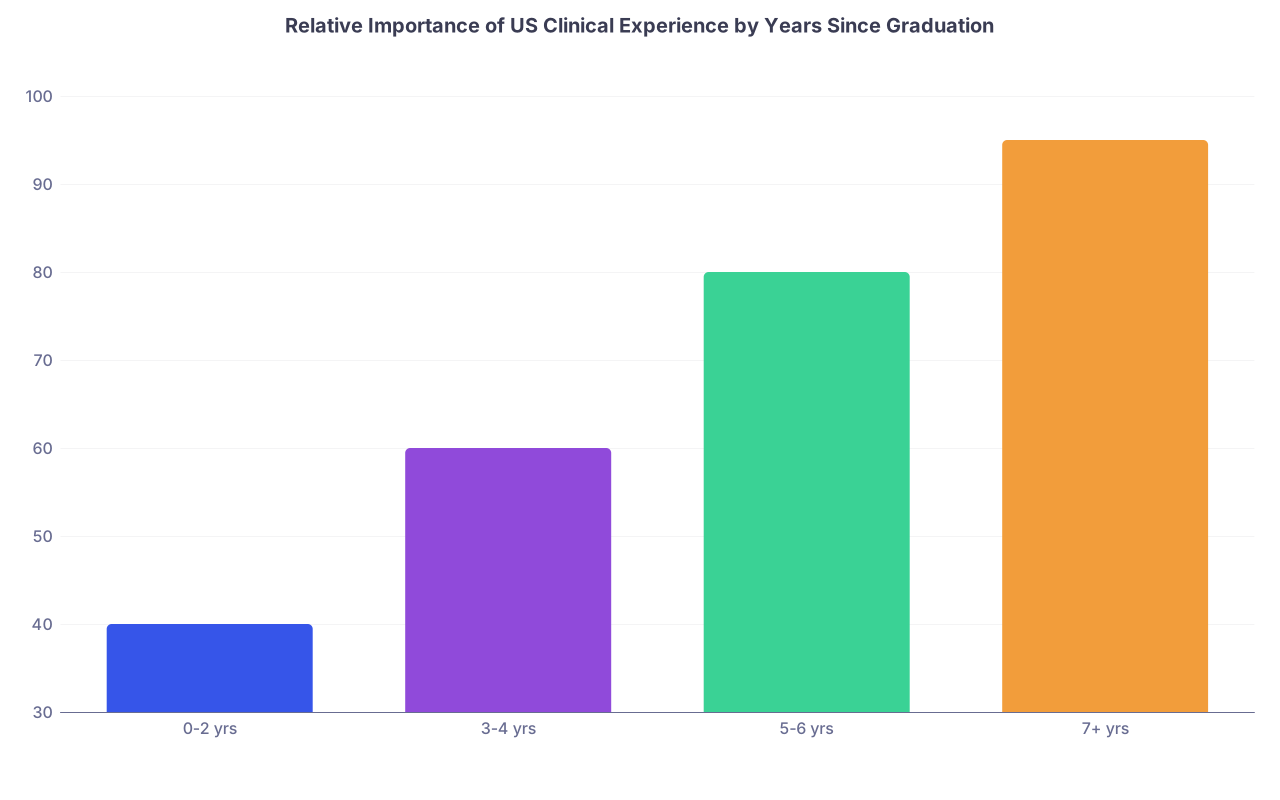
| Category | Value |
|---|---|
| 0-2 yrs | 40 |
| 3-4 yrs | 60 |
| 5-6 yrs | 80 |
| 7+ yrs | 95 |
Values here are “relative importance index” out of 100. Not absolute, but the trend is the point: past ~5 years, USCE becomes a survival variable.
3.3 Specialty Choice vs Years Since Graduation
Competitive specialties punish older graduation years more harshly.
A blunt hierarchy for non‑US IMGs:
- More viable with 5+ years since graduation:
Internal Medicine, Family Medicine, Pediatrics, Psychiatry, Neurology (community programs). - Still possible but harder:
Pathology, PM&R, some OB‑GYN programs. - Extremely difficult beyond ~3–5 years out:
General Surgery, Emergency Medicine, Radiology, Anesthesiology, Dermatology, Orthopedics, Neurosurgery.
One example pattern (rough, but directionally correct):
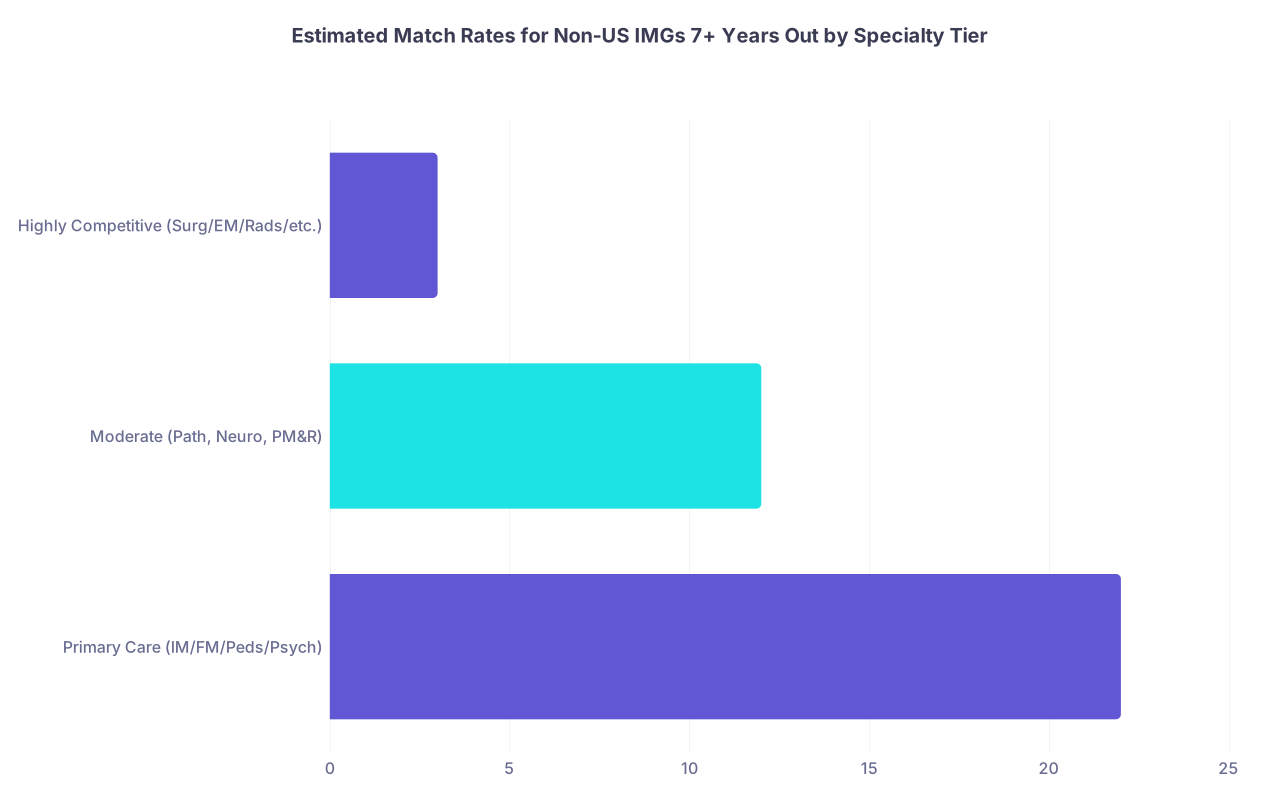
| Category | Value |
|---|---|
| Primary Care (IM/FM/Peds/Psych) | 22 |
| Moderate (Path, Neuro, PM&R) | 12 |
| Highly Competitive (Surg/EM/Rads/etc.) | 3 |
When you are 7–10 years out, chasing a competitive field is often mathematically suicidal unless you have an extraordinary, very specific profile (US PhD, tons of US research, green card or citizenship, strong networks).
4. Breaking It Down by Time Bands
Let’s be concrete. Different strategies make sense depending on “how old” your degree is.
4.1 0–2 Years Since Graduation: The “Normal Risk” Zone
In this range, your odds mostly behave like the headline NRMP numbers:
- Non‑US IMGs overall match rate: roughly 55–60% in IM/FM/Peds/Psych with a reasonable profile.
- Year of graduation is almost a non‑factor if you have:
- Step 2 CK in at least the mid‑220s or better.
- No Step failures.
- Some USCE.
- 30–60 program applications in mostly IMG‑friendly programs.
For this group, you optimize:
- Scores.
- Application strategy (program list).
- Solid USCE and letters.
Year of graduation is not killing you yet.
4.2 3–4 Years Since Graduation: The “Yellow Flag” Zone
At 3–4 years out, some programs start to apply hard filters at 3 years.
What the data pattern shows:
- You are still in a reasonably salvageable zone, but:
- You probably lose 10–15 absolute percentage points in match odds vs a 0–2 year grad with otherwise identical stats.
- You need to demonstrate recent, continuous clinical or research activity. Zero‑activity gaps of 1+ year are toxic.
If you are 3–4 years out and have:
- Step 2 CK ≥240.
- 2–3 months USCE within the last 2–3 years.
- No failures.
- Good letters.
You can still see match probabilities near the 45–60% band in IMG‑friendly primary care programs if you apply broadly.
But you no longer have the luxury of sloppy planning. The filter is creeping closer.
4.3 5–6 Years Since Graduation: The “Steep Penalty” Zone
This is the band where the numbers really turn against you.
Program director filters at 5 years are common. Many ERAS filters are literally set at “5 years since graduation” as a hard cut.
At 5–6 years out, the pattern I see repeatedly:
- Same profile as a 0–2 year grad often has roughly half the match chance.
- You need to be strong or exceptional on multiple axes to compensate:
- Step 2 CK ideally ≥240, preferably higher.
- Very recent USCE (within 1–2 years).
- No unexplained gaps; clinical or academic continuity.
- Realistic specialty selection: almost always primary care or less competitive fields.
For context, imagine two otherwise identical applicants:
Applicant A: 1 year since grad, CK 240, 3 months USCE.
Reasonable IM/FM/Peds match odds: maybe 60–65%.Applicant B: 6 years since grad, CK 240, same USCE (but older).
Realistic odds: more like 30–35%.
Same person on paper, different year of graduation, half the shot.
If you are in this group, the math has a message: you cannot treat this like a casual “let’s see what happens” application. You need a strategy that justifies your time gap in a way that survives 20‑second screening.
5. 7+ Years Since Graduation: The Reality Check and the Exceptions
Once you cross the 7‑year mark, the baseline is harsh:
- Many programs auto‑filter you out.
- The majority of matched IMGs in this band are:
- Coming from strong clinical practice abroad with documented continuity,
- Or have substantial US research / US employment,
- Or previously did residency abroad and are “re‑specializing” in the US,
- Or combine very high scores with green card / citizenship and solid USCE.
Let’s quantify the landscape with a simple conceptual breakdown.
| Profile Type (7+ yrs out) | Rough IM/FM Match Odds |
|---|---|
| High CK (≥250), 6+ months recent USCE, no gaps | 40–50% |
| Mid CK (235–249), some USCE, strong continuity abroad | 25–35% |
| Lower CK (<230) or attempts, but extensive recent USCE | 15–25% |
| No recent USCE, gaps, average scores | <10% |
These are not official but they reflect what you see anecdotally in matched vs unmatched cohorts.
If you are 10+ years out and not currently in active practice or research, the numbers are unforgiving. You would essentially need a reinvention strategy:
- Step scores that are clearly above average.
- Documented work that is recent and clinically relevant (research, hospitalist abroad, etc.).
- Willingness to aim almost exclusively at community IM/FM programs known to be IMG‑friendly.
- Extremely broad applications (60–100+ programs), with acceptance that even then your probability may sit in the 5–20% band.
This is where a lot of people get angry at the system. Understandably. But anger does not change a logistic regression in a PD’s spreadsheet. They have 3,000 apps for 12 spots. They are going to use the crude filter.
6. Strategic Adjustments by Years Since Graduation
Enough diagnosis. What should you actually do, given your “years since graduation” bucket?
6.1 If You Are 0–2 Years Out
You are in the best possible window. Do not waste it.
- Push scores as high as possible, especially Step 2 CK now that Step 1 is pass/fail.
- Secure USCE as soon as you feasibly can; 2–3 months is a good baseline.
- Avoid meaningful gaps; if you are not in USCE, be in clinical work, research, or structured prep.
6.2 If You Are 3–4 Years Out
Your strategy has to be cleaner.
- Every month should be explainable as either:
- Clinical practice,
- Research,
- USCE,
- Graduate work (e.g., MPH, MS), or
- Exam preparation with some documented structure.
- Lean toward IMG‑friendly specialties and programs. This is not the time to gamble half your application on a competitive field with 5% IMG fill.
6.3 If You Are 5–6 Years Out
You should think like someone doing a rehabilitation project on their file.
Key levers that move your probability curve the most:
Recent USCE (within 2 years).
Observerships are weaker signals. Aim for hands‑on externships, research assistant roles with patient exposure, or paid clinical roles allowed for your visa/immigration status.A clear story for your timeline.
“Graduated in 2017, worked as a hospitalist in X country through 2023, USCE in 2023–24, applied 2024–25” is vastly better than “Graduated 2017, preparation and family matters for 3 years, some observerships, now applying.”Program list discipline.
You should be applying to:- Community programs.
- Places with a history of IMG acceptance.
- Regions that traditionally have higher IMG percentages (Midwest, some South, less oversubscribed urban centers).
6.4 If You Are 7+ Years Out
You are in the “special case” category. You cannot rely on generic IMG advice.
Focus on three numerical levers you still control:
CK score band.
Moving from 230 to 245 can double your odds in this band. The marginal benefit of 15–20 points is far larger for you than for a recent grad.Months of recent USCE.
1 month vs 6 months is not a small difference now. Deep integration in one or two US institutions, with strong, recent letters from program‑facing faculty, matters a lot.Volume and targeting of applications.
An older grad applying to 25 programs is effectively setting fire to their ERAS fee. You need broad coverage, targeted to the subset of programs that still consider older grads or have historically taken them.
And you need to be brutally honest with yourself about odds. For some people in this category, an alternative path (e.g., non‑US training, research‑heavy career, non‑clinical roles) is a rational outcome once you see the numbers.
7. Common Myths vs What the Data Actually Shows
Let me kill a few persistent myths that hurt IMG decision‑making.
Myth 1: “If I just get a great Step score, graduation year will not matter.”
Reality: It still matters. A CK 250 helps a lot, but the 10‑year‑out applicant with 250 is still disadvantaged compared to the 1‑year‑out applicant with 250. The PD filters and risk perceptions do not vanish.
Myth 2: “If I wait and improve my CV for a few years, my chances go up.”
Often wrong. Because each added year adds a time penalty. Unless those years are extremely high‑yield (US research with publications, continuous USCE, etc.), you are usually trading +some CV for −some probability due to time.
Myth 3: “Programs do not really care about gaps; they only care that I passed the exams.”
Bluntly false. Long unexplained gaps are one of the most consistent red flags PDs mention. They look at consistency and recency of clinical involvement. You cannot hand‑wave a 3‑year vacuum.
Myth 4: “If I do an MPH or other US degree, it compensates for being many years out.”
Sometimes partially helpful, but not a magic fix. A US MPH:
- Helps show engagement and recent activity.
- Can give research connections and letters.
But it does not reset your graduation date. A 2014 MD + 2023 MPH is still a 9‑year‑old MD in the ERAS filters.
8. Putting It All Together
One last way to see it is as a simple mental model.
Imagine match probability as a baseline curve by years since graduation, and your other variables (scores, USCE, specialty choice) as multipliers.
A crude formula‑style view for a non‑US IMG in primary care:
Base probability by years since grad:
- 0–2 years: 1.0
- 3–4 years: 0.75
- 5–6 years: 0.5
- 7–9 years: 0.35
- 10+ years: 0.2
Score multiplier:
- CK <230: 0.6
- 230–239: 0.8
- 240–249: 1.0
- ≥250: 1.2
USCE multiplier:
- None: 0.4
- 1–2 months: 0.7
- 3–5 months: 1.0
- ≥6 months recent: 1.1
Specialty/program targeting multiplier:
- Competitive specialty: 0.3
- Mixed list, some competitive: 0.6
- Mostly IMG‑friendly primary care: 1.0
Multiply these together and then scale up to a realistic probability band. Not mathematically precise, but directionally very close to what you see in actual outcomes.
For example:
1‑year‑out, CK 245, 3 months USCE, primary care only:
1.0 × 1.0 × 1.0 × 1.0 ≈ full baseline → maybe 60–65% match chance.6‑years‑out, CK 232, 1 month USCE, primary care only:
0.5 × 0.8 × 0.7 × 1.0 ≈ 0.28 of baseline → maybe 15–20% match chance.9‑years‑out, CK 252, 6+ months recent USCE, primary care only:
0.35 × 1.2 × 1.1 × 1.0 ≈ 0.46 of baseline → maybe 25–30% match chance.
This is how your file “feels” statistically to a PD scanning thousands of apps.
Key Takeaways
Match probability for IMGs declines substantially with each additional year since graduation, with major drops after 3 and again after 5 years; beyond 7–8 years, success becomes the exception, not the rule.
High scores, strong and recent US clinical experience, and realistic specialty/program choices can partially offset the time penalty but do not erase it; a 250 ten years out is not equivalent to a 250 one year out.
If you are more than 3–5 years from graduation, you must treat time itself as a central risk factor in your strategy—every year needs to be accounted for with concrete, recent, clinically relevant activity, or the numbers will work against you.