The way program directors compare IMGs to US grads on rank list night is not “holistic.” It’s triage. And you need to understand that or you will get crushed.
Let me walk you through what actually happens behind those closed doors when your name is on the screen next to two or three US grads. Because it’s not the story you hear on webinars or from “advising offices.”
This is the back room version.
What Rank List Night Really Looks Like
You imagine some solemn academic ritual. It’s not. It’s a tired group of people staring at a spreadsheet at 9:45 pm, arguing over the last 15 spots with cold pizza on the table.
There’s usually:
- The program director (PD) – the final word.
- A couple key faculty.
- Chief residents.
- Sometimes an APD or coordinator quietly fact-checking.
The ERAS printouts and notes are already done. The interviews are over. The “preliminary list” has been generated weeks earlier using score cutoffs, filters, and subjective impressions. Rank list night is where the real comparison happens:
“Okay… who goes higher: this Caribbean grad with a 247 and rock‑solid letters, or this US MD with a 229 and an okay interview?”
This is the level where IMG vs US grad is absolutely explicit. They do not pretend everyone is equal. They don’t say it out loud in front of you. They do say it out loud in that room.
I’ve sat in rooms where someone literally said:
- “If this guy were a US grad, he’d be top 10.”
- “For an IMG, she’s actually really strong; maybe we bump her up.”
- “I like him, but we’ll get a US grad just like him without any visa headache.”
That last sentence kills more IMGs than Step scores ever will.
The Default Assumption: US Grad Wins the Tie
Let’s start with the ugly truth.
If a PD has two applicants who are roughly similar on paper and in the interview—one US grad, one IMG—the US grad almost always goes higher on the rank list. Often by a lot. Not a tiny nudge. Sometimes 20–40 positions higher on a list of 120.
Not because the IMG isn’t good. Because of risk management.
Here’s what’s going through PDs’ heads:
Predictability.
They’ve seen hundreds of US grads from US schools. They know the curriculum, grading, letter formats. They know what a “High Pass in Medicine at Iowa” actually means clinically. With most IMGs, they simply don’t know. Even if they want to be fair, they’re guessing.Remediation burden.
If someone struggles, the PD, faculty, and chiefs eat the problem. Underperforming US grads are easier to salvage, culturally and system-wise. With IMGs, there’s an added layer—documentation style, communication, systems navigation.Visa and HR chaos.
This is not about “liking” you less. It’s about:
“Do I really want to wake up to an email in June that their visa got stuck, and now we are down a resident?”
Many PDs have been burned once. That one bad experience shapes every future IMG decision.Institutional pressure.
Some chairs explicitly say it: “We should be mostly US grads.” They don’t write it in policy. They say it in meetings. I’ve heard it verbatim.
So the baseline rule of the room is: US grad wins the tie.
Your job as an IMG is to avoid being “a tie” at all.
The Real Rubric: How IMGs Are Scored Differently
PDs will never give you this rubric, but they use it. On rank night, it’s a fast mental calculus:
“Is this IMG strong enough that I’d be okay ranking them over an average US grad?”
There are four buckets that matter more for IMGs than for US grads: scores, recency, proof of US performance, and professionalism/communication.
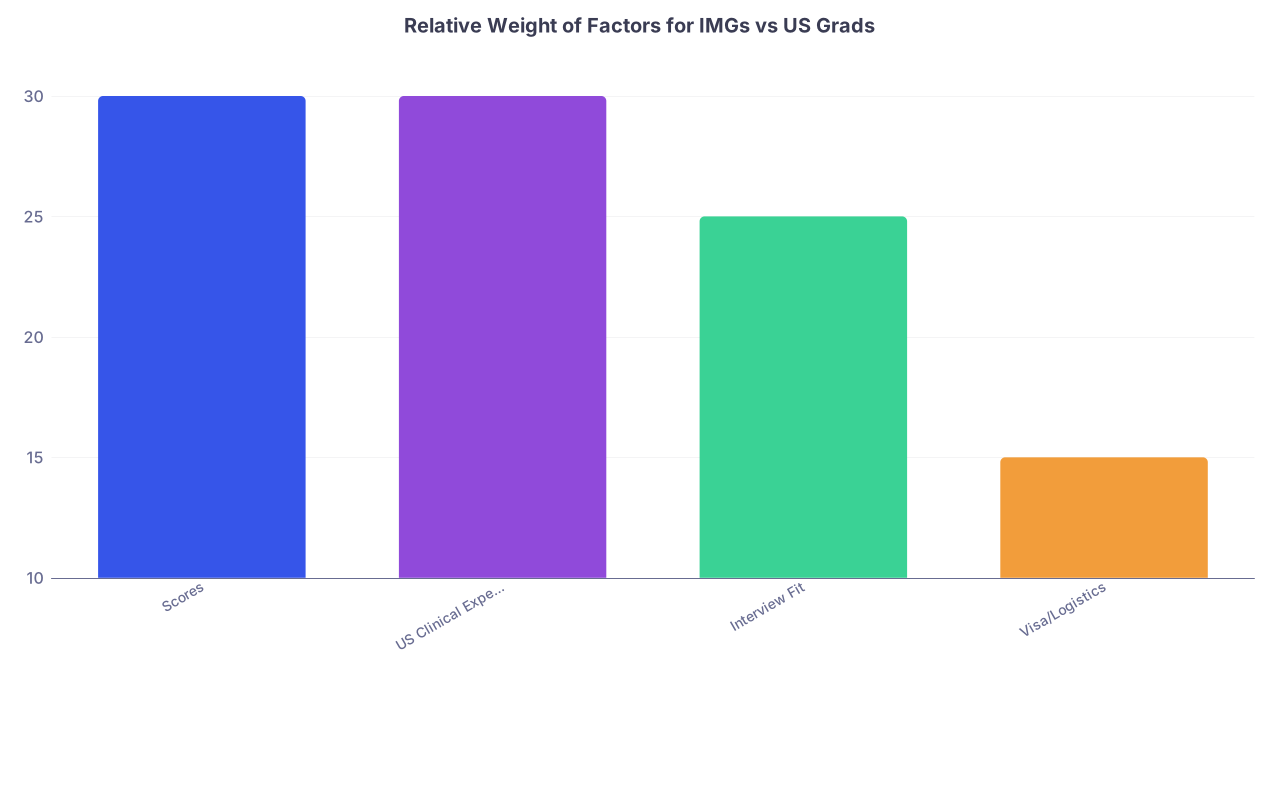
| Category | Value |
|---|---|
| Scores | 30 |
| US Clinical Experience | 30 |
| Interview Fit | 25 |
| Visa/Logistics | 15 |
1. Scores: The First Filter Is Harsher for You
For US grads, a borderline board score might still be okay if clinical grades and letters are great.
For IMGs, a borderline score can be fatal unless everything else is screaming “exceptional.”
Here’s the unspoken pattern in many internal medicine and FM programs:
- US MD with Step 2 CK 220, good interview → probably rankable, maybe middle of list.
- IMG with Step 2 CK 220, good interview → “Do we really want to take that risk when we can get a US grad at 220?”
And the exact same PD will say about an IMG with a 255 and solid US letters:
“Alright, this guy has clearly shown he can handle the material. Put him higher.”
You are not judged by the same curve. You are judged by: “Does this score de‑risk the unknowns of being an IMG?”
The cutoffs are also different in practice. For many mid-tier IM programs:
- US MD/DO: they’ll at least consider you down to low 220s if the rest of the file supports you.
- IMG: they really start relaxing only around mid‑240s and above. Below that, you need compelling compensators.
They’ll never publish that. But I’ve watched them enforce it.
2. Recency of Training: The “Old Grad” Penalty
US grads get a built‑in assumption: “fresh training, current knowledge.”
For IMGs, the first question is: “When did they graduate?”
If your year of graduation is >3–5 years ago, here’s the internal monologue:
- “Have they been practicing overseas? Are they stuck in habits that won’t translate here?”
- “Have they been out clinically? Are we signing up for a steep re‑learning curve?”
- “Why has it taken this long to get into residency? Any hidden red flags?”
Programs will say they’re “IMG friendly,” but many quietly avoid old grads unless the candidate checks off some very strong boxes (US research, strong US letters, perfect English, high scores).
3. Proof of US Clinical Performance: Not Just “USCE”
“US clinical experience” is a throwaway phrase. PDs aren’t impressed by just the words on your CV. They care about what exactly happened and who is willing to put their name on you.
What they look for with IMGs is very specific:
- Substantial time in US hospitals with direct patient-facing roles.
- Letters from US faculty who actually know how to evaluate residents, especially PDs, APDs, or core faculty.
- Clear statements in those letters that you functioned at or above the level of a US graduating student.
At rank night, it sounds like this:
- “Who wrote this letter? Oh, that’s from our former chief at Cleveland Clinic. He knows residents; I trust this.”
- Versus: “This is from a community doc I’ve never heard of who calls everyone ‘outstanding.’ Pass.”
If your USCE is 3 vague observerships and a shadowing note from “Dr. Smith, Private Clinic,” you are not competing with US grads. You are competing with other IMGs who have inpatient sub‑I level rotations and letters that say, “I would rank this applicant at the top of our own medical school class.”
How Interviews Actually Tip the Scale for IMGs
Here’s the part people misunderstand. The interview for an IMG isn’t just about “fit.” It’s often used as a stress test for communication and systems readiness.
For US grads, a slightly awkward interview can be shrugged off if the file is strong.
For IMGs, a slightly awkward interview can drop you 50 spots.
On rank night, comments get read out loud. Literally. Things like:
- “Accent a bit strong, might struggle with phone calls.”
- “Great rapport, patients will love her.”
- “Seemed unsure about US system basics.”
- “Had good clinical examples, clear reasoning.”
If you’re an IMG, they’re not just asking, “Do I like this person?” They’re asking, “Can I safely put this person on night float in 4 months talking to nurses and families?”
Let me be blunt: PDs have scars from communication disasters. The intern who couldn’t explain a plan to a nurse. The one who couldn’t handle a rapid response over the phone. Those scars land on IMGs in general, fairly or not.
So when two applicants are on the screen—US MD and IMG—and both interviewed “fine,” the PD will say: “Let’s push the US grad slightly up. Less risk.”
When an IMG interviews exceptionally—clear, organized, warm, with examples that sound like a US MS4—they’ll say: “You know what? She was one of the best interviews we had. Put her above a bunch of these mid‑tier US grads.”
That’s how you break the tie. You’re not aiming for, “That went okay.” You’re aiming for, “We’d take her over most US grads.”
Visa Status: The Factor They Pretend Does Not Matter (But It Does)
PDs and GME offices will tell you they’re “happy to sponsor visas.” Some genuinely are. Many are not.
On rank list night, this is how it plays out:
“I really like him, but he needs an H‑1B. Can we actually do that?”
Coordinator: “We’ve only done J‑1 the last few years. It’s a pain to switch.”
Translation: drop him 20–30 spots.“She’s on a J‑1, that’s fine, we’re used to that.”
Translation: neutral, if they already have infrastructure and comfort with prior J‑1s.“He’s a green card holder now?”
“Yes.”
“Okay, then just treat him like a US grad.”
That last line is key. Permanent residency or citizenship instantly removes one of the biggest biases in the room.
PDs do a mental weighting on every IMG:
- IMG + no visa issues + strong file → essentially competing in the same league as US grads (with a small penalty for unknown training system).
- IMG + visa + middling file → often pushed down below similar US grads “just in case.”
No one writes this in policy. I’ve just listened to the way the conversations change once “needs visa” is dropped into the room.
Where IMGs Actually Beat US Grads
Now the part no one tells you: IMGs do leapfrog US grads. All the time. But not by being “almost as good.” By being obviously better in at least one dimension—and solid in the rest.
Here’s what makes a PD look at your file and say, “Yeah, I’d take this IMG over a lot of US grads”:
1. Clinical horsepower that’s impossible to ignore
The PD saw you in person (or trusts someone who did) and heard things like:
- “He was functioning like an intern on day one.”
- “She ran codes better than most MS4s.”
- “He was presenting patients at 6:30 am and following every lab, every study.”
US grads often look neat on paper but don’t blow anyone away on the wards. An IMG who shows up with serious work ethic, ownership, and clinical sharpness gets remembered.
On rank night that sounds like:
- “She’s one of the strongest students I’ve seen this year—IMG or not.”
- “If she were from our med school, we’d rank her top 5.”
That phrase—“if she were from our med school”—comes up a lot. When they say it, you climb the list, fast.
2. Clear upward trajectory and resilience
PDs love a comeback story. But only if the comeback is complete and undeniable.
For a US grad, a rocky preclinical performance that improves later is nice, but not life‑changing.
For an IMG, a story like:
- Early mediocre home-country grades.
- Major personal or systemic obstacles.
- Then: Step 2 CK 250+, strong US rotations, research, polished interview.
That tells a PD: “This person fights through systems. They don’t fold.” And remember, residency is essentially controlled chaos. They want fighters, not ornaments.
3. Being “their” IMG
This is the least talked‑about advantage you can have.
If you did a rotation at that program. If you worked with their faculty. If their chief resident already said, “We should take her.” You stop being “generic IMG #37” and become “our student.”
On rank list night:
- “I know him. We’d be lucky to have him.”
beats
“Looks good on paper, but we don’t know him.”
For IMGs, a single in‑house advocate can move you 50+ positions. I’ve watched it. A transplant fellow stands up one year and says, “I worked with her for two months, she’s exceptional.” Instant jump from low-middle to high-middle on the list.
The Unfair Double Standard: Red Flags and Gaps
Here’s another place where IMGs and US grads are not treated the same: anything that smells like a red flag.
US grad with:
- One failed shelf.
- One below-average rotation.
- A six‑month LOA for mental health.
PDs discuss it, weigh the context, often still rank.
IMG with:
- One exam failure (even in home country).
- A multi‑year gap “studying for exams.”
- An unexplained shift from one country to another.
On rank night, someone will say: “We just have too many unknowns. Move them down.”
You don’t get the benefit of familiarity or institutional loyalty. The default with US grads is, “Our system vetted them.” The default with IMGs is, “We don’t fully know what happened, so we’ll assume risk.”
That doesn’t mean you’re dead with any blemish. But it means:
- Your explanation must be tight, honest, and framed by growth.
- The present performance (Step 2 CK, US letters, interview) has to decisively show you’re beyond that phase.
What You Can Actually Control as an IMG
You cannot change that you’re not a US grad. You cannot convince a PD to stop being risk averse at 10 pm in February.
But you can change how you look in that room when your file pops up next to a US grad’s.
Here’s what shifts your position on their list in a very real way:
Look obviously stronger on at least one major axis
If a US grad is at 230 with decent letters and you are an IMG at 232 with vague letters, you lose.
If you are:
- IMG with 248–255 CK
- Recent graduate
- 2–3 strong inpatient US rotations
- Letters from recognizable academic names describing you as top-tier
Now the conversation changes from, “Take the US grad, safer,” to, “Why wouldn’t we take this person? They’re clearly stronger.”
Make at least one US faculty stake their reputation on you
This is more powerful than a dozen “excellent student” letters.
You want a letter that, when it’s read at rank meeting, makes people stop:
- “I would gladly have this applicant in our residency program.”
- “They functioned at the level of a strong US MS4.”
- “I rank this applicant in the top 5–10% of students I have worked with in the last five years.”
PDs read between the lines. They know what a lukewarm US letter looks like. Your goal is to remove all doubt that you’ll do fine in their environment.
Train for the interview like it’s another board exam
Not in a robotic, over‑rehearsed way. In a “I can communicate as cleanly as any US grad” way.
You need to show:
- Crisp, structured thinking when you discuss patients and cases.
- Clear understanding of US hospital workflows (consults, handoffs, EMR, pages).
- Comfort with difficult conversations and uncertainty.
An IMG who interviews like a US grad and has better scores and stronger letters? That’s how you jump ahead.
What Really Decides Your Fate on Rank Night
Let me strip it down to what PDs are quietly asking themselves for every IMG:
- “If this person shows up on July 1, will they be safe?”
- “Will they make my life easier or harder?”
- “Are they clearly worth the extra risk compared with a similar US grad?”
If your file and your performance push all three answers toward “yes, easier, and absolutely worth it,” you don’t just “sneak in.” You get ranked over US grads.
If you look “fine” but not clearly stronger, you live and die by how far down the list a program has to go on Match Day.
The Bottom Line for IMGs
On rank list night, you are not being compared in some abstract global talent pool. You are being compared, line by line, to US grads the PD sees as lower risk.
Three things matter more than all the pretty language about “holistic review”:
- You must not be a tie. Be clearly stronger than comparable US grads on at least one major axis—scores, US rotations, letters, or interview performance—while staying solid in the others.
- You need at least one US academic advocate whose letter and word carry enough weight that, in the room, someone can honestly say, “I’d take this person over many of our own grads.”
- You must look safe and easy to integrate—no unexplained gaps, no vague USCE, no shaky communication—so that when your name is on the screen, no one asks, “Are we taking on too much risk?”
If you can engineer those three, the “IMG” label stops being a ceiling and becomes just another detail on a file that the PD is actually excited to rank high.
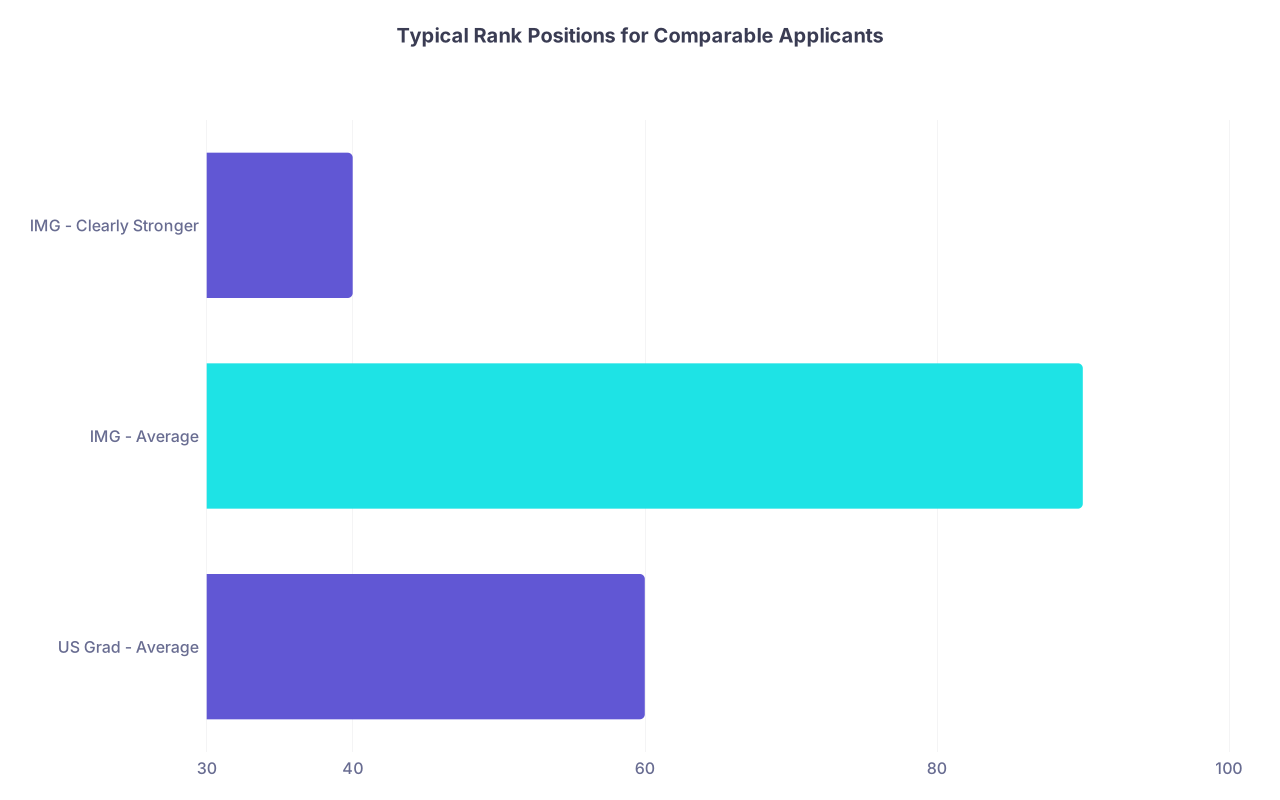
| Category | Value |
|---|---|
| US Grad - Average | 60 |
| IMG - Average | 90 |
| IMG - Clearly Stronger | 40 |