
The fastest way for an IMG to destroy hard‑earned opportunities is not with a bad Step score. It’s with one sloppy email or reckless social media footprint.
You’re already climbing uphill as an IMG. Program directors are looking for reasons to screen out, not bend over backwards to screen you in. Unprofessional communication gives them that excuse in seconds.
Let’s walk through the social media and email etiquette traps that quietly burn bridges—for interviews, for away rotations, for research, sometimes for visas—and how to avoid being that cautionary example people whisper about on selection committees.
1. The Social Media Landmines That Kill Credibility
, Inappropriate emails, Bad-mouthing programs, Boundary violations](https://cdn.residencyadvisor.com/images/articles_svg/chart-common-reasons-applicants-are-screened-out-for-pro-6806.svg "Common Reasons Applicants Are Screened Out for Professionalism")
| Category | Value |
|---|---|
| [Unprofessional posts](https://residencyadvisor.com/resources/img-applicant-challenges/the-unspoken-img-red-flags-pds-spot-in-10-seconds-on-eras) | 40 |
| Inappropriate emails | 30 |
| Bad-mouthing programs | 20 |
| Boundary violations | 10 |
Programs absolutely search you. Not always—but often enough that you cannot gamble.
Mistake #1: “Private account, I can post anything”
Big myth. Screenshots travel. Residents show each other things. Someone follows you from a research group, then a program coordinator sees it from their phone at lunch. I’ve seen faculty share an applicant’s Instagram story in a group chat with the sentence: “Hard pass.”
Things that get you blacklisted:
- Party photos with obvious intoxication or drugs
- Lewd captions, sexual jokes, thirst traps with your full name visible
- Making fun of patients, nurses, accents, or “stupid consults” (even if “anonymized”)
- Political or religious rants that are hateful, mocking, or extreme
- Memes mocking US healthcare, US doctors, or “dumb Americans”
- “IMG vs AMG” posts filled with bitterness and insults
Your account being “private” does not protect you from:
- Screenshots
- Someone in your network sharing content
- Being recognized by photos even without your name
If your username is anything close to your name, your med school, or your email—you’re traceable.
How to not make this mistake:
- Assume everything you post can land on a program director’s desk.
- Lock your accounts, yes—but also clean them. Delete stupid stuff.
- Change handles that are obviously unprofessional (@dr_shots_shots_shots is a no).
- Separate “professional” and “personal” accounts if you must—but keep the personal one low‑profile and very private, with people you actually know offline.
2. Email Addresses That Scream “Don’t Trust Me”

You’d think this is obvious. It’s not. Every cycle still has “cutedoc92@…” and “futurecardioking@…” sending residency applications.
You look unserious before they even read the subject line.
Mistake #2: Unprofessional or confusing email addresses
Examples that make you look like a teenager, not a physician:
- nicknamebaby123@…
- savagedoc@…
- medprincess@…
- dr.[Name] if you’re not licensed anywhere yet (yes, that rubs some people the wrong way)
Or email addresses that are:
- Overly long and absurd (firstnamemiddlenamefamilyname12345@…)
- Shared with a family member (yes, I’ve seen “aliandfatima@…”)
- From a domain known for spam or hacked accounts
How to not make this mistake:
Use a simple format:
- firstname.lastname@
- firstinitial.lastname@
- firstname.lastname.med@
Gmail is safe. Outlook is fine. Yahoo still works but looks dated. Anything bizarre or region‑specific that frequently gets blocked (some country domains) is risky for ERAS.
Create one clean, professional email and use it for:
- ERAS
- Research communication
- Program correspondence
- Visa‑related emails
Nothing else.
3. Subject Lines and Greetings That Get Ignored or Annoy
| Situation | Bad Subject Line | Good Subject Line |
|---|---|---|
| Post-interview thank you | Thanks | Thank you – [Your Name], [Program Name] interview |
| Application update | URGENT PLEASE READ | Application update – [Your Name], [Specialty] |
| Cold email for research | Need research help | Prospective volunteer – [Your Name], IMG |
| Scheduling question | Question | Interview scheduling question – [Your Name] |
Mistake #3: Vague or pushy subject lines
Program coordinators skim hundreds of emails. If your subject is:
- “Hello”
- “Question”
- “URGENT!!!”
- “PLEASE RESPOND”
…it looks amateur, needy, or spammy.
Avoid:
- ALL CAPS
- Exclamation marks
- Emotional words (“desperate for help”, “begging for opportunity”)
Use:
- Clear, neutral, searchable wording
- Your full name and context (“[Your Name] – IM applicant, Step 2 score update”)
Mistake #4: Over‑familiar greetings (or none)
Starting with:
- “Hey”
- “Hi dear”
- “Respected Sir/Madam” (seen constantly from South Asian applicants)
- “To whom it may concern” (lazy if the person’s name is available)
…immediately signals that you don’t understand US norms.
Better:
- “Dear Dr [Last Name],”
- “Dear Program Director [Last Name],”
- “Dear [First Name] [Last Name],” for coordinators or admin staff
If you don’t know gender or title:
“Dear [First Name] [Last Name],” is safer than guessing “Dr” or “Mr/Ms.”
4. Content Mistakes: What You Write That Makes People Hit Delete
Mistake #5: Dumping your entire life story in one email
Long, emotional paragraphs. Family struggles. Financial hardship. Rewriting your personal statement in the body of the email.
No one has time.
Common red flags:
- 800‑word emails for a simple question
- Multiple unrelated requests in one message
- Over‑sharing trauma with strangers hoping they’ll “understand” and give an interview
You need to look like someone who can write a focused progress note, not a novel.
Fix it:
- One main purpose per email.
- 3–7 short sentences max in the body for most messages.
- Bullets if multiple points are essential.
- Attachments only when requested or truly necessary.
Mistake #6: Being entitled or demanding
This one kills you quietly. No one will tell you they blacklisted you—but they do.
Examples:
- “I demand to know why I was not offered an interview.”
- “Please reconsider your decision to decline my interview invitation.”
- “I believe my application deserves special consideration due to my scores.”
- “I need a letter of support for my visa by tomorrow. Please send.”
Residency is already flooded with exhaustion and entitlement. Programs are allergic to more of it.
Better approach:
- Ask, don’t demand.
- “Would it be possible…”, “I was wondering if…”, “If feasible, I’d be grateful for…”
- Accept “no” once. Don’t push. Don’t send follow‑up essays arguing your case.
Mistake #7: Copy‑paste blasts with obvious errors
Program directors love showing each other these:
- “I am very interested in your Neurology program” sent to a Family Med program.
- Wrong program name. Wrong city. Wrong specialty.
- Leaving [PROGRAM NAME] in brackets because you forgot to change it.
I’ve personally watched PDs read those aloud in meetings with a smirk and say: “Next.”
Fix it:
- Create a base template, yes. But customize 3 key things every time:
- Program name
- Specialty
- One specific reason you’re writing to that program
- Re‑read the email slowly before sending. Out loud if you must. Catch the obvious.
5. Timing and Frequency: When Your Emails Become Spam
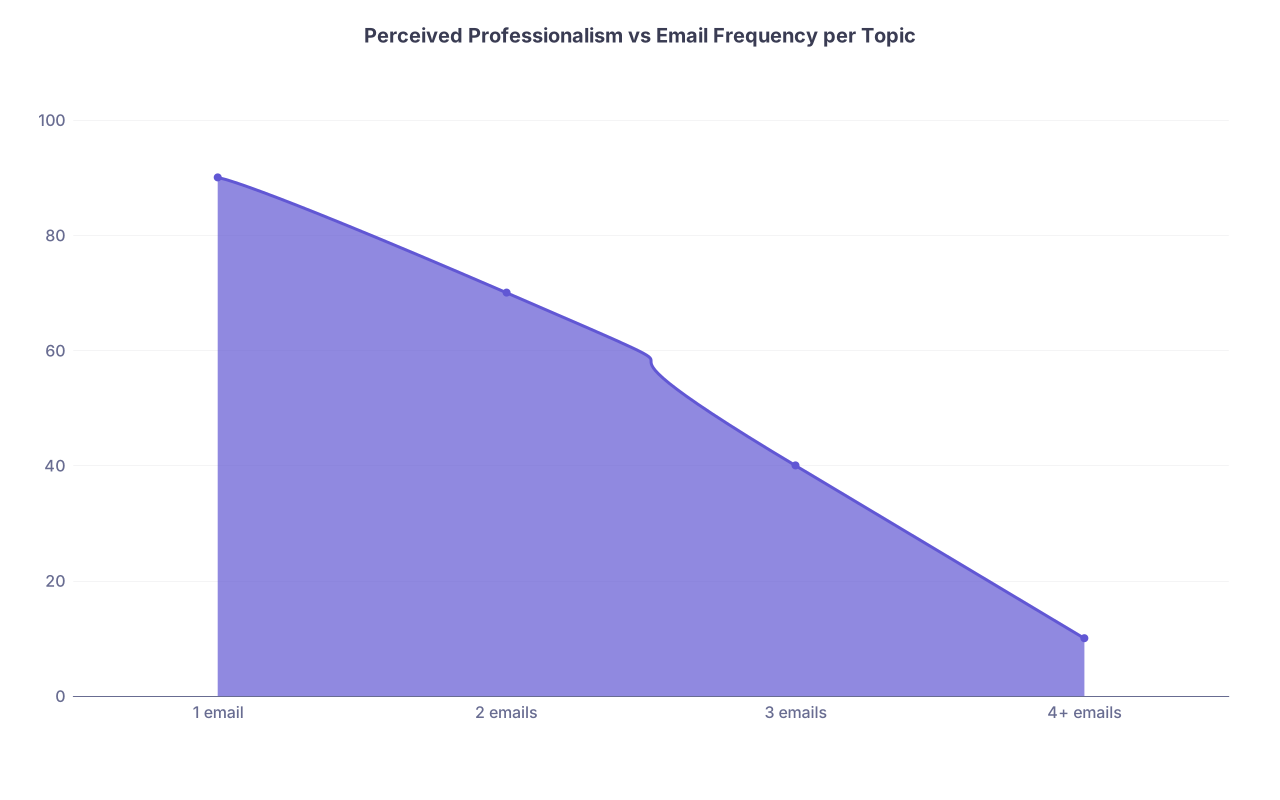
| Category | Value |
|---|---|
| 1 email | 90 |
| 2 emails | 70 |
| 3 emails | 40 |
| 4+ emails | 10 |
You’re anxious. You hit refresh on your inbox 50 times a day. That’s normal. Acting on that anxiety is what hurts you.
Mistake #8: Excessive follow‑ups
For one unanswered email:
- You send a follow‑up 24 hours later.
- Then another 48 hours later.
- Then you CC everyone including the department chair.
- Then you DM the program on Instagram.
That’s harassment, not persistence.
Reasonable timeline:
- Initial email
- One polite follow‑up after 7–10 days
- Then stop. Silence is your answer.
If it’s time‑sensitive (e.g., scheduling, impending deadline), you can follow up after 2–3 days—but again, once.
Mistake #9: Sending emotional late‑night emails
Midnight, you’re frustrated. You type out a strongly‑worded message about lack of fairness for IMGs. You rant about how they failed to respond or “respect your time”. You hit send.
Next morning, you regret it. They don’t.
Solutions:
- Never send important emails when you’re tired or angry. Write, save as draft, read next day.
- If you’re agitated, step away from the keyboard. Seriously.
6. Thank‑You, Interest, and Update Emails That Backfire

Mistake #10: Clingy or manipulative “interest” emails
Programs hate feeling emotionally blackmailed. Statements like:
- “This is my dream program and I will be devastated if I do not match here.”
- “I am begging you to give me a chance.”
- “You are my only hope due to my visa situation.”
You come across as unstable or boundary‑poor.
Better:
- “Your program is one of my top choices because…”
- “I’d be excited to train in a setting with…”
- For true #1 rank emails (where allowed): “If fortunate to be ranked by your program, I intend to rank [Program Name] first on my list.”
Short. Honest. No theatrics.
Mistake #11: Update emails with zero substance
PDs roll their eyes at:
- “Just checking in on my status.”
- “Any updates? I’m very interested.”
- “Sending this to remind you of my application.”
That’s noise.
Send an update only when you have something real:
- New Step score
- New publication or presentation
- Completed rotation in the US relevant to their specialty
- Visa status improvement
Structure:
- 1 sentence: who you are (name, AAMC ID, specialty)
- 1–2 sentences: the specific update
- 1 sentence: brief, calm expression of continued interest
Done.
7. Social Media Contact with Programs: Hidden Boundary Traps

| Step | Description |
|---|---|
| Step 1 | Applicant on social media |
| Step 2 | Low risk |
| Step 3 | Public posts |
| Step 4 | Private messages |
| Step 5 | Tagging program or faculty |
| Step 6 | Commenting frequently |
| Step 7 | DM to PD or faculty |
| Step 8 | DM to residents |
| Step 9 | High risk |
| Step 10 | Moderate risk |
| Step 11 | Moderate risk |
| Step 12 | Annoying if excessive |
| Step 13 | Program related contact? |
Programs do have social media. That doesn’t mean they want you in their DMs.
Mistake #12: Direct messaging PDs and faculty on Instagram/LinkedIn
Do not slide into a PD’s Instagram asking for:
- Interviews
- LoR
- Visa support
- “Feedback” on why you weren’t interviewed
It looks boundary‑blind.
LinkedIn is slightly more professional, but even there:
- Random connection requests with no context are weak.
- Long message essays asking for favors are off‑putting.
Residents might tolerate more—but remember, they talk. “This applicant has been blowing up my DMs” is not the sentence you want spoken in pre‑interview meetings.
Safe behaviors:
- Follow program accounts.
- Like posts occasionally.
- Comment very occasionally with something neutral and polite (“Thank you for sharing this!” / “Looks like a great educational experience.”)
That’s it.
8. Cultural Habits That Don’t Translate Well
A lot of IMGs hit landmines because they copy styles from their home countries that read very differently in the US.
Mistake #13: Overly flowery or submissive language
Phrases like:
- “I am at your mercy.”
- “I humble myself before your great institution.”
- “Kindly do the needful.”
- “Respected Sir, I will be forever indebted to you.”
These sound strange, dramatic, or even uncomfortable to US faculty.
Instead:
- Be polite but straightforward.
- “I would be grateful if you would consider…”
- “Thank you for your time and consideration.”
Mistake #14: Using WhatsApp like email
Some countries treat WhatsApp as a professional channel. In US medicine, cold‑texting someone’s WhatsApp (unless they explicitly invited it) is often seen as intrusive.
Avoid:
- Getting a number from a group chat and using it to ask for interviews.
- Messaging PDs or faculty on WhatsApp about your application unless they explicitly established that channel for that purpose.
9. Sloppy Form: Grammar, Formatting, and Signatures
You don’t need perfect English. You do need clean, understandable writing that doesn’t require extra work to decode.
Mistake #15: Zero structure
Emails that are:
- One massive chunk of text
- No paragraphs
- No greeting, no closing, just words
That looks careless—and PDs extrapolate: “Careless email, careless charting.”
Fix it:
- Short greeting
- 1–3 short paragraphs
- A clear closing line
- Your signature
Mistake #16: No signature or a messy one
You’re not a random person online. You’re an applicant. Your signature should make you easy to identify and contact.
Include:
- Full name
- Medical school, graduation year
- AAMC ID
- Specialty (e.g., “APPLYING: Internal Medicine 2026 Match”)
- Email and phone number
Avoid:
- Quotes, poems, religious verses (these can be misread or offend someone)
- Logos, images, huge colored fonts
10. The One Rule That Protects You from 90% of These Mistakes
Before you hit send or post, ask yourself:
“If this were printed and read aloud in a room of PDs, would I feel confident? Embarrassed? Or terrified?”
If the answer is anything other than “Comfortable,” don’t send it.
You’re not trying to be cute, edgy, impressive, or memorable. You’re trying to be:
- Clear
- Respectful
- Stable
- Low‑drama
Programs take the safe, boring, reliable communicator every time over the high‑energy, boundary‑pushing applicant with “personality.”
FAQ (Exactly 3 Questions)
1. Do programs really check applicants’ social media, or is that exaggerated?
Some do, some don’t—but you don’t get to choose which. Even if the PD doesn’t formally check, residents and coordinators might recognize you from platforms and share screenshots. It only takes one inappropriate post on one person’s phone to poison your reputation in that program. Treat your online presence as part of your application, because practically speaking, it is.
2. Is it ever okay to email a program to ask for an interview as an IMG?
You can express interest, but poorly done “begging for interviews” emails hurt more than they help. If you have a genuine connection (home state, visa already arranged, prior rotation there, new relevant achievement), one short, respectful email can be fine. Generic “please consider me for interview” blasts to 80 programs with no substance? That just brands you as spam.
3. How informal can I be in emails once I’ve met people during interviews or rotations?
Err on the side of formality until they clearly signal otherwise. If a faculty member signs off as “John” and writes very casually, you can soften slightly but still stay professional. Don’t switch to “Hey John” or use emojis, abbreviations, or jokes that could misfire. You’re not friends; you’re a trainee seeking a position. Treat every written interaction as something that might end up in your file.
Remember:
- One reckless post or email can undo years of hard work for an IMG.
- Professional, concise, calm communication is a competitive advantage—because many applicants don’t bother.
- When in doubt, choose the safer, quieter option; no one has ever lost a residency position by being “too professional” online.