
You finally have a free evening. It is 11:30 p.m., you have two more hospital shifts this week, ERAS opens soon, and your cursor is blinking on a document titled: “Internal Medicine Personal Statement – Final.”
You have rewritten this thing five times. Your friends said it was “good.” Your uncle (who is not a doctor) called it “inspiring.” You are about to upload it and be done.
Stop. This is exactly where IMGs make the kind of mistakes that scream “high risk” to program directors.
Let me walk you through the landmines I keep seeing, year after year, in IMG personal statements. Some of them are subtle. Some of them are so bad they get a file soft-rejected in 20 seconds.
You are not going to be that applicant.
Mistake #1: The “Tragic Backstory” Sob Story
Every year, dozens of IMGs start their statement like this:
“I was 6 years old when my grandmother died because there was no doctor in our village…”
or
“Coming from a poor country with a broken health system, I have always dreamed of coming to America to help my people…”
A harsh truth: to a U.S. program director, this can read as emotional manipulation, not motivation.
They have seen thousands of near-identical “village + death + poverty + dream” openings. It feels generic. It often positions you as a passive victim instead of an active professional.
Worse, it can trigger a “high risk” flag for two reasons:
- You may be over-identifying with suffering and under-emphasizing clinical maturity.
- It sometimes signals that the writer has not actually worked in a modern U.S. health system enough to understand what residency requires.
You do not need trauma to justify your interest in medicine. You already graduated from medical school. That question is done.
What you must not do:
- Over-dramatize childhood poverty, war, or family illness as the main “reason” to match.
- Spend more than 2–3 sentences on childhood or pre-med life.
- Use language that sounds like a charity commercial: “underserved,” “forgotten,” “voiceless” on repeat.
What you should do instead:
- Ground your motivation in recent, professional experiences.
- Talk about specific patient encounters in clinical rotations, USCE, or home-country residency that shaped how you think, not just how you feel.
- Show that your empathy translates into clinical actions, teamwork, and decision making.
If your story leans heavily on suffering, the program may wonder whether you are emotionally ready for 80-hour weeks in a U.S. system that will not stop to process your unresolved pain.
Mistake #2: Sounding Like You Want to Escape Your Country (Not Train in Theirs)
IMG applications that quietly scream “flight risk” often sound like this:
“The healthcare in my country is corrupt and outdated, and doctors are poorly paid. I dream of coming to the United States where medicine is advanced and doctors are respected.”
To you, that sounds honest. To them, that sounds like trouble.
Program directors are trying to protect their residents and their service coverage. They are asking: “If I invest 3 years in you, will you stay the course, or will you disappear to a different specialty, visa, or country?”
Red flags:
- Trashing your home country’s healthcare system or training.
- Over-praising the U.S. as “the best in the world” without any nuance.
- Framing the U.S. primarily as an economic or prestige upgrade.
- Implying you see residency as a “ticket out” rather than professional training.
This kind of writing signals:
- You may idealize the U.S. system and be shocked by its realities (burnout, bureaucracy, inequity).
- You may not be loyal to any system if a better deal appears.
- You might struggle with cultural humility and team dynamics.
How to fix this:
- Respectfully acknowledge your background without turning it into a complaint monologue.
- Emphasize what you want to learn and contribute in the U.S. system, not what you want to escape.
- Show you understand residency is a training job with service needs, not a visa machine.
A simple check: If someone from your home country’s ministry of health read your statement, would they feel insulted? If yes, a U.S. program director will probably feel uneasy too.
Mistake #3: Vague, Generic, Copy-Paste Content
If your personal statement could be used by any applicant in any specialty, you have a problem.
I keep seeing paragraphs like:
“Internal medicine is a vast field that allows for lifelong learning, continuity of care, and the opportunity to build long-term relationships with patients…”
This is accurate. It is also completely dead on arrival if you stop there. Programs have read it 1000 times.
Here is what makes an IMG statement look “high risk” to a jaded reader:
- Overuse of generic phrases: “ever since I was a child,” “I have always been passionate about helping others,” “I believe medicine is an art and a science.”
- Zero specific examples: no named rotations, no particular cases, no concrete decisions you made.
- Empty claims of “hard work,” “dedication,” and “strong work ethic” with no proof.
Generic = lazy. Lazy = risk.
You are competing with applicants who write like this:
“During my sub-internship at Elmhurst Hospital in Queens, I managed a panel of six hospitalized patients daily. One patient, a 56-year-old man with decompensated cirrhosis, forced me to confront how I communicate uncertainty…”
See the difference?
What you should do:
- Anchor your interest in internal medicine (or whatever specialty) with 2–3 specific, recent clinical moments.
- Name the setting: “community clinic in Houston,” “tertiary hospital in Mumbai,” “telemedicine clinic during COVID in São Paulo.”
- Show what you learned that changed your behavior, not just your feelings.
Ask yourself: could an AI model have written this paragraph? If yes, it is not good enough for you.
Mistake #4: Over-explaining or Defensively Justifying Your Weaknesses
IMGs with gaps, failures, or low scores often treat the personal statement as a courtroom. They try to litigate their case.
You see paragraphs like:
“Although my Step 1 score does not fully reflect my knowledge, I faced numerous challenges including family problems and test anxiety…”
or
“My gap between graduation and application was due to circumstances beyond my control, such as visa issues, financial constraints, and limited opportunities.”
Here is how a program reads that:
- You are making excuses instead of showing growth.
- You are fixated on your weaknesses, so they now dominate your narrative.
- You might bring drama or instability into the program.
Does this mean you ignore every red flag in your application? No. But the personal statement is not your primary damage-control tool. That is what the ERAS “Explanation” sections, advisor letters, or MSPE comments are for.
Biggest mistakes here:
- Giving long emotional explanations for scores or gaps.
- Blaming others: school, system, family, COVID, “lack of support.”
- Using self-pitying tone: “Despite all these obstacles, I still managed…”
Better approach:
- If you must mention a weakness, do it in 2–3 sentences, fact-based, without drama.
- Immediately pivot to what changed in your behavior, habits, or results.
- Use stronger evidence elsewhere: a high Step 2 score, strong recent USCE, publications, or letters.
If a third of your statement is “Let me explain why I failed X,” they will label you as unstable or high maintenance. And move on.
Mistake #5: Overly Emotional, Under-Professional Tone
Some IMG statements read like a diary entry. Lots of feelings, very thin on clinical substance.
Phrases like:
- “My heart broke when…”
- “I cried with the family as…”
- “This experience shattered me but also healed me…”
Residency directors do not want an unfeeling robot, but if your statement is 80 percent emotion and 20 percent medicine, you look unbalanced.
Red flags:
- Multiple references to crying, feeling “destroyed,” “broken,” or “devastated.”
- Dramatic metaphors: “My soul burned with a passion for medicine.”
- Language more suited to a novel than a professional application.
They worry:
- You may struggle with emotional boundaries.
- You may burn out quickly.
- You may bring chaos into already stressful inpatient teams.
Here is the fix:
- Pick 1–2 meaningful stories. Describe your feelings briefly, then shift the focus to your reasoning, actions, and reflection.
- Show resilience: how you processed the experience and integrated it into better patient care, communication, or teamwork.
- Keep the voice calm, thoughtful, and precise. Not flat, but controlled.
Let the content show you care. You do not need to scream it.
Mistake #6: Sloppy English and “CV Rewritten in Paragraphs”
Two separate but related disasters.
First, language.
I have read IMG statements with sentences like:
- “I am very adaptable with different cultural differences.”
- “During my rotation, I learned to handle the patient with empathy and sympathy.”
- “I have good communication skills in order to talk to the patients and doctor’s staff.”
One or two minor grammar errors will not kill you. But consistent awkward phrasing and wrong word choices scream “communication risk.” In residency, unclear communication can kill people. Program directors are not gentle about this.
Second, the CV-dump statement.
This one just re-lists:
- Medical school name.
- Every rotation.
- Every research project title.
- Every volunteer activity.
The narrative becomes: “I did this. Then I did that. Then I did this.”
No reflection. No synthesis. No judgment.
How programs interpret that:
- You cannot prioritize what matters.
- You do not understand the purpose of a personal statement.
- You might document your progress notes the same way: long, unfocused, hard to interpret.
How to avoid both:
- Have at least one fluent English speaker (ideally a physician in the U.S.) edit your statement. Not a family friend who “knows some English.” Someone who writes professionally.
- Limit your “CV content” to 2–3 key experiences that actually shaped your training goals or working style.
- Use US-style medical English: “attending,” “resident,” “pre-round,” “disposition,” “handoff,” etc. correctly, but do not overdo the jargon.
If your language is weak, fix it before you even think about polishing the story.
Mistake #7: Hazy or Suspicious Future Plans
Programs want to know: what will this person do with the training we give them?
Some IMG statements raise immediate red flags by being vague or contradictory:
- “I hope to pursue any fellowship I can obtain.”
- “Ultimately, I want to practice medicine in any country that gives me the opportunity.”
- “After residency, I will decide between clinical work, research, or maybe public health.”
To a program director, that sounds like:
- No clear commitment to the specialty.
- No understanding of realistic career paths.
- Potential future visa and retention issues.
There is also the opposite problem: over-specific and unrealistic.
- “My goal is to match into cardiology at a top-10 program and then work as an interventional cardiologist in New York.”
- “I am committed to academic medicine in a large university center with 80 percent research.”
If your application is not competitive for that path, this reads as naïve at best, delusional at worst.
What you should do:
- State a focused but flexible goal: “I am interested in a career in general internal medicine with the possibility of later subspecialty training in cardiology, depending on my performance and opportunities.”
- Emphasize practicing clinically, caring for diverse patients, and contributing to teaching or quality improvement.
- Avoid making your entire purpose “fellowship or bust.”
They are not looking for someone with a 20-year blueprint. They are looking for someone who knows what residency actually is, and wants to do it.
Mistake #8: Cultural Tone-Deafness and Hierarchy Problems
One subtle but dangerous pattern I see in some IMG statements: language that hints at difficulty with U.S.-style teamwork and hierarchy.
Examples:
- Over-emphasizing how you “supervised” nurses or “commanded” the team as a student or junior doctor.
- Dismissing other specialties: “Unlike surgery, internal medicine deals with the real thinking part of medicine.”
- Acting like you already know everything: “Given my extensive experience as an independent practitioner, I will be able to function as a senior resident immediately.”
Red flags for programs:
- You may not respect nursing, allied health staff, or interdisciplinary teams.
- You may struggle to accept supervision from younger U.S.-trained residents or attendings.
- You may dislike documentation, protocols, and evidence-based guidelines.
United States medicine is intensely team-based and protocol-driven. Attitude problems sink residents faster than knowledge gaps.
In your statement:
- Emphasize collaboration and learning from others, including nurses, pharmacists, and social workers.
- Show humility. Not self-hatred. Real humility: “I realized my approach was incomplete when the social worker pointed out…”
- Avoid any hint that you are “too advanced” for basic residency training.
If they sense entitlement, they will label you high risk and quietly move on.
Mistake #9: Length, Structure, and Format Errors That Scream “No Mentor”
There is a particular “IMG look” to some statements: tiny margins, single-spaced, 1,200+ words, no clear paragraphs, strange fonts, bolded sections, or even bullet lists.
That tells a program director:
- You did not bother to check how a U.S. personal statement should look.
- No one with U.S. experience reviewed your materials.
- You might struggle with basic professional norms here.
You want the opposite signal: “Someone has guided me. I know how this works.”
Basic rules that too many IMGs break:
- 600–800 words. You are not writing a thesis.
- Simple structure: brief intro, 2–3 body paragraphs, short conclusion.
- Normal font, no underlines, bold, or ALL CAPS anywhere.
- Clear paragraphs with line breaks, not a single giant block of text.
| Word Count | How It Looks | Risk Level |
|---|---|---|
| 300 | Superficial, underdeveloped | Medium |
| 600–800 | Focused, standard length | Low |
| 900–1100 | Rambling, unfocused | High |
| 1200+ | Disorganized, desperate | Very High |
If your statement breaks visual norms, you get judged before they read the first sentence.
Mistake #10: Ignoring the Specialty and Program Reality
A final, expensive error: sounding like you do not understand the specialty you are applying for.
For internal medicine:
- Writing only about pediatrics or surgery experiences.
- Focusing your entire narrative on psychiatry-like stories.
- Never mentioning complex adult medical decision making, chronic disease management, or inpatient team work.
For any specialty:
- Not even a hint that you know what their residents actually do all day.
- Platitudes without any specialty-specific details.
They will think:
- You might have switched specialties at the last second.
- You just need “anything in the U.S.,” not truly this field.
- You are at risk of being unhappy and leaving.
Fix it by:
- Anchoring at least half your clinical content in the specialty you are applying to.
- Showing awareness of both inpatient and outpatient realities if relevant.
- Avoiding generic “residency will allow me to…” lines that could belong to anyone.
You want the reader to think: “This person has actually seen our world and still wants to be in it.”
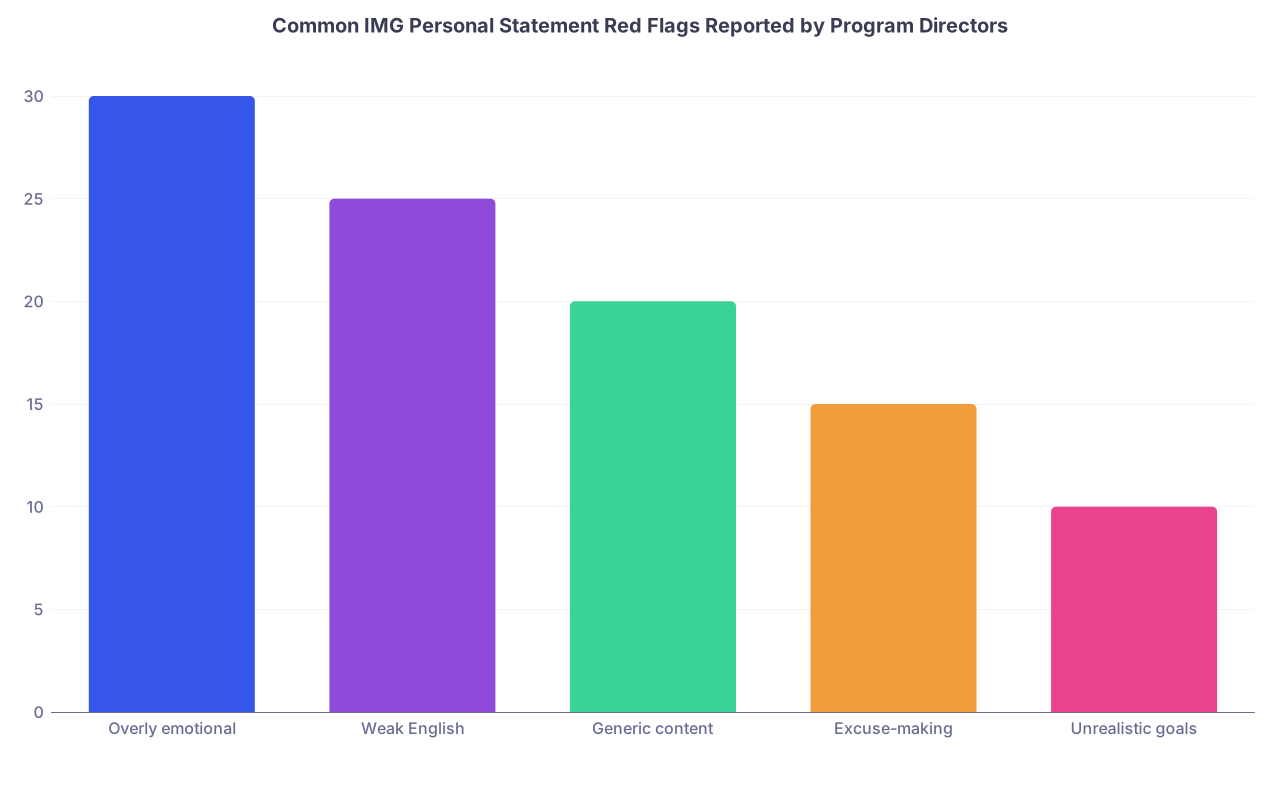
| Category | Value |
|---|---|
| Overly emotional | 30 |
| Weak English | 25 |
| Generic content | 20 |
| Excuse-making | 15 |
| Unrealistic goals | 10 |

| Step | Description |
|---|---|
| Step 1 | Draft Statement |
| Step 2 | Rewrite with clinical focus |
| Step 3 | Cut to 600-800 words and add specifics |
| Step 4 | Get fluent editor review |
| Step 5 | Condense and reframe |
| Step 6 | Upload to ERAS |
| Step 7 | Any sob story intro? |
| Step 8 | Too long or generic? |
| Step 9 | Language errors? |
| Step 10 | Unnecessary weakness explanations? |

Quick Self-Check: Does Your Statement Look “High Risk”?
Run these questions on your current draft. Be brutal.
- Do the first 3–4 sentences sound like a movie trailer about your childhood rather than a professional starting point?
- Could 70 percent of your content apply to any applicant in any specialty?
- Are you spending more time explaining your failures than demonstrating your strengths?
- Would an American intern or resident roll their eyes at your level of drama or self-praise?
- Does your future plan sound like “anything, anywhere, as long as I get in”?
If you are nodding yes to more than one, you are not ready to upload.

FAQ (Exactly 5 Questions)
1. Should I mention that I am an IMG directly in my personal statement?
You do not need to introduce yourself as an IMG; your application already shows that. What you should do is selectively use international experiences that highlight maturity, resourcefulness, or adaptability. Do not spend a paragraph complaining about credentialing or visas. Focus on what you learned practicing or training in your system, then bridge to how that prepares you for U.S. residency.
2. Can I reuse the same personal statement for all internal medicine programs?
You can use one core statement for all IM programs, but if you start inserting specific program names, you must be extremely careful. Sending a “Dear University of X” statement to Program Y looks disastrous and unprofessional. Most IMGs are safer using a strong, generic (but still specific and thoughtful) IM statement without program names, then customizing in the program-specific questions or supplemental essays where allowed.
3. How much personal hardship is appropriate to include?
Two to three concise sentences that provide context are enough. For example: mentioning that you supported your family financially during medical school can help explain resilience and time management. Writing half a page about family illness, war, or financial struggle usually backfires. The line is simple: if the hardship does not directly shape your professional growth or behavior, it stays out.
4. Who is the best person to review my personal statement?
Prioritize someone who meets three criteria: fluent in written English, familiar with U.S. medical culture, and willing to be blunt. A U.S.-trained attending or senior resident in your specialty is ideal. A non-medical native English speaker is helpful for language polish, but they might miss content red flags. Be cautious with large WhatsApp or Facebook groups; you often get random, conflicting advice and sometimes outright bad edits.
5. Can a strong personal statement compensate for low scores or old graduation year?
No. It can prevent you from being immediately discarded, and it can help differentiate you among applicants with similar metrics, but it cannot “erase” serious objective weaknesses. What it can absolutely do is make things worse if you write defensively, sound unstable, or look unprofessional. Your realistic goal: a clean, thoughtful statement that does not raise new concerns. Silent asset, not flashy miracle.
Key points:
- Do not write a tragic, defensive, or overly emotional narrative that makes you look unstable or high maintenance.
- Stay professional, specific, and grounded in recent clinical experiences that show you understand the specialty and U.S. training.
- Fix language, structure, and tone so your statement quietly says: “Low risk, coachable, and ready to work.”