
You are sitting in a cramped call room at 10:30 p.m. The ward is finally quiet. You have your laptop open to ERAS, cursor blinking in the “Experiences” section.
You have:
- A couple of audits from home country.
- Some bedside teaching you did for juniors.
- A half-finished QI project someone mentioned might “help for residency.”
What you do not have is a clear academic story. No defined niche. Nothing that screams: “This is who I am as an academic resident and this is how I add value from day one.”
This is where most IMGs lose ground. Not because they are not smart enough or hardworking enough. Because their application looks like a random list of activities instead of a coherent academic identity.
Let me break down how to fix that.
We will build a tight, realistic academic niche around three things you can actually control as an IMG:
- Quality Improvement (QI)
- Teaching
- Local, low-resource academic projects
Not fantasy RCTs, not 10 PubMed papers in 6 months. Real work. Structured properly. Sold correctly.
1. Why IMGs Need an Academic Niche (More Than US Grads)
US seniors can sometimes match with a “generic” application if their scores and school are strong. IMGs usually cannot. Program directors want to see:
- Evidence you understand U.S.-style academic medicine.
- Proof you can contribute meaningfully to the program’s priorities: QI, education, patient safety, systems-based practice.
- A clear, believable academic direction.
Without that, you are just another applicant with “good scores and some observerships.” That is not enough in competitive cycles.
For IMGs, a niche does three things:
- It makes you memorable: “That applicant who built the sepsis QI bundle and taught interns.”
- It de-risks you: you look less like someone who will struggle to adapt.
- It gives interviewers something substantive to talk about: projects, methods, impact.
You are not trying to be a world expert. You are trying to look like a resident who will plug into their QI meetings, teaching curriculum, and hospital committees on day one.
So we design the niche around what programs already value and measure: QI metrics, teaching capacity, and local improvement work.
2. The Core Niche: QI + Teaching + Local Projects
Think of your “academic niche” as a Venn diagram with three overlapping circles.
- Circle 1: Quality improvement / patient safety
- Circle 2: Teaching / medical education
- Circle 3: Local, context-driven projects (often low-resource, high-impact)
Your goal is to live in the overlap.
What this looks like in practice
Examples of a coherent niche:
Internal Medicine–focused IMG
- QI: Reduced inappropriate telemetry use in a small hospital.
- Teaching: Ran weekly case discussion sessions for interns around diagnostic reasoning and over-testing.
- Local projects: Created a simple ward checklist to improve discharge medication reconciliation.
Pediatrics-focused IMG
- QI: Improved vaccination documentation rates in clinic.
- Teaching: Designed short teaching huddles for nurses on catch-up vaccine schedules.
- Local projects: Built a paper-based reminder system for parents in low-resource setting.
None of this requires a U.S. academic center or a grant. But it does require structure, documentation, and alignment with residency expectations.
3. Quality Improvement as Your Anchor
QI is the easiest and most credible academic entry point for IMGs. Programs are drowning in required QI metrics. They need residents who “get it.”
Your mistake is thinking QI means “I did an audit.” That is not QI. That is data collection.
QI in residency language means:
- Defined problem tied to a guideline or standard.
- Process mapping and root cause analysis.
- Plan-Do-Study-Act (PDSA) cycles or similar framework.
- Measurement before and after.
- Sustainability or handoff.
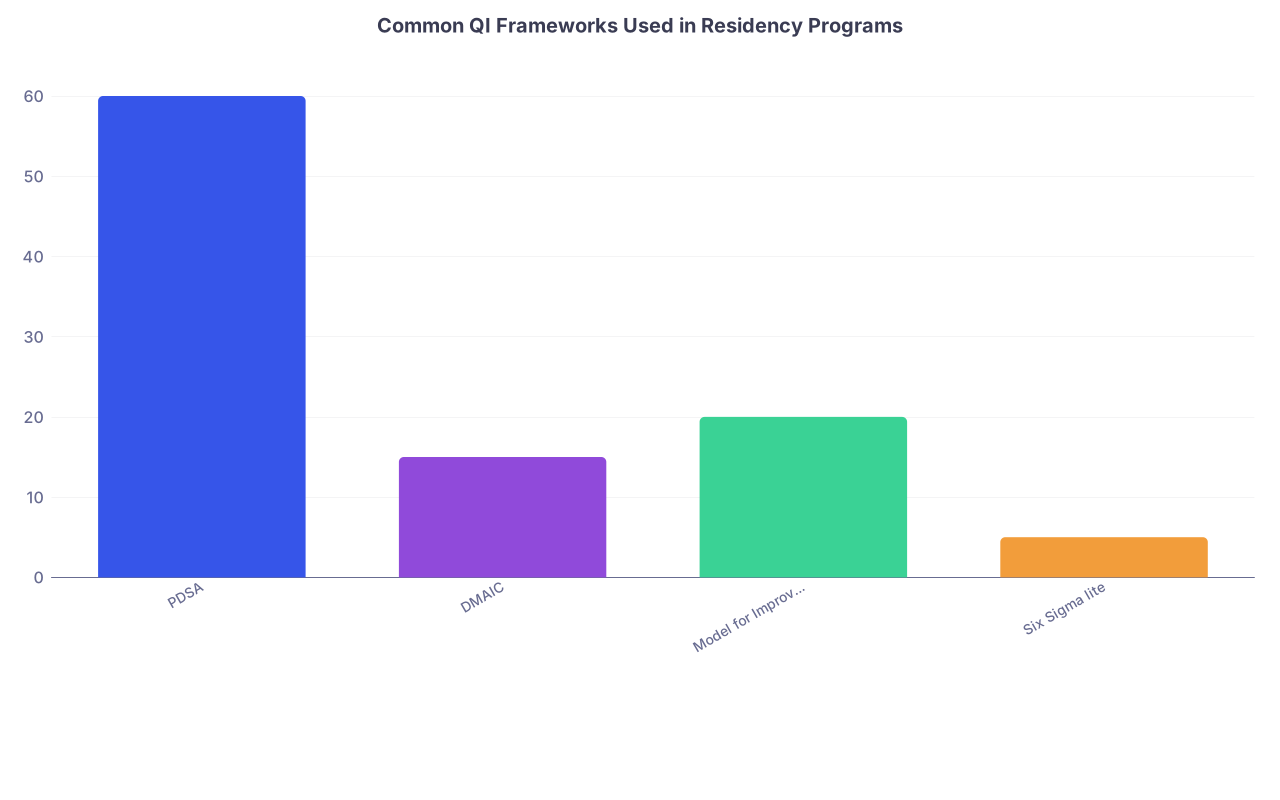
| Category | Value |
|---|---|
| PDSA | 60 |
| DMAIC | 15 |
| Model for Improvement | 20 |
| Six Sigma lite | 5 |
The minimal viable QI project (MVQP) for an IMG
You are not going to run a multi-center trial. Aim for something that:
- Is feasible in your current hospital/clinic.
- Can be completed in 3–6 months.
- Produces simple pre/post data.
- Has a clear connection to patient safety, guidelines, or efficiency.
Concrete examples:
- Surgical ward: Reduce inappropriate perioperative antibiotic duration from >72 hours to guideline-recommended ≤24 hours for clean cases.
- Medicine ward: Improve VTE prophylaxis documentation and ordering in high-risk inpatients.
- Outpatient clinic: Increase documentation of smoking cessation counseling.
How to structure a QI project properly
Use the Model for Improvement / PDSA structure. Do not improvise. Programs recognize this language immediately.
Key components:
Problem statement
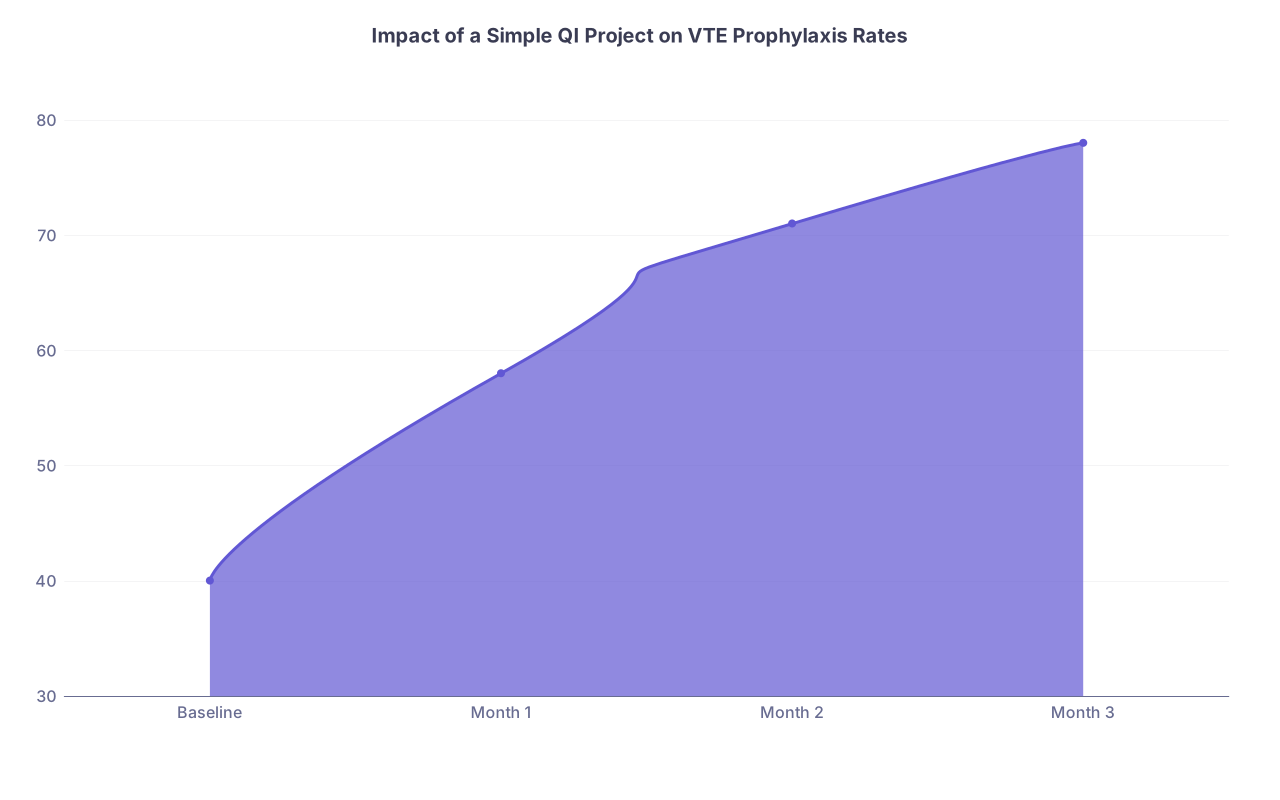
“On our internal medicine ward, only 40% of eligible high-risk patients receive pharmacologic VTE prophylaxis within 24 hours of admission, increasing risk of preventable VTE events.”Aim statement (SMART)
“Increase appropriate VTE prophylaxis ordering for eligible high-risk inpatients from 40% to 75% within 4 months on the internal medicine ward.”Measures
- Outcome: percentage of eligible patients receiving prophylaxis.
- Process: percentage of admission notes with documented VTE risk assessment.
- Balancing: rate of major bleeding events (even if just monitored descriptively).
Interventions
This is where IMGs often go too vague: “We educated staff.” No. Be concrete.Examples:
- Added a VTE risk checklist to admission templates.
- Ran two 15-minute teaching sessions for residents and nurses.
- Placed reminder posters in the physician workroom.
PDSA cycles
- Cycle 1: Introduce checklist with one admitting team, measure for 2 weeks.
- Cycle 2: Adjust checklist based on feedback, scale to entire ward.
- Cycle 3: Add automatic nurse prompt to remind physicians about prophylaxis.
Results
Use simple before/after numbers. A basic run chart is enough.Sustainability
- Checklist integrated into standard admit forms.
- Project handed off to a junior colleague for ongoing audit every 3 months.
You can run this kind of project in a non-U.S. setting and it will still be respected, as long as the structure and thinking are correct.
4. Teaching: Turning Informal Help into Academic Capital
You probably already teach. Finals review sessions. Bedside discussions. WhatsApp groups where you explain ECGs to juniors.
Residency programs value this. They are required to show ACGME (or equivalent) that residents are involved in teaching and curriculum. They want people who will not just hide in the corner.
The problem: most IMGs describe their teaching like this:
- “Taught medical students.”
- “Organized teaching sessions.”
- “Mentored juniors.”
That is filler. It does not sound academic. We need to turn it into structured “medical education” work.
Three levels of teaching involvement
Think in ascending order of strength:
Informal teaching
- Bedside teaching of physical exam.
- Explaining concepts during rounds.
This is fine but weak on its own.
Structured session design
- Created a recurring teaching series with specific topics and objectives.
- Developed slides or cases.
- Collected feedback from participants.
Educational leadership / curriculum work
- Coordinated a teaching schedule.
- Introduced a new format (case-based learning, mini-CEX sessions).
- Evaluated the impact (pre/post quiz, attendance, satisfaction scores).
As an IMG, you should be hitting level 2 at minimum, and ideally at least one level 3 experience.
How to build a concrete teaching portfolio
If you still have access to a hospital, clinic, or medical school, you can do this now.
Example structure:
- Topic series: “Core Topics in Ward Medicine for Interns”
- Audience: first-year interns or senior medical students
- Format: 30-minute weekly sessions, 6–8 weeks
- Topics:
- Approach to hyponatremia
- Management of acute GI bleed
- Rational use of antibiotics in pneumonia
- Discharge planning and medication reconciliation
Add:
- Learning objectives for each session (1–3 concise points).
- Short pre/post question (even 3–5 MCQs in Google Forms).
- Feedback survey (1–2 questions about clarity and usefulness).
Now you can write on your CV:
- “Designed and delivered an 8-week case-based teaching curriculum for 15 internal medicine interns focusing on high-yield inpatient problems; average knowledge scores improved from 58% to 79% on pre/post testing (n=14 respondents).”
That sounds like someone who will be a strong teacher-resident. Which is exactly what programs want.
5. Local Projects: Using Your Context as a Strength, Not a Weakness
Many IMGs operate in resource-limited settings. They see system failures daily: missing labs, lost charts, poor follow-up. Most of you just survive it. Some of you document it and fix one piece.
Local projects are where you can actually stand out, if you frame them correctly.
The trap: writing “Did an audit on x” or “Surveyed y.” That reads like homework.
We want: “I understood a local problem; I measured it; I tried targeted interventions; I extracted lessons that apply anywhere.”
Good local projects for IMGs
Examples that translate well to U.S. programs:
- Improving follow-up of abnormal lab results in a busy outpatient clinic.
- Reducing missed doses of critical medications due to stockouts or workflow failures.
- Streamlining communication between ED and wards for handovers.
- Implementing a simple sepsis recognition and response protocol.
These do not require fancy tech. They require observation, basic data, and a clear story.

| Step | Description |
|---|---|
| Step 1 | Notice recurring problem |
| Step 2 | Define specific measurable aim |
| Step 3 | Collect baseline data |
| Step 4 | Map process and identify causes |
| Step 5 | Design simple low cost interventions |
| Step 6 | Implement in small pilot |
| Step 7 | Measure impact |
| Step 8 | Refine or scale |
| Step 9 | Document and present |
Turning local reality into academic language
Take a common scenario:
Reality: On your ward, antibiotics are frequently out of stock. Nurses substitute alternatives or skip doses. Physicians do not always know. Patients get under-treated.
You could:
- Measure: Percentage of antibiotic doses actually given as prescribed for certain common regimens over two weeks.
- Identify failure points: pharmacy, communication, documentation, substitution.
- Intervene:
- A simple “stock-out notification” sheet that nurses complete and send to pharmacy and the team.
- A documentation field in the chart when substitutes are used.
- Re-measure: Has documentation improved? Are dose omissions reduced?
- Reflect:
- “In this resource-limited setting, system changes focusing on communication and transparency improved antibiotic administration reliability despite stock constraints.”
Programs read that and think: This person understands systems-based practice. They know how to work within constraints. They are not just checking boxes.
6. Combining Everything into One Coherent Niche
Now we layer these three elements—QI, teaching, local projects—into one clear story. That story needs to be obvious in three places:
- Your ERAS (or equivalent) experiences.
- Your personal statement.
- Your interview answers.
Building your academic “headline”
If I had to summarize you in one line on an interview score sheet, what would it be?
Examples:
- “IMG with strong QI background in inpatient medicine and clear interest in teaching interns about patient safety.”
- “Pediatrics-focused IMG who led vaccination documentation QI project and designed a teaching series for junior trainees.”
- “Resource-limited setting experience translated into systems-based QI and pragmatic education work.”
If your current CV does not support a sentence like this, that is your work.
| Specialty Focus | QI Theme | Teaching Focus | Local Project Angle |
|---|---|---|---|
| Internal Med | VTE prophylaxis | Intern bootcamp sessions | Ward admission and discharge workflow |
| Pediatrics | Vaccination quality | Parent education mini-talks | Catch-up scheduling and documentation |
| Surgery | Antibiotic stewardship | Pre-op teaching for interns | Peri-op checklist implementation |
| Psychiatry | Follow-up adherence | Case conferences for students | Community clinic engagement systems |
| Family Med | Chronic disease QI | Group visits and teaching | Hypertension or diabetes registries |
7. Documenting and Presenting Your Work Like an Academic
Content is one half. Packaging is the other. Many IMGs do decent work and then bury it in weak descriptions.
You need to describe every major QI / teaching / local project with:
- Scale: how many patients, learners, or months.
- Methods: what framework, what measurement, what intervention.
- Outcome: even if modest.
- Your role: lead vs contributor.
Example: weak vs strong descriptions
Weak:
- “Participated in an audit of antibiotic use on the medical ward.”
Strong:
- “Led a 4-month QI project on appropriate antibiotic duration for community-acquired pneumonia on a 30-bed internal medicine ward (average 70 admissions/month), using PDSA methodology. Developed an audit tool, collected baseline data showing 65% exceeded guideline-recommended duration, implemented an educational intervention and standardized discharge summary checklist, and improved guideline-concordant duration to 82% at follow-up.”
Weak:
- “Taught medical students during clinical rotations.”
Strong:
- “Designed and delivered a 6-session bedside teaching series on core physical examination skills for 3rd-year medical students (groups of 6–8), including structured mini-CEX assessments and written feedback; 92% of participants rated sessions as ‘very useful’ on anonymous surveys.”
You see the pattern.
8. Converting Non-U.S. Experience into U.S.-Relevant Language
Here is the harsh truth: some faculty skim your application and mentally downgrade anything that is not U.S.-based. You do not fix that by pretending you worked in Boston. You fix it by speaking their language.
Translate everything into:
- Aims, measures, outcomes.
- Recognizable frameworks: PDSA, root cause analysis, run charts, pre/post evaluation.
- Systems language: workflows, communication failures, standardization, sustainability.
Do not write:
- “We did a project to improve.”
Write:
- “We identified [measurable problem], defined a [SMART aim], used [QI framework], implemented [specific interventions], and achieved [quantified result] over [timeframe].”
Also, use numbers. Always.
| Category | Value |
|---|---|
| Baseline | 40 |
| Month 1 | 58 |
| Month 2 | 71 |
| Month 3 | 78 |
Numbers like that catch attention far more than “we improved VTE prophylaxis.”
9. Integrating Your Niche into the Application and Interviews
All this work only matters if you actually integrate it into how you present yourself.
ERAS / CV
Aim for:
- 2–3 major QI / local projects with strong descriptions.
- 1–3 clearly described teaching roles, ideally one with curriculum design or evaluation.
- If you have abstracts/posters: at least one tied to your niche (QI or education).
Avoid listing 15 mini-things. A few deep, well-structured experiences beat a scatter of superficial ones.
Personal statement
You do not need to write a “QI manifesto.” But your narrative should:
- Show how you noticed a problem in your training environment.
- Describe how you moved from frustration to structured improvement.
- Highlight one concrete project and what you learned about systems, teamwork, and teaching.
Then connect that to what you want to do in residency:
- “I hope to further develop my skills in QI and resident education, particularly around safer inpatient transitions and high-value care.”
Interviews
Expect questions like:
- “Tell me about a project you are proud of.”
- “Have you been involved in quality improvement?”
- “How have you contributed to teaching?”
- “What would you like to work on academically during residency?”
You should be ready with 2–3 polished stories, each with:
- Context
- Your role
- Actions
- Results
- Reflection
If you cannot explain your QI project in 2–3 minutes to a tired attending at 4 p.m., you did not prepare.
10. If You Are Starting Late (Final Year or Postgraduate)
You may be reading this six months before application season and thinking: “Too late.”
It is not ideal, but you can still salvage something focused.
Prioritize in this order:
- One clean QI project (3–4 months, simple, tightly structured).
- One structured teaching activity (even a 4–6 session series with pre/post test).
- Basic local project framing around anything you are already doing (rounds, clinics, chart reviews).
Do not chase more observerships just for the sake of it if it means sacrificing project time. A U.S. letter saying “hard worker” is less impactful than a strong letter saying:
- “This applicant designed and led a thoughtful QI project in our unit and presented it clearly to our department.”
You are designing a niche, not collecting stickers.
FAQ (Exactly 4 Questions)
1. Does my QI or teaching project have to be done in the U.S. to matter?
No. I have seen strong matches with all QI and teaching work done outside the U.S. What matters is structure, clarity, and how you present it. A well-designed VTE prophylaxis QI project from a hospital in India, Nigeria, or Egypt can look very strong if it uses clear aims, basic measures, PDSA cycles, and documented outcomes. Many U.S. faculty actually like seeing resourceful projects done in constrained environments.
2. I have only audits, no formal “QI.” Can I still use them?
Yes, but you should upgrade them. Take an existing audit and frame it within a QI approach. Even if the intervention phase was limited, describe: baseline measurement, identification of gaps, proposed or partial interventions, and follow-up data if any. If you still have access to the setting, you can even run a mini PDSA cycle now to convert a “dead audit” into a live QI project.
3. I am not naturally a “teacher.” Do I really need teaching experience as an IMG?
You do. Programs expect residents to teach—students, interns, even patients. You do not have to be charismatic, but you must show you have made some structured effort to teach and can think about education beyond “I explained things.” A small, thoughtful teaching series with a few learners and a basic evaluation is enough to show you understand your role as a future teacher-resident.
4. How many QI/teaching projects do I need for a strong application niche?
For most IMGs, two to three substantial experiences are enough: one or two solid QI/local projects and one or two structured teaching roles. Depth beats volume. A single, well-run 4–6 month QI project plus a well-designed teaching series can form a very coherent niche if you describe them with clear aims, methods, and outcomes, and you tie them together in your personal statement and interviews.
With a defined academic niche in QI, teaching, and local projects, you stop looking like “an IMG trying to get in anywhere” and start looking like “a future resident who will improve our systems and teach our people.”
Once that identity is clear and documented, the next step is brutal but simple: aligning your program list and interview strategy with that niche. Which programs will actually value what you built, and how do you target them intelligently?
That is the next move in your journey—after you close this laptop and start structuring that first project properly.