It is March. You have your Step scores in hand, you are halfway through final year, and every WhatsApp group you are in is screaming the same word: “USCE.” People are forwarding PDF lists of “top observerships,” seniors are flexing about their “strong US letters,” and some consultant back home just told you, very confidently, that “any U.S. experience is fine.”
That last sentence is wrong. Flatly.
If you treat all U.S. clinical experience as interchangeable, you will waste time, money, and your one realistic shot at building a competitive portfolio. The mix of electives, externships, and observerships matters. The order matters. Specialty alignment matters. The type of letter you get out of each one matters the most.
Let me break this down specifically.
1. What Program Directors Actually Mean by “USCE”
Start with their definition, not yours.
When most U.S. residency program directors say “USCE,” they are picturing you:
- Actively involved in direct patient care,
- In a U.S. hospital or clinic,
- Working in a role similar to a U.S. medical student or preliminary resident.
That does not describe every rotation that calls itself “USCE” on a website.
Rough hierarchy, from strongest to weakest, in the eyes of most Internal Medicine and Pediatrics PDs:
- U.S. core or sub-internship–level electives (4th-year electives, acting internships; hands-on, orders, notes).
- Hands-on externships (postgraduate) with real patient responsibility under supervision.
- Standard student electives (official visiting-student status, but not sub-I intensity).
- Structured observerships with clear educational goals but no touching patients.
- Shadowing-style observerships (trail behind, no defined role, vague letter).
- Random clinic “experience” with no documentation (frankly useless for ERAS).
Programs are not identical, but that hierarchy is roughly how it lands.
So when you are planning your mix, you are not just collecting “months of USCE.” You are trying to maximize:
- Months of hands-on, evaluated work,
- In your target specialty,
- That will generate strong, detailed U.S. letters.
Everything else is secondary.
2. Electives vs Externships vs Observerships: What They Really Give You
Let us define the three, stripped of marketing language.
A. U.S. Clinical Electives (as a Student)
These are usually done in your final year of medical school via VSLO (Visiting Student Learning Opportunities) or direct institutional agreements.
What they usually include:
- You are listed as a student on the team.
- Chart access (EPIC, Cerner, etc.); you write notes that are co-signed.
- You present patients, sometimes write orders (or at least pend them).
- You attend teaching rounds, morning report, noon conferences.
- Graded evaluation → easily converted to a US LOR.
This is the gold standard for IMGs still enrolled in school.
Where they shine:
- Internal Medicine ICU sub-I at, say, UConn → PD sees: “acted as subintern; managed 6–8 patients; took call.”
- Outpatient elective in Endocrinology at a university program → specialty-aligned letter saying you are serious about Endocrinology.
Where they struggle:
- If you do random “Dermatology cosmetic clinic elective” yet want IM, the PD sees misalignment.
- If your med school does not qualify for VSLO or you are already graduated, you may not be eligible at all.
B. Externships (Postgraduate, Hands-On)
Externship is a messy word; everyone abuses it. I am talking about postgraduate, hands-on roles where you function like a student or junior resident (but technically are not a trainee in an ACGME program).
Two main types:
Hospital-based externships (rare but strong):
- You join inpatient teams, see patients, write notes, present, sometimes carry the pager.
- These are often labelled “clinical scholars,” “pre-residency fellows,” or “clinical research fellows” but function as de facto externships.
Private clinic externships (common, variable quality):
- You room patients, take histories, write notes, maybe propose plans.
- Quality depends entirely on the supervising physician’s commitment and reputation.
Upside:
- Accepts graduates. Good for those out of school.
- Demonstrates recent, hands-on U.S. experience.
- Can fill “gap years” in a meaningful way.
Downside:
- Big variation in credibility. A random paid externship in a no-name clinic means less than a structured hospital appointment.
- Some “externships” are glorified scribes or MAs. Helpful, but weaker justification for “clinical reasoning” letters.
C. Observerships (Shadowing, No Direct Care)
Observership = you are in the room. You watch. You do not touch patients or chart.
Variations:
- University hospital observership: Structured, exposure to academics, but zero patient care tasks.
- Private practice observership: You follow a doctor in clinic; may or may not even see inpatients.
- Paid observership companies: The quality ranges from decent structured teaching to pure tourism with a white coat.
What observerships can realistically give you:
- Exposure to U.S. workflow, vocabulary, documentation culture.
- Networking if the attending cares about teaching and has IM program connections.
- A letter that comments on professionalism, punctuality, and interest—but often cannot comment on your independent clinical decision making.
This does not make observerships useless. But they do not carry the same weight as hands-on USCE, particularly for more competitive specialties.
3. PD Expectations by Specialty and Applicant Type
Let us get concrete. “How much USCE do I need and of what type?” depends on two things:
- Your specialty (IM vs FM vs something procedural).
- Your timeline (current student vs 2–3 years post-grad).
| Applicant Type | Specialty Focus | Ideal USCE Mix (Total 3–6 months) |
|---|---|---|
| Final-year IMG (on time grad) | IM/FM | 2–3 mo hands-on electives + 1–2 mo observership |
| Late grad (1–3 years post) | IM/FM | 2–3 mo externships + 1–2 mo observership |
| High-risk profile (old grad, low scores) | IM/FM | 3–4 mo externships + 1–2 mo observership |
| Competitive specialty (Neuro, EM, etc.) | Specialty-aligned | 2–3 mo electives + 1–2 mo observership/externship |
| Transitional/prelim target | IM/Surgery mix | 2 mo IM electives + 1–2 mo surgery exposure |
This is not gospel. But it is the ballpark I have seen over and over in applicant portfolios that actually match.
4. How to Build the Right Mix: Scenarios
You do not need an abstract lecture. You need specific build-outs.
Scenario 1: Final-Year IMG, Targeting Internal Medicine, On-Time Graduation
- Step 2 CK: 240
- Graduation: July
- No prior U.S. experience
Optimal sequence:
Aug–Sep (M4): Inpatient IM elective at a mid-tier academic program
Aim: Hands-on ward experience, morning report, real evaluation.
Output: 1 strong IM LOR from a U.S. academic attending.Oct: ICU or Cardiology sub-I/elective at the same or similar institution
Aim: Demonstrate ability to handle high-acuity; maybe get a second letter.
Output: Sub-I style letter: “Functioned at the level of a U.S. subintern.”Nov: Outpatient IM or subspecialty clinic (Endocrine, GI, etc.)
Aim: Show continuity care interest, broaden your exposure.
Output: Either a 3rd letter or reinforcement of the first two.Dec or Jan: 1-month observership at a community IM program
Aim: Program type variety; possible letter that comments on “fit” with community setting.
Output: A letter that might be shorter but shows you are adaptable across settings.
Why this mix works:
- 2–3 months of solid, graded, hands-on experience.
- Specialty-aligned.
- Within 6–12 months of your ERAS application (so “recent”).
- Enough different attendings to get 2–3 letters without diluting depth.
Scenario 2: IMG Graduate, 3 Years Out, Mixed Scores, Wants FM/IM
- Step 1: Pass (borderline)
- Step 2 CK: 225
- Graduation: 3 years ago, mixed non-U.S. experience
You have two problems: time since graduation and modest scores. You need recency and proof you can function in U.S. systems.
Optimal sequence:
2–3 months of solid clinic- or hospital-based externships
Pick sites where you:- See patients independently first,
- Present to the attending,
- Write notes,
- Get structured feedback.
These can be community IM or FM settings. Avoid “just scribe” roles unless they explicitly allow clinical assessment and documentation as an IMG.
1–2 months of observerships at programs that actually sponsor J1/H1 or take IMGs
This is not random. You pick observerships tethered to:- FM community programs with heavy IMG presence, or
- Mid-size IM programs in IMG-friendly regions (New York, New Jersey, Michigan, Texas in particular settings).
Collect 2 letters from externships (hands-on, detailed) + 1 from observership (fit and professionalism).
The externship letters fight the “old grad” narrative. The observership letter can be a foothold at a program that likes to see you before interviewing.
Scenario 3: Strong Student IMG, Wants Neurology
- Step 2 CK: 255
- Good home neurology exposure, with research
Here you care about specialty alignment more than raw USCE volume.
Suggested:
- 1 month: Neurology inpatient elective at a U.S. academic center.
- 1 month: General IM or ICU elective (most Neuro PDs value this).
- 1 month: Neurology outpatient or stroke service.
- Optional: 1 month Neurology observership at a program known for accepting IMGs.
Your mix is narrower but sharper. You want letters that show neurologic reasoning in a U.S. setting, not random surgery or OB/GYN experiences.
5. Hands-On vs Observership: Strategic Ratios
Here is the question you actually care about: “How many months of observerships is too many?”
Rule of thumb I have used:
- For a first-time applicant with recent graduation: at least 2–3 months hands-on (electives/externships) before you hit 2–3 months observerships.
- For old grads or low scores: push that toward 3–4 months hands-on if you can afford it. Observerships should be used surgically—to get into particular programs for exposure, not to pad your CV volume.
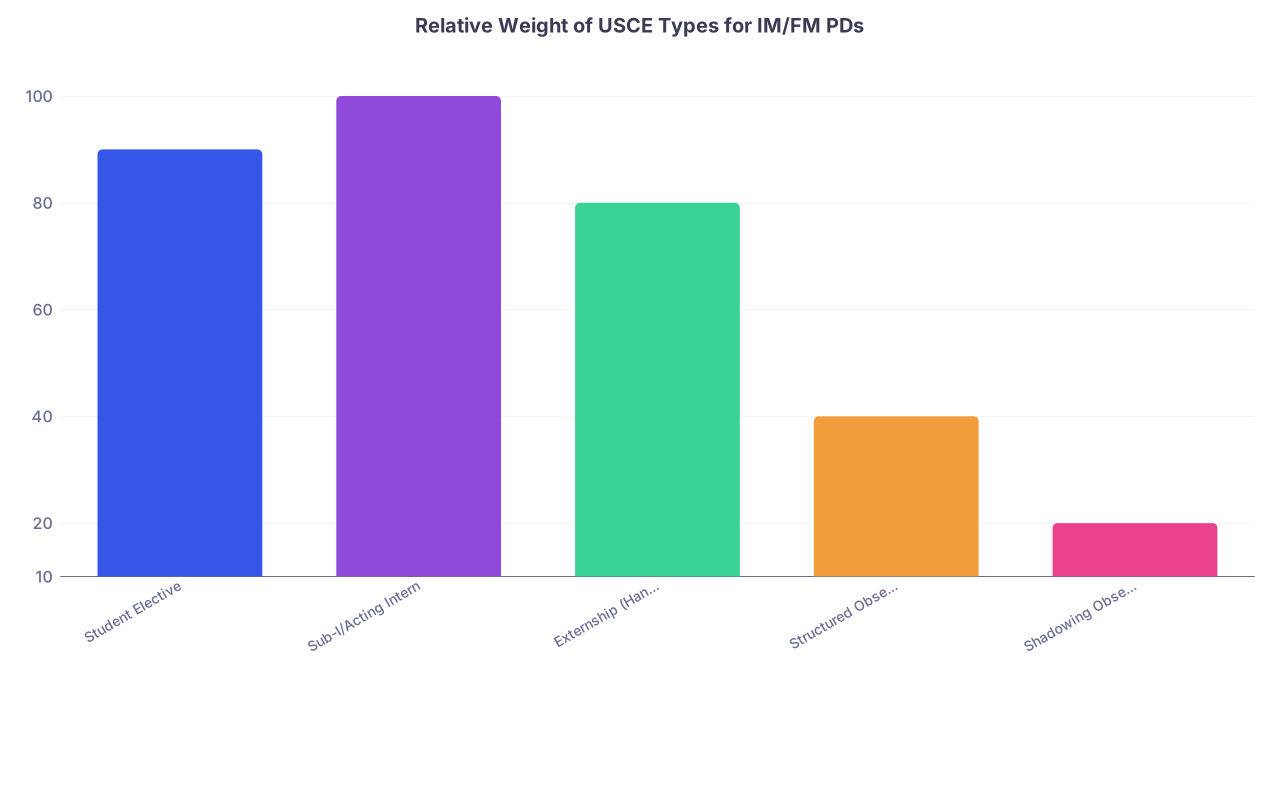
| Category | Value |
|---|---|
| Student Elective | 90 |
| Sub-I/Acting Intern | 100 |
| Externship (Hands-on) | 80 |
| Structured Observership | 40 |
| Shadowing Observership | 20 |
Think of observerships as supplemental:
- Good for seeing U.S. documentation and clinic flow.
- Occasionally good for 1 more LOR.
- Not a substitute for actual evaluated patient care.
Someone with 4 months of observership and zero hands-on will lose to someone with 2 months of real electives and 1 month observership almost every time.
6. Getting Letters That Actually Help You
Everything about your mix should be back-calculated from this question: “Who can write my three best letters?”
Strong letters describe:
- How many patients you followed.
- How you presented.
- Your clinical reasoning.
- Specific patient encounters that show growth or skill.
- Your reliability under pressure.
You will not get that from a casual observer role where you sat in the corner, or from spending 2 weeks flitting between teams.
So:
Stay at least 4 weeks per site whenever possible.
Letters from 1–2 week stints are usually generic.Make it clear you want a letter from day 1.
Not in a needy way, but: “Dr. X, one of my goals for this month is to earn a strong letter for residency. I would appreciate any feedback that can help me get there.”Ask the right attendings.
- For IM: academic IM faculty or chiefs, not random private subspecialists with no teaching role.
- For FM: PDs, APDs, or core faculty at FM programs.
Choose depth over number of programs.
Two 4-week hands-on rotations with excellent letters beat four 2-week superficial rotations every single time.
7. Common USCE Planning Mistakes (That Cost People Matches)
I have watched good candidates sabotage themselves. Same patterns, again and again.
Mistake 1: Chasing Famous Names Instead of Real Roles
Applicant picks a big-name place (e.g., “Harvard-affiliated observership”) where they:
- Cannot touch patients.
- Are 1 of 10 observers on a team.
- Attendings barely learn their name.
They then skip a hands-on community elective where they could have been the only IMG and gotten a detailed letter.
Program directors would rather see a strong hands-on letter from “BronxCare” or “St. Mary’s Community Hospital” than a vague observership letter from a top-5 name brand that says you were “enthusiastic and punctual.”
Mistake 2: Massive Specialty Mismatch
Want Internal Medicine but your U.S. experiences are:
- 1 month: Cardiac surgery observership
- 1 month: Pain clinic shadowing
- 1 month: Dermatology elective
Your file looks unfocused. The PD is asking, “Why IM? And can this person manage floor patients?”
You needed at least 2 months of general IM or ICU somewhere.
Mistake 3: All Experiences Ancient
You did one amazing elective in 2019. Then nothing. It is now ERAS 2026.
Programs consider:
- “Recent clinical experience” usually = within the last 2 years.
- If all your U.S. time is >3 years old, they worry your skills and familiarity are rusty.
You need at least 1–2 months of recent USCE in the 12–18 months before you apply.
Mistake 4: Overloading Short, Fragmented Rotations
Some people cram:
- 2 weeks Cardiology
- 2 weeks GI
- 2 weeks Endocrine
- 2 weeks Nephrology
- 2 weeks ICU
- 2 weeks clinic
Looks impressive on a CV. But no one knows you well enough to write anything other than “pleasant and interested.”
8. Where to Do What: Academic vs Community vs Private
This is another nuance IMGs underestimate.
Academic Centers
Pros:
- Stronger brand recognition.
- Structured teaching.
- Good for showing you can work in complex systems.
Cons:
- Harder to get, especially if your school is non-VSLO.
- Often more observers/trainees → harder to stand out.
- More likely hands-off if you are not a “visiting student” officially.
Best use: At least one solid elective or sub-I here, for the letter and name recognition. Do not obsess about doing everything at famous places.
Community Hospitals with Residency Programs
Pros:
- More responsibility; you may be de facto subintern.
- PDs and APDs are close to the clinical teams; easier to get influential letters.
- Often IM-friendly, especially in the Northeast, Midwest, and some Southern states.
Cons:
- Less glamorous for your home-country pride.
- Some have variable teaching quality.
Best use: Two birds with one stone—hands-on USCE and realistic networking at programs that actually rank IMGs.
Private Clinics / Single-Attending Sites
Pros:
- Easier to secure.
- You can be the only learner, so more 1-on-1 time.
- Can show outpatient skills, which FM especially values.
Cons:
- Variable letter strength and perceived rigor.
- If the attending has no academic tie or teaching role, the letter’s impact is limited.
Best use: As supplement externships or gap-fillers, ideally with an attending who either:
- Is faculty somewhere, or
- Well-known regionally and has past experience mentoring IMGs into residencies.
9. Timing Your USCE Relative to ERAS
You want your best USCE to be:
- Not too old (ideally within 12–18 months of ERAS submission).
- Completed early enough for letters to be uploaded before interview season ramps up.
A workable timeline for a September ERAS submission:
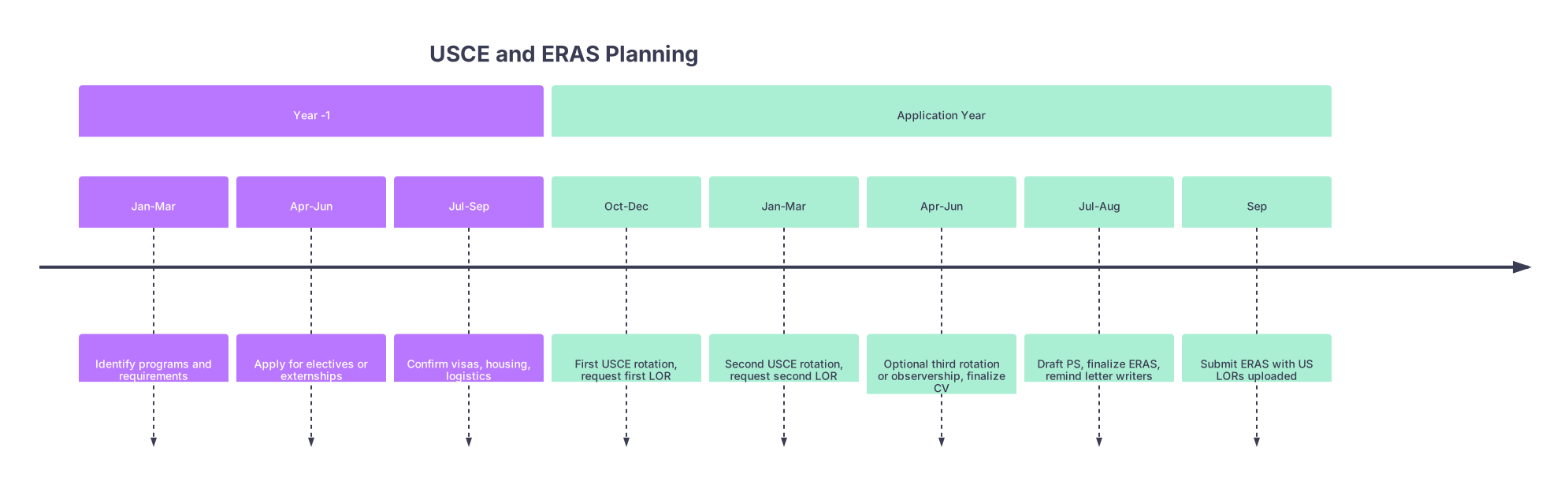
| Period | Event |
|---|---|
| Year -1 - Jan-Mar | Identify programs and requirements |
| Year -1 - Apr-Jun | Apply for electives or externships |
| Year -1 - Jul-Sep | Confirm visas, housing, logistics |
| Application Year - Oct-Dec | First USCE rotation, request first LOR |
| Application Year - Jan-Mar | Second USCE rotation, request second LOR |
| Application Year - Apr-Jun | Optional third rotation or observership, finalize CV |
| Application Year - Jul-Aug | Draft PS, finalize ERAS, remind letter writers |
| Application Year - Sep | Submit ERAS with US LORs uploaded |
Key points:
- Do not put your only U.S. rotation in July–August right before ERAS; letters may be delayed.
- Finish at least 2 substantial U.S. experiences by March–April of your application year so letters have time to be written and uploaded.
10. Cost, Visa, and Reality Checks
I will say the quiet part out loud: this is expensive and messy.
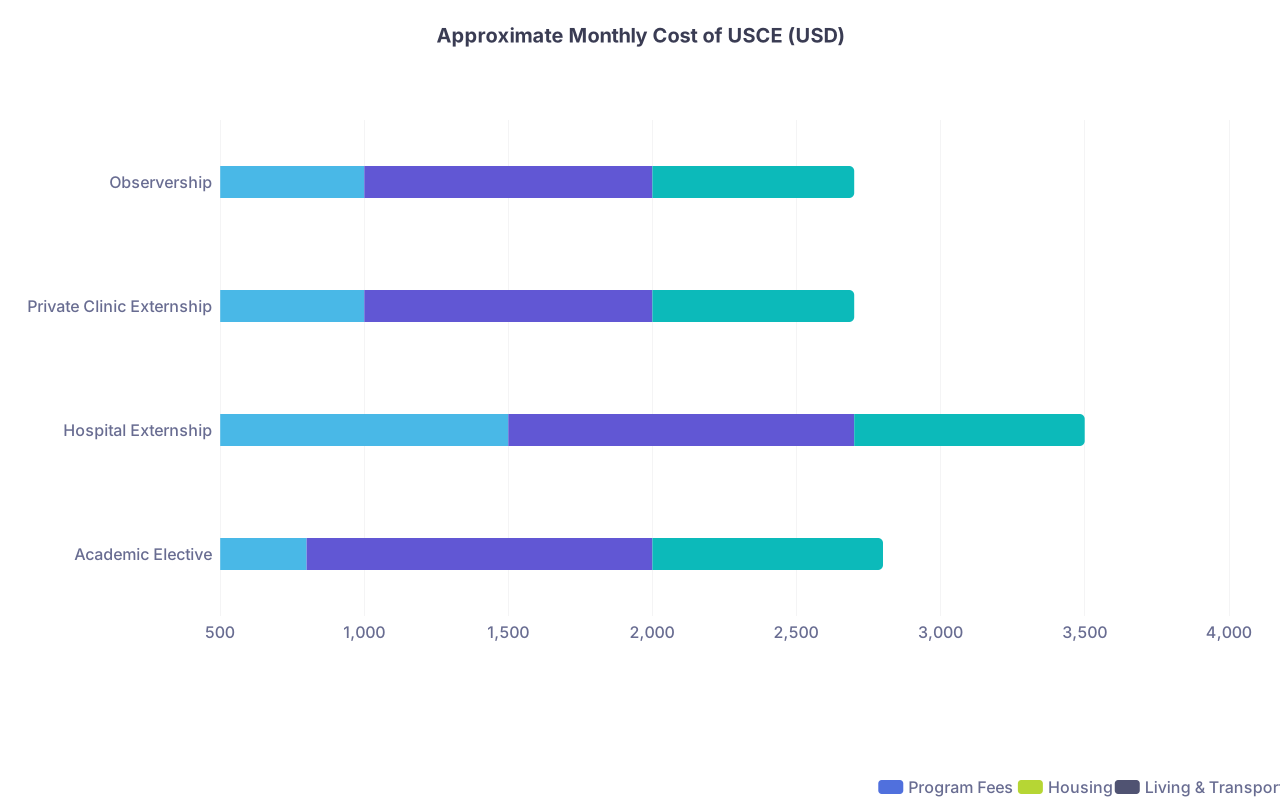
| Category | Program Fees | Housing | Living & Transport |
|---|---|---|---|
| Academic Elective | 800 | 1200 | 800 |
| Hospital Externship | 1500 | 1200 | 800 |
| Private Clinic Externship | 1000 | 1000 | 700 |
| Observership | 1000 | 1000 | 700 |
Rough ballpark per month, all-in, often lands around $2500–3500 if you are paying program fees plus housing in a major city.
Because of that:
- You cannot do everything.
- You should be discriminating.
Priority if money is tight:
- At least 2 months of strong, hands-on IM/FM USCE (electives if student, externships if graduate).
- 1 month of observership strategically placed at an IMG-friendly program that matches your profile.
- If funds remain, add 1 more rotation at a different type of site (e.g., academic vs community).
Visa issues:
- Many electives require B1/B2 or J-1 student visa for training.
- Some externships treat you as an “observer” on a B1/B2 even if hands-on; this lives in a gray zone.
- If you plan J-1 for residency, keeping paper trails clean matters, but PDs care more about whether you can legally be present and work once matched.
Do not get seduced by programs that promise residency if you do their externship. Unless they are literally saying, “This is a pre-match pipeline and here is our historical data,” treat those claims with skepticism.
11. Quick Tuning: Sanity-Check Your Planned Mix
Before you lock in rotations, run your list through this filter:
- Do I have at least 2 months of hands-on U.S. IM/FM (or my specialty) in the last 2 years?
- Will I get at least 2 U.S. letters from people who actually saw me clerk patients, present, and write notes?
- Is at least 70% of my U.S. time in or near the specialty I am applying to?
- Do I have both an academic-flavored experience and something closer to the community / real-world practice?
- Is there any month where I am just shadowing aimlessly that could be swapped for more substantial work?
If the answer to any of these is “no,” recalibrate before you drop nonrefundable deposits.
You are not trying to impress your classmates. You are trying to build a file that a 52-year-old PD, skimming 80 applications per night in October, reads and thinks:
- “Recent hands-on U.S. IM experience.”
- “Knows our system.”
- “Has letters I can trust.”
- “Profile fits what we can train.”
If your electives, externships, and observerships are moving you toward that reaction, you are on track. If they are just adding lines to your CV, you are wasting money.
Get your mix right, lock in your letters, and then we can talk about the next step—how to convert that USCE into interview invites with a personal statement and application that actually match the story you have built. But that is a different chapter.