
Most IMGs treat ECFMG and Pathways as boxes to tick. That is why they get burned by deadlines, policy changes, and last‑minute panic.
Let me be blunt: if you are not using ECFMG timelines and Pathway rules strategically, you are handing away control of your Match year. I have watched smart IMGs lose an entire cycle over a missing OET score, a late primary source verification, or a misunderstanding about which Pathway they actually qualified for.
Let me break this down precisely so you do not become that story.
1. ECFMG Certification Is Not Just a Certificate. It Is a Clock.
Most IMGs think: “Pass Step 1, Step 2 CK, maybe OET, fill some forms, done.” Wrong. ECFMG certification is a time‑sensitive sequence that has to line up with ERAS, NRMP, and your visa plans.
At the highest level, ECFMG certification for residency requires:
- Medical school credentials verified (primary source verification).
- USMLE exams passed (Step 1, Step 2 CK).
- Clinical and communication skills requirement satisfied (Pathway / OET or older Step 2 CS legacy).
- Final approval (certification issued) before a hard cutoff: usually late May of the Match year.
The trap is that each of those has its own timeline and bottlenecks, and they do not move at the same speed.
The real bottleneck: primary source verification
I have seen this one ruin entire cycles.
Your diploma and transcripts must be verified directly with your med school. That process depends on:
- How responsive your school is.
- Whether they are already recognized and connected to ECFMG systems.
- Whether there are administrative delays, holidays, strikes, etc.
I have seen primary source verification take:
- 2–3 weeks for efficient, well‑organized schools.
- 3–6 months for many public universities.
- 6–12 months (yes, a full year) for some under‑resourced schools or those with bureaucracy from another century.
If you are planning to apply in September, and your diploma will only be issued in July, and your school is notorious for slow paperwork? You are playing with fire if you do not start coordination early.
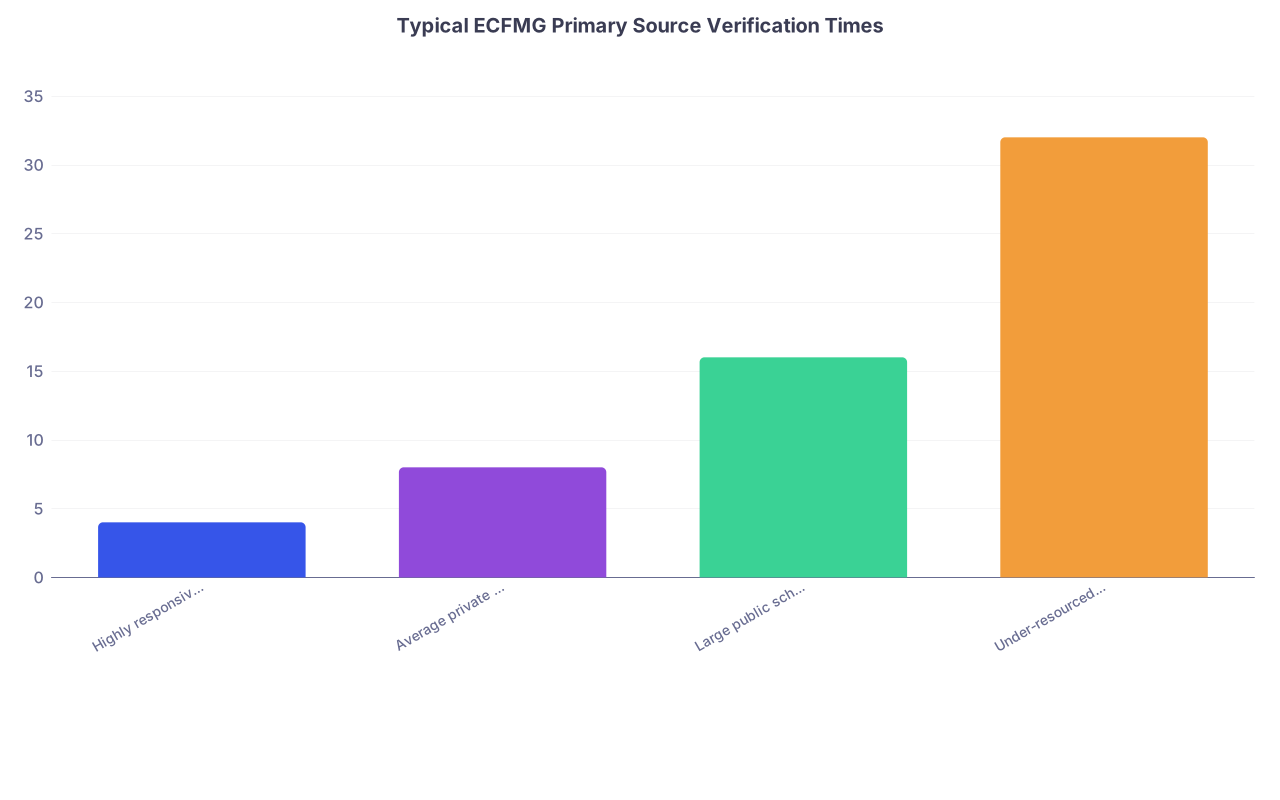
| Category | Value |
|---|---|
| Highly responsive schools | 4 |
| Average private schools | 8 |
| Large public schools | 16 |
| Under-resourced schools | 32 |
(Values = approximate weeks from document submission to verification)
The non‑negotiable Match‑year facts
For a typical Match year (e.g., Match 2026):
- ERAS opens for submission: mid‑September 2025.
- Programs start downloading: usually just after opening.
- Rank order list deadline (NRMP): late February 2026.
- ECFMG certification deadline: usually late May 2026.
If your ECFMG certificate is not issued by that May date, NRMP can invalidate your Match. I have seen candidates matched in March and then lose their position because certification was not finalized on time. That pain is entirely avoidable with proper planning.
So your mindset should be:
“I want my ECFMG certificate in hand before ERAS opens, not scrambling to get it after interviews.”
This changes how you schedule each component.
2. Pathways: Which One You Use Changes Your Entire Timeline
The ECFMG Pathways are not just checkboxes; they define:
- What exams you need (e.g., OET Medicine).
- What documentation your school or local authority must provide.
- How long your file will sit in review.
The details change slightly each cycle, but the conceptual structure remains similar. You need to understand which type of candidate you are and what that implies.
The major Pathway “personas”
In reality, Pathways boil down to a few archetypes:
- Graduates from accredited, well‑recognized schools with strong clinical evaluation systems.
- Graduates licensed to practice in their home country with some postgraduate clinical experience.
- Students from schools without robust formal evaluation systems, relying primarily on OET + forms.
- Older graduates with interrupted careers, limited documentation, and sometimes inactive licensure.
Each of these maps to different Pathways (numbers change over time, but the requirements cluster around these ideas).
| IMG Profile | Likely Pathway Complexity | Key Extra Requirements |
|---|---|---|
| Recent grad, strong school | Low–Moderate | OET + school forms |
| Licensed physician with residency at home | Moderate | License verification + OET |
| From under‑resourced/unaccredited school | High | Detailed forms, OET, sometimes extra attestations |
| Older grad, limited current practice | High | Documentation of competence, OET, sometimes additional review |
Your first strategic task: identify your profile early, ideally 1–2 years before you apply, and study the Pathway options from the prior cycles. ECFMG tends to adjust details, not reinvent the system annually.
Why Pathway choice must be made early
Because it affects:
- Whether you must take OET and when.
- Whether you need active licensure at home.
- Whether your school must complete certain forms (and how long they take).
- Whether a faculty member must attest to your clinical skills.
For example:
- If your pathway relies on your current license, and you let it lapse while working in a non‑clinical job, you may box yourself into a more complex pathway later.
- If your pathway needs a dean’s letter or evaluation forms, and you wait until the last semester of med school to ask for them, you will be at the mercy of administrative delays.
3. OET Medicine: The Silent Gatekeeper
For most current Pathways, OET Medicine is the communication skills gatekeeper. Many IMGs underestimate it and schedule it like a casual English test. Then they repeat it. Once. Twice. And now they are running into ERAS season.
Let me be precise:
- Required score pattern is usually B or higher in each subtest (Listening, Reading, Writing, Speaking).
- Many candidates are strong in Listening and Reading but underestimate Writing and Speaking, especially under time pressure.
- Results take time to be released and then to be delivered to ECFMG.
Where OET fits in your timeline
OET needs to be completed far enough ahead that:
- You get your scores.
- You have time to repeat if needed.
- ECFMG receives and processes the results.
- Any pathway application that depends on OET can be completed before ERAS opens.
A rational strategy:
- Target your first OET attempt 9–12 months before the ERAS season you care about.
- Build in buffer for at least one repeat.
- Only count yourself “safe” once your passing OET report is confirmed as received and linked in your ECFMG account.
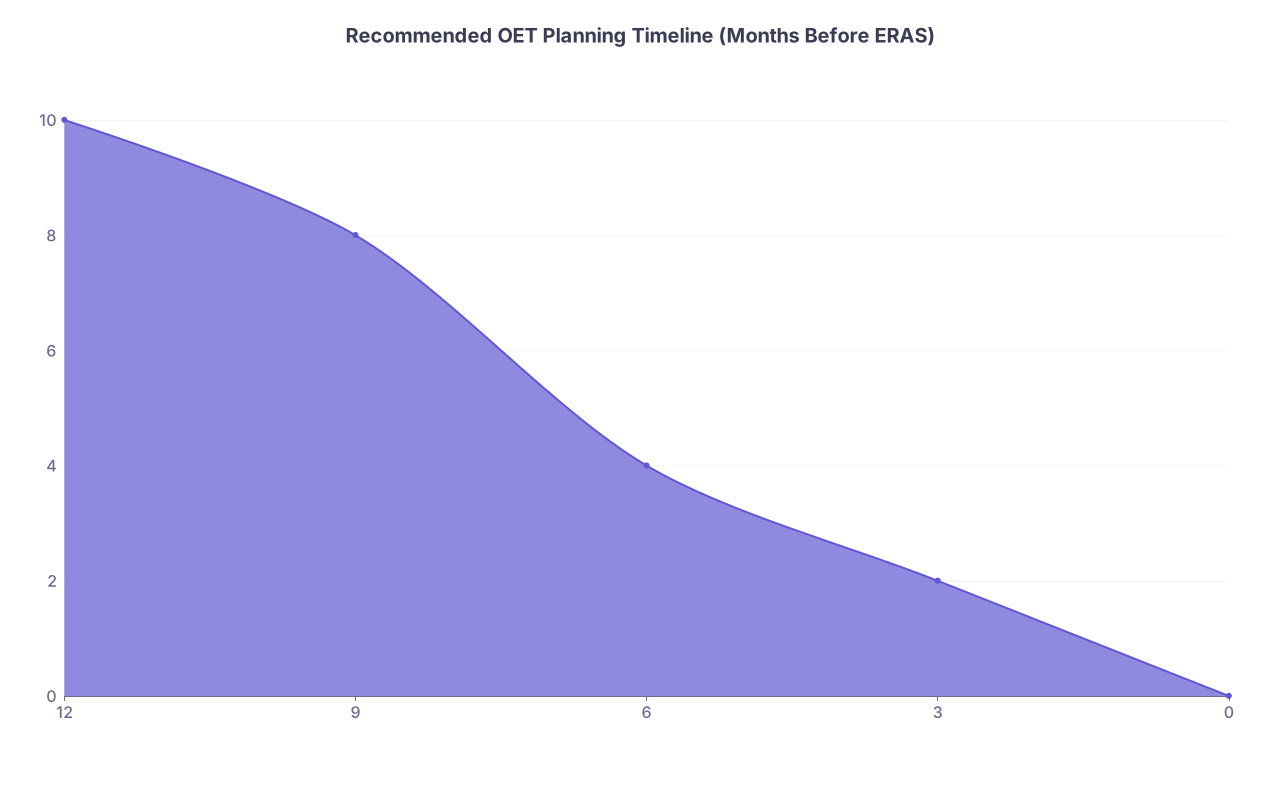
| Category | Value |
|---|---|
| 12 | 10 |
| 9 | 8 |
| 6 | 4 |
| 3 | 2 |
| 0 | 0 |
(Values approximate “risk buffer” – higher is better; zero at ERAS opening when no buffer left.)
4. Building a Cohesive IMG Timeline Around ECFMG and Pathways
Let’s stop thinking in isolated tasks and build one coherent timeline. I will map this for a hypothetical candidate aiming for Match 2027 (ERAS September 2026). You can shift the years, the logic holds.
Stepwise timeline (backwards planning)
Start with the end and walk backwards.
End point: Match 2027
- ECFMG certificate fully issued by May 2027 at the latest.
- You want it done well before that.
Spring 2027 (Jan–Apr)
- This should be a low‑risk period regarding certification.
- All ECFMG components should already be complete.
- You focus on interviews (if SOAP, etc.) and visa steps.
If you are still waiting for primary source verification or pathway approval in this window, your planning failed. Harsh, but true.
ERAS / NRMP season: Sep 2026 – Feb 2027
You want to enter ERAS with:
- Step 1: passed.
- Step 2 CK: passed (or at least score available early in season).
- OET: passed with valid scores in ECFMG system.
- Pathway application: submitted and preferably approved.
- Medical school diploma: issued and submitted for verification (ideally already verified).
The critical ECFMG window: Jan–Aug 2026
This is where most IMGs either secure their future or create a slow-motion disaster.
What should be done or nearly done by January 2026?
- Step 1: passed.
- Pathway research: you know your intended Pathway and requirements.
- OET: at least first attempt scheduled, preferably already passed by then.
What must be done between Jan–Aug 2026?
- Step 2 CK: completed with enough buffer that the score is reported before ERAS opening.
- OET: passed if not done earlier; retake if necessary.
- Pathway application: filled, documents requested from school / authorities, submitted.
- Diploma: collected ASAP after graduation and submitted for ECFMG verification.
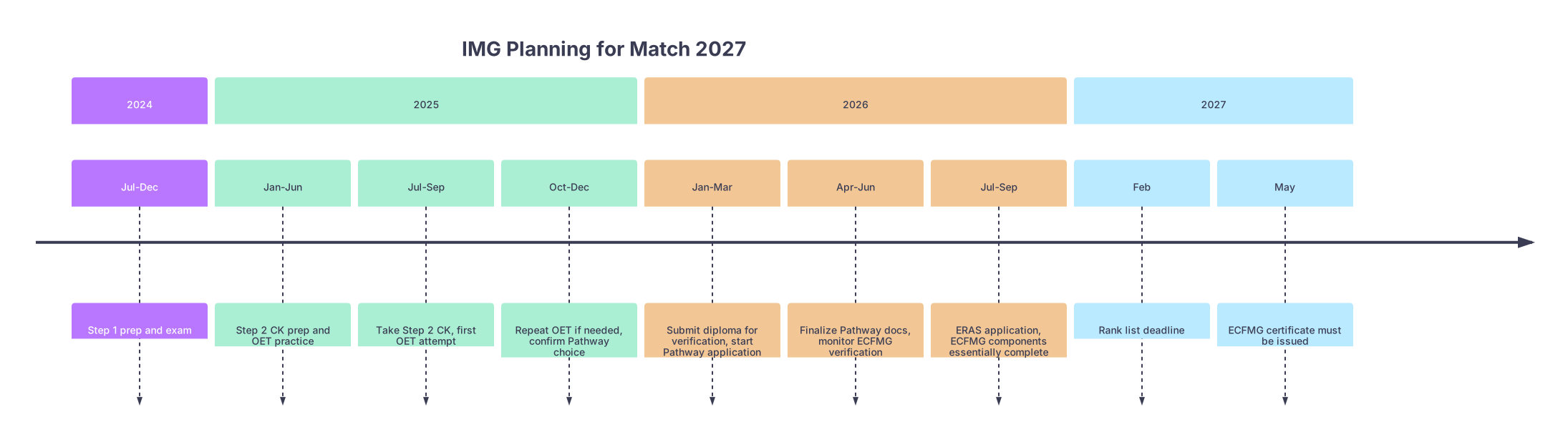
| Period | Event |
|---|---|
| 2024 - Jul-Dec | Step 1 prep and exam |
| 2025 - Jan-Jun | Step 2 CK prep and OET practice |
| 2025 - Jul-Sep | Take Step 2 CK, first OET attempt |
| 2025 - Oct-Dec | Repeat OET if needed, confirm Pathway choice |
| 2026 - Jan-Mar | Submit diploma for verification, start Pathway application |
| 2026 - Apr-Jun | Finalize Pathway docs, monitor ECFMG verification |
| 2026 - Jul-Sep | ERAS application, ECFMG components essentially complete |
| 2027 - Feb | Rank list deadline |
| 2027 - May | ECFMG certificate must be issued |
You see the pattern: ECFMG and Pathways are not “later admin tasks”. They live in the center of your planning.
5. Strategic Use of ECFMG Status for Program Signaling
Here is where the smarter IMGs quietly outperform everyone else.
Programs look at several ECFMG‑related things:
- Are you already ECFMG certified?
- If not, how far along are you?
- Is your school recognized and verified cleanly?
- Does your timeline look realistic for starting on July 1?
A PD will never say this formally, but this is how they subconsciously categorize you:
“Low risk” IMG
Already ECFMG certified or obviously on track, with OET and Pathway done, only diploma verification pending but clearly underway.“Possible risk” IMG
Exams done, but no visible progress on Pathway / OET; unclear if certification will be done in time.“Administrative headache” IMG
Still taking Step 2 CK late in the year, Pathway not started, documents scattered, or school with known verification delays.
You want to project “low risk.” That means:
- If you can realistically complete all components and get certified before ERAS, do it. You will look stronger on paper and in interviews.
- If you cannot, then you should at minimum have:
- Both USMLE steps passed.
- OET passed and linked.
- Pathway application submitted early, with school documentation requested.
And you should mention this clearly in your application or personal statement (“Pathway application submitted; pending final ECFMG certification”) rather than leaving PDs guessing.
6. High‑Risk Scenarios and How to Defuse Them
Let me run through the most common disaster patterns I have seen and how you can avoid them.
Scenario 1: Late Step 2 CK + pathway backlog
Candidate takes Step 2 CK in August, aiming for ERAS in September. Score releases mid‑September. OET is still pending. Pathway not started. Diploma not verified. ECFMG file is essentially incomplete at the time programs first review.
Outcome: They look incomplete and risky. Some programs auto‑filter them out. Even if they progress later, the first impression damage is done.
Fix:
Schedule Step 2 CK earlier—even if that means delaying graduation by a few weeks locally, it can be worth it for your US timeline. Build OET into the spring before your application, not the same month as ERAS.
Scenario 2: Primary source verification stuck in limbo
Candidate submits diploma in July after graduation. Their school is slow. By November, verification is still pending. Candidate interviews, matches, but verification is not completed by the May deadline.
Outcome: Match at risk. I have seen last‑minute scrambles with deans signing emergency letters, but not everyone is saved.
Fix:
- Talk to your school months before diploma issuance. Ask:
- Who in the office handles ECFMG verification?
- What is their process? Electronic? Postal mail?
- How long do they typically take?
- Keep polite but persistent communication. You cannot control them, but you can remind.
- If your school is historically slow, submit every required document the same week you receive them. No “I will scan this next month.”
Scenario 3: Misunderstanding Pathway eligibility
Candidate assumes they qualify for a specific Pathway based on an old blog post or Telegram group rumor. They structure everything around that assumption. In the new cycle, ECFMG updates criteria. They no longer qualify easily.
Outcome: Emergency restructuring. Suddenly they must produce additional evaluations or prove licensure they do not have.
Fix:
- Every single year: read the official ECFMG documentation yourself when the new cycle opens. Do not outsource your future to WhatsApp screenshots.
- Work with the most restrictive, realistic reading of the rules. If you qualify for multiple Pathways, choose the one that is:
- Least dependent on other institutions’ speed.
- Most stable historically from year to year.
7. How to Integrate Research, USCE, and Scores With ECFMG Strategy
This is where advanced IMGs think like chess players, not checklist followers.
You are balancing:
- Step preparation and exam dates.
- OET and Pathway requirements.
- ECFMG documentation.
- US clinical experience (USCE).
- Research or observerships.
- Application strength for competitive vs. less competitive specialties.
You cannot do all of this maximally at once. So you prioritize based on specialty target and where you are in the pipeline.
Example:
If you are aiming for internal medicine at community programs with mid‑range thresholds, the biggest Match determinant will often be:
- Step 2 CK score.
- Visa status.
- Timing and completeness of application.
In that situation:
- You do not sabotage your Step 2 CK prep in order to squeeze in an extra month of research that adds little to your profile.
- You do ensure ECFMG and Pathway tasks are in motion during lighter periods of study, not while cramming 12 hours a day a month before your exam.
For more competitive fields (derm, plastics, radiation oncology), very few IMGs match at all. ECFMG still needs to be perfect, but there you aggressively front‑load research and US connections. Even then, your ECFMG timeline must be locked down early, because any question mark about certification will immediately disqualify you from already tiny opportunities.
8. Year‑by‑Year Planning Template for IMGs
Let me give you a more concrete scaffold. Assume a six‑year med school with graduation in mid‑2026 and Match 2027 as the goal.
Year 3–4 (preclinical / early clinical)
- Confirm your school’s ECFMG recognition status.
- Ask senior IMGs from your school how long diploma verification took them. Write that number down.
- Decide: US or not? If yes, USMLE becomes a core project, not an optional afterthought.
Year 4–5
- Step 1 prep and exam. Try to have Step 1 passed no later than mid‑Year 5.
- Start exploring Pathway options based on your school’s evaluation system and any home‑country licensure paths.
- Lightly expose yourself to OET‑style listening and speaking. Not deep prep, but get the flavor.
Year 5–6
- Dedicated Step 2 CK prep.
- Plan Step 2 CK date to be at least 12–15 months ahead of your intended Match.
- Around the same period, seriously begin OET prep.
- First OET attempt ideally ~12 months before ERAS.
Final year / immediate post‑graduation
- Collect diploma and required transcripts immediately.
- Submit them to ECFMG for verification within weeks. Not months.
- Start your chosen Pathway application once OET is passed.
- Make sure all forms your dean or school must complete are requested early and tracked.
By the time ERAS opens, your life should look boring from an ECFMG standpoint. No drama. Just a nearly complete or already certified status.
9. How Policy Changes Should Affect Your Strategy (Without Paralyzing You)
Yes, ECFMG policies and Pathway details shift. No, that is not an excuse to sit paralyzed “waiting to see.”
The stable pillars that almost never change:
- You need primary source verification of credentials.
- You need to pass USMLE Step 1 and Step 2 CK.
- You need documented clinical and communication competence (now via Pathways / OET).
So you focus your long‑term planning on those pillars.
Then each year when the new requirements are published:
- You read every line of the official ECFMG document related to IMGs and Pathways.
- You map your situation against the new criteria.
- You adjust only what must be adjusted.
What you do not do:
- Make life‑changing decisions based solely on rumors from Facebook IMG groups.
- Assume last year’s Pathway definitions will be copied and pasted unchanged.
- Wait until June of the application year to confirm your Pathway.
If you anchor your plan on exams, documentation, and early OET, you will adapt more easily to tweaks.
FAQs
1. Should I delay my ERAS application until I am fully ECFMG certified?
If you can realistically obtain certification before ERAS opens without sacrificing exam scores, yes, that is ideal. Being fully certified sends a strong low‑risk signal. However, do not delay ERAS a whole year just to have the certificate if you will already have both Steps passed, OET done, and your Pathway in progress with realistic completion by the Match‑year deadline. The key is: no major uncertainty by the time programs rank.
2. When is the latest I should take OET for a given Match cycle?
If you are serious about minimizing risk, your last possible OET attempt should be about 3–4 months before ERAS opens. That gives time for score release, potential retake, and ECFMG linking. Anything closer than 2 months to ERAS becomes high risk, especially if you are not confident about a first‑time pass.
3. Can I apply to residency if my medical diploma is not yet issued?
You can register and even start parts of the ECFMG process while still a student, but full ECFMG certification requires your final medical diploma and its verification. For ERAS applications, programs will tolerate pending certification, but there is a hard stop by the May deadline of the Match year. If your school issues diplomas very late or inconsistently, you must factor that into your choice of Match year.
4. What if my school is notoriously slow with ECFMG paperwork?
Then you compensate with time and pressure. You submit required documents the same week you receive them. You identify the exact office and person responsible. You follow up consistently and politely. And you move your internal ECFMG deadline earlier. If others from your school routinely took 6 months to clear verification, you do not plan on a 2‑month turnaround for your cycle. You assume the worst, not the best.
5. How important is it to mention my ECFMG/Pathway status in my personal statement or ERAS?
It matters when your status is “in progress.” If you are already certified, ERAS will show that and you do not need to dwell on it. If you are not yet certified but are well along—both Steps passed, OET passed, Pathway submitted—then a short, factual line in your application or PS clarifying this helps reduce perceived risk. Something like: “All ECFMG requirements, including OET and Pathway application, have been completed; final certification is pending routine document verification.” That reassures PDs you have not ignored the process.
Key points to walk away with:
- ECFMG certification and Pathways are a timeline project, not a late‑stage formality. Treat them like core exams in your planning.
- OET Medicine and primary source verification are the two most common choke points—give them generous buffers.
- Programs reward IMGs who look administratively low‑risk; use early certification and clear communication of your status as strategic advantages.