
The match system is not “fair.” But that doesn’t mean you’re already dead in the water.
If you graduated 7+ years ago as an IMG and you’re only now thinking about US residency, you’re basically playing this game on hard mode. And yeah, programs will care. They won’t pretend they don’t. Some will filter you out without even reading your name. That’s the ugly part.
But “hard mode” isn’t the same as “impossible.”
Let’s cut through the noise and talk about what you’re really scared of and what’s actually still possible.
The Brutal Truth: How Bad Is a 7+ Year Gap Really?
You’re scared there’s some secret line in the sand. Like: “More than 5 years since graduation = auto rejection.”
Some programs basically do that. They just don’t always say it out loud.
A lot of IMGs hear the same phrases over and over in rejection emails or from advisors:
- “We prefer recent graduates.”
- “Graduation date within the last 3–5 years.”
- “We look for continuous clinical experience.”
Translation: long gaps are a problem.
Here’s the part nobody explains well:
Your graduation year isn’t by itself the thing that kills you. It’s what programs assume it means.
They see:
- Outdated medical knowledge
- No recent clinical exposure
- Possibly poor or missing US clinical experience (USCE)
- Questionable commitment (“Why now?”)
- Risk you’ll struggle with exams, EMR, pace, or teamwork
They’re trying to reduce risk. You look like risk on paper.
And yet. I’ve personally seen:
- A 10-years-out-of-med-school IMG match internal medicine after passing Step 1, Step 2, 10+ US LORs, 3 observerships, and 1 research year
- A 12-year graduate with a non-clinical job in between match into psychiatry after 2 years of consistent US experience and a very clear story
- A 9-year-out surgeon from overseas match prelim surgery, then transition to categorical
They weren’t unicorns. They were just ridiculously methodical, and they didn’t do it in one season.
So no, there isn’t a universal “too late.”
There is “too unprepared.” And that’s what most late IMGs are without realizing it.
What Programs Actually See When They Look at You
Let’s be honest about what your ERAS file looks like in their heads.
They’re sitting there on their third cup of coffee, flipping through applicants, 2,000+ files deep. They hit yours:
- Graduation year: 7–15 years ago
- US Clinical Experience: maybe none, maybe observerships from years back
- Work since graduation: mixed – non-clinical, different country, maybe gaps
- Scores: maybe good, maybe old, maybe not taken yet
- Age: they’ll notice, even if they don’t say it
- Visa: if you need one, your file’s already heavier
In that split second, they’re silently asking:
- Can this person function safely on Day 1?
- Have they actually touched real patients recently?
- Are they going to pass Step 3 and boards?
- Are they going to burn out or quit?
If your application doesn’t clearly answer those questions, you’re done before you start.
This is the part that hurts:
Being “a doctor back home” and “motivated” is not enough anymore.
Especially not after 7+ years.
You have to overcompensate in very specific ways.
The Big Fears You Probably Haven’t Said Out Loud
Let me just say the stuff that keeps looping in your head at 2 a.m.:
- “What if I spend years on this, spend money I don’t really have, and still don’t match?”
- “What if I’m just too old now and everyone thinks I’m past my prime?”
- “What if programs think I’m desperate or ‘using’ the US system as a backup?”
- “What if I can’t handle exams anymore? I haven’t studied like that in years.”
- “What if I drag my family through this and fail in front of everyone?”
You’re not crazy. These are real risks.
But here’s the counterweight: you’re already paying a cost by doing nothing. Every year:
- Your knowledge decays more
- Your graduation year gets further away
- You still feel stuck and ashamed and keep Googling the same questions
The decision isn’t between “comfortable safety” and “risky attempt.”
It’s between:
- Certain stagnation and
- Risky pursuit with a small but real chance of success
I’d still pick the second one—if you’re willing to treat this like a multi-year, full-contact project, not a side hobby.
What Actually Moves the Needle for “Older” IMGs
Let’s talk strategy, not vague motivational fluff.
You probably need to build a compensated profile. Meaning: your weaknesses are glaring, so your strengths must be blinding.
Here’s what actually matters for someone 7+ years out:
- Recent, continuous clinical exposure – preferably in the US
Not “I volunteered at a clinic once a week.” Real, structured, recent stuff.
The ideal stack (built over 1–2 years):
- 2–4 solid US clinical experiences (observerships, externships, hands-on where possible) in your target specialty
- Strong letters from US physicians who actually know you, not just “To whom it may concern, they observed me.”
- Ongoing clinical work somewhere (telemedicine, home country clinical job, research with patient contact, etc.) so you’re not “out of practice”
- Proven academic ability recently
If your med school was a decade ago, nobody cares that you were top 10% in 2011 if your last serious exam was also in 2011.
You need:
- Passed USMLE/COMLEX exams (Steps 1 and 2 at minimum; Step 3 is huge for older IMGs, especially visa-seeking)
- Not just pass, but reasonably strong performance if possible
- All exams done before you apply, especially as a late graduate
- A coherent, believable story
You can’t just say:
“I always dreamed of US residency, but life got in the way.”
That sounds like an excuse.
You need to spell out:
- What you’ve been doing since graduation (specifically, not vaguely)
- How those years add value to you as a resident (maturity, leadership, systems knowledge, language skills, etc.)
- Why now – why this year, what changed?
- Why this specialty – not in a cheesy way, but with real, grounded reasons that match your experiences
- Evidence you understand US medicine as it exists now, not 10 years ago
Program directors get nervous about:
- EMR
- Team-based care
- Communication style
- Cultural expectations
- Patient-centered, documentation-heavy practice
You counter that by:
- US rotations and LORs explicitly mentioning how you fit into US teams
- Maybe some QI/project involvement
- Maybe some US-based research or quality-related work
- Clear interview answers that show you know what residency is actually like, not just TV medicine
Harsh but Real: You Probably Won’t Match on Your First Try
I hate saying that, but if I’m honest: many 7+ year-out IMGs who eventually match don’t do it in their first cycle.
What I’ve seen more often:
- Year 1: Apply with half-baked profile, few interviews, no match
- Year 2: Use the gap to add USCE, research, Step 3 → finally match
- Or: First year is “data gathering” to see where they get interest, then they sharpen their application
If you go in expecting a one-and-done miracle, every rejection will feel like a verdict on your worth as a doctor and a human.
If you go in expecting a 2–3 year runway, every cycle becomes feedback:
- Did I get any interviews at all?
- Which programs showed interest?
- Did anyone comment on my gap, scores, or experience?
- What changed after I added X (Step 3, research, USCE)?
You’re scared of “wasting years.”
But time’s moving anyway. The real question is whether those years are at least building something.
Concrete Steps If You’re 7+ Years Out and Still Want This
Let’s say you decide you’re not done. What then?
You don’t start with ERAS. You start with fixing your biggest red flags.
Step 1 – Get brutally honest about your file
No sugar-coating. Ask:
- Do I have any recent (last 1–3 years) clinical work?
- Are my exams done? If not, how long realistically?
- Do I have even one strong US letter?
- Have I done anything that proves I still function as a clinician?
If all boxes are “no,” then applying this upcoming cycle just to “see what happens” is probably burning money.
Step 2 – Build a 12–24 month plan
Not just hope. A plan.
You might map out something like:
Months 1–6:
- Hardcore exam prep (Step 2 if not done, then Step 3)
- Simultaneously searching, emailing, and networking for US observerships or externships
Months 7–18:
- 2–3 US rotations
- At least one research or QI position if you can get it
- Clinical job in your home country or related medical work if US options are limited
- Craft personal statement and story around your journey and what changed
Application Cycle:
- Apply to a wide but realistic list: more community programs, more IMG-heavy places, maybe less competitive specialties
- Have backup plan ready (another year of work, more USCE, maybe SOAP strategy if needed)
Step 3 – Decide how much risk you can actually stomach
You have to answer some ugly questions:
- How much money can I realistically pour into this over 2–3 years?
- How many times am I willing to apply? 1 cycle? 2? 3?
- What happens if I never match? What’s my plan B?
It sucks thinking that way, but pretending those questions don’t exist won’t protect you.
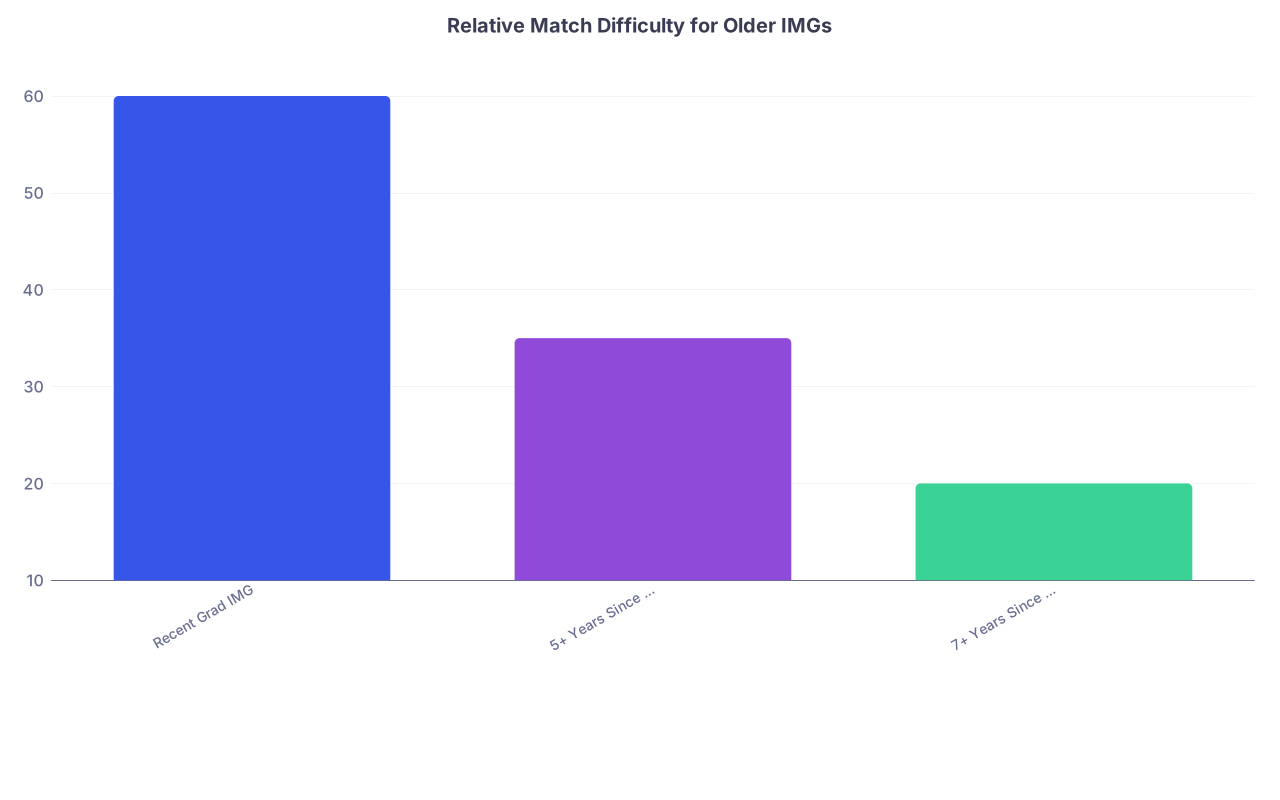
| Category | Value |
|---|---|
| Recent Grad IMG | 60 |
| 5+ Years Since Grad | 35 |
| 7+ Years Since Grad | 20 |
(Numbers are illustrative, not exact statistics, but the pattern is real: the longer out you are, the steeper the climb.)
You’re Not Too Late. You’re Just Not Allowed to Be Average.
Here’s the mindset shift that hurts but helps:
A fresh IMG can sometimes match with:
- Average scores
- One or two US rotations
- Decent letters
- No real story, just “I want to be a doctor in the US”
You cannot.
If you’re 7+ years post-graduation, you’re in a different category entirely.
You need to look exceptionally deliberate.
You almost have to overwhelm programs with:
- “Yes, I graduated a while ago—and here is everything I’ve done since to stay sharp and relevant.”
- “Yes, I took time away—and here’s what I learned and how it makes me a better resident.”
- “Yes, I’m older—but here’s my track record of responsibility, teamwork, stability, and grit.”
Think of it like this:
You’re asking them to take a risk.
Your entire application has one purpose: convince them that you are a calculated risk, not a blind gamble.

When Is It Actually Too Late?
Let me be brutally honest, because dancing around this doesn’t help.
It’s not too late just because:
- You’re 7–15 years from graduation
- You’re in your late 30s or even 40s
- You’ve done other work in the meantime
- You’re from a less-known med school
- You have to take Step exams now after years away from books
It might be too late for now if:
- You’re not willing to rebuild your profile over 1–3 years
- You won’t or can’t invest in USCE and exams
- You want a hyper-competitive specialty (derm, ortho, plastics) with no prior strong record
- You refuse to apply broadly or only want “top” programs or locations
And it might be time to stop if:
- You’ve applied multiple well-prepared cycles with:
- Good scores,
- USCE,
- US LORs,
- Step 3,
- Reasonable rank list
…and you still get nowhere
- It’s destroying your finances and mental health
- You no longer recognize yourself outside of “the person who keeps trying to match”
That’s not failure. That’s you refusing to let this system be the only measure of your worth.
But you’re not anywhere near that decision point yet.
You’re still at: “Should I even start?”
If you want a clean, comfortable guarantee, you won’t get one.
What you can get is this: it’s late, but not too late—if you treat this like the hardest professional project of your life.

| Step | Description |
|---|---|
| Step 1 | Decide to Pursue Residency |
| Step 2 | Assess Current Profile |
| Step 3 | Plan and Take Step Exams |
| Step 4 | Secure USCE and Clinical Role |
| Step 5 | Strengthen LORs and Story |
| Step 6 | Apply Broadly with Clear Narrative |
| Step 7 | Start Residency |
| Step 8 | Analyze, Improve, Decide on Next Cycle |
| Step 9 | Exams Done? |
| Step 10 | Recent Clinical Work? |
| Step 11 | Matched? |
FAQ (Exactly 5 Questions)
1. Do programs really have a strict “5-year since graduation” cut-off?
Some do. Some publicly say “within 3–5 years,” others quietly filter by graduation year in ERAS without telling you. But many programs don’t have a hard line and will consider older grads who bring strong USCE, solid scores, and a coherent story. You can’t control the silent filters; you can only make yourself competitive for the places that don’t auto-reject you.
2. I haven’t practiced clinically in years. Is that the kiss of death?
It’s a huge red flag, but not final—if you fix it. You’ll almost certainly need recent clinical involvement before you apply: US observerships/externships, research involving patient interaction, or solid clinical work in your home country. “I haven’t seen patients in 8 years but I really want this” is not going to land well. You need to show you still function as a clinician today, not just historically.
3. Should I take Step 3 as an older IMG?
If you can handle it, yes. For older IMGs—especially those needing visas—Step 3 is a big plus. It tells programs: this person can clear future licensing hurdles. That said, a failed Step 3 is worse than not having it. So you should only take it once you’ve prepared properly. But in a crowded, biased field, having Step 3 passed can nudge you from “risky” to “slightly less risky.”
4. Is it smarter to switch to an “easier” specialty like family medicine or psych?
“Easier” is relative, but yes: competitive specialties with limited spots (derm, ortho, plastics, neurosurgery) are borderline impossible for an older IMG without an insane profile. Internal medicine, family medicine, psych, peds—these are more realistic. But realistic doesn’t mean easy. You still need the same fundamentals: exams, USCE, letters, story. The specialty choice just determines how steep the uphill is.
5. How do I explain my long gap without sounding defensive or pathetic?
You keep it clean and factual. One paragraph in your personal statement, maybe a concise explanation in interviews: what happened, what you did with that time, and how it made you more prepared. You don’t apologize for existing. You don’t over-share every painful detail. You anchor it in growth: “During those years I worked in X / handled Y / learned Z. Now, here is what I’ve done recently to get clinically ready again.” Programs care much more about what you’ve done in the last 2–3 years than the exact shape of your gap.
Key takeaways:
- Being 7+ years out as an IMG makes this harder, not impossible—your gap is a problem only if you leave it unexplained and uncompensated.
- You’ll probably need 1–3 years of serious effort (exams, USCE, strong letters, clear story) before you’re truly competitive.
- It’s not too late to start—but it is too late to start casually.