
What do you do when you passed your exam… but the score is embarrassingly low for the specialty or programs you want?
Let me be direct: this is one of the most painful gray zones for IMGs. Failing is clear. Scoring high is clear. Passing with a low score? That’s where people make some of their worst strategic decisions.
You’re not really asking “Can I improve?”
You’re asking: “Is retaking this exam going to HELP me match, or just create more problems?”
Here’s how to answer that.
1. The Brutal Truth: How Programs Actually See Low but Passing Scores
Most IMGs underestimate how program directors think.
They don’t see “Pass.”
They see three things:
- Your raw score (if Step 2 / non-USMLE / pre-pass-fail era)
- Your pattern (first time pass vs fail vs retake)
- Your trajectory (upward, flat, or downward)
For IMGs, scores are often used as an initial filter. Especially at more competitive or academic programs.
Let’s break what a “low but passing” score often means in real life:
- For Step 2 CK:
- Below ~220: tough for competitive specialties, questionable for some university IM/FM programs, especially as an IMG.
- 220–235: usable for primary care/IM/less competitive programs, but not helping you stand out.
- 240+: starts helping you, especially as an IMG.
Non-US exams (PLAB, MCCQE, etc.) work a bit differently, but the logic is similar: a pass is required, higher scores sometimes help, and multiple attempts can hurt.
Now the key point:
A single low but passing attempt is usually better than a failure or multiple attempts.
That’s why retaking “just to raise the score” is often a bad idea unless:
- Retakes are allowed and common, and
- Programs don’t see all attempts, or
- Your current score is truly out of range for your realistic target.
For USMLE specifically:
You can’t “repeat” a passing Step exam anymore just to improve the score. If you passed, that’s it. The score is permanent. So in many cases, this “retake or not” question is more relevant to:
- Step 2 if you failed once and passed low
- Non-US exams (e.g., PLAB, OET, MCCQE)
- Country-specific licensing exams where repeats are allowed
So I’ll structure the rest of this like you do have a choice: a retake is on the table (for some exam, Step 2 or others), and you’re wondering if it’s smart.
2. The Core Framework: When Retaking Helps vs When It Hurts
Here’s the decision framework I actually use with IMGs:
You should only seriously consider retaking if most of these are true:
Your current score clearly blocks your target specialty/region
- Example: 210 Step 2 CK and you’re dreaming of US dermatology as an IMG. That door is effectively closed anyway.
- Example: Borderline PLAB/OET score and you’re below what most NHS trusts or training posts prefer.
You have a realistic path to 20+ point improvement (for USMLE-type exams) or a significantly higher band/percentile on other exams.
- Not “I hope.”
- “I have done UWorld correctly, NBME predict higher, my English/reading speed is actually better now, etc.”
Programs in your target area:
- See and value higher scores, and
- Don’t blacklist multiple attempts automatically
You’re early enough in your journey that delaying 6–12 months won’t wreck your entire timeline.
If those don’t line up, you’re usually better off owning your current score and building the rest of your application around it instead of gambling on a retake.
Let me make it simpler:
| Situation | Retake Likely Worth It? |
|---|---|
| Very low score + early in prep + clear chance to improve 20+ points | Yes |
| Low-moderate score + average prep + 5–10 point possible gain | Usually no |
| Competitive specialty dreams but mediocre score and limited resources | No – adjust specialty/targets |
| Primary care focus + passing score in range + strong CV potential | No – build everything else |
| Country exam where retakes are common and higher band clearly rewarded | Maybe – context dependent |
If you’re expecting a 5–10 point bump on a second attempt, it’s almost never worth the risk of looking like you needed multiple tries.
3. Specialty Reality Check: What Your Score Can and Can’t Buy You
You can’t answer “retake or not” without admitting what you’re aiming for.
Here’s the uncomfortable breakdown.
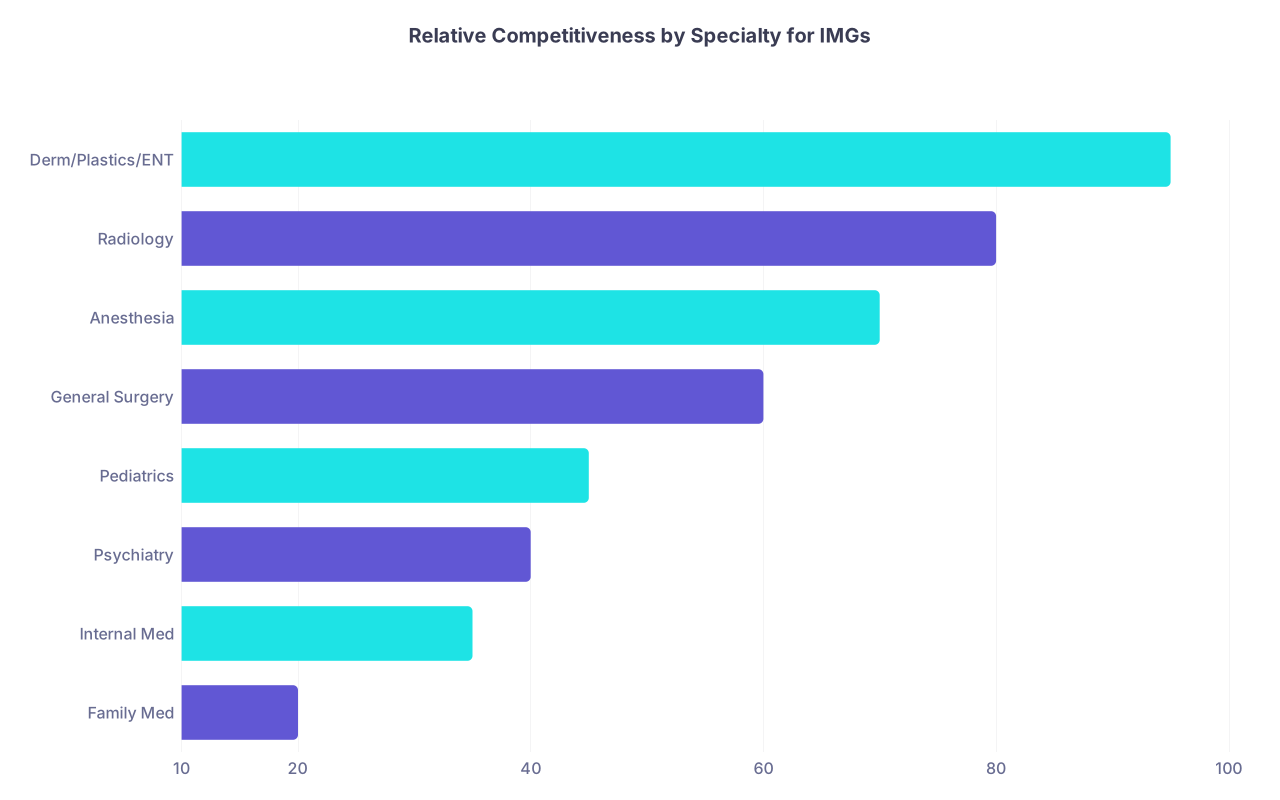
| Category | Value |
|---|---|
| Family Med | 20 |
| Internal Med | 35 |
| Psychiatry | 40 |
| Pediatrics | 45 |
| General Surgery | 60 |
| Anesthesia | 70 |
| Radiology | 80 |
| Derm/Plastics/ENT | 95 |
Higher number = harder for IMGs (rough idea, not exact data).
For less competitive specialties (FM, some IM, Psych, Peds)
If you’re targeting:
- US: community FM, community IM, some psych, some peds
- UK: non-training NHS posts first, then training routes
- Canada: extremely IMG restrictive, so exam score is one hurdle among many
For these fields, as an IMG:
- A low but passing score is often acceptable if:
- No failures
- Good clinical experience (USCE/UKCE)
- Solid letters
- Clear commitment to the specialty
Retaking for these specialties rarely changes your fate, unless your score is truly abysmal or you actually failed first then barely passed.
For mid-to-high competitiveness (university IM, anesthesia, rads, surgery)
Here, scores start to matter more. But they’re not the only metric.
- A low Step 2 score (say 215) does hurt you for:
- University IM programs in the US
- Competitive or oversubscribed UK training posts
- Retaking might be attractive, but only if:
- You’re early (no big gaps yet)
- You can demonstrate you underperformed relative to your true ability
- You have a plan to show big improvement
Still, multiple attempts can scare off programs that worry about test-taking reliability.
For ultra-competitive (Derm, Plastics, ENT, some Rads, Ortho)
If you’re an IMG with a low but passing score and aiming at these, don’t retake first.
Adjust expectations.
You’re not going to retake your way into derm from a 210 starting point as an IMG. Those fields are dominated by:
- Top scores
- US grads
- Research-heavy CVs and institutional connections
Your leverage is much better spent on:
- Research
- Networking at academic programs
- Considering alternate but related specialties
- Or different countries/routes entirely
Retaking in this setting is usually self-punishment, not strategy.
4. The Hidden Costs of Retaking: What People Don’t Factor In
Most IMGs only think: “If my score goes up, I’m better off.”
They ignore the collateral damage.
Time
Retaking a big exam properly is:
- 3–6+ months of serious prep
- Delayed applications by at least one cycle sometimes
- More “gap” time on your CV you’ll have to explain
Programs notice unexplained gaps. “Studying again for an exam I already passed” often doesn’t sound impressive.
Money
Exam fees, prep materials, lost income, visa/relocation delays.
If you’re already stretching finances, another 6 months without progress can hurt you more than a slightly low score.
Psychological load
I’ve seen IMGs who retook, scored only modestly higher, and then walked into interviews feeling insecure and apologetic. Program directors sense that.
If a retake doesn’t fundamentally change your competitiveness, all you’ve done is:
- Add stress
- Lose time
- Slightly adjust numbers that don’t actually move your application tier
5. When You Shouldn’t Retake: Red Flag Scenarios
Let me spell out some clear “don’t do it” situations.
You should NOT retake (or try to repeat an exam) if:
- You barely have time to apply this upcoming cycle and would have to delay a full year just to marginally improve.
- Your predicted improvement (based on NBMEs or practice scores) is small, like 5–10 points.
- Your target specialty and programs routinely accept IMGs with scores in your current range.
- The exam authority or programs strongly disfavor multiple attempts (common in many regions).
- Your main weaknesses are obviously elsewhere:
- No USCE/UKCE
- Weak letters
- No specialty-specific commitment
- Poor personal statement or interview skills
Don’t use retaking as a way to avoid fixing the real problems in your application.
6. Smart Alternatives to Retaking: How to Work With a Low Score
Let’s say you decide: “Retaking isn’t worth it.”
You’re not done. You just have a different job now: make the rest of your application so strong that your low score is just background noise.
Here’s how.
1. Pick targets that actually fit your score
Stop aiming blind. Build a target list where IMGs with your profile have actually matched.
Talk to:
- Recent IMGs from your med school
- Residents from your country in your target system
- Specialty-specific IMG groups
Your motto: “Right doors, not more doors.”
2. Build a clear upward trajectory
If your licensing exam score is mediocre, show:
- Improved later exam performance (if any remain)
- Strong clinical evaluations
- Good in-training or workplace feedback
- Evidence that you learn fast and perform well in real clinical settings
Programs care about reliability: will you pass boards, handle call, not crumble under pressure?
A low score hurts less if you:
- Passed on first attempt
- Have strong later evaluations and performance
3. Lean hard into clinical experience + letters
For IMGs, high-quality USCE/UKCE can sometimes outweigh a mediocre score.
What works:
- 2–4 months of supervised, hands-on or high-quality observerships in your target specialty
- Letters that say more than “hardworking and pleasant”
- You want: “This applicant performed at or above the level of our interns”
- Or: “I would not hesitate to rank this applicant highly on our list”
4. Own your score, don’t apologize for it
On interviews, if your score comes up, a solid answer looks like:
- Brief context (if any), no drama
- Evidence of growth
- Confidence in your current clinical performance
Example:
“I was disappointed with that score, to be honest. Since then I changed how I study and focused more on question-based learning. My clinical performance evaluations have been strong, and I’m confident I can handle the in-training exams. My recent practice metrics reflect that.”
Then stop talking. Don’t over-explain.
7. A Simple Step-by-Step Decision Guide
Use this as your personal flowchart.

| Step | Description |
|---|---|
| Step 1 | Low but passing score |
| Step 2 | Do not retake - build rest of CV |
| Step 3 | Adjust specialty/targets |
| Step 4 | Keep score, improve other areas |
| Step 5 | Apply with current score |
| Step 6 | Plan focused retake with clear goal |
| Step 7 | Blocks target specialty or country? |
| Step 8 | Realistic big improvement? |
| Step 9 | Retakes accepted by programs? |
| Step 10 | Early enough in timeline? |
If you land on C, E, G, or I: stop obsessing over the exam. Your energy belongs elsewhere now.
FAQs
1. I’m an IMG with a low Step 2 score but no failures. Is that worse than someone with a higher score but one fail?
For many programs, a clean record with a lower score is better than a high score after a fail. A fail can be a major red flag for some PDs, especially in competitive fields. They worry about you struggling with boards or in-training exams. So if you’ve got a low but passing first attempt, don’t envy the person who failed once then “redeemed” themselves. You might actually be in a stronger position.
2. Should I explain my low score in my personal statement?
Usually no. Unless there’s a very clear, concrete, and now-resolved reason (serious illness, exam-day emergency, major life event) and you can show strong performance since. Even then, keep it to 1–2 sentences. Over-explaining looks defensive. Program directors don’t want a dramatic story; they want evidence you’ll be solid in residency.
3. If I can’t retake, how do I know if my score is “good enough” for my specialty?
Look at actual match outcomes, not rumors. Join specialty-specific IMG groups, talk to residents with similar backgrounds, search for match statistics, filter program PDFs for “IMG” and “score” if available. If multiple IMGs with your kind of score have matched recently into your target specialty and region, you’re in range. If you can’t find anyone even close—time to adjust.
4. Does research help offset a low exam score for IMGs?
It can. Especially for academic IM, rads, onc, and some surgical fields. But “I have three case reports” isn’t enough to override a truly weak score. Substantial research (multiple projects, real responsibility, maybe a publication or poster at a known conference) can move you from “probably no” to “maybe worth interviewing.” It’s a multiplier if your score isn’t fatal—but it rarely saves an application that’s completely out of range.
5. What if my friends all say I should retake to be “competitive”?
Your friends don’t run residency programs. A lot of IMGs talk in absolutes: “Under 240 is trash,” “You need 250+,” etc. That’s noise. Focus on your actual target programs and what they’ve historically accepted. Retaking because of peer pressure is one of the dumbest moves I see. If a retake doesn’t clearly change your tier of competitiveness, you’re just burning time and money for bragging rights.
Key points to walk away with:
- A low but passing score is often better than a failure or multiple attempts; retaking rarely helps unless you can clearly jump tiers.
- Your strategy should be driven by target specialty + country reality, not ego or peer pressure.
- If retaking won’t meaningfully change your odds, stop fixating on the number and invest heavily in the rest of your application: right programs, real clinical experience, strong letters, and a coherent story.