
How much US clinical experience do you actually need as an IMG—4 weeks, 12 weeks, a full year—or are you just guessing and hoping someone on Reddit is right?
Let me give you a straight answer first, then we’ll build the framework.
If you’re an IMG applying to a moderately competitive IM or FM program, a realistic minimum target is:
- 8–12 weeks of solid, clinical, hands-on or direct patient-care USCE (not just observerships)
- With at least 2 strong US LORs from that experience
- Completed before you submit ERAS
Can people match with less? Yes. Do they? Every year. But if you want to plan like an adult and not like a gambler, that 8–12 week range is where I’d anchor.
Now let’s make this practical, based on who you are and what you’re aiming for.
1. First: What Actually Counts as “USCE” (And What Doesn’t)
Programs are annoyingly inconsistent in how they define US clinical experience, but there’s a practical way to sort this.
Here’s the hierarchy—from strongest to weakest, in the eyes of most PDs:
US Residency-Style Experience (Best)
- Sub-internships / acting internships where:
- You write notes
- You present patients
- You’re treated like a junior intern
- Rotation types: Internal Medicine wards, ICU, Surgery, Pediatrics, etc.
- Usually for current students or very recent grads
- Sub-internships / acting internships where:
Hands-On Clinical Rotations
- You see patients, take histories, do physical exams, present to attendings, help with orders (under supervision)
- Can be through:
- University hospitals
- Community hospitals
- Reputable third-party companies linked to real hospital sites
- These generate the best, specific LORs
Direct Patient-Care but Less Formal
- Clinical externships after graduation where:
- You work alongside residents/attendings
- You’re on the floors, clinics, ED, etc.
- Not always called “USCE” by every program, but many PDs value it highly if clearly described
- Clinical externships after graduation where:
Observerships (Weak, but Better Than Nothing)
- You shadow, watch, maybe discuss cases
- No direct patient contact
- Letter quality is often generic: “He was punctual, interested, etc.”
- These DO NOT replace real USCE, but they can help for:
- Networking
- Showing some exposure to US system
Research Only (Usually Not USCE at All)
- Pure bench/clinical research with no patient care
- Great for academic programs or research-heavy specialties
- But it does not answer: “Can this person function on my wards?”
You want as much of category 1–3 as possible. Observerships are filler, not foundation.
2. The Real Question: How Much USCE Do You Need?
USCE isn’t one-size-fits-all. You adjust it based on:
- Specialty competitiveness
- Your exam scores
- Time since graduation
- Your citizenship/visa status
- How weak the rest of your application is
Here’s a simple way to look at it.
| Applicant Type | Recommended USCE | Ideal US LORs |
|---|---|---|
| Strong IMG, recent grad | 8 weeks | 2–3 |
| Average IMG, recent grad | 8–12 weeks | 2–3 |
| >5 years since grad | 12–16 weeks | 3–4 |
| Low scores / attempts | 12–20 weeks | 3–4 |
| Aiming for competitive specialty | 12–24 weeks | 3–4 |
Let me translate that into real numbers.
If you’re a strong applicant (good scores, recent grad, aiming IM/FM)
- Step 2 CK: ≥ 240
- YOG: within 2 years
- No major red flags
You can realistically target:
8 weeks of solid USCE (clinical, not just observership) with 2 strong US LORs.
You’ll be competitive for many community and some university-affiliated programs if the rest of your application is put together well.
If you’re an average applicant (most people)
- Step 2 CK: 220–239
- YOG: within 3–5 years
- No big professionalism issues
You’re better off with:
8–12 weeks of USCE and 3 US LORs if you can.
Some of that can be mixed hands-on and observership, but at least 8 weeks should be genuinely clinical.
If you’re an older grad / have red flags
- YOG: > 5–7 years
- Or Step attempts / lower scores
- Or switching specialty / non-clinical gap years
You’re in “show me, don’t tell me” territory. PDs will assume rust until proven otherwise. Aim for:
12–16+ weeks of USCE, ideally within the last 12 months, and 3–4 US letters that clearly state you function at an intern level.
3. Specialty-Specific Reality Check
Some specialties simply demand more USCE from IMGs. Not always written on the website, but very real on the PD side.
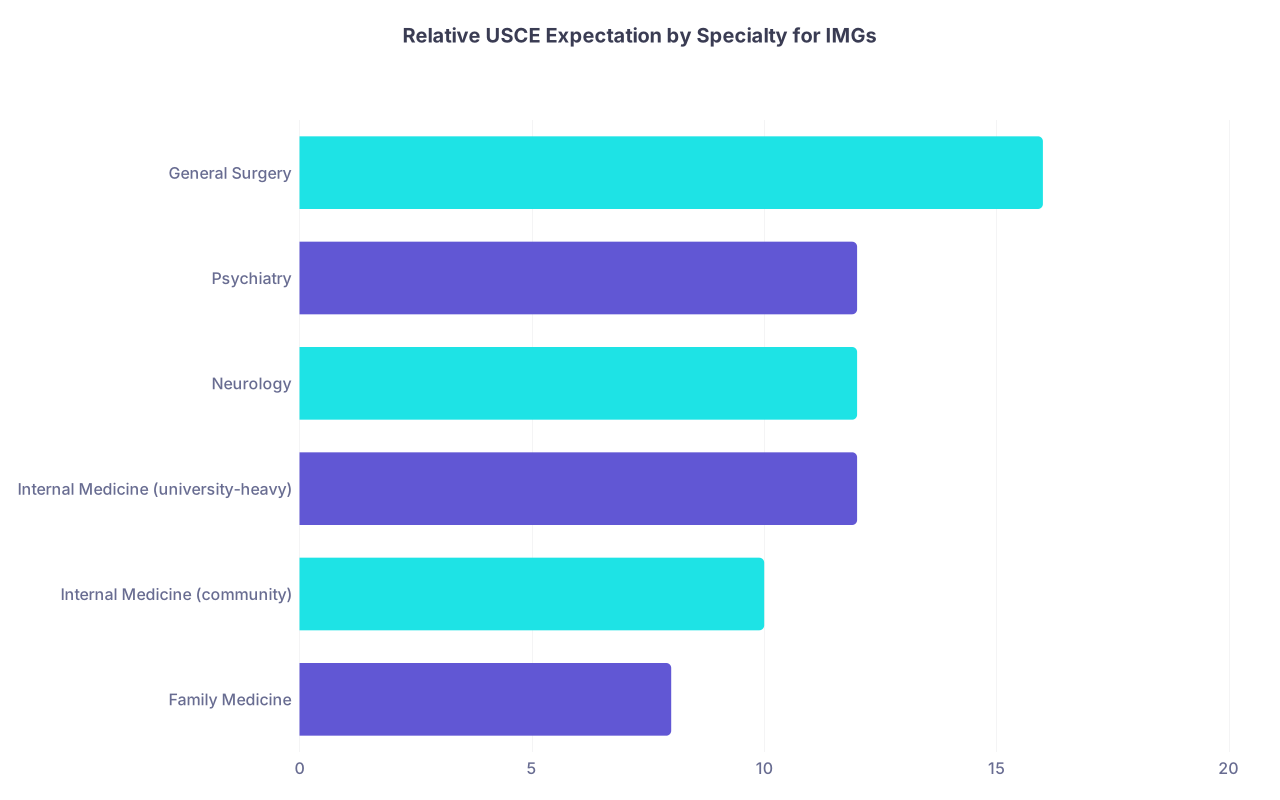
| Category | Value |
|---|---|
| Family Medicine | 8 |
| Internal Medicine (community) | 10 |
| Internal Medicine (university-heavy) | 12 |
| Neurology | 12 |
| Psychiatry | 12 |
| General Surgery | 16 |
Interpretation (those numbers are typical “comfortable” week targets, not strict rules):
Family Medicine
- 6–8 weeks USCE is often enough if the rest is solid
- FM values continuity, primary care exposure, and communication more than fancy ICU stuff
Community Internal Medicine
- 8–12 weeks is where most matched IMGs land
- At least one rotation on inpatient IM if possible
University-Based IM / Academic Programs
- 12+ weeks is safer
- They care about letters from academic attendings, especially from their own or comparable institutions
Neurology / Psychiatry
- 12 weeks total USCE, with at least 4–8 weeks in the specialty if possible, is a good target
- They still want to see internal medicine exposure
General Surgery (and more competitive fields)
- 16–24 weeks of very strong, hands-on USCE is not crazy for serious applicants
- At least 1–2 sub-I/AI equivalents if your school or visa situation allows
- Letters from US surgeons carry a lot of weight
4. The 3-Pillar Framework: Think in “Weeks + Letters + Freshness”
Stop thinking only in “How many weeks.” Programs are looking at three things together:
- Total weeks of credible USCE
- Number and quality of US letters from that USCE
- How recent that experience is
The stronger the other two, the more you can sometimes get away with less of the first.
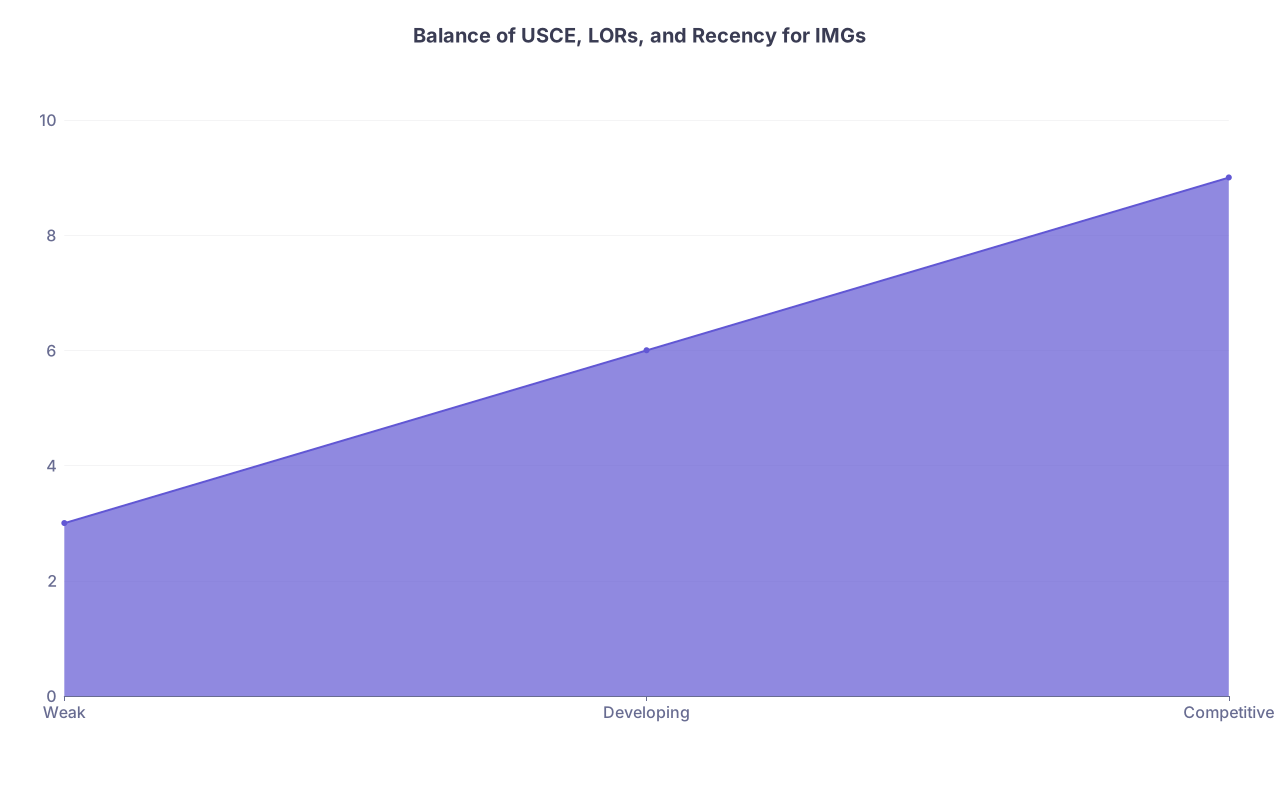
| Category | Value |
|---|---|
| Weak | 3 |
| Developing | 6 |
| Competitive | 9 |
That area chart is conceptual: weak vs developing vs competitive applicants tend to have USCE, letters, and recency all improving together.
Here’s how I’d structure the pillars:
Pillar 1: Weeks (Breadth and Depth)
- Aim for at least:
- 8 weeks for strong applicants
- 8–12 weeks for average
- 12–16 weeks+ for red flags / older grads / competitive fields
Split that time smartly:
- 1–2 rotations in your target specialty
- 1–2 rotations in general IM/FM/wards/ICU
Pillar 2: Letters (Your Real Currency)
For most IMGs, the letters from USCE matter more than the raw number of weeks.
You want:
- At least 2 US clinical letters; 3 is better
- Ideally:
- 1–2 from attendings in your target specialty
- 1 from IM/FM ward attending who can say you function at PGY-1 level
A single, detailed, specific letter from a well-known attending is more valuable than 4 generic “he was nice and came on time” LORs.
Pillar 3: Recency (How Fresh It Looks)
Programs quietly ask: “Can this person walk into my hospital and not drown?”
So:
- USCE more than 24–36 months old starts to lose power
- If you’re >5 years from graduation, they like to see:
- At least some USCE in the 12 months before you apply
If your last real clinical experience was 2019, no amount of “I am passionate about medicine” in your personal statement fixes that.
5. What If You Can’t Afford More Rotations?
I’ve worked with plenty of IMGs who simply cannot pay for 6 different US rotations. Financial and visa limits are real.
Here’s how to make limited USCE work harder:
Prioritize rotation type over total weeks
- One gold-standard 4-week inpatient IM or FM rotation is more valuable than three fluffy observerships
- If you can do only 8 weeks, make sure at least:
- 4 weeks = inpatient medicine (ward/ICU)
- 4 weeks = your target specialty or strong outpatient setting
Maximize letter quality
- Show up early, present clearly, volunteer appropriately
- Ask for feedback before the end: “How can I improve to function like an intern?”
- Ask for the letter when you’ve had at least 2–3 weeks of consistent interaction
Leverage any non-US but recent clinical work
- If you’ve been working abroad clinically:
- Make that clear on your CV and personal statement
- Get one excellent non-US clinical letter in addition to your US letters
- If you’ve been working abroad clinically:
Use observerships strategically
- Networking value > CV value
- If you can’t get real hands-on at a specific hospital, an observership might get you face time with:
- PDs
- APDs
- Core faculty
6. A Simple Planning Timeline
If you’re 9–18 months away from applying, here’s a structure that works for most IMGs.
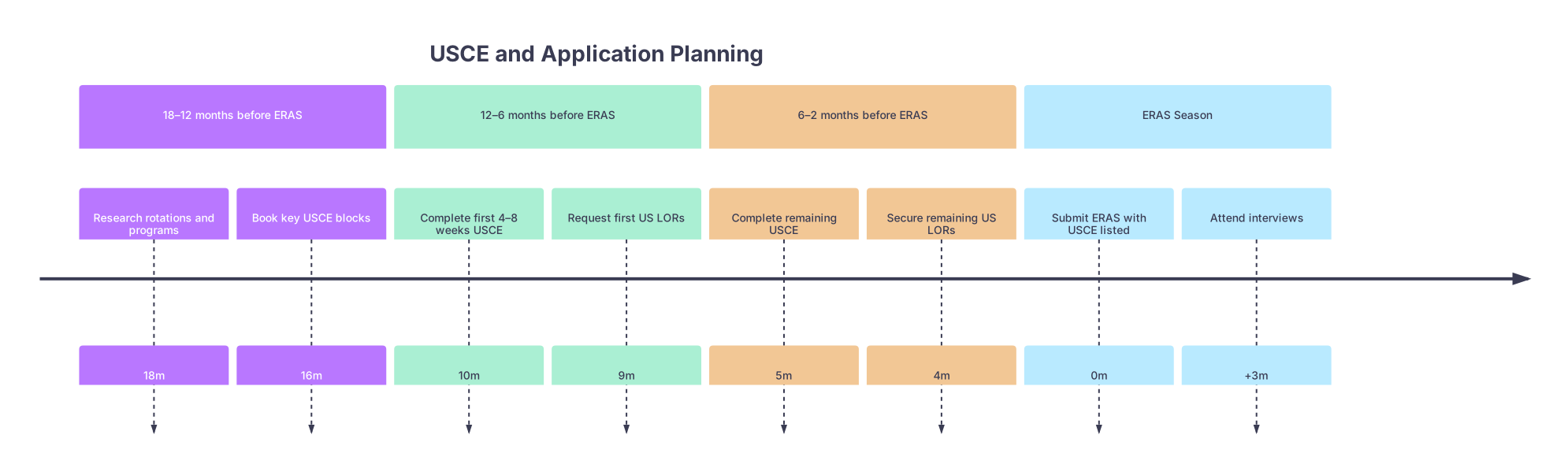
| Period | Event |
|---|---|
| 18–12 months before ERAS - Research rotations and programs | 18m |
| 18–12 months before ERAS - Book key USCE blocks | 16m |
| 12–6 months before ERAS - Complete first 4–8 weeks USCE | 10m |
| 12–6 months before ERAS - Request first US LORs | 9m |
| 6–2 months before ERAS - Complete remaining USCE | 5m |
| 6–2 months before ERAS - Secure remaining US LORs | 4m |
| ERAS Season - Submit ERAS with USCE listed | 0m |
| ERAS Season - Attend interviews | +3m |
If you’re closer than that, compress where you must, but still try to:
- Finish at least one US rotation before ERAS opens
- Have at least two US LORs uploaded early in the season
7. Red Flags That Tell You “You Need More USCE”
You probably need more USCE than you think if:
- You graduated >5 years ago and have no recent clinical work
- Your prior application seasons got very few or no interviews
- All your letters are from your home country and 3+ years old
- Your only US experience is:
- One 2-week observership
- Or a 4-week research observership with no real clinical exposure
In these situations, adding another 8–12 weeks of focused, strong USCE can be the difference between “auto-screen reject” and “Okay, let’s give them a look.”
8. The Bottom Line Framework
If you remember nothing else, use this decision rule:
Target:
- 8 weeks USCE + 2–3 US LORs if you’re strong
- 8–12 weeks + 3 LORs if you’re average
- 12–16+ weeks + 3–4 LORs if you’re older grad/with red flags/aiming competitive
Make sure at least one rotation is:
- Inpatient IM/FM (wards/ICU preferred)
Ensure your USCE is:
- Within 1–2 years of application
Treat letters as:
- The main product of your USCE
That’s what “enough” USCE looks like for most IMGs who actually match.
FAQs
1. Can I match with zero USCE as an IMG?
Yes, but it’s rare and usually limited to:
- US citizens/green card holders
- Very strong applicants (excellent scores, research, connections)
- Certain FM or very IMG-friendly community programs
If you’re asking this question, you probably shouldn’t count on being the exception. Even 4 weeks of good USCE is massively better than none.
2. Do observerships count as USCE?
Technically, some programs lump them under “US clinical experience,” but functionally they’re the weakest form. Most PDs don’t see pure observerships as equivalent to real, hands-on rotations. Use them as a bonus or networking tool, not your main clinical exposure.
3. Is one 4-week rotation enough if I get a great letter?
If your profile is strong (recent grad, solid scores, no red flags) and the letter is truly outstanding and specific, one 4-week rotation can be enough for some community IM/FM programs. But for safety, I’d still push toward at least 8 weeks if you can. Programs are more comfortable when they see your performance repeated in more than one setting.
4. How old is “too old” for USCE?
USCE older than 2–3 years starts to feel stale, especially if you haven’t been doing clinical work in the meantime. If you’re an older graduate or have a long gap, aim for at least 4–8 weeks of fresh USCE in the 12 months before you apply, even if you’ve done some years ago.
5. Should I do more USCE or more research if I have limited time?
For most IMGs targeting IM/FM/Neuro/Psych/community programs, more USCE beats more research. Choose research only if:
- You’re applying to very academic programs
- Or a research-heavy specialty
- And you already have a baseline of 8–12 weeks of USCE with solid letters
If you’re below that USCE baseline, fix the clinical side first.
Open your CV right now and count: How many real weeks of recent, clinical, US experience do you have, and how many solid US letters can you get from it? If the numbers do not match the targets above for your profile, your next step this week is to identify and book your next rotation—before you waste another application season guessing.