You’re six months from ERAS opening. Your CV is… fine, but not impressive. You’ve got some observerships, a couple of conference posters from home, and decent scores. Now you’ve been offered two options: a 1-year unpaid research position at a big academic center, or a chance to line up 3–4 US clinical rotations over the next year.
You cannot do both well. So the real question: as an IMG, should you prioritize research or more clinical experience?
Here’s the answer you’re looking for: it depends on your target specialty, your current profile weaknesses, and how much time you have before applying. Let’s walk through this like a decision consult, not vague “it depends” fluff.
1. The Core Rule: What Does Your Target Specialty Reward Most?
If you ignore everything else, remember this:
Programs don’t reward “effort.” They reward evidence you can function in their world.
For IMGs, that “evidence” usually comes in three flavors:
- US clinical experience (USCE) + strong US letters
- Research productivity (especially in competitive specialties)
- Board scores and recency of graduation
Different specialties value these in different proportions.
| Specialty | Priority for IMGs |
|---|---|
| Internal Medicine (community-heavy) | Clinical > Research |
| Internal Medicine (academic) | Research ≥ Clinical |
| Family Medicine | Clinical >> Research |
| Pediatrics | Clinical > Research |
| Neurology | Clinical ≥ Research |
| Psychiatry | Clinical > Research |
| General Surgery | Research ≥ Clinical |
| Radiology / Derm / Neuro / Ortho | Research >> Clinical |
If you’re aiming for:
Family Med / Community Internal Med / Psychiatry / many Pediatrics programs
You almost always get more return from US clinical experience + strong US letters than from a low-impact research year.Academic Internal Med / Neurology / General Surgery / Radiology / Derm / other very competitive fields
Research can move the needle a lot more, but only if it’s real, productive, and targeted to that specialty.
This is the first filter. If your dream is Yale cardiology down the line, your path doesn’t look the same as someone happy with a solid community IM job in Ohio.
2. When You Should Clearly Prioritize US Clinical Experience
If any of these describe you, clinical experience should usually win:
- You have little or no USCE (0–1 months)
- Your letters are weak or all from outside the US
- You’re >3 years from graduation and worried about “freshness”
- You’re applying to community-heavy specialties like FM, IM (non-academic focus), Psych, many Peds
Programs use USCE for two main reasons:
- To see how you function in the US system, and
- To generate trusted US letters from people they know or recognize.
What “Good” US Clinical Experience Looks Like
Not all USCE is equal. The hierarchy is basically:
- Hands-on electives / subinternships (if still a student)
- Hands-on externships (graduates)
- Strong, structured observerships with active involvement
- Shadowing or random “experience” with no defined role (lowest value)
You want:
- 1–3 months in your target specialty
- At least 2 strong US letters from those rotations
- Ideally at teaching hospitals or programs that take IMGs
If you have:
- 0 months USCE and no US letters → Pick clinical.
- 1 month USCE and one decent letter → Probably still pick clinical until you have 2 solid letters.
- 3–4 months targeted USCE and strong letters → Then research becomes more interesting if your specialty needs it.
The Biggest Mistake I See
IMGs stacking 6–8 months of low-yield observerships with generic letters like “hard worker, pleasant, punctual” and expecting that alone to get them into academic IM.
Too much low-quality clinical is just as bad as too much weak research. You want enough good clinical, not infinite mediocre clinical.
3. When You Should Clearly Prioritize Research
Now the flip side. You should seriously consider prioritizing research if:
- You’re aiming for highly competitive specialties:
- Dermatology
- Radiology
- Neurosurgery
- Ortho
- Academic General Surgery
- Top-tier academic IM with subspecialty plans (e.g., cardiology, GI, heme/onc)
- Your CV is clinically acceptable, but academically empty
- You want to end up in a research-heavy career or academic track
For these fields, not having research is a red flag. Not because they want articles for fun, but because research is their culture. They want colleagues who understand that world.
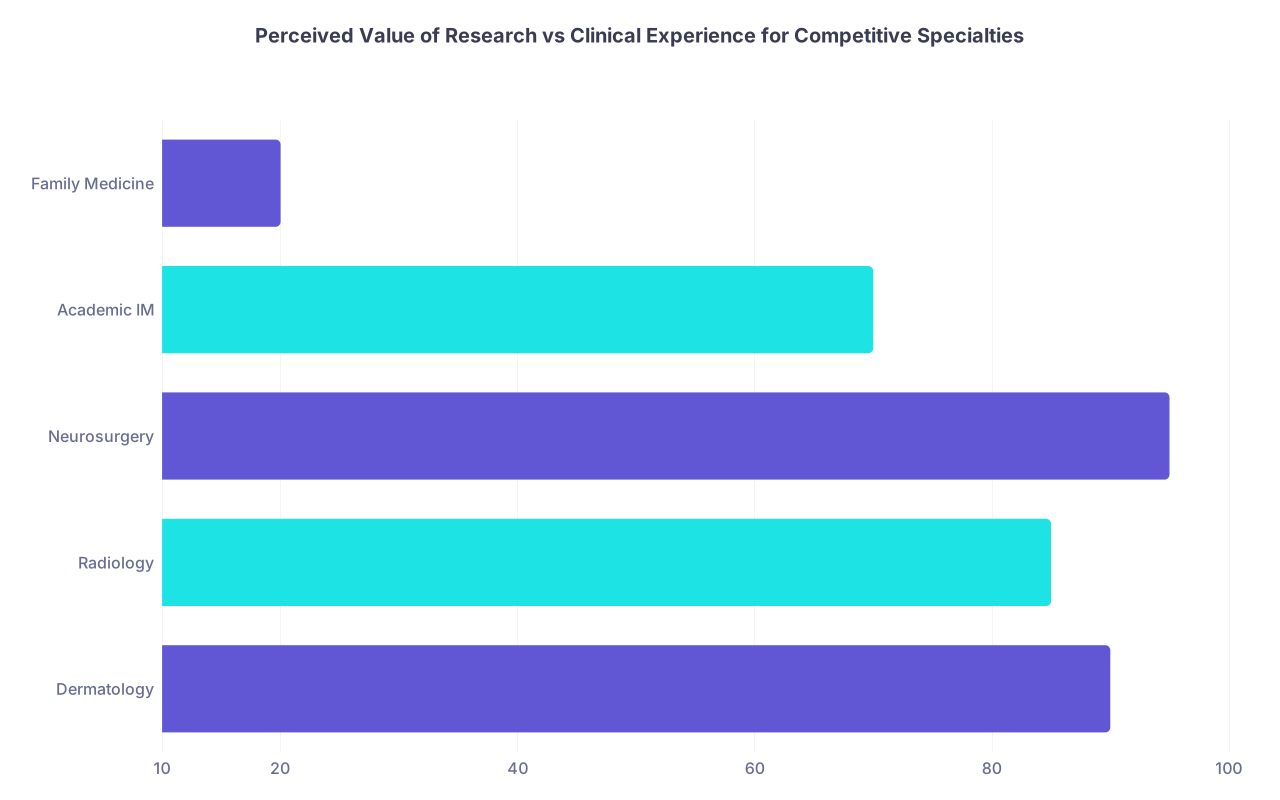
| Category | Value |
|---|---|
| Dermatology | 90 |
| Radiology | 85 |
| Neurosurgery | 95 |
| Academic IM | 70 |
| Family Medicine | 20 |
What Counts as “Serious” Research for IMGs
You’re not impressing anyone with “I helped with data entry on a QI project.”
Programs look at:
- Type of work: Clinical outcomes, meta-analyses, retrospective cohorts, trials, specialty-specific work
- Productivity:
- Abstracts → Posters → Presentations → Publications
- Timeframe: What you did in the last 2–3 years, not what you did 8 years ago in undergrad
- Mentor name and institution: Well-known PI or department chair > unknown private clinic
A good 1-year research position should give you a realistic shot at:
- 1–3 abstracts/posters
- 1+ publication (submitted or accepted)
- A strong letter from a recognizable academic physician
If your “research opportunity” is just someone telling you “maybe we’ll find a project later,” that’s not a good reason to sacrifice clinical.
4. Time Until Application: The Real Constraint
You can’t cram everything into 3 months. Let’s be practical.
If You’re Applying This Coming Cycle (6–9 months away)
You need moves that pay off quickly.
High-yield:
- US clinical rotations that generate immediate letters
- Finishing ongoing research to get submitted or accepted status on something you can list
- Polishing your CV, personal statement, and networking in programs where you rotate
Low-yield for this year’s match:
- Starting a brand-new basic science project that won’t publish for 2–3 years
- Committing to a 1-year unpaid research job that won’t give you outputs before ERAS
If your timeline is short and your clinical is weak, the answer is almost always: clinical first.
If You Have 1–2 Years Before Applying
Now you can think in sequences, not either/or:
Year 1: Focus on research at a strong academic place
Year 2: Do USCE at that same institution → get letters from both your PI and clinicians
Or the reverse:
Year 1: Build USCE + letters
Year 2: Get research in your target specialty now that you’ve proven yourself

| Step | Description |
|---|---|
| Step 1 | Now |
| Step 2 | Prioritize US Clinical |
| Step 3 | Year 1 - Research |
| Step 4 | Year 2 - US Clinical |
| Step 5 | Year 1 - US Clinical |
| Step 6 | Year 2 - Optional Research |
| Step 7 | Time to Application |
| Step 8 | Specialty Type |
If you have time, the best profiles don’t choose one forever. They sequence both strategically.
5. How to Decide For You – A Simple Framework
Here’s how I’d walk you through this as if you were sitting in my office.
Step 1: Define your realistic target specialty in this cycle
Step 2: Count your current assets:
- USCE months in that specialty: 0 / 1–2 / 3+
- Number of strong US letters (people who know you well and will write detailed praise): 0 / 1 / 2+
- Research outputs in that specialty: 0 / 1–2 abstracts or posters / ≥1 publication
- Time since graduation: <2 years / 3–5 years / >5 years
Step 3: Match it against this table:
| Profile Type | Priority |
|---|---|
| No USCE, no US letters, no research | Strong USCE first |
| 2–3 months USCE, 2 letters, no research | If competitive field → research; otherwise optional |
| Strong research, no USCE | Must get USCE before applying |
| Some USCE, weak letters, weak research | Improve clinical + letters |
| Aiming for Derm/Rads/Neurosurg with no research | Research immediately |
Step 4: Ask yourself bluntly:
- “If a PD looked at my CV right now, what’s the most obvious hole?”
- “Does my target specialty care more about seeing me work in their system, or seeing that I can produce academic work?”
That hole is what you should fill next.
6. How Program Directors Actually Think About This
I’ve heard versions of this from multiple PDs, often over bad coffee during interview season.
For community IM/FM/Psych PDs, typical mindset:
- “I want someone who can hit the ground running on wards.”
- “Do they understand US documentation, communication, reliability?”
- “Do I trust the letter writers who are vouching for them?”
If you come with:
- 4 months USCE
- Strong letters from US attendings
- Pass on Step 2 and decent scores
You’re much more attractive than someone with 6 papers and no US clinical footprint.
For academic IM / competitive specialties, mindset shifts:
- “Will this person help our academic profile?”
- “Are they comfortable with literature, projects, QI, presentations?”
- “Do they have a story that fits an academic trajectory?”
If you show up with:
- No research in their specialty
- No sense of academic direction
You’re behind. Even with some USCE.
7. Avoid These Common IMG Traps
I’ve seen these hurt applicants over and over:
Infinite observerships: 8–10 months of low-yield shadowing without building tight relationships or getting strong letters. That’s just time burned.
Fake or fluff research: Listing “10 projects” that are all “in progress,” none submitted, no clear role. PDs can smell padding.
Misaligned research: Applying to Psych with only GI and oncology research. It’s something, sure, but not nearly as convincing as one solid Psych project.
Ignoring recency: Being 7 years out of graduation, no recent USCE, but spending a year on a lab bench. Many programs care more about clinical recency than another low-impact paper.
Overestimating weak publications: A single case report in a predatory journal is not a research year. It’s an anecdote.
8. Concrete Scenarios – What You Should Do
Let’s make this painfully specific.
Scenario 1: Future Community IM Physician
- IMG, 3 years since graduation
- Step 2: 234
- USCE: 1 month IM observership
- No research
- Wants community IM, open to anywhere
Your move: More clinical, yesterday.
Aim for:
- 2–3 more months of IM USCE
- 2 strong IM letters from US attendings
- Maybe one small QI or case report if organically available, but don’t chase it at the expense of rotations.
Scenario 2: Wants Academic IM with Cardiology Fellowship
- IMG, 1 year since graduation
- Step 2: 245
- USCE: 2 months IM, 2 decent letters
- Research: 0
- Has 18 months before ERAS
Your move: Hybrid, weighted to research first.
Year 1: 9–12 months cardiology/IM research at a decent academic center → aim for abstracts + at least 1 manuscript
Year 2: 2–3 months IM USCE at that institution → get letters from both clinical and research mentors.
Scenario 3: Aiming for Radiology / Derm
- Strong scores, some home-country research, no US research
- 1–2 months USCE in IM or general rotations
- 1 year before application
Your move: Research. Hard.
Find a serious, specialty-aligned research position in radiology or derm. Use whatever USCE you already have to show clinical baseline, but your differentiator will be academic work and letters from big names in that field.
9. Quick Reality Check: What If You Choose Wrong?
You’re not ruined forever if you pick “research” and realize 8 months later you needed more clinical. It just means your next step needs to compensate.
Bad path:
1 year low-yield research → apply with no USCE → weak match.
Better salvage path:
1 year research → 3–4 months USCE → apply a cycle later with a balanced application.
You’re allowed to adjust your strategy. Just don’t stack multiple low-yield years back-to-back.
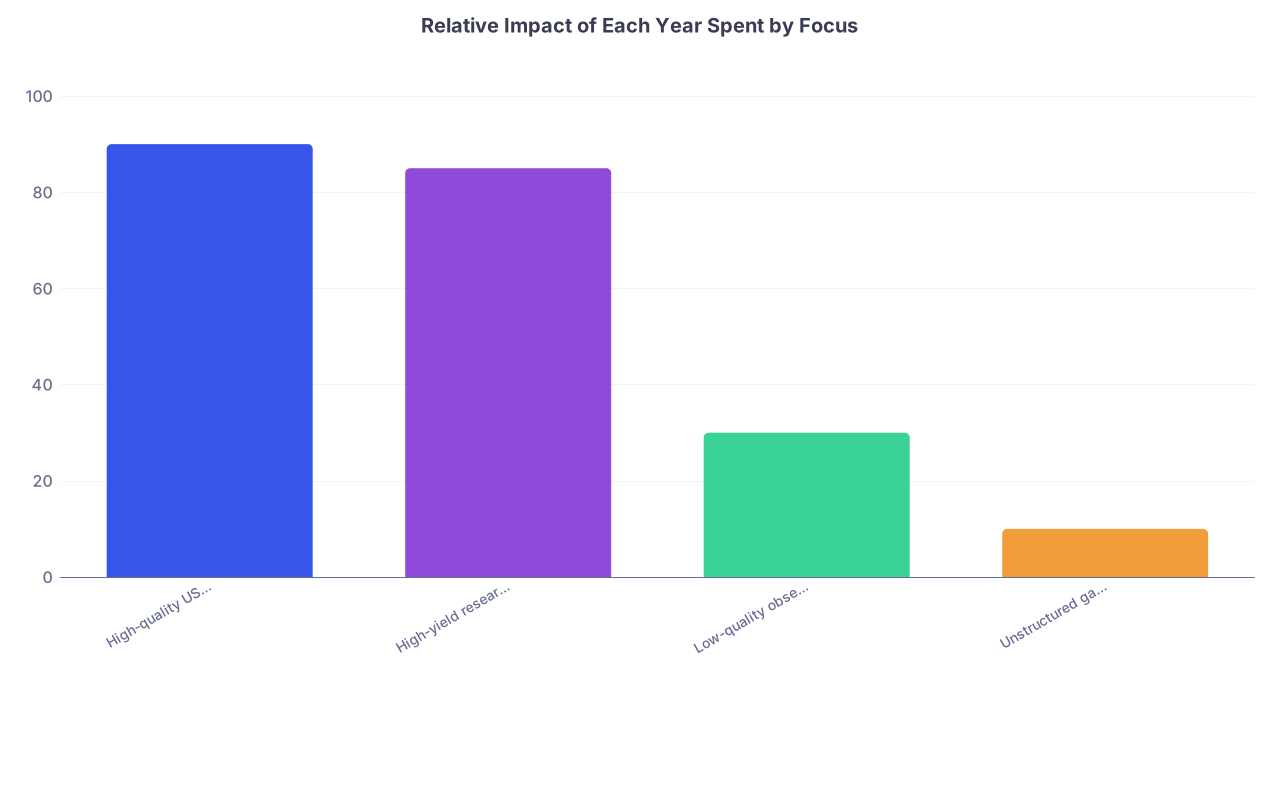
| Category | Value |
|---|---|
| High-quality USCE year | 90 |
| High-yield research year | 85 |
| Low-quality observership year | 30 |
| Unstructured gap year | 10 |
FAQ – Exactly 7 Questions
1. I have zero US clinical experience but a chance at a research year. What should I do?
If you’re targeting community IM/FM/Psych or want to match soon, US clinical first. Programs will be nervous about someone with no demonstrated ability to function in the US system. If you’re targeting a highly competitive specialty and have 1–2 years, you might do research first but you still need USCE before applying.
2. How many months of USCE are “enough” for most IMGs?
For most less-competitive specialties, 2–3 months of good, specialty-aligned USCE plus 2 solid US letters is usually enough to not be clinically “underqualified.” More can help, but after that, you hit diminishing returns unless those extra months are at very strong programs or with influential attendings.
3. Does research in any field help, or does it need to be in my target specialty?
General research is better than none, but specialty-aligned research is clearly stronger. Psych programs prefer Psych research. Cards fellowships like cardiology-related work. The closer your research is to what you say you want to do, the more coherent your story and the stronger the impact.
4. Are case reports and small projects worth doing?
Yes, as supplements. A couple of well-done case reports with your name first can show initiative and familiarity with academic writing. But they’re not a substitute for serious research if you’re aiming at competitive specialties. For community-oriented specialties, a few small projects plus solid USCE is usually enough.
5. How recent should my clinical experience be to still count?
Ideally, within the last 1–2 years when you apply. If your only clinical experience is 4–5 years old, many PDs will quietly downgrade you. In that situation, recent USCE becomes more urgent than research.
6. Is a low-yield research year ever better than strong USCE?
For most IMGs applying to non-ultra-competitive specialties: no. A weak research year with no publications or clear outputs is generally less valuable than a year spent getting robust USCE and powerful letters. The only exception is if that research position gives you access to a famous mentor whose letter can open doors.
7. Can I match with no research at all?
Yes, absolutely—for many specialties and many programs. Plenty of IMGs match into Internal Medicine, Family Medicine, Psychiatry, and Pediatrics with minimal or no research, as long as they have:
- Solid scores
- Strong, recent USCE
- Good letters
If you’re chasing competitive academic fields or top-tier universities, then research becomes closer to mandatory.
Key Takeaways
- Choose based on specialty + your biggest current gap, not what people on forums glorify.
- For most IMGs in community-oriented fields, strong USCE and letters beat a weak research year.
- For competitive academic specialties, high-yield, specialty-focused research can be decisive—but only if it’s real, productive, and paired with at least some US clinical experience.