
Does My Year of Graduation as an IMG Matter This Much? How to Interpret It
It’s late at night. You’ve got ERAS open, your CV on one side, and that one line keeps bothering you: “Year of Medical School Graduation.” You graduated 2, 5, maybe 8 years ago. You keep seeing “within 5 years of graduation” on program websites. Your brain: Am I already done before I even start?
Let me be blunt: yes, your year of graduation matters as an IMG. But not in the simplistic, fatalistic way people scare you with on forums.
Here’s the answer you’re looking for:
Your year of graduation is a filter, not a verdict. Programs use it as a quick risk screen. Some will auto-screen you out. Others won’t care if your profile is strong and your clinical story makes sense. Your job is to understand which is which, and then build an application that makes your graduation year almost irrelevant.
Let’s break it down.
1. How Much Does Year of Graduation Actually Matter?
Programs care about three things with graduation year:
- How “rusty” your clinical skills might be.
- How likely you are to pass boards and survive residency.
- How serious and committed you really are.
They use year of graduation as a lazy proxy for all three.
Here’s the reality I’ve seen over and over:
- 0–2 years from graduation: Almost never a problem, assuming your other metrics are reasonable.
- 3–5 years from graduation: Mixed zone. Some programs still fine. Some start getting hesitant.
- 6–10 years from graduation: This is where many programs quietly screen you out unless you have something very strong going for you.
10 years from graduation: Doable but hard. You must be very intentional and strategic.
Now the nuance:
This interacts with everything else—USMLE scores, U.S. clinical experience (USCE), specialty choice, visa needs, research, and gaps.
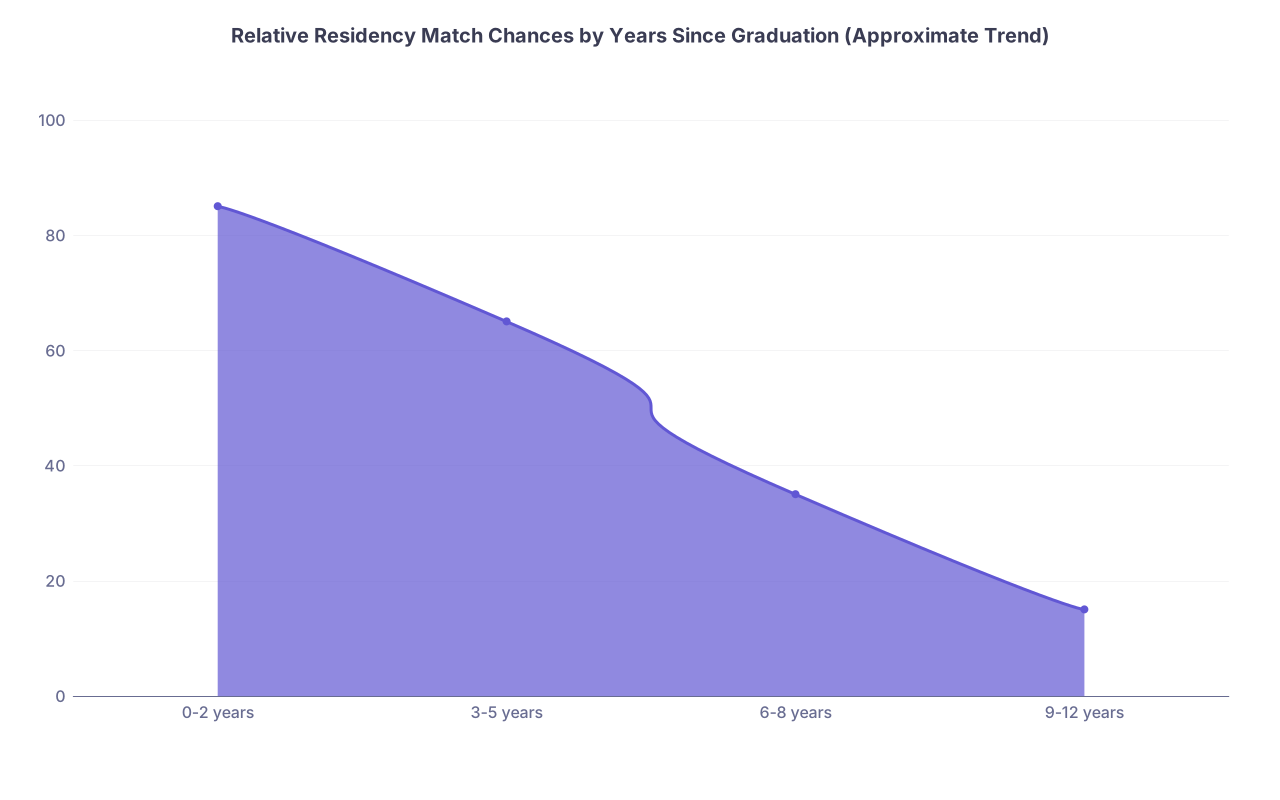
| Category | Value |
|---|---|
| 0-2 years | 85 |
| 3-5 years | 65 |
| 6-8 years | 35 |
| 9-12 years | 15 |
Those numbers aren’t official NRMP statistics. They’re a realistic shape of what actually happens for IMGs I’ve worked with: the further you are from graduation, the more the default odds drop—unless you actively counter the concerns.
2. Why Programs Care So Much About Your Graduation Year
You are not fighting the year itself. You’re fighting what it signals.
Here’s what program directors see in each situation.
Recent Graduate (0–3 Years Out)
Signal: “Knowledge reasonably fresh, still in ‘training mode,’ easier to mold.”
If you’re here:
- Your graduation year is not your problem.
- Your real battleground: scores, USCE, letters, and communication skills.
Graduated 2022, applying 2025? That’s fine. A year or two doing USCE, Step studying, or research doesn’t scare most PDs.
Mid-Range Graduate (3–6 Years Out)
Signal: “Possible drift. Why so long? Still sharp or out of practice?”
This is where explanation and proof matter.
They will ask (even if they don’t say it out loud):
- Have you been clinically active?
- Have you done recent relevant work (last 1–2 years)?
- Are you just now figuring out you want U.S. residency, or has this been a clear path?
If the last real clinical work on your CV is 2019 and you’re applying 2025 with no clear reason why… that’s a problem. Not because of the year, but because it looks like you’ve been drifting.
Older Graduate (>6–7 Years Out)
Signal: “High risk unless they prove otherwise.”
For older grads, PDs worry about:
- Outdated knowledge: guidelines and standards change quickly.
- Difficulty re-adjusting to training structure after independent practice.
- Board exam performance: data suggests pass rates fall as distance from med school increases.
You overcome this with:
- Recent USCE or hands-on practice (not 7 years ago, recent).
- Strong, fresh letters that talk about your current performance.
- Completion of Steps with solid scores and no fails.
- Clear story: You’re not “on a break”; you’ve been progressing.
3. The Truth About “Cutoffs” for Year of Graduation
You’ve seen them:
- “We prefer graduates within 5 years of medical school.”
- “Must have graduated within the last 3 years.”
- Or nothing at all said—and they just filter quietly.
Here’s what these actually mean.
| Program Statement | What It Usually Means |
|---|---|
| “Within 3 years of graduation” | Hard-ish filter; older grads rare |
| “Within 5 years of graduation” | Flexible if you are strong elsewhere |
| “Recent graduation preferred” | Older grads accepted if profile is strong |
| No statement on graduation year | Depends heavily on PD and context |
I’ve seen:
- “Within 3 years” programs match someone 7 years out because they had U.S. research, fresh USCE, great letters, and no gaps.
- Programs with no stated limit quietly reject >7-year grads almost universally.
So what do you do?
- Believe the strictest statements. If they say “must be within 3 years,” they usually mean it. Don’t waste half your application list there if you’re 8 years out.
- Treat “preferred” as negotiable. That’s your opportunity zone—if you bring clear, recent clinical and exam currency.
- Email selectively for clarification. Not, “Will you take me?” but: “I am a 2016 graduate with completed Steps and recent U.S. clinical experience—do you consider applicants more than 5 years from graduation?”
Don’t spam programs with these emails. Choose 5–10 where you’d genuinely be competitive otherwise.
4. How to Interpret Your Graduation Year in Context
Let’s make this practical. Match your situation to one of these:
Scenario A: IMG, Graduated 0–3 Years Ago
Your year of graduation is neutral-to-positive.
What matters more:
- Step 1 (if taken) and Step 2 CK scores
- USCE quality and recency
- Visa status
- Specialty choice (IM vs derm, etc.)
Your strategy:
- Stop obsessing over “recency” and start obsessing over performance.
- Get 2–3 solid U.S. letters that show you are teachable, hardworking, and clinically safe.
- Apply early, broadly, and realistically.
Scenario B: IMG, Graduated 4–7 Years Ago, Clinically Active
Example: Graduated 2018, working as a physician in your home country since, Steps done 2023–2024.
Your year of graduation is a mild red flag that you can absolutely fix.
You need to show:
- No “dead” years.
- Continued clinical exposure.
- Clear motivation for switching systems now—and not as a last resort.
Your strategy:
- Prioritize programs that either:
- Don’t mention year limits, or
- Say “within 5 years preferred” (but no hard rule).
- Make your recent clinical work front and center in your CV and personal statement.
- Do at least some U.S. clinical work (observerships, externships if possible) in the 12–18 months before applying.
Scenario C: IMG, Graduated 8+ Years Ago or With Long Gaps
This is the hard lane. Not impossible, but not forgiving.
If this is you, you must stop thinking “How do I hide my graduation year?” and start thinking “How do I prove I’m as sharp and current as a 2022 grad?”
You need:
- Steps all completed, with decent scores and no repeated failures.
- Fresh clinical or research activity, ideally in the U.S., in the last 1–2 years.
- A CV that shows progression, not random wandering.
- A specialty choice that matches reality (internal medicine, family medicine, psych more realistic than plastics).
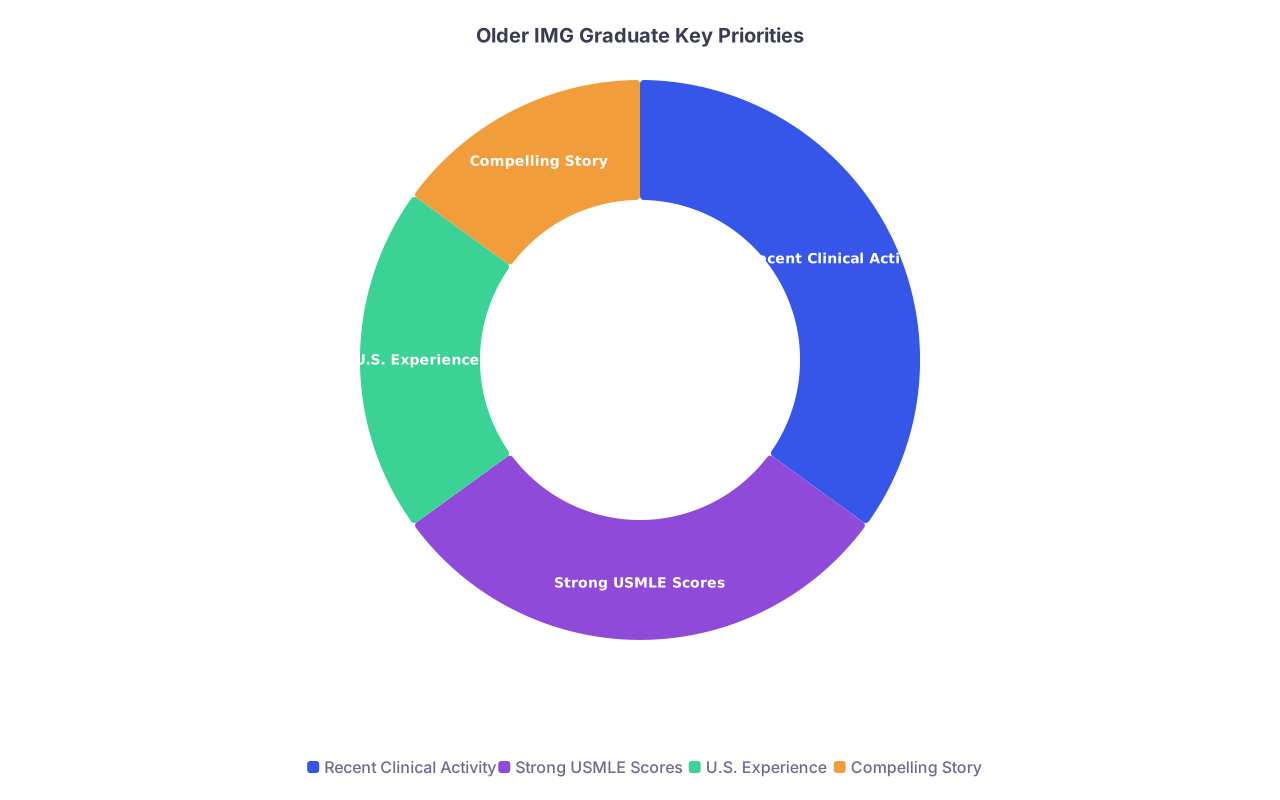
| Category | Value |
|---|---|
| Recent Clinical Activity | 35 |
| Strong USMLE Scores | 30 |
| U.S. Experience | 20 |
| Compelling Story | 15 |
Your strategy:
- Stop chasing “name” programs. Focus on IMG-friendly, community-heavy, less competitive fields.
- Accept you might need an intermediate step: research fellowship, MPH, or repeated USCE to rebuild your clinical profile.
- Apply broadly. Very broadly.
5. How to Make Your Graduation Year Matter Less
You cannot change your graduation year. You can absolutely change how programs feel about it.
Here’s how.
1. Crush the “Currency” Problem
If you’re older or have gaps, you must overcompensate on recency:
- Recent USCE (observerships/externships in the last 12–18 months).
- Recent board exams with good scores.
- Recent structured clinical or academic work (hospital, research, teaching).
If the last meaningful item on your CV is 2017? That’s not a graduation-year problem. That’s a “you disappeared” problem.
2. Tell a Straight, Coherent Story
PDs hate vague or evasive explanations. If there were gaps, own them briefly and show what changed.
Bad:
“I took time to explore different opportunities and now decided on U.S. residency.”
Better:
“From 2016–2019 I worked as a primary care physician in rural India. In 2019 I decided to pursue internal medicine training in the U.S. due to broader training opportunities and started structured U.S. exam preparation and observerships.”
Short, specific, and honest beats long and vague.
3. Align Specialty With Reality
Tough truth:
If you’re 9 years out, need a visa, have average scores, and are aiming for derm or ortho as an IMG, your graduation year is the least of your problems. The entire profile is misaligned.
For older grads:
- Internal medicine, family medicine, psychiatry, pediatrics: more forgiving.
- Pathology, neurology: possible with strong academics.
- Surgical subspecialties: extremely difficult without major research or connections.

6. Choosing Programs When You’re Worried About Graduation Year
Don’t apply blindly and hope.
Use a simple filter framework:

| Step | Description |
|---|---|
| Step 1 | Start - Your Grad Year |
| Step 2 | Standard IMG Friendly List |
| Step 3 | Check Program Website |
| Step 4 | Low Priority or Skip |
| Step 5 | Check for IMG Friendliness |
| Step 6 | Apply - Higher Priority |
| Step 7 | >5 Years Out? |
| Step 8 | Hard 3-5 Year Limit Stated? |
| Step 9 | Takes IMGs Recently? |
How to do this fast:
- Look at program websites: Any explicit year cutoffs? Hard filters?
- Check recent residents: Are there obvious IMGs? Are they all recent grads or mixed?
- Use filters in FREIDA / residency explorer where possible (though not all list year preferences).
- Talk to your network: seniors from your school, people from your country who matched there.
You want a list where:
- A chunk of programs either don’t mention year limits or are clearly flexible.
- You’re not wasting 40% of your applications on “within 2–3 years only” programs if you’re 10 years out.
7. Common Mistakes IMGs Make Around Graduation Year
I see the same errors repeatedly.
- Hiding gaps instead of explaining them. PDs assume the worst when you leave blank space.
- Relying only on home-country practice with nothing recent. “But I was a doctor for 10 years” doesn’t help if you look academically stale.
- Choosing ultra-competitive specialties with an old grad year. That’s how you burn thousands of dollars and end up unmatched.
- Ignoring program criteria. Applying to tons of programs that clearly say “must be within 3 years” when you’re 9 years out is not strategy. It’s denial.
- Weak personal statement. If you’re older, your PS is not optional fluff. It’s where you show growth, maturity, and a clear, logical path.
8. What You Should Actually Do Next (By Category)
If You’re ≤3 Years From Graduation
- Focus 90% of your energy on Steps, USCE, letters, and communication skills.
- Graduation year is not your bottleneck. Stop obsessing about it.
If You’re 4–7 Years From Graduation
- Get or maintain continuous clinical or academic involvement.
- Secure recent U.S. experience if at all possible.
- Be selective but not timid: many programs are still open to you.
If You’re 8+ Years From Graduation
- Be brutally honest about specialty choice.
- Stack the deck with recency: new USCE, new research, maybe an MPH or U.S.-based academic role.
- Build a program list specifically biased toward IMG-heavy and flexible programs.
- Accept that you might need more than one application cycle.

FAQ: Year of Graduation for IMGs
Is there a strict maximum number of years after graduation to match as an IMG?
No universal maximum. Many programs informally prefer ≤5 years. Some enforce 3–5 year limits. A minority will still consider 8–10+ years if you have recent strong clinical or academic activity and solid scores. But the further out you are, the smaller your realistic program pool.Can strong USMLE scores overcome an older graduation year?
They help a lot but do not completely erase concerns if you have big gaps or no recent clinical work. A 250 Step 2 from a 2012 grad with no recent activity is still risky. A 240 Step 2 plus fresh USCE, clinical work, and a coherent story is far more powerful than scores alone.Does U.S. clinical experience really reduce the impact of my graduation year?
Yes. Recent USCE tells programs you’ve seen patients in a U.S.-style system, had your skills evaluated recently, and can function in the current clinical environment. For older grads, strong recent USCE is often the difference between being auto-discarded and getting interviews.How do I explain long gaps after graduation in my application?
Briefly, honestly, and with a focus on what changed and what you’ve done since. One paragraph in the personal statement or ERAS experiences description is enough. Avoid defensive or emotional explanations; stick to facts and show your current trajectory is stable and intentional.Should I avoid programs that state a graduation year limit if I’m older?
If they say “must be within X years,” consider that a near-hard filter and apply only if you have something exceptional and still have enough other programs to apply to. If they say “preferred,” they’re more flexible—apply if the rest of your profile fits. Protect your budget and your expectations.I’m 9+ years out from graduation. Is it still worth trying for residency?
It can be, but only if you’re willing to be strategic and realistic. You’ll likely need strong, recent clinical or academic involvement, completed Steps with good scores, a less competitive specialty, and a broad application strategy. If you refuse to adjust expectations or invest in updating your profile, then no—it won’t be worth it.
Open your CV right now and look at the last 3–4 years. Are you clearly active, growing, and clinically or academically engaged—or does it look like you vanished? Fix that first. Once your recent story is strong, your year of graduation becomes just one line, not the line that defines you.