
The hype around paid externships is massively overrated for most IMGs.
If you’re choosing between one expensive paid externship and several solid free observerships, the better choice for most applicants is:
Multiple high-quality experiences that give you strong U.S. letters of recommendation and real program connections—whether they’re paid or free.
Let’s break this down in a way that actually helps you make a decision, not just sells you a package.
1. What Residency Programs Actually Care About
Residency program directors are not impressed by the word “externship” on its own. They care about what it produces.
Here’s what matters most for IMGs in the U.S. clinical experience (USCE) category:
- Type of experience
- Direct patient care (true hands-on clinical elective / sub-I / externship)
- vs pure observership (shadowing only)
- Setting
- ACGME-accredited teaching hospital > community clinic with no teaching role
- Experience at a residency program that actually takes IMGs > random private group
- Letters of Recommendation
- Who wrote it (core teaching faculty vs random private doc)
- How specific and strong it is
- Whether it clearly describes your clinical skills and work ethic
- Relevance
- Internal Medicine letters for IM
- Family Med letters for FM
- Psych letters for Psych, etc.
- Duration and consistency
- 2–3 months of solid, continuous USCE looks better than one short block
Program directors do not sit there and rank: “Paid externship: +2 points. Free observership: -1 point.” That’s not how it works.
They ask:
“Did this applicant work directly with patients under supervision?”
“Did they get a strong letter from someone I trust?”
“Did they function like a sub-intern or like a tourist?”
2. Paid Externship vs Free Observership: What’s the Real Difference?
Let’s be blunt: a lot of “paid externships” advertised to IMGs are basically rebranded observerships with a nice website and a big invoice.
Use this simple comparison:
| Factor | Strong Externship | Strong Observership |
|---|---|---|
| Direct patient care | Usually yes | Usually no |
| Notes/orders in EMR | Sometimes | Rare |
| Contact with program faculty | Sometimes | Sometimes |
| LOR quality potential | High if faculty involved | Can be high if teaching doc |
| Cost | High (often $2–5k/month) | Low or free |
The key question:
Is the paid externship actually giving you more of what programs value (hands-on work, teaching faculty, strong LORs, contact with residency leadership)?
If yes, it might be worth it.
If no, you’re just paying for a word.
3. When a Paid Externship Can Be Better
I’ve seen situations where a paid externship clearly beat multiple observerships. But those were specific, not generic.
A paid externship is more valuable when:
- It’s at a hospital with a residency program that takes IMGs
- Example: Community hospital IM residency where externs round with residents, present patients, and are seen by the PD or APD.
- You truly have hands-on responsibilities
- Calling consults with supervision
- Writing notes in the EMR
- Following your own patient list on rounds
- Presenting in morning report or case conferences
- You’re guaranteed evaluation by core teaching faculty
- Not just “Dr. X runs a private clinic and you’ll shadow”
- It’s your only realistic way to get U.S. hands-on experience
- Your med school doesn’t allow U.S. electives
- You’ve already graduated and can’t do student electives
- You have visa/location constraints
In those cases, a well-structured, hands-on externship for 1–2 months can dramatically boost your application, if you maximize it:
- Show up early
- Ask for feedback
- Make your interest in residency clear
- Proactively ask for a strong, detailed letter near the end
4. When Multiple Free Observerships Are Actually the Better Move
Now the other side—what most IMGs are actually facing.
You have options like:
- University-affiliated observerships
- Hospital-based IMG observership programs
- Observerships with physicians who are core faculty for a residency
And then there’s a generic private clinic externship that costs $3–5k/month.
If your choice is:
- Option A: One expensive “externship” in a private clinic with no residents, no teaching conferences, and no name recognition
- Option B: 3–4 months of observerships at teaching hospitals / with residency faculty
Then Option B wins almost every time.
Why?
Because over multiple free observerships you can:
- Get 2–3 solid U.S. letters
- Build relationships at more than one program
- See how different systems run (helps in interviews)
- Show consistency of U.S. experience (not just a one-off month)
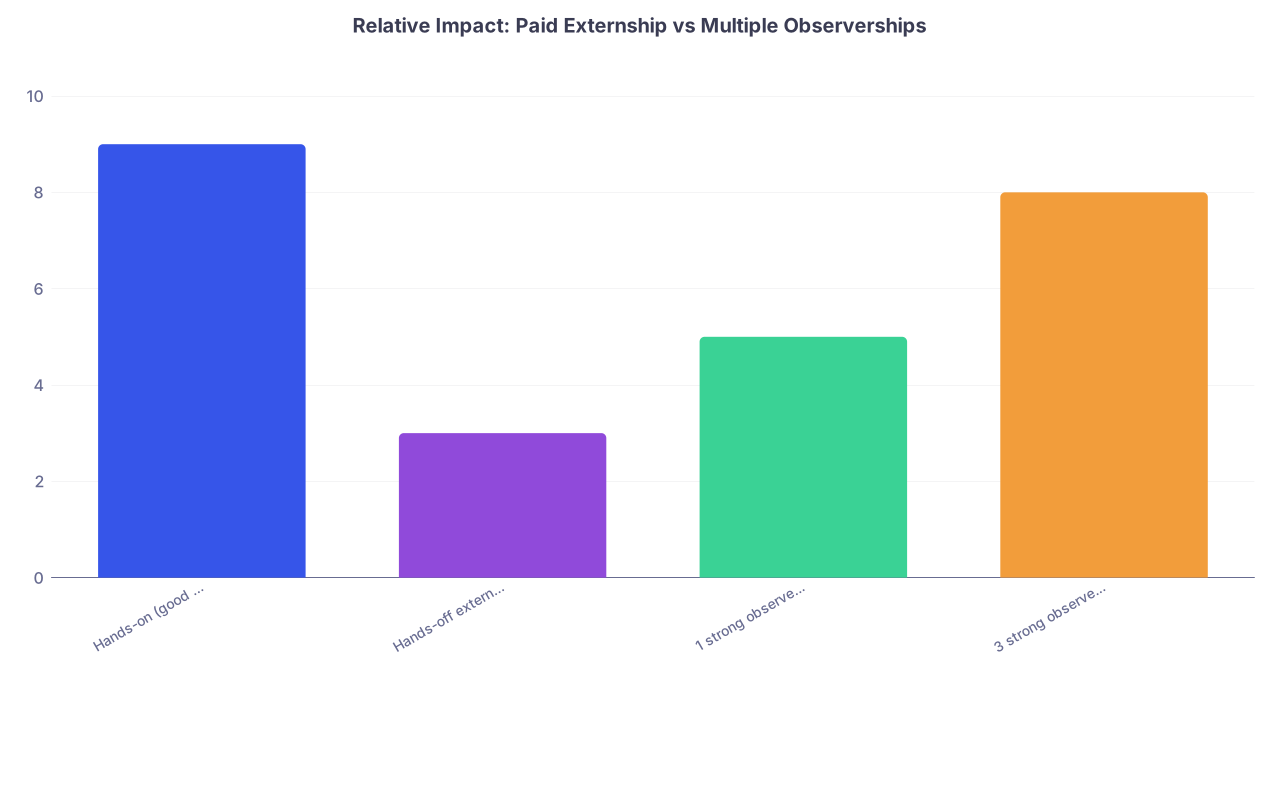
| Category | Value |
|---|---|
| Hands-on (good externship) | 9 |
| Hands-off externship | 3 |
| 1 strong observership | 5 |
| 3 strong observerships | 8 |
This isn’t scientific. But it’s realistic.
A great externship = excellent.
A weak externship = worse than nothing, because you also lost your money.
Three strong observerships with strong letters = almost as good as a strong externship for many programs.
5. The Money Question: Is It Worth the Cost?
You need to treat this like an investment decision, not an emotional decision.
Ask yourself three hard questions:
- Will this experience give me at least one strong, detailed U.S. LOR from a teaching physician?
- Will I interact with residents/faculty from an ACGME-accredited program that actually interviews IMGs?
- Can I reasonably afford this without wrecking my ability to pay for ERAS, Step exams, and interviews?
If the answer to #1 or #2 is “no,” paying thousands of dollars makes little sense.
If the answer to #3 is “no,” do not sink your financial life into an externship. Programs won’t give you extra points for going broke.
I’ve seen applicants spend $10,000+ on externships and then have to cut their application list in half because they ran out of money. That’s backwards.
You need budget left for:
- ERAS fees
- Extra programs (IMGs often need 120+ applications for competitive specialties)
- Flights and lodging for in-person or hybrid interviews (still happens)
- Step 3 (which is a real advantage for IMGs before the Match)
6. How Program Directors Actually Read “Externship” and “Observership”
Let me decode what they look for.
They scan your ERAS CV and see:
- “Clinical Externship – Internal Medicine – 1 month – Dr. X Clinic”
- “Observership – Internal Medicine – 1 month – Y Community Hospital”
They don’t stop at the label. They look at:
- Location – is it a teaching site?
- Description in the LOR – did you have a defined role?
- Your personal statement – do you actually sound like you learned something real?
- Pattern – is this one random U.S. month or part of a coherent path?
A strong observership at a real teaching hospital, where the letter says:
“She pre-rounded on patients with residents, participated in daily teaching rounds, and consistently demonstrated strong clinical reasoning despite her observer status…”
That beats a vague externship letter that says:
“He completed a one-month externship in my clinic and observed patient care.”
The word “externship” on paper means nothing.
The content means everything.
7. A Simple Decision Framework: What You Should Actually Do
If you’re stuck choosing, use this framework.
Step 1: Define your main gap
What are you missing?
- No U.S. letters at all?
- Only one weak U.S. letter from years ago?
- No exposure to internal medicine in the U.S.?
- No proof you can function in the U.S. system?
Your clinical experiences should be built to fix the biggest weaknesses.
Step 2: Prioritize these outcomes (in this order)
- Strong, recent (within 1–2 years), U.S. LORs in your specialty
- Direct or near-direct clinical involvement (presenting, case discussions, notes if possible)
- Connection to actual residency programs
- Duration of U.S. experience (2–3 total months minimum is a good target)
- Name recognition if it comes with the above (big university letter is nice, but not magic)
Step 3: Compare your options brutally
For each possible rotation (paid or free), answer:
- Who will supervise you? Are they teaching faculty?
- Will you see residents? Attend teaching rounds?
- Is there a realistic path to a strong letter?
- Does this site have a residency that lists “International Medical Graduates welcome” or shows IMGs among current residents?
- What exactly are you allowed to do—shadow, present, write notes, call consults?
Now you’re ready to decide:
Choose the paid externship if:
- It’s truly hands-on at a teaching hospital
- You’ll work with residency faculty
- You can get at least one powerful LOR
- You can still afford a broad application
Choose multiple free observerships if:
- They’re at hospitals with residencies
- You can get 2–3 strong letters
- The paid option is basically clinic shadowing with no teaching structure
Here’s a quick flow:

| Step | Description |
|---|---|
| Step 1 | Need US Experience |
| Step 2 | Consider paid externship 1-2 months |
| Step 3 | Do 2-3 observerships and get LORs |
| Step 4 | Reassess country, timing, or specialty |
| Step 5 | Hands-on at teaching hospital available? |
| Step 6 | Strong teaching observerships available? |
8. Bottom Line: Which Is Better?
Answering your question directly:
Is a paid externship better than multiple free observerships for IMGs?
Not by default.
A good hands-on externship at a teaching hospital that leads to a strong letter and real faculty contact is better than a stack of weak observerships.
But in the real world, many IMGs are choosing between:
- One overpriced, low-yield “externship” in a private clinic
vs - Several decent, free or low-cost observerships in teaching environments
In that very common situation, multiple high-quality observerships win. Every time.
FAQ (Exactly 7 Questions)
1. Do residency programs require an “externship” specifically, or just U.S. clinical experience?
Most programs don’t care about the exact label. They care about U.S. clinical experience that shows you function in the system and produces strong LORs. Some will specify “hands-on USCE preferred,” but they almost never insist on the word “externship.”
2. How many months of U.S. clinical experience should an IMG aim for?
For most IMGs applying to Internal Medicine, Family Medicine, or Pediatrics, a minimum of 2–3 months of recent (within 1–2 years) U.S. experience is a reasonable target. More can help, but only if the quality stays high and you’re not repeating the same low-yield shadowing month after month.
3. Are university hospital observerships better than community hospital externships?
Not automatically. A community hospital externship where you work closely with residents and faculty can be more valuable than shadowing silently at a big-name university where nobody really knows you. Prestige helps only if it comes with a strong letter and meaningful role.
4. Can a strong observership letter compete with a hands-on externship letter?
Yes, if the observership letter is detailed and specific. If the attending describes your case discussions, presentations, clinical reasoning, professionalism, and how you compared to U.S. students, that letter can absolutely compete with an externship letter—especially when the externship was basically clinic shadowing.
5. Does doing an externship at a hospital increase my chance of matching there?
It can, but only if:
- The hospital has a residency program
- Residents and faculty actually work with you
- You leave a strong impression and get a good letter
Even then, it’s no guarantee. Think of it as increasing your odds slightly at that program and giving you one stronger LOR for all programs.
6. What if I can only afford one month of any U.S. experience—paid or free?
If money is tight, I’d pick the single highest-yield month you can find, regardless of paid vs free: teaching hospital, residency present, strong mentor, realistic path to a detailed LOR. One powerful, well-leveraged month is better than stretching yourself thin for something expensive and mediocre.
7. Are agency-arranged paid externships safe to trust?
Some are legitimate, many are over-marketed, and a few are outright terrible. Before paying:
- Ask for the exact hospital/clinic name
- Confirm if there’s an ACGME residency there
- Ask if you’ll interact with residents and teaching faculty
- Request sample schedules and a sample evaluation form or LOR format If they’re vague on details and heavy on buzzwords, that’s a red flag. Walk away.
Key points to keep in mind:
- Programs care about quality and content, not the word “externship.”
- One strong, hands-on month can beat three weak “shadowing” months—but three good observerships with strong letters can rival a paid externship.
- Protect your budget; do not pay thousands unless you’re clearly getting more of what residency programs actually value.