
If You’re an Older IMG With Family Obligations: Structuring a Realistic Plan
What do you actually do when you’re 35+, an IMG, with a spouse, maybe a kid or two, maybe aging parents—and you still want a US residency without destroying your family in the process?
This is where fantasy plans die. And real, grown‑up strategy starts.
I’m going to talk to you like you’re serious, because if you’re in this situation and still reading about residency, you probably are. You don’t have time for vague “follow your dreams” nonsense. You need a plan that accounts for:
- Your age
- Your visa status
- Your family’s financial needs
- Your scores / timeline / gaps
- The reality of the US Match (which is not kind to older IMGs)
Let’s build a plan that’s ambitious but not delusional.
Step 1: Get Brutally Clear on Your Starting Point
Before you plan anything, you need a diagnosis. Not vibes. Facts.
Write this down. On paper. Not in your head.
- Year of med school graduation
- Country/school of graduation
- USMLE status:
- Step 1: taken? score or Pass? attempts? year?
- Step 2 CK: taken? score? attempts? year?
- Step 3: taken? score? year?
- Any US clinical experience? type? dates?
- Current location: in US or abroad?
- Visa situation: citizen, GC, H1B, dependent, or needing sponsorship?
- Family obligations:
- Spouse working or dependent?
- Kids’ ages?
- Any caregiving for parents?
- Financial runway:
- How many months can you afford to be primarily focused on applications/prep?
- Any debt in home country?
Now, here’s the hard part: categorize your competitiveness honestly.
| Profile Level | Typical Features | Realistic Target |
|---|---|---|
| Strong | Recent grad, >240/250+, USCE, no gaps | Many IM/FM, some competitive |
| Moderate | 3–7 years since grad, ~220–240, some USCE | Community IM/FM, maybe psych/peds |
| High-Risk | >7 years since grad, gaps, no USCE, low scores | Limited IM/FM, prelim, SOAP focus |
| Critical | Multiple fails, very old grad, no USCE | Consider alternate careers or long-term rebuild |
If you’re an older IMG (let’s say >30) with family obligations, you’re almost never in the “Strong” pool unless you’re an exception (top scores + recent grad + great USCE). You’re usually in Moderate to High‑Risk.
Knowing where you are lets you build a plan that doesn’t blow up your family for a 5% chance.
Step 2: Set a Time Horizon: 1‑, 2‑, or 3‑Year Plan
You cannot run on vague “I’ll keep trying.” Your spouse will hate it. Your kids will feel it. You’ll burn out.
You need a defined time window. Here’s how I’d structure it.
One‑Year Plan (Already Exam-Ready, Some USCE)
This is for you if:
- Steps mostly done (at least Step 1 + Step 2), taken within the last 3–4 years
- Some US clinical exposure (observerships, externships, research electives)
- You’re already in the US or can come quickly
- Financially, you cannot stretch this out forever
Focus:
- Polish application (CV, personal statement, letters)
- Maximize USCE in the specialty you’re targeting
- Target realistic specialties and program tiers
- Prepare hard for interviews / communication skills
Two‑Year Plan (Need USCE or Scores Updated)
This is the most common reasonable plan for older IMGs with families.
You might be here if:
- You have Step 1 and Step 2 but they’re older (>4–5 years) or mediocre
- No or minimal USCE
- Some gaps after graduation
- You can afford 2 years of a lean, demanding period with careful budgeting
Year 1:
- Lock in USCE (observerships, externships, research)
- Strengthen CV with one consistent role (research assistant, clinical volunteer, scribe, hospital assistant—whatever’s actually possible)
- Prepare and possibly take Step 3 (huge plus for older IMGs, especially those seeking visas)
- Start networking deliberately (not fake LinkedIn spam)
Year 2:
- Apply early and broadly
- Maintain continuity in your US role (programs like seeing you are still in clinical/research environment)
- Interview prep + backup planning (SOAP, prelim, alternate specialties)
Three‑Year Plan (Older Grad with Big Gaps or No US Ties)
This is where you are if:
- You graduated >7–10 years ago
- No USCE
- No recent clinical work anywhere
- Scores average or multiple attempts
- Family cannot withstand repeated failure without clarity
Year 1:
- Re-establish clinical identity (work as physician in home country OR research/clinical role in US)
- Start or continue exam sequence (finish Step 2 / Step 3)
- Begin USCE or build pathway to it via networking and smaller roles
Year 2:
- Intensive USCE + research + consistent supervisor relationships for LORs
- Solidify specialty choice based on actual feedback, not dreams
Year 3:
- Apply with full force; if no traction, you sit down with your family and discuss whether a 4th, 5th attempt is actually responsible
You should not go beyond a 3‑year “active effort” phase without having a frank “Are we done?” conversation. That’s not quitting. That’s being a parent/spouse who is accountable.
Step 3: Choose Specialty and Programs with Your REAL Odds in Mind
You don’t get to be an older IMG with kids and still pretend you’re equally competitive for Dermatology and Radiology. You’re not.
Here’s where reality usually lands:
- Most realistic: Internal Medicine, Family Medicine, Psychiatry
- Plausible but harder: Pediatrics, Neurology
- Very tough as older IMG: Surgery, OB/GYN, Anesthesia, Radiology, EM, subspecialties directly
I’m not saying “never.” I’m saying “what is the chance vs what will your family pay for chasing that chance?”
Use data. Not rumors from WhatsApp.
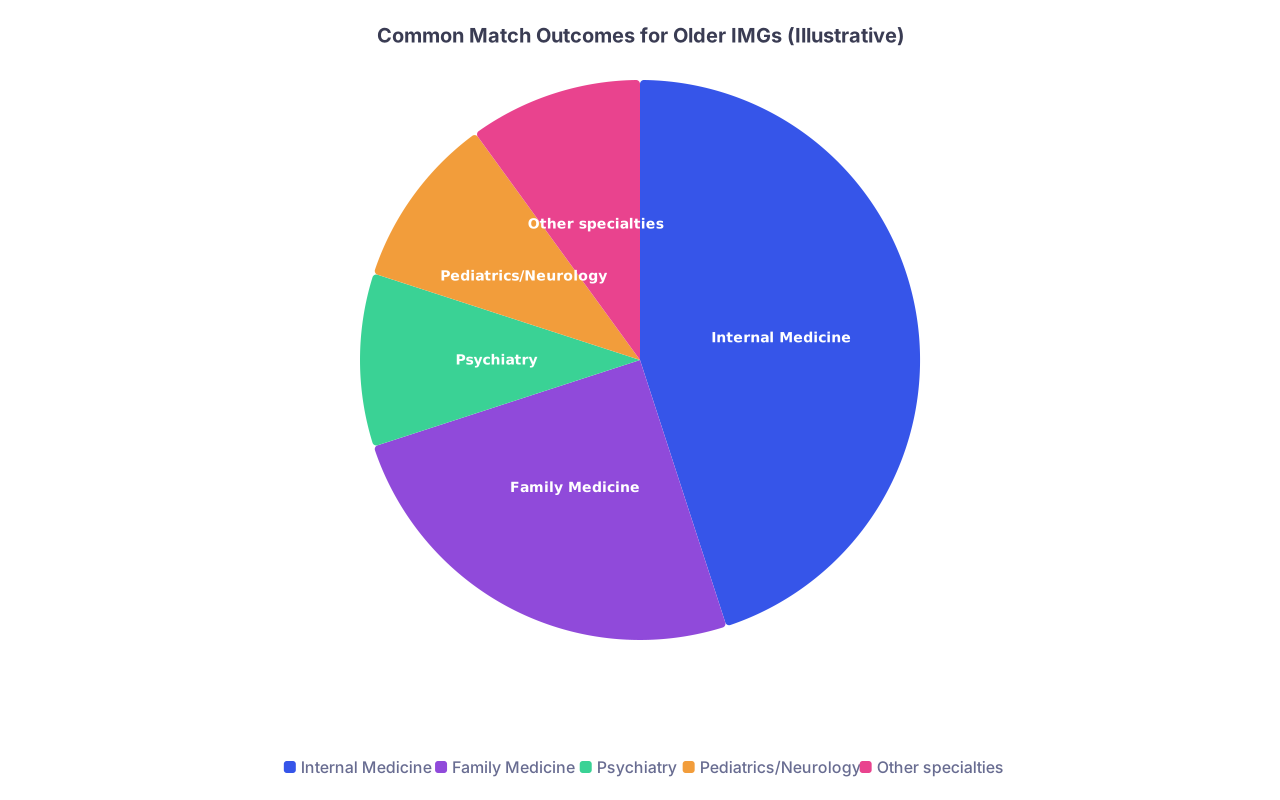
| Category | Value |
|---|---|
| Internal Medicine | 45 |
| Family Medicine | 25 |
| Psychiatry | 10 |
| Pediatrics/Neurology | 10 |
| Other specialties | 10 |
Your filter for choosing where to apply if you’re older with a family:
- Programs that accept older year of graduation (check their websites or past resident bios)
- Programs with a track record of IMGs
- Locations where your family can realistically live (not luxury, but also not unsafe/destructive)
- Visa‑friendly if you need it (do not “hope” they’ll sponsor; verify)
Step 4: Build a Weekly Structure That Your Family Can Survive
Here’s where most older IMGs blow it. They either:
- Go 100% “grind mode,” ignore their spouse/kids, and relationships rot
- Or they try to “be there for everything,” and their prep/application is half‑baked
You need structure. Blocks. Not chaos.
Let’s say you’re working part‑time or full‑time and have family duties. You carve your life like this:
- Non‑negotiable work hours
- Protected “family anchor times”
- Structured “exam/application” blocks
Example for someone working 40 hours, with a spouse and one kid:
- Weekdays:
- 6:00–7:30 am: focused study (before kid wakes)
- Work day
- 6:00–8:30 pm: family time, putting kid to bed, dinner
- 8:30–10:30 pm: lighter work (questions, reading, emails, application tasks)
- Saturday:
- 3–4 hours exam/app dedicated time (coordinate with spouse ahead of time)
- Sunday:
- Mostly family day, 1–2 hours evening planning / light review
Is it exhausting? Yes. But it’s sustainable for 12–24 months if you and your spouse consciously agree to it.
Use a visible calendar—on the fridge, shared Google Calendar, whatever—so your spouse doesn’t feel like your residency chase is this vague black hole sucking away your time.
Step 5: Have the Hard Talk With Your Spouse (and Maybe Older Kids)
If your partner thinks this is “a 6‑month thing” and you secretly know it’s a 3‑year trench war, you’re setting yourself up for fights and resentment.
You sit down and you say something like:
“If I go for US residency seriously, this is likely a 2–3 year effort. It will mean X, Y, Z sacrifices. Here’s the timeline I’m proposing. Here are the stop‑loss points if it’s not working. I want us to decide this together, not me dragging you through it.”
Specifics you must cover:
- Financial expectations (How tight will money be? Who’s working? Any loans?)
- Childcare plan (Who watches kids during exam blocks / observerships / interviews?)
- Relocation possibilities (Are you both okay moving to a small town for residency?)
- What happens if you do not match after year 1, year 2, year 3?
Most people avoid this talk and hope it “works out.” That’s how you end up with a Match and a marriage in crisis at the same time.
Step 6: Design a USCE/Research Strategy That Matches Your Visa and Family Status
Big constraint for older IMGs with families: you can’t just bounce city to city for unpaid observerships like a 23‑year‑old.
You need concentration, not scatter.
If you’re already in the US (any status)
Priority: find something stable in ONE geographic area if possible.
Options that actually work for many:
- Research assistant / coordinator in a department where IMGs historically match
- Long‑term observership (3–6 months in same institution > 3 scattered 4‑week ones)
- Scribe roles in outpatient clinics (less glamorous, but real US clinical exposure and income)
- Hospital roles: medical assistant, clinical associate, care coordinator (varies by state and visa)
Your goal: become part of the furniture somewhere. That’s how you get the “I know this applicant well and would rank them” type LORs.
If you’re outside the US
You’ll probably need a phased approach:
- Keep working clinically in your country (programs want to see you didn’t stop practicing 5 years ago)
- Take Steps in a tight time frame (don’t stretch Step 1–2–3 over 8 years)
- Plan one or two targeted US trips for USCE or research:
- Quality > quantity
- Try to secure 2–4 months in one institution or connected sites
Do not drag your whole family across continents for a 4‑week unpaid observership unless you’ve done the math and logistics carefully.
Step 7: Money: Build a Realistic Budget and Stop Lying to Yourself
Older IMGs with kids can’t play the “I’ll figure it out later” money game. This process is expensive, especially if you’re outside the US.
List your major costs:
- Exam fees (Step 1, 2, 3)
- ECFMG certification fees
- US travel for CS‑type alternatives, USCE, or interviews
- ERAS application + NRMP fees (easily $2,000–$5,000+ if you apply broadly)
- Visa costs if applicable
- Lost income from reduced work / time off
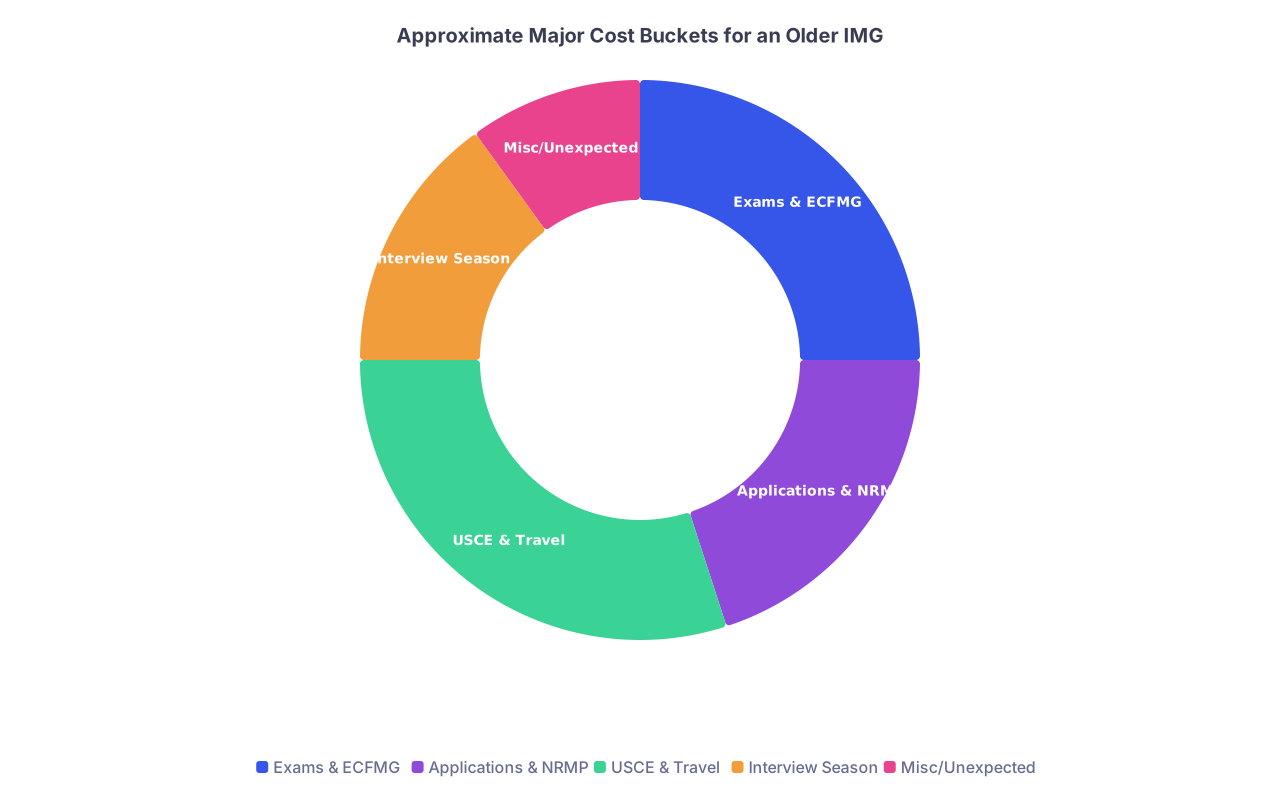
| Category | Value |
|---|---|
| Exams & ECFMG | 25 |
| Applications & NRMP | 20 |
| USCE & Travel | 30 |
| Interview Season | 15 |
| Misc/Unexpected | 10 |
Then you ask:
- How many months can we run like this before this becomes reckless?
- Are we okay with using savings? How much?
- Are we taking on debt? From where? Under what terms?
If the money numbers don’t work at all, that’s not a sign to “push harder.” It’s a sign to adjust the plan length, specialty targets, or even country targets.
Step 8: Application Strategy: Depth > Spray‑and‑Pray
Once you’re in the application year, here’s what a realistic, older IMG approach looks like.
1. Application Components
You absolutely cannot afford weak basics:
- Personal statement: clear about who you are, what you’ve been doing all this time, why that helps you as a resident
- CV: no unexplained gaps; even caregiving, family, non‑clinical work can be framed honestly but coherently
- Letters: at least 2 strong US letters in your specialty if at all possible
2. Program List Construction
This is where older IMGs often cheat themselves. They say, “I’ll focus on quality, not quantity” and then apply to 60 mostly unrealistic programs.
You need both: breadth + realism.
| Program Type | Number | Notes |
|---|---|---|
| University programs | 20–30 | Only if IMG‑friendly history |
| Community teaching | 60–80 | Main focus, especially IMG heavy |
| Prelim/TY | 10–20 | Backup, especially if you can reapply later |
If you’re older, with family, and not a superstar applicant, 100–150 programs in IM or FM isn’t “overkill.” It’s standard.
3. Interview Season and Family
If you live in the US with kids, you probably can’t bounce to 20 interviews in random cities without planning.
- Decide early how many interviews you’ll do before you start saying no (usually 12–15 solid IM/FM interviews is plenty, if they’re real options)
- Batch travel where possible
- If outside US, try to schedule interviews in chunks, not constant back‑and‑forth
Step 9: Have a Plan B and C That Doesn’t Destroy Your Identity
You’re older. You have people relying on you. So you need layered plans.
Plan A: Match in your target specialty/year.
Plan B: SOAP, prelim position, different but doable specialty (FM instead of IM, IM instead of psych, etc.).
Plan C: Long‑term non‑residency path that still uses your training.
Examples of real Plan Cs I’ve seen older IMGs move into:
- Clinical research career (coordinator → manager → PhD or high‑level role)
- Public health / MPH → local or international NGO or government work
- Pharma / biotech (medical affairs, safety, regulatory)
- Hospital administration / quality improvement roles
- Telemedicine in home country or regional roles (sometimes combined with US‑based research or admin)
Having Plan B/C doesn’t mean you’re less committed. It means you’re an adult.
Step 10: Mental Health and Burnout: Protect the Asset (That’s You)
This is not a “nice to have” topic. Older IMGs with responsibilities are at high risk of:
- Chronic guilt (not enough for family, not enough for career)
- Burnout from long prep + rejections
- Depression during repeated application cycles
You need some basic rules:
- One day a week where no one is allowed to talk to you about USMLE/residency
- Some form of physical activity (walk around the block, basic home workout) 3–4 times a week
- One trusted person (spouse, friend, therapist, mentor) you can tell the truth to: “I’m scared this won’t work.”
This is not weakness. It’s maintenance.
A Simple 24‑Month Example Plan (Older IMG, Married, One Child)
To make this concrete, here’s something I’ve seen work.
Profile: 36‑year‑old IMG, 6 years since graduation, practicing in home country, married, 4‑year‑old child, no USCE, Step 1 Pass, Step 2 CK 226 two years ago, needs visa.
Year 1 (Abroad for most of it):
- Keep working clinically full time (keep your skills and income)
- Study for Step 3 evenings/early mornings, aim to take it by end of year
- Start remote research collaboration (data work, literature, case reports) with a US contact (yes, this is work, but it’s doable via email/Zoom)
- Save aggressively for USCE and application year
Year 2 (Part in US):
- Take Step 3 early in the year and pass
- Use savings to come to US for 3–4 months of focused USCE at 1–2 hospitals (ideally in IM or FM)
- Get 2 solid US letters
- Apply broadly in IM + FM, with clear explanation of your experience and Step 3 as a strength
- During the rest of the year, continue remote research or clinical work back home, so there’s no dead time on your CV
Your spouse and you agree up front: “If after 2 full application cycles with this plan there is no serious traction, we revisit whether continuing is fair to the family.”
That’s a grown‑up plan.
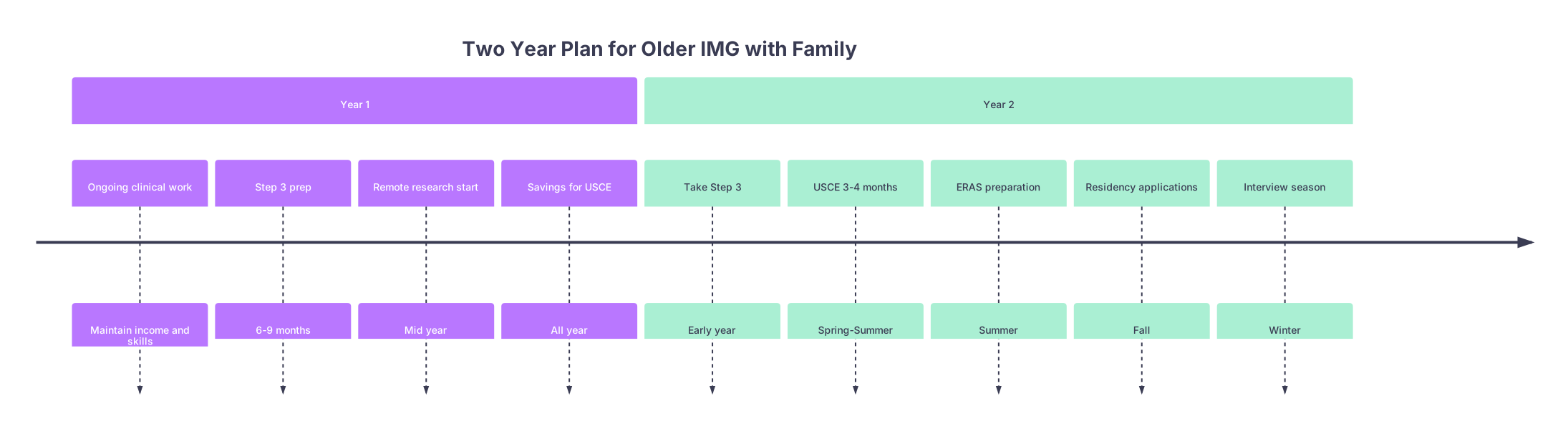
| Period | Event |
|---|---|
| Year 1 - Ongoing clinical work | Maintain income and skills |
| Year 1 - Step 3 prep | 6-9 months |
| Year 1 - Remote research start | Mid year |
| Year 1 - Savings for USCE | All year |
| Year 2 - Take Step 3 | Early year |
| Year 2 - USCE 3-4 months | Spring-Summer |
| Year 2 - ERAS preparation | Summer |
| Year 2 - Residency applications | Fall |
| Year 2 - Interview season | Winter |
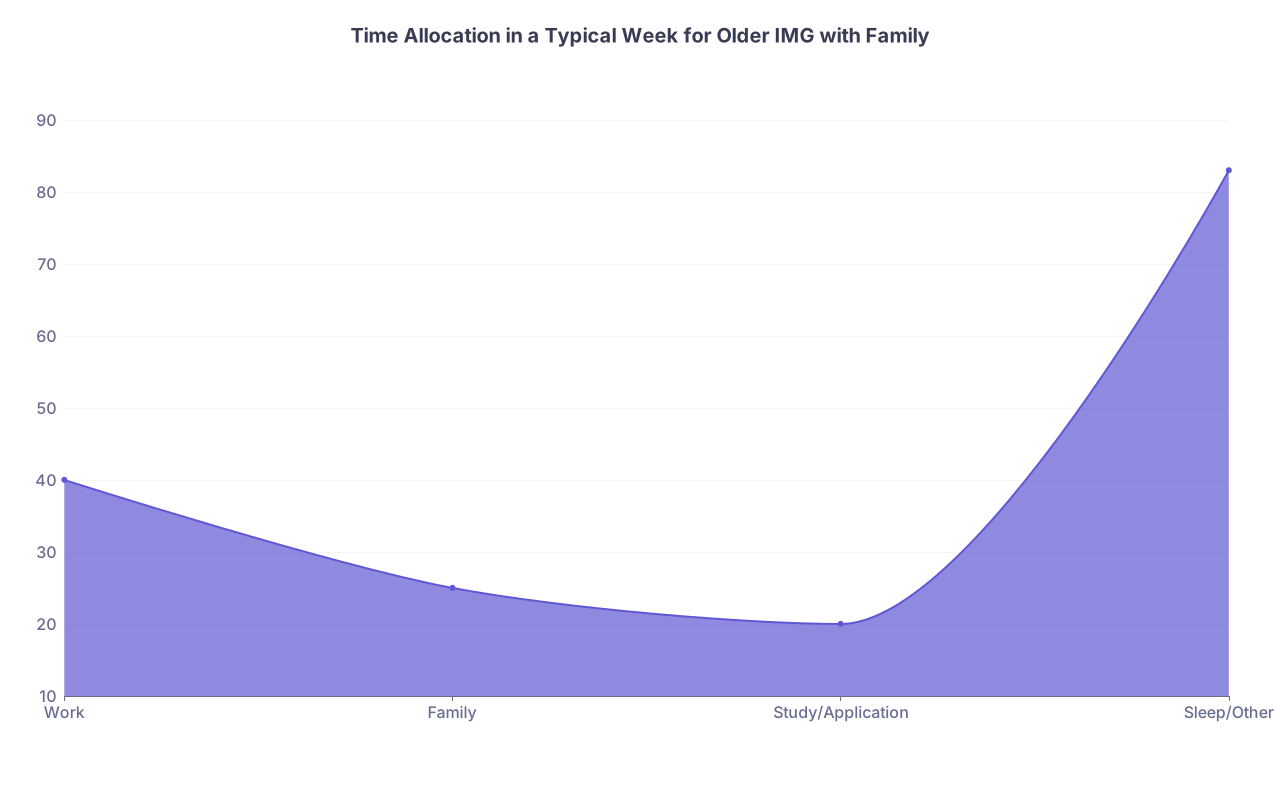
| Category | Value |
|---|---|
| Work | 40 |
| Family | 25 |
| Study/Application | 20 |
| Sleep/Other | 83 |
Key Takeaways
- You need a defined 1‑, 2‑, or 3‑year plan with honest milestones, not an endless “I’ll keep trying.”
- Your strategy must match your realities: age, exam history, family needs, visa, finances—no fantasy thinking.
- Protect your relationships and your mind while you chase this. Residency is important. Your life is bigger.
FAQ (Exactly 3 Questions)
1. I’m an older IMG, 10+ years since graduation, with kids. Is it still worth trying for US residency?
Maybe. Not automatically yes. If you’re willing to commit 2–3 hard years, can afford the process without bankrupting your family, and are open to less competitive specialties and community programs, it can be worth a serious attempt. But you should set clear limits: “If I don’t get X (interviews/offers) by Y cycle, I pivot.” If you’re clinging only because you’re afraid to let go of the dream, not because the numbers or circumstances make sense, that’s a red flag.
2. Should I leave my family in my home country while I go to the US for USCE or exams?
Sometimes yes, sometimes no. If you’re coming for 3–6 months of focused USCE and your spouse has a stable job, kids are in school, and finances are tight, it can be more responsible to come alone first. But you must have a concrete time frame and communication plan, not “I’ll just see how it goes.” If you’re thinking of moving everyone for a completely uncertain, unpaid, short observership with no long‑term plan, that’s risky and often not fair to them.
3. I did not match this year. As an older IMG with a family, should I reapply or stop?
Before you decide, you do a post‑mortem, not a panic reapplication. How many interviews did you get? From what level of programs? Was your exam/USCE profile clearly below typical matched applicants? If you got zero to very few interviews, you likely need a structural change (more USCE, research position, better application strategy), not “same thing, more programs.” If your spouse is already at the edge of their tolerance and your finances are strained, it may be more responsible to reframe the plan toward a non‑residency career rather than dragging this out year after year.