
The US system does not care that you completely reinvented your career abroad—unless you make it care.
If you switched specialties in your home country (or another country) and now you’re applying to US residency as an IMG, you’re in a risky but salvageable position. Programs are suspicious by default: “Why did this person jump around? Are they going to leave us too?” If you do not answer that clearly and convincingly, you will bleed interview invites.
Let’s walk through what you’re actually up against—and exactly what to do about it.
What Your “Switched Specialty” Story Looks Like From the PD’s Chair
Let me translate the quiet part program directors say in their offices.
You:
– Finished med school abroad
– Started one specialty (say, internal medicine)
– Then changed to a different one (say, radiology, anesthesia, psych, surgery, whatever)
– Now you’re applying to US residency in some specialty that may or may not match what you most recently did
Them:
“Why did they quit? Could they not handle the first specialty? Are they chasing prestige? Are they just trying to come to the US and will jump ship if a better offer shows up? Is this someone who will bail during PGY-2?”
Program directors aren’t allergic to non-linear paths. They’re allergic to risk. They care about:
- Commitment – Will you stay 3–5 years?
- Performance – Can you handle the work?
- Fit – Does your history match your new ‘story’?
- Visa/IMG risk – Extra boxes they have to check that they do not deal with for US grads.
Your job is simple, but not easy: make your specialty switch look like a deliberate evolution, not an escape.
Step 1: Get Your Story Straight Before You Touch ERAS
Do not open ERAS. Do not email anyone. First, build your narrative.
You need a clean, believable arc that connects:
- Med school →
- First specialty abroad →
- Switch →
- Current specialty choice in the US
Here’s the structure that works:
- What originally drew you to your first specialty
- What you learned in it (skills, mindset, clinical exposure)
- The moment(s) you realized it was not your long-term fit
- The concrete reasons the new specialty is better aligned with who you are
- Evidence that you’ve already committed to the new path (USCE, research, courses, exams, mentorship)
Notice what’s missing:
No vague “I just felt it was not right” or “I wanted more patient contact” lines. Those sound like you left on emotion, not reflection.
Example for someone who did surgery then switched to internal medicine:
- “I went into surgery for the technical challenges and acute impact.”
- “Working in the OR taught me to perform under pressure, manage complex perioperative patients, and communicate succinctly with a team.”
- “Over time, I realized I was consistently drawn to pre-op optimization and long-term management in clinic rather than the OR itself.”
- “I found more satisfaction in complex diagnostic reasoning and continuity of care than in procedures.”
- “That’s why I completed additional work in internal medicine—ward coverage, outpatient clinics, and US observerships. The environment and daily work in internal medicine match the kind of doctor I want to be.”
You want PDs to think: “That actually makes sense.”
Step 2: Decide Which Specialty You’re Actually Applying To (No Fantasy)
If you switched specialties abroad, I’m going to be harsh: you have less room than others to “try your luck” across random US specialties. Indecision will kill you here.
You must:
- Pick ONE primary specialty
- Optionally add ONE realistic backup that you can still explain cleanly
If your specialty history looks like this:
- Med school → IM residency year → Switched to radiology → Now want US psych
That’s three completely different identities. You need to pick what’s winnable and defensible.
Honest reality check:
| Specialty | IMG Friendliness | Typical IMG Step 2 (Matched) |
|---|---|---|
| Internal Med | High | 225–240+ |
| Family Med | High | 220–235+ |
| Pediatrics | Moderate | 225–240+ |
| Psychiatry | Moderate | 225–240+ |
| Neurology | Moderate | 225–240+ |
If you bounced between specialties and now want something like derm, ortho, plastics, ENT, or rad onc as an IMG without monster scores and strong US backing—that’s not a plan, that’s denial.
Pick a realistic lane. Then commit your whole application to that lane: experiences, letters, personal statement, ERAS entries.
Step 3: Translate Your Foreign Specialty Work Into Assets, Not Red Flags
Your previous training can either be the strongest or weakest part of your application. It depends entirely on how you frame it.
Do this with your prior specialty:
- Convert responsibilities into US-style language:
“In charge of ward of 20–25 patients” → “Senior resident responsible for daily management and discharge planning of 20–25 inpatients, including…” - Highlight universal skills: clinical reasoning, team leadership, crisis management, teaching juniors, communication with families.
- Connect specific experiences to your target US specialty.
Example: You were an anesthesiology trainee, now applying to internal medicine.
Translate like this:
- Pre-op assessments → complex medical optimization
- ICU shifts → hemodynamic management, ventilator management
- OR communication → succinct, time-critical communication with surgeons and nurses
- Post-op follow-up → pain control, complications, discharge planning
Then explicitly bridge: “These experiences made me realize I wanted to follow patients beyond the perioperative window and manage their chronic complex conditions long term, which led me to internal medicine.”
Do NOT:
- Trash-talk your old specialty: “I hated surgery, it was toxic.” Big red flag.
- Sound like you couldn’t cope: “I left because it was too demanding.”
- Hide it: ERAS, ECFMG, and your MSPE/Dean’s letter usually reveal the truth. If you look like you’re hiding, you’re done.
Own the path. Cleanly.
Step 4: Build Evidence That Your New Specialty Choice Is Real
Words alone will not convince US programs. They want proof.
You need recent, specialty-aligned work. As an IMG with a specialty switch, you’re in the “show, don’t tell” category.
Minimum set of activities you should have, if at all possible:
US Clinical Experience (USCE) in the specialty you’re applying to
- Observerships, externships, or hands-on electives
- At least 2–3 months is ideal; 1 month is bare minimum if that’s all you can get
Letters of Recommendation from US physicians in that specialty
- At least 2 from US in your target specialty
- 1 can be from abroad if that person knows you very well and mentions your transition thoughtfully
Some specialty-specific academic or extracurricular work
- Case report, QI project, poster, small research project, online course (like Harvard Online, Coursera-type but reputable) in that field
- Not for prestige. For consistency.
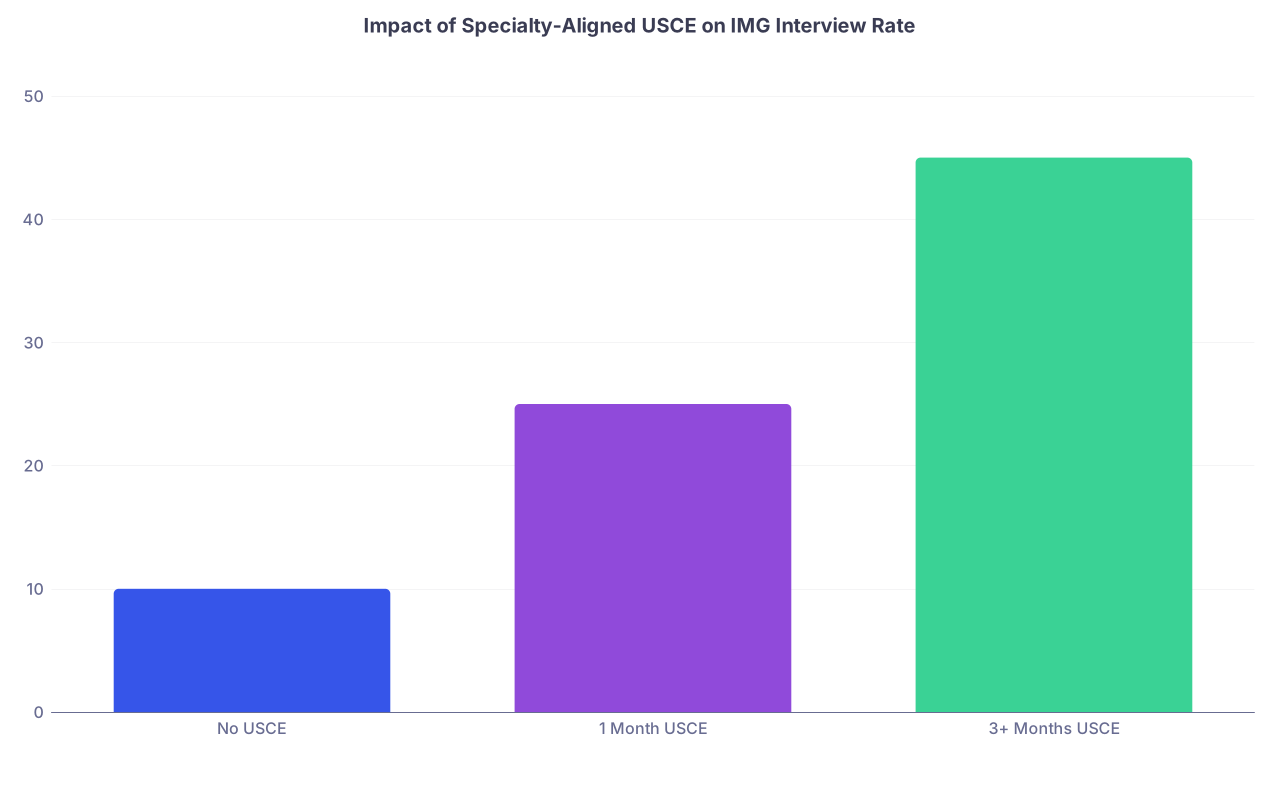
| Category | Value |
|---|---|
| No USCE | 10 |
| 1 Month USCE | 25 |
| 3+ Months USCE | 45 |
If you’re applying this coming season and have none of this, you have two realistic options:
- Delay application one year and build it properly
- Apply very broadly to IMG-friendly programs with a realistic expectation of few interviews
Throwing in an application with no aligned US experience when you already look “unusual” on paper is like expecting a loan when your credit history is a mess and you bring no documents.
Step 5: How to Handle the Switch in Your Personal Statement
Your personal statement is where you either calm the PD’s anxiety or fuel it.
You have two big jobs:
- Explain the switch simply, without drama
- End with conviction about your chosen field
Structure that usually works for a “switcher” IMG:
- Short opening that shows you in the new specialty (clinic, ward, consult, case)
- Brief background: initial training in previous specialty
- What you learned there and what you valued
- The clear, specific reasons you realized another field fit you better
- The steps you took to explore and commit to the new specialty (USCE, work, study, mentorship)
- What you now enjoy and seek in this specialty, and what you bring from your prior training
- One or two lines connecting your goals to the type of residency program you want
Notice: your old specialty is a supporting character, not the main story.
Common mistakes I see:
- Spending 70% of the statement defending the old switch
- Sounding apologetic or defensive: “I know it might seem like…”
- Overexplaining: listing every conflict with your old specialty
You want calm confidence. “This is the path I took, this is why, and here’s what I bring now.”
Step 6: Prepare for the Interview: The One Question You Cannot Fumble
There’s a question you will almost certainly get:
“So tell me about your transition from [old specialty] to [new specialty].”
If you ramble, look uncomfortable, or tell three different stories to three different interviewers, that will cost you ranks.
You need a 60–90 second, practiced answer with this shape:
- Positive: what initially attracted you to old specialty
- Insight: what you discovered about yourself/your interests
- Pivot: how that led you toward the new specialty
- Evidence: what you did to confirm and commit to the new one
- Confidence: why you are sure now and what makes you a strong candidate
Example (radiology → psychiatry):
“I chose radiology initially because I loved pattern recognition and the idea of impacting many patients through imaging. During my residency training abroad, I realized that the moments I found most meaningful were actually outside the reading room—discussing results with referring clinicians and working directly with patients in interventional procedures. I missed having a longitudinal relationship and hearing patients’ stories in more depth. That led me to explore psychiatry more seriously. I spent the past two years working in outpatient and inpatient psychiatric settings, completed US observerships, and pursued additional training in psychopharmacology and psychotherapy basics. Those experiences confirmed that psychiatry aligns with how I want to practice medicine: long-term relationships, complex human behavior, and team-based care. I’m confident this is the right field for me, and I bring with me the careful observation and systematic thinking I developed in radiology.”
You’re not confessing a crime. You’re explaining a mature career decision.
Practice this out loud. Record yourself. Fix any parts that sound shaky or defensive.
Step 7: Clean Up the Timeline and Gaps (PDs Notice Everything)
Non-linear paths often come with awkward gaps and overlaps:
- Few months between programs abroad
- Time spent studying for USMLE
- Periods working non-clinical jobs or caring for family
Do not leave these blank. Unexplained time is suspicious.
You want a clean, continuous timeline in ERAS:
| Years | Activity |
|---|---|
| 2015–2021 | Medical School |
| 2021–2022 | Surgery Residency Year 1 (Country X) |
| 2022–2023 | Transition period + USMLE preparation |
| 2023–2024 | Internal Med work + USCE in US |
In the “Description” sections you can briefly clarify:
- “Transitioned from surgery to internal medicine after reflecting on long-term career goals; during this period I… [concrete things, not just ‘thought about my life’].”
If you did absolutely nothing for long periods, do not invent activities. But do show something—online courses, local volunteer work, exam prep, family responsibilities. PDs don’t demand perfection; they demand honesty.
Step 8: Calibrate How Broadly and Where You Apply
You are not a standard IMG. You’re an IMG plus a specialty switch. That combination forces you to overcompensate in some areas.
Basic rules of thumb:
- Apply to a LOT of programs in your specialty (often 80–120+ for internal medicine/family medicine/psych/neurology if you’re an IMG with any red flags or non-linear path).
- Focus heavily on community and university-affiliated community programs; top academic places tend to be more conservative.
- Prioritize programs with histories of taking IMGs and visa sponsorship.
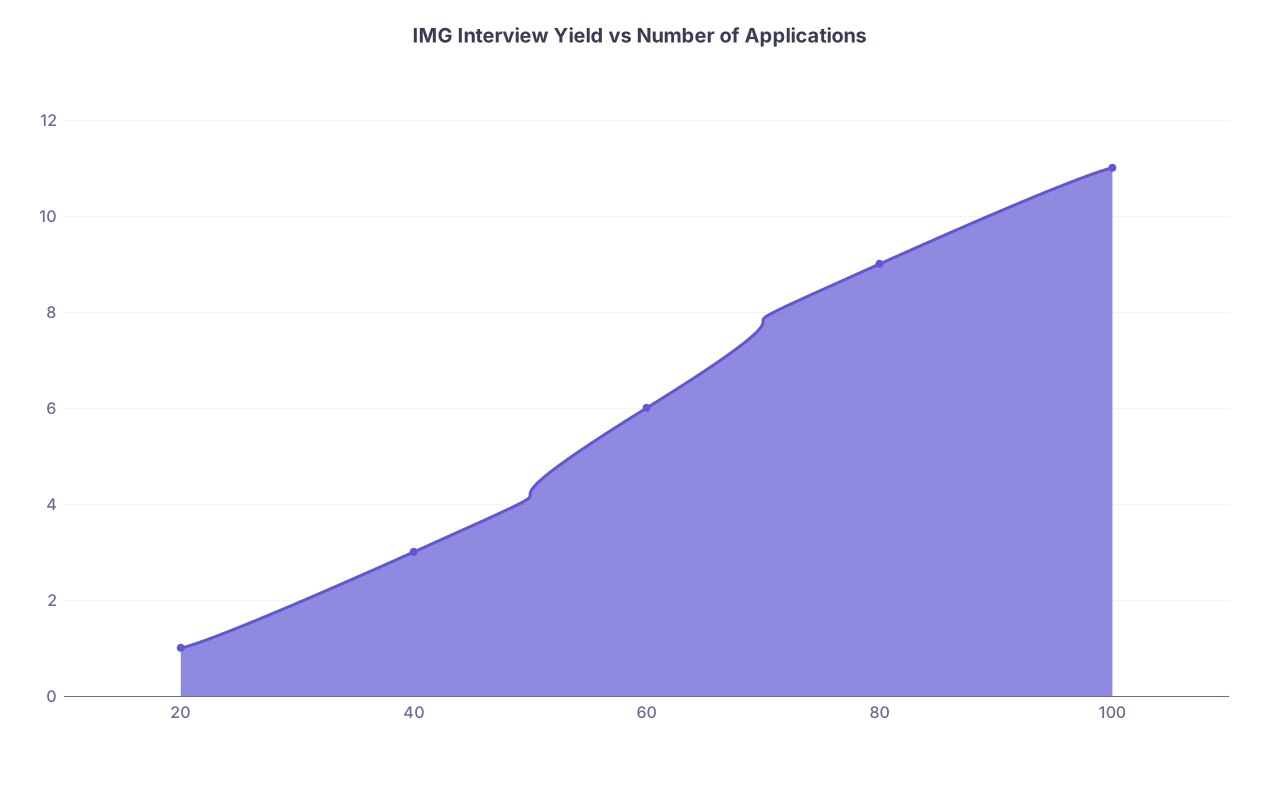
| Category | Value |
|---|---|
| 20 | 1 |
| 40 | 3 |
| 60 | 6 |
| 80 | 9 |
| 100 | 11 |
The point: your road is steeper. Do not under-apply and then blame the system.
If you’re 5+ years out of graduation and switched specialties, you’re in even higher-risk territory. That doesn’t mean impossible, but you should be very intentional about:
- Building contacts
- Doing observerships at programs you plan to apply to
- Emailing programs (briefly, professionally) where you have a genuine connection
Step 9: Use Your “Switch” as a Strength in Some Places
Here’s the upside almost no one talks about: done right, your past specialty can make you stand out positively.
Examples:
- Surgery background → IM or EM: “Handles pressure, comfortable with acutely ill patients, procedural skills.”
- Anesthesia → IM or critical care path: “Strong ICU and peri-op experience, ventilator management.”
- Radiology → neurology/IM: “Imaging interpretation advantage, better communication with radiologists.”
- Psych → FM/IM: “Comfortable with mental health, high-yield for outpatient medicine.”
The trick is to:
- Make it part of your “value add,” not your main identity
- Tie it to things programs actually care about: efficiency, teaching, patient safety, complex cases
You can use this in:
- Personal statement
- Interview answers (“What strengths do you bring?”)
- Letters from prior attendings highlighting those transferable skills
Just don’t sound like you’re still half in love with your old specialty.
Step 10: Spot the Red Lines You Can’t Cross
There are a few things that, if you do them, will cripple your chances more than the actual specialty switch ever could.
Do not:
- Apply to multiple specialties with obviously different personal statements that programs can smell a mile away (yes, they talk, especially within the same hospital).
- Hide or lie about previous training, exam attempts, or program departures. Hospitals can and do verify.
- Blame your old system, supervisors, or country excessively. That signals you might blame them next.
- Argue with program coordinators or ask them to justify rejections or lack of invites. You will get silently blacklisted.
Mature, accountable, and realistic beats perfectly linear background every time.
A Quick Reality Filter: Should You Push Now or Restructure for a Year?
If you’re reading this and thinking, “I have almost none of the ‘evidence’ you described,” then pause.
Here’s a blunt quiz:
| Question | If NO… |
|---|---|
| Step 2 ≥ about 225–230? | Focus on retake/improvement |
| ≥ 1 month USCE in target specialty? | Delay a year, get USCE |
| ≥ 2 LoRs in target specialty (prefer US)? | Build those before applying |
| Clear, practiced explanation of switch? | Write and rehearse it |
| No unexplained gaps > 6 months? | Clarify/structure those |
If you say “no” to most of these, throwing an ERAS application this cycle is more like a lottery ticket than a strategy. You’re better off spending 12 months fixing those boxes and applying once with a serious shot.
What You Should Do Tonight
Do not try to “fix” everything at once. Start by stabilizing the foundation: your story.
Here’s your concrete next step for today:
Open a blank document and write three paragraphs:
- Why you chose your first specialty and what you gained from it.
- The specific experiences that made you realize another specialty fit you better.
- What you’ve done since then that proves your commitment to the new field.
No fluff. No excuses. Just the real story, clearly.
Once that looks clean, you’ll know exactly what gaps you need to fill—USCE, letters, exam scores, or timeline clarity—and you can build from there.
You cannot change your past specialty switch. But you can absolutely control how intelligently you present it.