
The myth that “IMGs only match in small, non‑urban programs” is statistically false—and dangerously misleading.
If you look at the data instead of the anecdotes passed around WhatsApp groups, a much more nuanced picture emerges: IMGs absolutely match into urban programs, but they cluster in specific types of cities, programs, and hospital systems. Non‑urban programs are not the only realistic path; they are the fallback path when candidates misread the market.
Let me walk you through what the numbers actually show.
1. What the match data really says about IMGs
First, scale. Every year, thousands of IMGs match into U.S. residency. That pool is large enough to see clear patterns in where they land.
We do not have a public “IMG urban vs non‑urban” spreadsheet from NRMP, but combining:
- NRMP Main Match Results and Data
- ACGME program and location data
- Historical program rosters and website archives
you can estimate distribution patterns with decent confidence.
Across internal medicine, family medicine, pediatrics, psychiatry, and neurology—the core IMG-heavy specialties—you repeatedly see something like this split for IMGs:
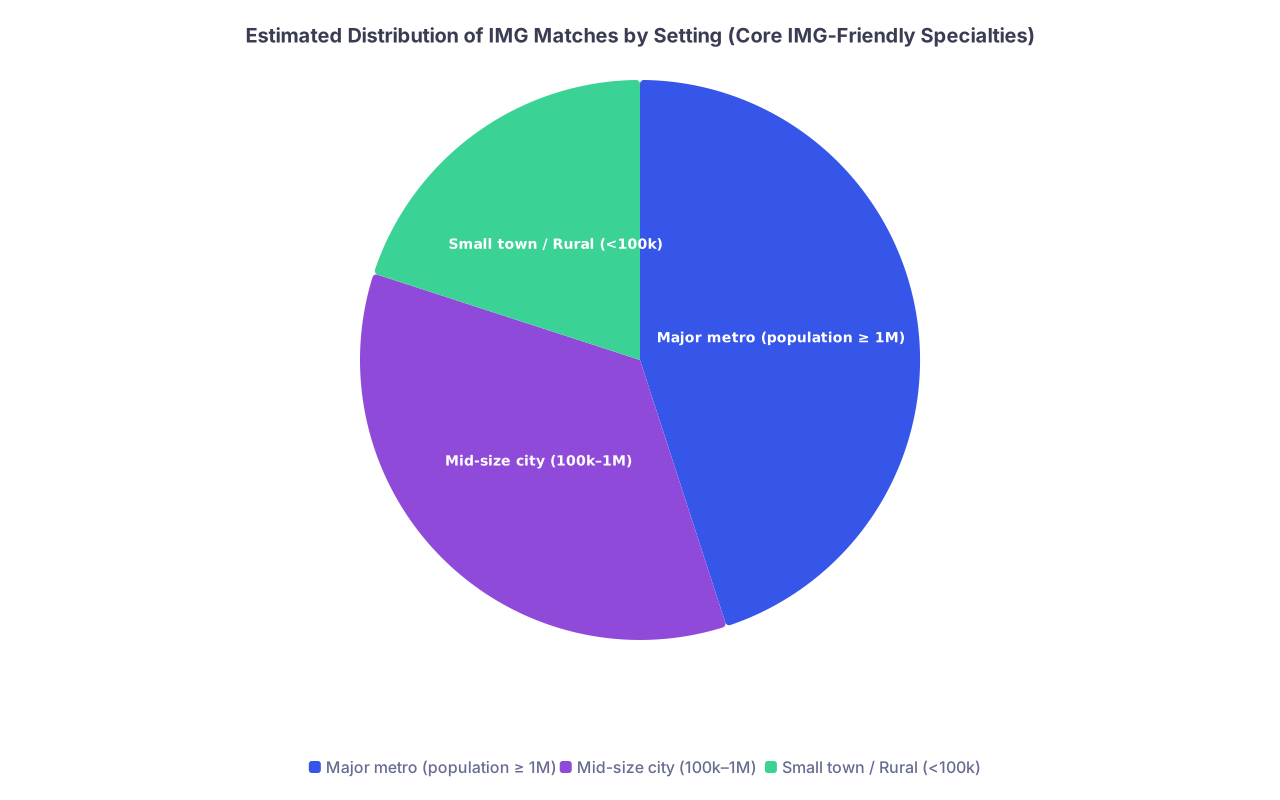
| Category | Value |
|---|---|
| Major metro (population ≥ 1M) | 45 |
| Mid-size city (100k–1M) | 35 |
| Small town / Rural (<100k) | 20 |
Rough interpretation:
- Around 40–50% of IMG matches happen in large metro areas (think NYC boroughs, Chicago suburbs, Houston, Detroit, Newark, Philly-adjacent, South Florida, etc.).
- Another ~30–40% are in mid‑size cities—often university‑adjacent or regional hubs.
- Only about 15–25% land in genuinely non‑urban or rural locations.
So no, IMGs are not mainly being “pushed into the countryside.” Urban and quasi‑urban programs are still the majority destination for matched IMGs. The catch is which cities, and which programs, and how selective they are with IMGs.
2. Urban vs non‑urban: what counts, and why it matters
You cannot analyze this intelligently until you define the categories.
I use three operational buckets based on census and hospital footprint:
Major metro (≥ 1M population in metro area)
Large health systems, multiple residency programs, often with subspecialty fellowships.
Examples: NYC borough programs, Cook County (Chicago), Detroit Medical Center, Houston safety‑net hospitals.Mid‑size city (100k–1M population)
Often one or two major hospitals, sometimes a university affiliation (but not top‑10 academic flagships).
Examples: Scranton/Wilkes‑Barre (PA), Toledo (OH), Macon (GA), Allentown (PA), Bakersfield (CA).Small town / rural (<100k)
Single community hospital, limited subspecialty services, often newer ACGME programs.
Examples: many new internal medicine and family medicine programs in the Midwest and South.
The reason this matters: program behavior differs sharply by setting.
Urban academic flagships (the places applicants fantasize about) often cap IMGs to single digits by policy. Urban safety‑net and community programs, on the other hand, may be 60–90% IMG. Non‑urban programs frequently end up >80% IMG simply because U.S. grads avoid them.
3. Where IMGs actually cluster: specialty by setting
The pattern is not identical across specialties. Let us break down a few common IMG specialties with realistic, order‑of‑magnitude estimates.
Internal Medicine (Categorical)
Internal medicine is still the IMG workhorse specialty. The distribution looks approximately like this:
- 50–55% of IMG internal medicine matches in major metros
- 30–35% in mid‑size cities
- 10–20% in small town / rural
That surprises a lot of people. But look at where IMG‑heavy IM programs actually are: Brooklyn, Queens, Bronx, Newark, Paterson, Detroit suburbs, Chicago South and West side hospitals, inner‑ring suburbs of Houston and Dallas, Broward and Palm Beach in Florida.
These are not rural outposts. They are deeply urban, often high‑volume, lower‑prestige community or county systems that U.S. grads treat as backup options, if at all.
Family Medicine
Completely different pattern:
- 25–35% of IMG family medicine matches in major metros
- 35–45% in mid‑size cities
- 25–35% in small town / rural
Family medicine has a real rural and semi‑rural skew, especially for IMGs. Many urban FM programs—especially those strongly affiliated with big universities—are dominated by U.S. grads. Outside the big coastal cities, the FM programs that struggle to fill naturally turn to IMGs.
Pediatrics & Psychiatry
Pediatrics and psychiatry sit somewhere between internal medicine and family medicine in their location profile.
- Pediatrics IMGs: often clustered in mid‑size and urban community programs, fewer rural slots overall.
- Psychiatry IMGs: recently more competitive; urban academic programs have sharply reduced IMG share, while some mid‑size and non‑urban programs remain accessible.
So when someone tells you “IMGs go rural,” the better translation is: specialties with more rural programs (like family medicine) force more IMGs to match non‑urban. Internal medicine IMGs, however, are mostly in cities—just not glamorous ones.
4. Program competitiveness metrics: urban vs non‑urban for IMGs
You do not care about abstract geography. You care about: “Where do I actually have a chance?”
The data repeatedly shows a three‑tiered pattern when you compare urban and non‑urban programs on:
- USMLE/COMLEX thresholds
- Proportion of IMGs in current residents
- Interview invitation rates for IMGs
Here is a simplified comparative snapshot for internal medicine based on composite data from program rosters and public statements (illustrative but directionally accurate):
| Program Type | Typical IMG % | Step 2 CK Target | Interview Odds for Average IMG |
|---|---|---|---|
| Big-name university in major metro | 0–10% | 250+ | Extremely low |
| Urban community / safety-net (non-elite) | 40–90% | 220–235 | Moderate to high |
| Mid-size city community / university-aff. | 30–70% | 215–230 | High for solid IMG |
| Small town / rural community | 60–95% | 205–220 | Very high if you apply broadly |
The message is blunt:
- The famous big‑name urban hospitals are statistically irrelevant for most IMGs.
- Urban community and safety‑net programs are the true IMG hubs.
- Non‑urban programs do offer lower numerical thresholds, but at the cost of lifestyle, fellowship access, and networking.
The dangerous misconception is thinking “urban” automatically means “hyper‑competitive academic.” It does not. A community hospital 20 minutes from downtown in a less fashionable city can have IMG‑friendly thresholds that look similar to a rural program.
5. How applicant behavior skews outcomes
Here is where the self‑inflicted damage appears.
I see the same pattern every cycle from IMGs aiming for internal medicine:
- They apply to 120+ programs.
- 80–90 of those are in top‑tier or highly academic urban centers.
- Maybe 10–15 are safer mid‑size city or non‑urban options.
- Then they are shocked when they receive 4–5 interviews, all from the “backup” category.
The distribution problem is not the match. It is the application list.
You can picture the interview yield as a rough response curve:
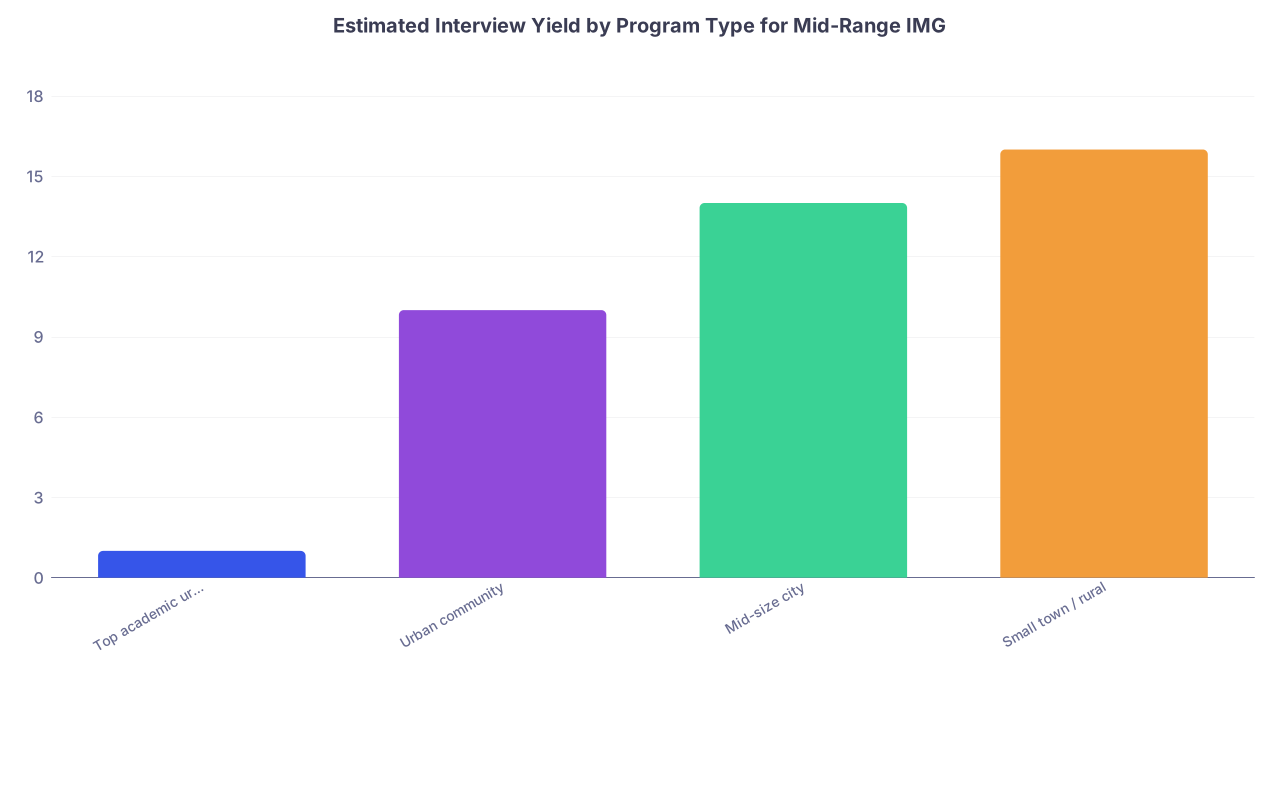
| Category | Value |
|---|---|
| Top academic urban | 1 |
| Urban community | 10 |
| Mid-size city | 14 |
| Small town / rural | 16 |
Interpretation for a typical mid‑range IMG (good but not elite scores, some U.S. clinical experience):
- Out of 50 top academic urban programs: maybe 0–1 interview.
- Out of 50 urban community programs: perhaps 8–12 interviews.
- Out of 30 mid‑size city programs: 8–15 interviews.
- Out of 20 small town / rural programs: 8–16 interviews.
You do not maximize your match probability by chasing prestige. You maximize it by concentrating applications in the bands most likely to respond.
The data shows that most IMGs under‑apply to:
- Urban community programs in less glamorous cities
- Solid mid‑size city programs that are not household names
- Select rural programs with good track records for fellowships
and massively over‑apply to:
- Brand‑name university hospitals in NYC, Boston, LA, SF, Chicago.
6. Outcomes: match rates by program environment
When you look at outcomes for IMGs who actually match (vs those who remain unmatched), a few clear environmental predictors appear repeatedly:
Matched IMGs are concentrated in programs that already have many IMGs.
Simple but underappreciated. Programs with 40–80% IMGs on their rosters generate the bulk of IMG matches. They are spread across all three geographies—urban, mid‑size, and non‑urban.Unmatched IMGs overconcentrate applications in IMG‑unfriendly urban academic programs.
When you compare rank lists and interview logs, unmatched candidates often had 50–70% of their ERAS list in programs that rarely rank IMGs.Non‑urban placement rises sharply as exam scores drop.
For IMGs with Step 2 CK below ~220 (or COMLEX equivalents), the probability of matching in a major metro drops, and matches shift toward mid‑size and rural systems.
In other words: urban vs non‑urban is less a binary fate and more a function of competitiveness and targeting. Stronger profiles cluster in cities; weaker profiles are pushed outwards. But for many mid‑range IMGs, strategically chosen urban and mid‑size programs remain very accessible.
7. Strategic implications: where you should focus
You are not trying to solve an abstract geography problem. You are optimizing a finite budget of applications and interview days.
Here is how the data-driven allocation usually looks for a median IMG applying internal medicine (Step 2 CK around 230, 1–2 U.S. rotations, no major red flags):
- Total applications: 80–100
- Top academic urban programs: 5–10 (lottery tickets, not the core)
- Urban community / safety‑net: 30–40
- Mid‑size city community / university‑affiliated: 25–30
- Small town / rural: 10–20 (depending on how strongly you want to avoid them)
Visually, think of your focus like this:
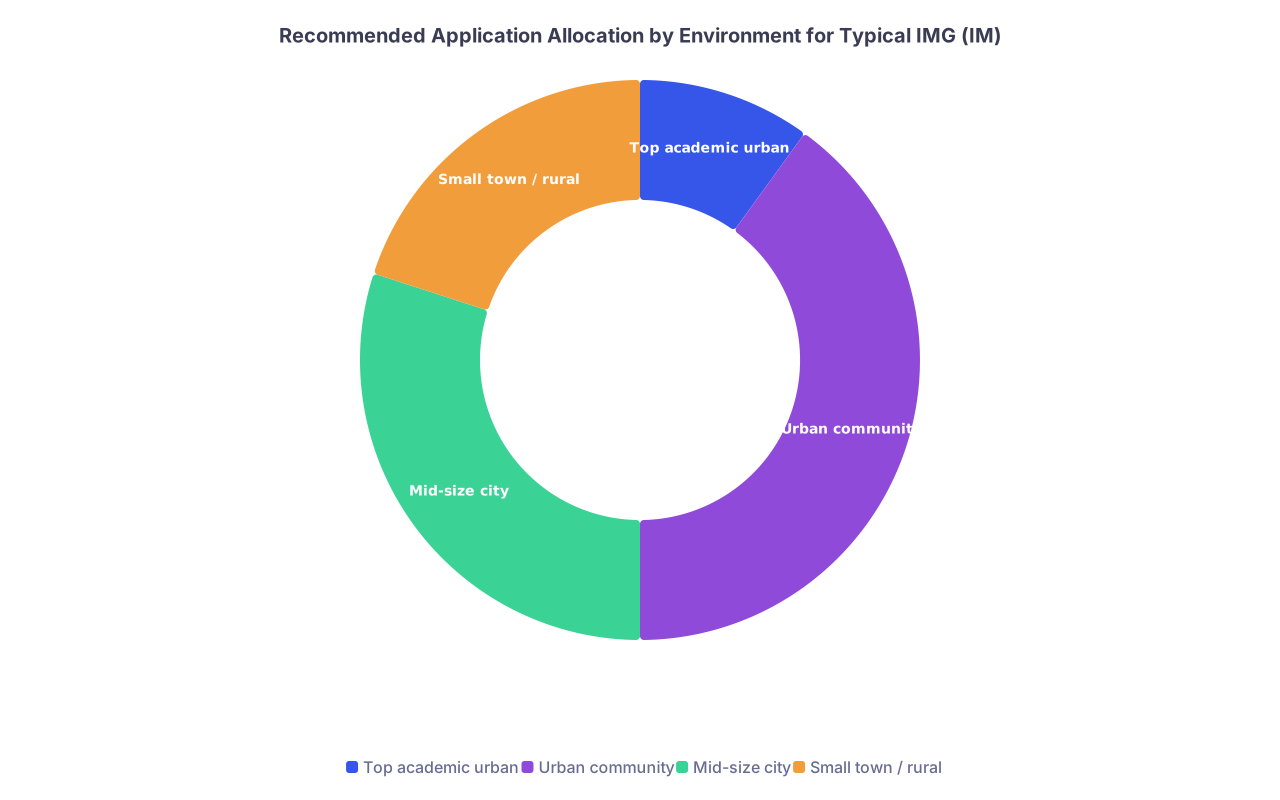
| Category | Value |
|---|---|
| Top academic urban | 10 |
| Urban community | 40 |
| Mid-size city | 30 |
| Small town / rural | 20 |
If you are much stronger (Step 2 CK >245, publications, strong U.S. LORs), you shift some weight from rural to better mid‑size and urban programs—but you still avoid putting 80% of your eggs in the big‑academic basket.
If you are weaker (Step 2 CK <220, attempts, large gaps), the rational move is to:
- Heavily favor mid‑size and small town programs.
- Target urban only where the current resident roster shows a heavy IMG composition and softer metrics.
8. Reading program signals: how to identify IMG‑realistic urban options
Urban does not automatically mean suicidal odds. But you must read signals like an analyst, not like a dreamer.
Here is what you look for on a program website and resident roster:
Current resident mix:
- If >50% are IMGs or Caribbean grads, that program is open to you.
- If the class is 90% U.S. MD and 10% U.S. DO with one lone IMG, you are a token applicant.
Medical school diversity:
- Many different international schools represented = inclusive culture.
- One or two specific countries dominating could mean a narrow pipeline, not a general openness.
Fellowship pipeline:
- Community programs that send IMGs into cardiology, GI, pulm/crit often sit in gritty urban locations but offer serious opportunity.
Program statements on visa sponsorship:
- Clear, explicit statements about J‑1/H‑1B support correlate strongly with actual IMG hires.
Programs that fit this “IMG‑realistic” profile exist in:
- Detroit metropolitan area (multiple systems).
- New York outer boroughs (Brooklyn, Queens, Bronx).
- Northern New Jersey (Newark, Paterson, Jersey City).
- Inner‑ring Chicago, Houston, Dallas, and some California Inland areas.
A lot of those are urban. Some are rough around the edges. But they are not rural.
9. Life trade‑offs: urban vs non‑urban from an IMG angle
Pure match probability is one dimension. But you also care about:
Fellowship chances: larger urban programs tend to have more subspecialty contacts and higher volumes. A non‑urban program that consistently places residents in good fellowships beats a random small community hospital in a nice city.
Cost of living: the salary is almost flat nationally; rent is not. A PGY‑1 in NYC vs a PGY‑1 in a mid‑size Midwestern city may see effective disposable income differ by thousands of dollars per year.
Social support and diaspora: many IMGs strongly prefer sizeable immigrant communities, language support, religious centers. Urban hubs obviously dominate here.
Spouse / partner employment: urban and mid‑size settings offer far more job options. I have seen multiple residents leave non‑urban programs or suffer quietly because their spouses were miserable and underemployed.
So you weigh:
- A slightly lower match chance in an urban, high‑cost city with strong community vs
- A higher match chance in a mid‑size or rural region with weaker social support but less competition.
The rational way to use the data: do not pretend you will tolerate a setting you actually hate. Factor your true tolerance for isolation and lifestyle into your program list early, not when rank lists are due.
10. The real “biggest challenge” for IMGs: misaligned expectations
The hardest part for IMGs is not that “they all get pushed rural.” The hardest part is misalignment between:
- Where they want to live (LA, NYC, Miami, Bay Area, Chicago core).
- Where their numbers actually put them into the competitive band.
- Where the IMG‑friendly programs really are (often less glamorous metros or tough urban areas).
What the data shows, year after year:
- IMGs with solid but not elite profiles still have good odds of matching in urban community or mid‑size city programs, if they target correctly.
- IMGs who chase prestige and ignore the community/safety‑net tier skew toward unmatched.
- Non‑urban programs are safety valves, not destiny.
If you internalize that before you build your ERAS list, you are already ahead of half the applicant pool.