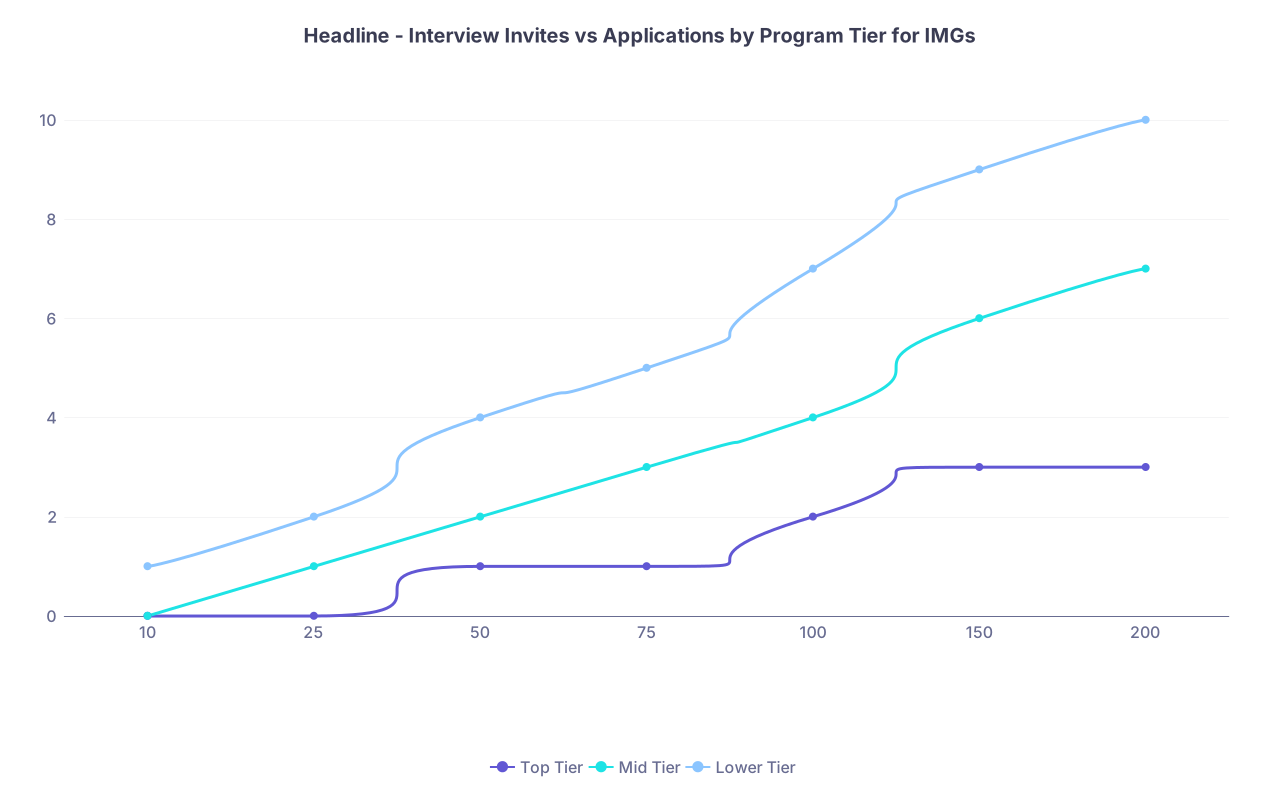
| Category | Top Tier | Mid Tier | Lower Tier |
|---|---|---|---|
| 10 | 0 | 0 | 1 |
| 25 | 0 | 1 | 2 |
| 50 | 1 | 2 | 4 |
| 75 | 1 | 3 | 5 |
| 100 | 2 | 4 | 7 |
| 150 | 3 | 6 | 9 |
| 200 | 3 | 7 | 10 |
The biggest mistake IMG applicants make is thinking “more applications = more interviews” in a straight line. The data shows the curve is not linear. It flattens. Hard. And it flattens differently depending on program tier.
You are not buying interviews by the unit. You are moving along a yield curve that changes with your profile, your Step scores, and where you aim.
Let’s map that out properly.
1. Defining the Problem: What “Interview Yield” Actually Is
I am going to use “interview yield” in a precise, quantitative way:
- Interview Yield = (Number of Interview Invitations) ÷ (Number of Applications Submitted)
So if you apply to 120 internal medicine programs and get 6 interviews, your yield is 6 / 120 = 0.05, or 5%.
For IMG applicants, two patterns show up repeatedly:
- Yield varies strongly by program tier
- Yield starts low, rises, then plateaus as you add more programs
You feel this in real life as:
“First 30–40 apps got me most of my invites; the next 80 felt like throwing money into a fire.”
The twist: this effect is more brutal in “top tier” programs and more forgiving in lower tiers.
To have a sensible discussion, we need a working tier definition for internal medicine and similar fields from the IMG perspective:
- Top Tier: University-based, academic-heavy, strong reputation, often university hospital + VA, high fellowship placement, many USMDs, frequently located in large metro or coastal region.
- Mid Tier: Solid community or university-affiliated programs, reasonable board pass rates, mix of US grads and IMGs, moderate fellowship chances.
- Lower Tier / Safety: Mostly community hospitals, often IMG-heavy, sometimes newer or in less popular locations, limited fellowship track but solid for primary care / hospitalist routes.
These are not official NRMP labels. They are how program directors, residents, and applicants actually talk about them. And IMG interview yield behaves differently across them.
2. The Core Curves: Applications vs Invitations by Tier
Let me put some realistic, aggregated numbers on the table. These are stylized but based on common patterns I see in residency advising data for IMGs with “viable but not superstar” profiles (e.g., Step 2 CK 235–250, one or two USCE experiences, no major red flags).
Imagine a reasonably competitive IMG in internal medicine. As they increase applications, typical interview counts might look like this:
| Total IM Applications | Top Tier Invites | Mid Tier Invites | Lower Tier Invites |
|---|---|---|---|
| 20 | 0 | 1 | 2 |
| 40 | 1 | 2 | 3 |
| 60 | 1 | 3 | 5 |
| 80 | 2 | 4 | 6 |
| 100 | 2 | 5 | 7 |
| 140 | 3 | 6 | 8 |
| 180 | 3 | 7 | 9 |
Translate that into yield:
At 40 apps:
- Top tier yield: 1 / 40 = 2.5%
- Mid tier yield: 2 / 40 = 5%
- Lower tier yield: 3 / 40 = 7.5%
At 100 apps:
- Top tier yield: 2%
- Mid tier yield: 5%
- Lower tier yield: 7%
What you see:
- Yield does not climb after ~60–80 programs; the marginal invite per extra 20 apps gets smaller.
- Lower tier programs deliver more interviews per application for many IMGs.
- Top tier remains stubbornly flat.
That is the yield curve in action: early gains, then diminishing returns.
3. Why the Curves Look Different by Tier
You can either fight the math or understand it. Here is what drives those curves.
3.1 Top Tier Programs: The Cliff
For IMGs, top tier internal medicine programs are not a broad opportunity field; they are a narrow gate. In many of these, the IMG acceptance funnel looks like this:
- They receive 4,000–6,000 applications total.
- They pre-screen heavily on:
- USMLE Step 2 CK (e.g., 250+ realistic threshold for IMGs)
- US clinical experience (LORs from academic attendings)
- Graduation year (often ≤ 3–5 years)
- Visa status (some simply do not sponsor, or only J‑1)
That turns into an interview yield curve that behaves more like a step function than a smooth line.
For IMGs:
- Below certain score/experience thresholds: yield is near zero, regardless of whether you apply to 10 or 80 such programs.
- Once you cross their internal cutoffs: you may pick up a few interviews, but adding more applications mostly increases the chance of 1–2 hits, not a steady linear climb.
This is why an IMG with Step 2 CK 260 and strong research might apply to 40 academic IM programs and get 8–10 invites. Another with 235 might apply to the same 40 and get zero. Exact same number of applications. Completely different yield.
The result is a highly non-linear curve:
Applications below a threshold move you horizontally, with almost no vertical gain.
3.2 Mid-Tier Programs: The “Normal” Curve
Mid-tier programs create the most intuitive relationship between applications and interviews.
Patterns I routinely see:
Early applications (first 20–40) deliver the majority of your “easy” interviews. They are the programs:
- Open to IMGs
- Not smothered in 5,000+ applications
- Willing to talk to Step 2 CK 230–245 candidates if the rest of the file is coherent
Going from 20 → 40 applications often doubles your interviews.
Going from 40 → 80 might add another 50–70%.
Going from 80 → 120 may only add 1–2 more invites.
Classic diminishing returns.
For a mid-strength IMG:
- Yield might start around 6–8% for the first 40 mid-tier apps, then drift down to 4–5% as you push out to 100–120 because the additional programs are either:
- More competitive than your profile
- Less IMG-friendly
- Poor geographic fits where you have no signal (no ties, no rotation there, etc.)
3.3 Lower Tier / Safety Programs: The Reliable Workhorse
Lower-tier programs, especially IMG-heavy ones, often produce the highest and most stable yields—assuming you match their filters:
- They may filter by:
- USMLE Step 2 CK > 220 or > 230
- YOG (year of graduation) < 5 or < 10 years
- Minimum number of months USCE
If you clear these, the data shows IMGs can see 8–12% yield at these programs early on. That means:
- 40 targeted lower-tier applications → 4–5 interviews not unusual
- 80 similar-quality lower-tier applications → 7–10 interviews typical for a decent profile
But again, this is not proportional forever. Eventually you exhaust the reasonable matches and start sending applications to places where:
- You do not meet filter criteria.
- They already have a huge pipeline of IMGs from specific regions or partner schools.
- They rarely interview fresh candidates without strong internal recommendation.
The yield curve still bends down. It just bends later than the top-tier curve.
4. Step Scores, IMG Status, and Curve Shifts
Talking about “the” yield curve is misleading. It is not one curve. It is a family of curves indexed by your Step scores, YOG, visa status, and clinical experience.
4.1 Step Score Bands
For illustrative purposes, consider three Step 2 CK bands for IMGs in internal medicine:
- Band A: ≥ 255
- Band B: 235–254
- Band C: 215–234
For each band, the same program tiers behave differently. A rough pattern:
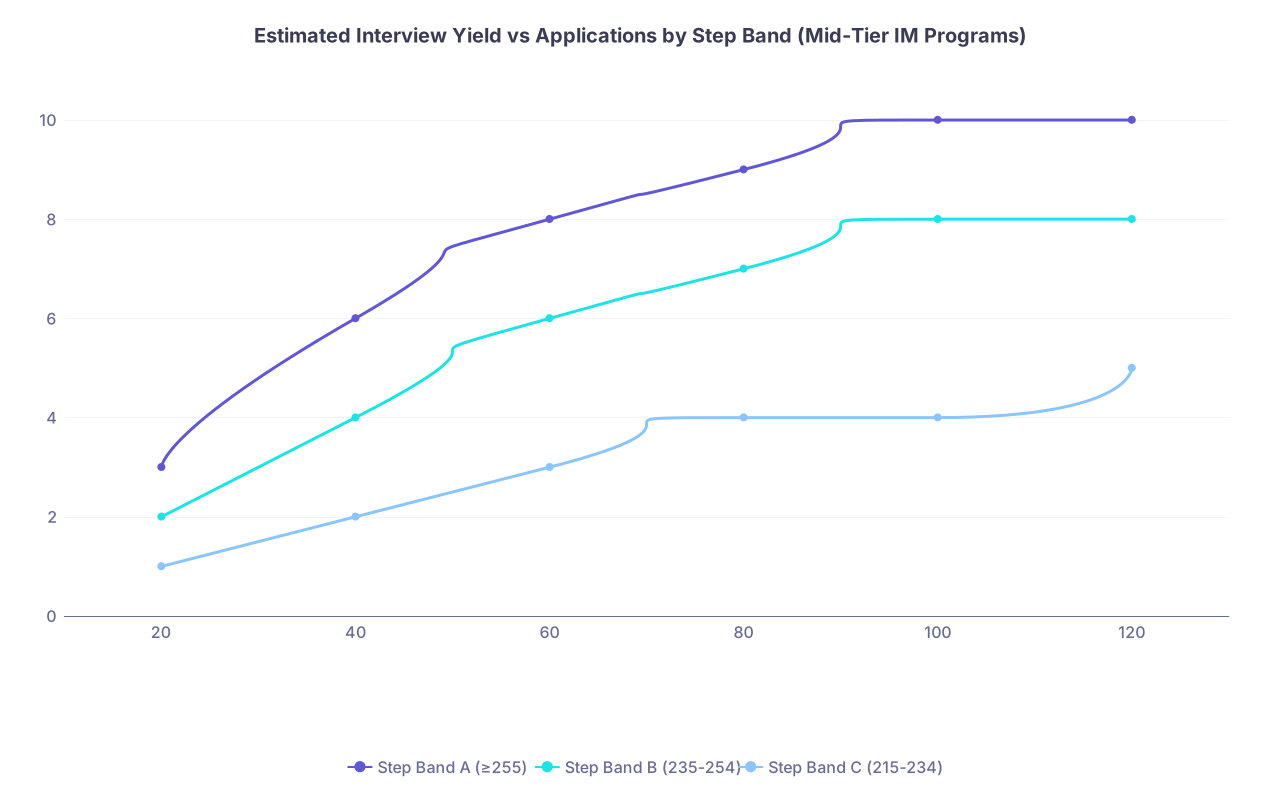
| Category | Step Band A (≥255) | Step Band B (235-254) | Step Band C (215-234) |
|---|---|---|---|
| 20 | 3 | 2 | 1 |
| 40 | 6 | 4 | 2 |
| 60 | 8 | 6 | 3 |
| 80 | 9 | 7 | 4 |
| 100 | 10 | 8 | 4 |
| 120 | 10 | 8 | 5 |
Interpretation (for mid-tier only, keeping this simple):
- High scorers (Band A) see strong early returns.
- Many mid-tier programs might interview them with only 40–60 applications.
- Mid scorers (Band B) gain from expanding out to 80–100.
- Their early apps still generate good yield, but some programs will default to US grads if overloaded.
- Lower but still passing scorers (Band C) rely heavily on high-volume, IMG-friendly applications.
- Yield is lower and increases more slowly.
Top-tier curves are even more sensitive to Step bands; for Band C, yield at top tier is essentially 0 no matter how many you apply to, unless there is extreme networking / internal advocacy.
4.2 Non–US IMG vs US-IMG
Data from NRMP and program director surveys are clear: US-IMGs have higher interview and match rates than non–US IMGs, even at similar Step scores.
On yield curves:
A US-IMG with Step 2 CK 240 and one home sub-I may look, to many programs, similar to a weaker USMD. Yield on mid-tier and some top-tier programs is meaningful.
A non–US IMG with the same Step 2 CK, no US clinical degree, and limited USCE experiences may see 30–50% lower yield from the same list.
That means if you are non–US IMG:
- You cannot simply copy a US-IMG’s application strategy and expect the same slope.
- Your efficient application window often sits higher—maybe 120–160 applications total in IM instead of 60–100—to reach the same total number of interviews.
5. Where the Curve Flattens: Diminishing Returns Thresholds
Let me be blunt: The data strongly suggests that for most IMGs in internal medicine, past a certain number of applications, you are just paying for noise.
Those thresholds depend on profile strength and how intelligently your list is built, but rough breakpoints look like this:
| Profile Type | Programs Where Returns Flatten Hard |
|---|---|
| Strong IMG (Step 2 CK ≥ 255) | ~80–100 well-chosen programs |
| Average IMG (Step 2 CK 235–254) | ~120–140 programs |
| Borderline IMG (Step 2 CK 215–234) | ~160–200 programs |
That does not mean “never apply beyond this number”. It means:
- The marginal probability that program #141 adds a new interview is low if the first 140 were already reasonably chosen.
- Often < 1–2% per additional application.
Think in expected values. If after 120 apps your yield is 5%, then each extra 20 applications, on average, may only contribute:
- 20 × 0.02 to 0.03 = 0.4–0.6 extra interviews
So you pay for 20 and realistically get an extra half-interview. That is expensive.
6. Tier Mix: How Many Top vs Mid vs Lower Tier?
The single most damaging misconception I see among IMGs is “spray everything, including all the famous names, maybe something hits.”
The data contradicts this. For an average IMG (Step 2 CK 235–245, non-US grad, 1–2 USCE rotations, no major red flags), a more rational distribution of 140 internal medicine applications might look like:
- 10–15% Top Tier (14–20 programs)
- 45–55% Mid Tier (65–80 programs)
- 30–40% Lower Tier (45–55 programs)
Why:
Top tier: Your individual yield here will be near zero unless you are exceptional, so you buy a lottery ticket with 10–20 carefully selected programs where:
- They explicitly state they interview IMGs.
- Your mentors have contacts.
- You have geographic or institutional ties.
Mid tier: This is where most of your realistic interview volume lives.
Lower tier: This is where your floor gets built. The “I at least will not end up with zero interviews” insulation.
What I keep seeing instead:
- Applicant sends 40–60 applications to high-profile university programs, 40 to mid-tier, 40 to lower-tier.
- Their Step 2 CK is 230.
- They end the season with 2–3 interviews from lower-tier only.
- Then they say “I applied to 140 programs, it’s just random.”
No. The yield curve at top tier for your profile was mathematically close to 0 from the start. You simply refused to believe the curve.
7. Timing, Filters, and List Quality: Hidden Multipliers
There are three non-obvious factors that quietly distort your yield curve: submission timing, filter matching, and list quality.
7.1 Early vs Late Submission
Residency programs do not literally give 100% of interviews to early applications, but early submission undeniably inflates yield:
- An IMG who submits ERAS at opening and completes all documents early can see 20–30% higher interview yield versus someone similar who submits 4–6 weeks late.
Mechanism:
- Many programs screen in “batches.”
- Once they have filled 80–90% of interview slots, late applications—even strong ones—get seen less favorably.
So your curve can shift upward or downward based purely on timing. Same number of apps, different slope.
7.2 Filter Matching vs Random Shotgunning
I have seen spreadsheets where applicants log 180 programs and only bother checking:
- Specialty = IM
- They sponsor visas?
That is it.
The more structured way is to pre-filter for:
- Explicit IMG friendliness (NRMP charting outcomes, program websites, consistently IMG-heavy rosters).
- Score filters close to your own numbers (via program statements, previous applicants’ shared data, or known cutoffs).
- YOG restrictions (many programs say “within 3–5 years”).
If you do that, your yield curve steepens because the denominator (applications) is no longer bloated with automatic rejections.
In crude numbers, for similar profiles:
- Shotgun list: 160 apps → 5 interviews (3.1% yield)
- Filtered, realistic list: 120 apps → 7 interviews (5.8% yield)
Less money spent, more interviews. Because the curve is not about “how many” you sent. It is about “where” you sent them.
7.3 List Redundancy and Geography
Redundancy kills yield.
Example scenario:
- Applicant targets only New York, New Jersey, and Pennsylvania.
- Sends 180 IM applications but 140 of them are in a 200-mile radius, many to programs with similar applicant pools and filters.
What happens:
- The same type of candidate saturates that market.
- Programs in that region are oversubscribed, many strongly preferring US grads.
- Yield tanks, regardless of total applications.
Meanwhile, if the same candidate spreads 180 apps across:
- Northeast + Midwest + South + some smaller markets (e.g., Midwest community programs, less-known regions in the South or Mountain West),
the overall yield often jumps notably. Because the same profile faces lighter competition in certain geographic markets.
Your curve is not national; it is regional. Over-concentrating in “popular” cities flattens it fast.
8. How Many Interviews Are “Enough” for an IMG?
The NRMP data is unambiguous:
- For IMGs in internal medicine, match probability climbs sharply up to around 8–10 contiguous ranked programs, then increases more gently.
Which means your true target is not “how many applications” but “how many interviews.” Applications are just the input step.
That reframes the yield curve question:
Strong IMG (Step 2 CK ≥ 255): You might expect 8–12 interviews with 60–90 reasonably chosen applications. Doubling your applications beyond that delivers mostly redundant insurance.
Average IMG (Step 2 CK 235–245): Reasonable target:
- 8–10 interviews from 120–150 well-constructed applications.
- If you are sitting at 3–4 interviews after 120 apps, adding 40–60 more only helps if your list changes qualitatively (new regions, more IMG-friendly targets), not just in quantity.
Borderline IMG (low 220s, older YOG, visa-dependent):
- Realistically, you may need 160–220+ applications, strongly weighted toward IMG-heavy, lower-tier programs, to reach 5–8 interviews.
- But even here, the yield curve flattens. Pure volume cannot fully overcome hard filters like “Step 2 CK ≥ 230” if you do not meet them.
The key is not to chase infinite applications. It is to reach the interview count zone where data shows your match probability crosses 60–70%.
9. Practical Takeaways: How to Use Yield Curves To Build Your List
If you want this to be more than theory, you should build your own expected-yield model before clicking “submit” on 200 programs.
A simple process:
- Segment your list into three tiers: Top, Mid, Lower.
- For each program, assign a crude probability of an interview (0–10%) based on:
- Their IMG history
- Your Step 2 CK relative to stated or known cutoffs
- Your visa/YOG fit
- Sum the probabilities.
- That sum is your expected number of interviews.
For example:
- 20 top tier at 1% each → 0.2 expected interviews
- 70 mid tier at 5% each → 3.5 expected interviews
- 60 lower tier at 8% each → 4.8 expected interviews
Total: 8.5 expected interviews.
If, after doing this honestly, your expected interviews are < 5, you either:
- Need to improve your profile (Step 2 CK, more USCE, better LORs) before the next cycle, or
- Need to shift your tier mix more heavily to lower-tier / IMG-heavy programs, or
- Need to expand total applications somewhat.
But at least the decision is data-driven, not wishful.
10. The Bottom Line
Three core points:
- Interview yield for IMGs is not linear; it follows a curve with diminishing returns, and the curve shape shifts dramatically by program tier and by your profile strength.
- Top-tier programs offer, for most IMGs, near-zero yield beyond a small number of carefully targeted applications; mid-tier and lower-tier programs generate the majority of realistic interview volume.
- You should optimize for expected interviews, not raw application count—using filters, realistic tier mix, and geographic diversification to bend your yield curve upward instead of throwing money at a flat line.